Rare Vintage, Antiques and Art Collector / Curator / Personal Shopper From Japan
Louis Vuitton x Takashi Murakami OnTheGo BB Panda Monogram Rare Archive Collaboration Bag M13668
Louis Vuitton x Takashi Murakami OnTheGo BB Panda Monogram Rare Archive Collaboration Bag M13668
Couldn't load pickup availability
Have a reasonable price in mind? Submit your best offer and our concierge will review it personally.
Louis Vuitton × Takashi Murakami
OnTheGo BB, monogram canvas with Panda motif
Compact two-way handbag with leather trim and shoulder strap
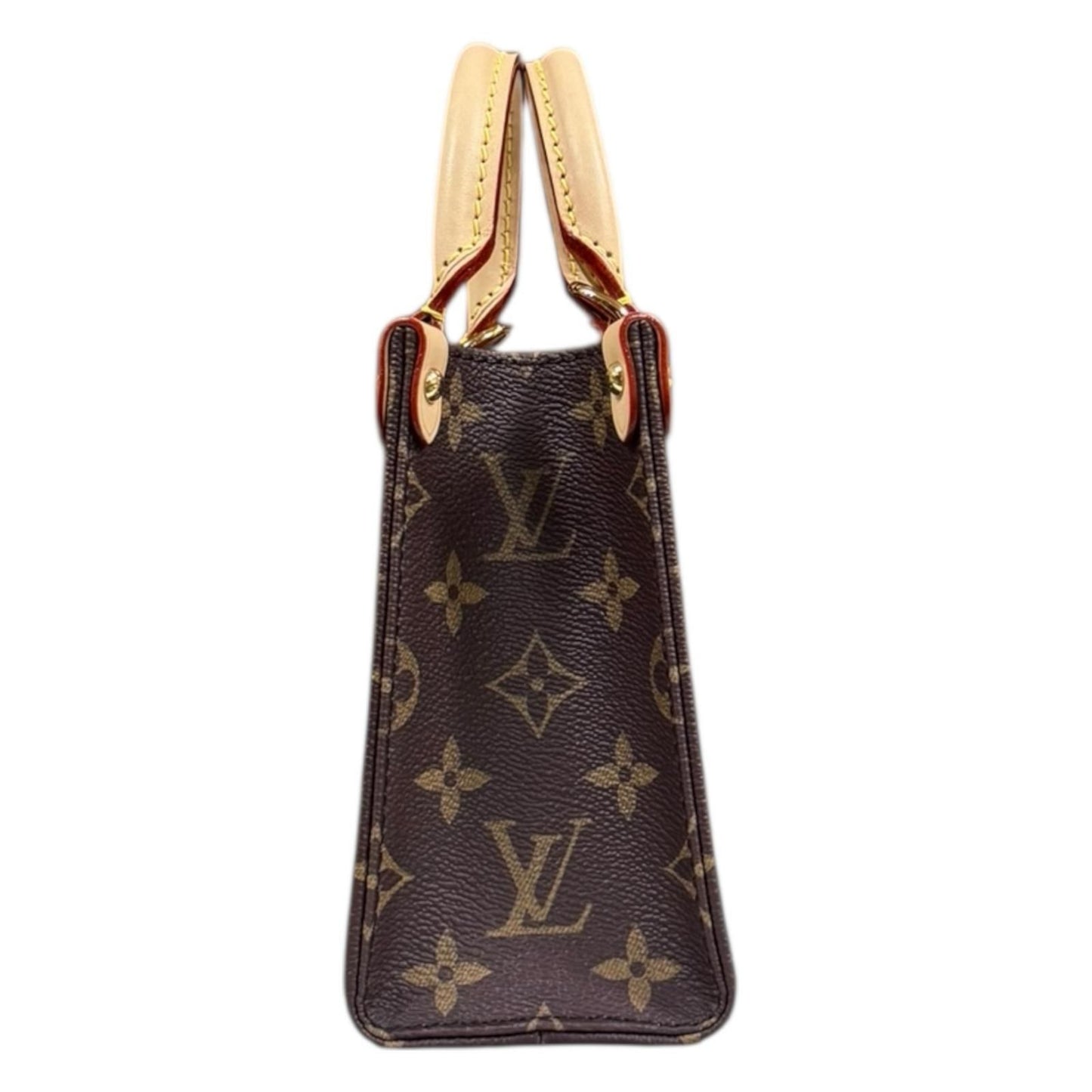
A sharply resolved example from the Louis Vuitton and Takashi Murakami collaboration, the present OnTheGo BB is distinguished by its concentrated use of Murakami’s Panda imagery against the house’s classic monogram field. Rather than adopting an all-over graphic strategy, the design retains the formal clarity of the Vuitton surface while allowing a single, highly animated character motif to re-center the composition.
The compact scale of the BB silhouette intensifies this relationship, bringing the Panda into immediate visual prominence while preserving the disciplined structure associated with the model. Natural leather trim, gold-tone hardware, and a detachable shoulder strap maintain the object’s luxury vocabulary, even as the character intervention introduces a more playful and destabilizing register.
Presented as a pre-owned example with light wear noted, the bag nonetheless retains the essential strength of its design language and remains a compelling object within the more distilled branch of the Murakami–Vuitton archive.
Object
Louis Vuitton × Takashi Murakami OnTheGo BB
House
Louis Vuitton
Artist / Collaboration Layer
Takashi Murakami
Model
OnTheGo BB
Reference
M13668
Material
Monogram canvas with natural leather trim and detachable shoulder strap
Colorway
Brown monogram base with multicolor Panda motif
Hardware
Gold-tone
Carry Format
Top handle plus detachable shoulder strap, two-way configuration
Measurements
Approx. 18 cm width × 15 cm height × 8 cm depth
Handle drop approx. 22 cm
Shoulder strap approx. 103 to 127 cm
Weight
Approx. 330 g
Country of Manufacture
France
Condition Context
Pre-owned example with light surface wear and light wear to handle / strap, while retaining the essential compositional clarity of the design
Accessories Noted
Shoulder strap
Rarity Type
Murakami collaboration object in micro-structured tote form, defined less by all-over graphic saturation than by concentrated character placement
The Monogram Learns to Make Room
There are Murakami–Vuitton objects that operate through accumulation, through the flooding of surface, through repetition so emphatic that the original house language is forced into transformation. This is not one of them. Here the strategy is narrower, sharper, and in some ways more intelligent.
The monogram remains almost entirely itself. The brown field, the disciplined repetition, the familiar cadence of Vuitton’s inherited visual code all remain intact. Then the Panda arrives, not multiplied, not dispersed, not turned into pattern, but placed as a singular interruption. That is what gives the piece its tension. The house does not dissolve. It is displaced, emotionally, by one animated figure.
This is Murakami working through precision rather than saturation.
The Panda as a Center of Gravity
Murakami’s Panda has always been one of his most effective inventions because it occupies several emotional registers at once. It is comic, childlike, unruly, slightly excessive, and never entirely innocent. Its face seems open and chaotic at the same time. It belongs naturally to Murakami’s larger universe, yet it also feels capable of hijacking whatever surface it enters.
That is exactly what happens here.
Placed against the monogram field, the Panda becomes more than a motif. It becomes the gravitational center of the object. The eye does not first read the bag as a tote, or even as Vuitton. It moves toward the figure, then outward from it, only afterward registering the formal body that holds it. This reverses the normal hierarchy of luxury branding. The house becomes background structure. The character becomes event.
And because the Panda is rendered with dimensional fullness rather than merely implied through abstract sign, it introduces a sense of movement even while fixed. It feels like it has landed on the bag rather than been printed onto it.
A Smaller Silhouette with a Sharper Idea
The OnTheGo family typically carries a language of portability and urban utility. In larger sizes, that utility becomes almost architectural. In the BB format, however, the structure compresses. It becomes less like a work bag and more like a formal proposition. The compact body intensifies every design decision because there is so little room for dilution.
That makes the Panda placement even more successful.
On a larger bag, the motif might read as part of a larger graphic program. Here, because the body is so condensed, the single figure dominates immediately. The bag becomes almost diagrammatic: formal structure, iconic field, character intrusion. It is one of those cases where scale sharpens the concept rather than reducing it.
This is why micro-format Murakami Vuitton pieces can become so compelling. They force the collaboration into more distilled decisions.
Vuitton Structure, Murakami Instability
What gives the object its real power is that the silhouette never abandons its discipline. The top handles remain upright and composed. The body remains rectangular, compact, resolved. The natural leather trim and gold hardware continue to perform the house’s long-standing role of refinement and continuity.
Murakami enters that order as instability, but a highly controlled instability.
He does not make the bag chaotic. He makes it slightly unruly. Just enough for the object to feel alive. Just enough for the monogram to stop behaving like a complete system and begin behaving like a stage set.
This is one of the deepest pleasures of the Murakami–Vuitton dialogue at its best: the collision is never crude. It is calibrated. The luxury object remains elegant, but no longer emotionally neutral.
Character Against Pattern
Pattern has one kind of power. Character has another.
Pattern saturates. It creates atmosphere, field, and rhythm. Character individualizes. It creates attachment, memory, and emotional asymmetry. This bag is built around the second logic. It does not seek to overwhelm through repetition. It seeks to mark itself through singularity.
That gives it a very different position in the archive. It is not a “full treatment” Murakami piece. It is a focused one. It does not carry the instantly extroverted force of the most flamboyant collaboration outputs, but it has something rarer in exchange: it feels authored around one decisive image rather than simply decorated by a system.
For mature collectors, that often becomes the more enduring quality.
Why the Simplicity Is Deceptive
Shallow sellers tend to underread bags like this because the design looks easy. Brown monogram, one Panda, compact form. But conceptual simplicity is often much harder to achieve than dense surface treatment. Every element has to matter. There is nowhere for weak design to hide.
Here, nothing is wasted.
The Panda is large enough to interrupt, but not so large that the house disappears. The monogram remains visible enough to sustain Vuitton identity without competing too aggressively. The natural leather introduces warmth against the visual noise of the figure. The red interior visible in the alternate angle adds a hidden pulse of intensity without disturbing the front-facing calm.
What looks effortless is in fact extremely edited.
Condition, Use, and the Persistence of the Image
Because this is a pre-owned example, the correct question is not whether it is untouched, but whether the central image remains persuasive. That is what matters most with a bag like this. A little life on the leather or slight surface wear does not dissolve the conceptual proposition. The object survives as long as the formal body remains stable and the Panda’s visual authority remains intact.
That appears to be the case here.
The bag still reads cleanly. The motif still strikes. The silhouette still holds. That is enough for the object to remain strong inside a serious collection, especially given that pieces of this type are rarely encountered in an endlessly replaceable stream. Compact Murakami Vuitton works with this much immediate character logic are not interchangeable. Once a specific configuration disappears, replacement becomes less a matter of money than of patience.
Why This One Matters
Some Murakami–Vuitton pieces are important because they transformed the surface of luxury. Others matter because they compressed the collaboration into a more distilled language. This belongs to the second group.
It offers not abundance, but concentration. Not a field of Murakami, but a figure of Murakami. Not maximal takeover, but a single extremely effective displacement of attention.
That makes it easier to underestimate. It also makes it easier to live with, easier to collect seriously, and harder to forget once seen properly.
It is not merely a cute collaboration tote. It is a highly edited conversation between house structure and character intervention. And those are often the pieces that survive longest in memory.
Authenticity & Stewardship
Evaluated under the Japonista Luxury Collaboration Authentication Framework™
Each work within the Louis Vuitton × Takashi Murakami collaboration is examined through a multi-disciplinary authentication process:
• Brand verification across Louis Vuitton production standards and collaboration-era releases
• Artist attribution aligned with Takashi Murakami’s Superflat practice and Kaikai Kiki production ecosystem
• Material and construction assessment including coated canvas, leather trims, hardware, and finishing details
• Print integrity evaluation across monogram reinterpretations, color layering, and surface consistency
• Condition and structural review, including wear patterns, color stability, and preservation status
Where applicable, date codes, hardware engravings, production identifiers, and collaboration-specific characteristics are reviewed to confirm authenticity and period alignment.
Guaranteed 100% Authentic.
All works are curated and backed by the Japonista Lifetime Authenticity Warranty™, with emphasis on both luxury manufacturing integrity and artistic authorship.
A Note on Collaboration, Superflat & Cultural Shift
The Louis Vuitton × Takashi Murakami collaboration represents a defining moment in early 21st-century visual culture—where luxury fashion and contemporary art dissolved their boundaries.
Murakami’s Superflat philosophy reimagined the Louis Vuitton monogram through vibrant color, character motifs, and graphic expansion—transforming a heritage luxury code into a globally recognized cultural symbol. Pieces from this era are not merely accessories; they are art objects embedded within fashion systems.
At Japonista, these works are approached as hybrid cultural artifacts. They carry the precision of luxury craftsmanship alongside the conceptual framework of contemporary Japanese art.
Surface aging, patina, and signs of use are evaluated with care—preserving authenticity while respecting the integrity of both material and print.
Our role is to steward these pieces as part of a larger narrative: one that reshaped how art, commerce, and identity intersect.
Inquiries, Availability, and Private Consideration
Many Louis Vuitton × Takashi Murakami works are no longer in production and have entered the secondary market as highly sought-after collectibles. Certain pieces are held firmly due to rarity, condition, or specific print variations.
All inquiries are handled with discretion. We welcome thoughtful discussion regarding production era, print type, condition grading, and long-term collectibility.
Collectors building focused archives—whether centered on Murakami’s collaboration period, monogram variations, or specific silhouettes—may consult with us for deeper guidance.
Concierge Support & Collector Guidance
Japonista Concierge™ provides tailored assistance for collectors navigating luxury-art collaborations:
• Collaboration-era differentiation and model identification
• Print variation analysis and rarity positioning
• Preservation and storage guidance for coated canvas and leather goods
• Wearability versus archival conservation considerations
• Strategic acquisition planning for long-term collectible value
For select rare or high-value works, private reservation or structured acquisition arrangements may be available on a case-by-case basis.
Before Proceeding
We encourage collectors to review our shop policies and house guidelines available through the links in our website footer. These outline shipping protocols, condition standards, and handling considerations specific to luxury goods and collectible fashion.
Understanding these guidelines ensures informed acquisition and proper long-term care.
A Closing Note
The Louis Vuitton × Takashi Murakami collaboration stands as a landmark moment—where heritage luxury met contemporary art, and a monogram became a canvas.
These pieces are not simply fashion items; they are records of a cultural shift—objects that captured a time when boundaries between disciplines dissolved into something entirely new.
At Japonista, we steward these works with clarity and intention, ensuring they continue their journey with collectors who recognize both their craftsmanship and their cultural significance.
Concierge Support & Collector Guidance
Japonista Concierge™ provides personalized assistance for collectors seeking deeper insight into edition hierarchies, release cycles, and long-term preservation strategies for contemporary works.
Whether your interest is exhibition display, investment alignment, or art-historical study, we guide each acquisition with clarity and market literacy.
For select high-value works, private reservation or structured arrangements may be available on a case-by-case basis.
Before Proceeding
We kindly encourage collectors to review our shop policies and documentation guidelines, which outline condition transparency, edition verification standards, and shipping precautions specific to contemporary art works.
A Closing Note
Thank you for exploring Japonista’s curated Takashi Murakami & Kaikai Kiki archive. These works exist at the intersection of art theory, commercial production, and global cultural dialogue—and we are honored to steward them with institutional seriousness.
If you have questions or wish to explore related items, please feel free to contact Japonista Concierge™ at any time.