Rare Vintage, Antiques and Art Collector / Curator / Personal Shopper From Japan
Louis Vuitton x Takashi Murakami Arty Capucines EW Rainbow Handbag N89666 ED258/380 Mink Fur Art Basel Paris Collector Piece
Louis Vuitton x Takashi Murakami Arty Capucines EW Rainbow Handbag N89666 ED258/380 Mink Fur Art Basel Paris Collector Piece
Couldn't load pickup availability
Have a reasonable price in mind? Submit your best offer and our concierge will review it personally.
Item Name: Arty Capucines EW “Rainbow” Handbag (Edition 258/380)
Category Classification: Museum-Tier Luxury Art-Handbag / Editioned Collectible Object
Brand / Maker: Louis Vuitton × Takashi Murakami
Collection: Artycapucines VII (Art Basel Paris unveiling cycle)
Reference: N89666
Edition: Numbered — 258 / 380 worldwide
Retail (Launch): ~¥4,191,000 / ~$28,400
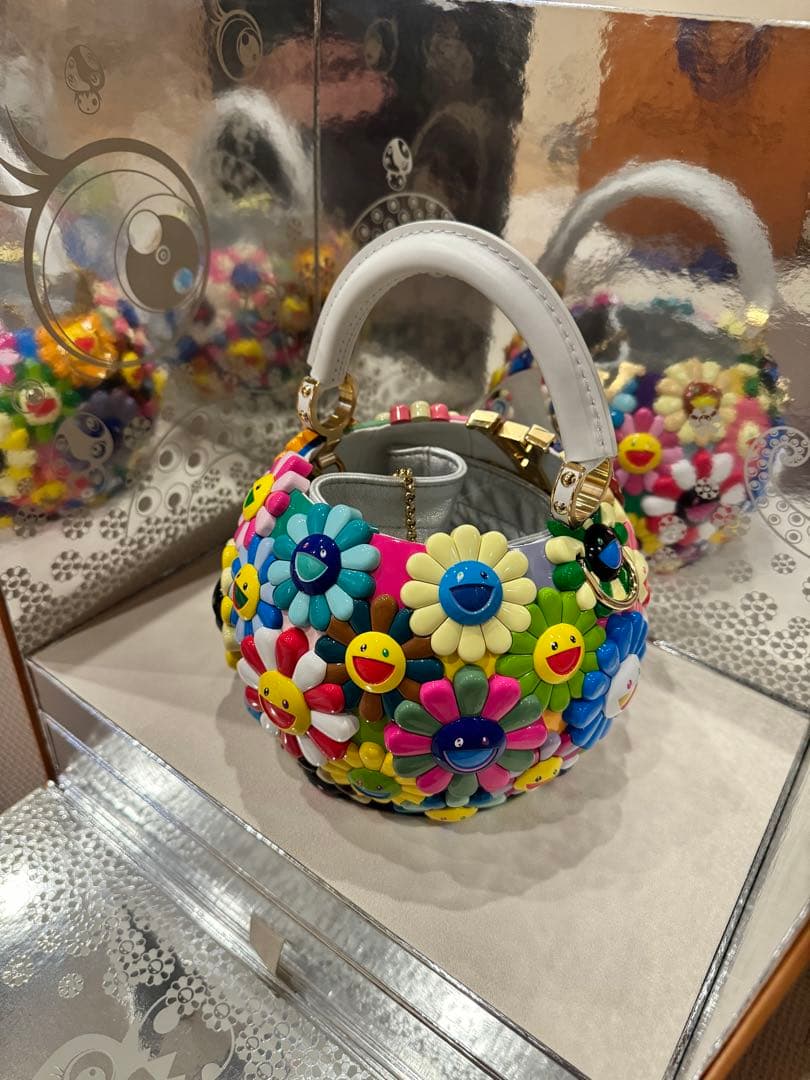
Visual signatures: Rainbow Flower body, one smiling face side, one sleeping face side, white top handle, yellow-enamel LV initials.
A numbered Artycapucines VII sculptural handbag from the Art Basel Paris Murakami chapter, produced in a worldwide edition of 380, representing the premium art-object end of the Louis Vuitton x Murakami relationship.
Material Composition:
- Mink fur (full body sculptural surface)
- Cowhide leather trim & lining
- Gold-tone hardware with enamel LV initials
- Thermoformed internal structure
Dimensions: ~30 × 18 × 11 cm
Origin: Made in France (as per tag)
Condition: Pre-owned (very good to excellent conditon); collectible-grade presentation.
Included Items: Handbag (full set: box, dust bag, documentation as shown in the photos)
OVERVIEW
This bag is not just “LV x Murakami.” It is, based on the official Artycapucines VII release details and the visual match to your photos, the Louis Vuitton x Takashi Murakami Arty Capucines EW Rainbow, reference N89666. The match points are unusually strong: the east-west Capucines shape, the all-over Rainbow Flower body, the white handle, the gold-tone LV initials with yellow enamel, and the whimsical dual-face treatment described by Louis Vuitton. Louis Vuitton’s official product page says this model uses thermoformed construction, is overlaid with mink fur, and measures 30 x 18 x 11 cm.
More importantly, the edition logic lines up with what your collector told you. Multiple contemporary coverage sources identify this exact model as the Arty Capucines EW Rainbow, priced at $28,400 and limited to 380 pieces worldwide.
The broader context matters, because this is what gives the piece its real gravitational pull. Louis Vuitton officially presented Artycapucines VII with Takashi Murakami at Art Basel Paris as the seventh edition of the Artycapucines project, describing it as a kaleidoscopic reimagining of the Capucines with added collector pieces. LVMH likewise notes the collection was unveiled at Art Basel Paris 2025. In other words, this was not a routine seasonal handbag drop. It was positioned from birth as a cross-border art-fashion collector project.
On the design side, this specific EW Rainbow model is one of the most theatrical entries in the lineup. Louis Vuitton says it depicts Murakami’s iconic Rainbow Flower design, while Japanese fashion coverage says the house reinterpreted the structure and dimensions of the Capucines to realize the form of Murakami’s Rainbow Flower motif. That is the crucial point: this is not merely a printed Capucines. The bag itself is being pushed toward sculptural character-object territory, which is why it reads almost like a wearable Murakami flower head rather than a conventional luxury handbag.
That sculptural reading is backed by construction details. Louis Vuitton states the bag is sculpted using thermoformed technology and overlaid with mink fur in a vibrant palette, with one side showing a smiley face and the other a sleeping face. PurseBop’s reporting mirrors the same idea, describing the white leather body engulfed in Murakami’s signature rainbow floral design and emphasizing the two different facial expressions. This is why the piece sits in a very different category from the more familiar 2003-era Murakami multicolore canvas pieces. Those were iconic luxury-pop hybrids. This is closer to a limited sculptural object that happens to function as a handbag.
The Murakami context raises the stakes even further. Vogue’s 2024 interview with Murakami called his original 2003 collaboration with Louis Vuitton a pivotal moment that helped usher luxury deeper into pop culture and helped define the blurred boundary between commerce, art, and fashion. Sotheby’s, writing in 2026, similarly frames Murakami x Louis Vuitton as the collaboration that defined a generation. So this 2025 Art Basel Paris Artycapucines chapter is not just another collaboration sitting on top of a famous archive. It is a late, self-aware, premium-tier return to one of the most culturally important fashion-art partnerships of the century.
That is the real collector thesis here:
This piece has three concentric rarity engines running at once. First, it is part of the Artycapucines program, which is already Louis Vuitton’s art-forward, prestige-heavy Capucines platform. Second, it is tied specifically to Takashi Murakami, whose motifs are among the most globally legible and commercially magnetic in the house’s crossover history. Third, this particular configuration was capped at 380 pieces worldwide, which is scarce enough to matter, but not so microscopic that it disappears from collector consciousness. It lives in the sweet spot where a piece is both rare and recognizable.
There is also a useful distinction between this and the general 2025 Louis Vuitton x Murakami re-edition. The re-edition collection that launched in phases in 2025 revived multicolore, panda, cherry blossom, and cherry motifs for a broader commercial audience. This bag is not that mass-visible re-edition lane. It belongs to the Artycapucines VII universe unveiled for Art Basel Paris, where the pieces were more experimental, sculptural, and tightly limited. That separation matters for pricing psychology because buyers are not comparing this only to a Speedy or Alma from the re-edition program. They are comparing it to collector-tier art objects within Vuitton’s modern art initiative.
ICONOGRAPHY / DESIGN LANGUAGE
The Rainbow Flower is one of Murakami’s most globally recognized symbols:
- Hyper-optimistic surface
- Psychological duality beneath (joy vs emptiness)
- Flat art rendered into physical object
Here, it is not printed — it is embodied.
The bag itself becomes:
- A face (smiling vs sleeping duality)
- A creature-like presence
- A hybrid between plush sculpture and luxury artifact
MATERIAL & CONSTRUCTION
This piece breaks from standard Capucines logic.
Instead of structured leather dominance:
- The exterior is fully enveloped in mink fur
- The structure is thermoformed, meaning sculpted rather than stitched traditionally
This results in:
- A volumetric, almost animated silhouette
- A tactile, high-luxury sensory experience
- A fragile strength paradox (soft surface, rigid core)
HISTORICAL / CULTURAL CONTEXT
The Louis Vuitton × Murakami relationship is one of the most important fashion-art collaborations ever executed.
But this piece belongs to a later evolutionary phase:
- Post-2003 multicolore era
- Post-hype normalization
- Entering archive + legacy consolidation phase
Artycapucines VII (Art Basel Paris) represents:
- Vuitton reasserting dominance in art-fashion dialogue
- Murakami returning not as disruptor, but as institutionalized master
COLLECTOR RELEVANCE
This sits in a rare overlap of:
- Luxury collectors (Capucines tier buyers)
- Murakami art collectors
- Archive fashion investors
- Art Basel-adjacent acquisition circles
It is NOT:
- A daily-use bag
- A casual Murakami piece
- A trend item
It is:
👉 A portfolio object
COLLECTOR’S RESONANCE
This piece chooses its owner.
It resonates with:
- Individuals who collect meaning, not logos
- Buyers who understand editioned luxury as asset class
- Collectors who want something that sits between
gallery pedestal and wardrobe
This is not worn casually.
It is deployed intentionally.
SUMMARY
A numbered Artycapucines VII Murakami “Rainbow” handbag represents the convergence of:
- Institutional luxury
- Contemporary art legacy
- Controlled scarcity
It stands as a wearable sculpture and a collector-grade cultural artifact.
Authenticity & Stewardship
Evaluated under the Japonista Luxury Collaboration Authentication Framework™
Each work within the Louis Vuitton × Takashi Murakami collaboration is examined through a multi-disciplinary authentication process:
• Brand verification across Louis Vuitton production standards and collaboration-era releases
• Artist attribution aligned with Takashi Murakami’s Superflat practice and Kaikai Kiki production ecosystem
• Material and construction assessment including coated canvas, leather trims, hardware, and finishing details
• Print integrity evaluation across monogram reinterpretations, color layering, and surface consistency
• Condition and structural review, including wear patterns, color stability, and preservation status
Where applicable, date codes, hardware engravings, production identifiers, and collaboration-specific characteristics are reviewed to confirm authenticity and period alignment.
Guaranteed 100% Authentic.
All works are curated and backed by the Japonista Lifetime Authenticity Warranty™, with emphasis on both luxury manufacturing integrity and artistic authorship.
A Note on Collaboration, Superflat & Cultural Shift
The Louis Vuitton × Takashi Murakami collaboration represents a defining moment in early 21st-century visual culture—where luxury fashion and contemporary art dissolved their boundaries.
Murakami’s Superflat philosophy reimagined the Louis Vuitton monogram through vibrant color, character motifs, and graphic expansion—transforming a heritage luxury code into a globally recognized cultural symbol. Pieces from this era are not merely accessories; they are art objects embedded within fashion systems.
At Japonista, these works are approached as hybrid cultural artifacts. They carry the precision of luxury craftsmanship alongside the conceptual framework of contemporary Japanese art.
Surface aging, patina, and signs of use are evaluated with care—preserving authenticity while respecting the integrity of both material and print.
Our role is to steward these pieces as part of a larger narrative: one that reshaped how art, commerce, and identity intersect.
Inquiries, Availability, and Private Consideration
Many Louis Vuitton × Takashi Murakami works are no longer in production and have entered the secondary market as highly sought-after collectibles. Certain pieces are held firmly due to rarity, condition, or specific print variations.
All inquiries are handled with discretion. We welcome thoughtful discussion regarding production era, print type, condition grading, and long-term collectibility.
Collectors building focused archives—whether centered on Murakami’s collaboration period, monogram variations, or specific silhouettes—may consult with us for deeper guidance.
Concierge Support & Collector Guidance
Japonista Concierge™ provides tailored assistance for collectors navigating luxury-art collaborations:
• Collaboration-era differentiation and model identification
• Print variation analysis and rarity positioning
• Preservation and storage guidance for coated canvas and leather goods
• Wearability versus archival conservation considerations
• Strategic acquisition planning for long-term collectible value
For select rare or high-value works, private reservation or structured acquisition arrangements may be available on a case-by-case basis.
Before Proceeding
We encourage collectors to review our shop policies and house guidelines available through the links in our website footer. These outline shipping protocols, condition standards, and handling considerations specific to luxury goods and collectible fashion.
Understanding these guidelines ensures informed acquisition and proper long-term care.
A Closing Note
The Louis Vuitton × Takashi Murakami collaboration stands as a landmark moment—where heritage luxury met contemporary art, and a monogram became a canvas.
These pieces are not simply fashion items; they are records of a cultural shift—objects that captured a time when boundaries between disciplines dissolved into something entirely new.
At Japonista, we steward these works with clarity and intention, ensuring they continue their journey with collectors who recognize both their craftsmanship and their cultural significance.
Concierge Support & Collector Guidance
Japonista Concierge™ provides personalized assistance for collectors seeking deeper insight into edition hierarchies, release cycles, and long-term preservation strategies for contemporary works.
Whether your interest is exhibition display, investment alignment, or art-historical study, we guide each acquisition with clarity and market literacy.
For select high-value works, private reservation or structured arrangements may be available on a case-by-case basis.
Before Proceeding
We kindly encourage collectors to review our shop policies and documentation guidelines, which outline condition transparency, edition verification standards, and shipping precautions specific to contemporary art works.
A Closing Note
Thank you for exploring Japonista’s curated Takashi Murakami & Kaikai Kiki archive. These works exist at the intersection of art theory, commercial production, and global cultural dialogue—and we are honored to steward them with institutional seriousness.
If you have questions or wish to explore related items, please feel free to contact Japonista Concierge™ at any time.