Rare Vintage, Antiques and Art Collector / Curator / Personal Shopper From Japan
Louis Vuitton Murakami Camouflage Monogram Mini Boston Tote Rare Archive Utility Bag Khaki Denim Style
Louis Vuitton Murakami Camouflage Monogram Mini Boston Tote Rare Archive Utility Bag Khaki Denim Style
Couldn't load pickup availability
Have a reasonable price in mind? Submit your best offer and our concierge will review it personally.
Louis Vuitton × Takashi Murakami
Camouflage Monogram Mini Boston / Tote Bag
Textile body with leather trim and utility-pocket façade
A notably restrained yet conceptually rich example from the Louis Vuitton and Takashi Murakami collaboration, the present mini Boston-style bag is distinguished by its camouflage textile body subtly integrated with the house monogram. Unlike more immediately recognizable outputs from the partnership, the design here privileges atmosphere over spectacle, embedding the LV pattern into a muted khaki-gray field that reveals itself gradually through close viewing.
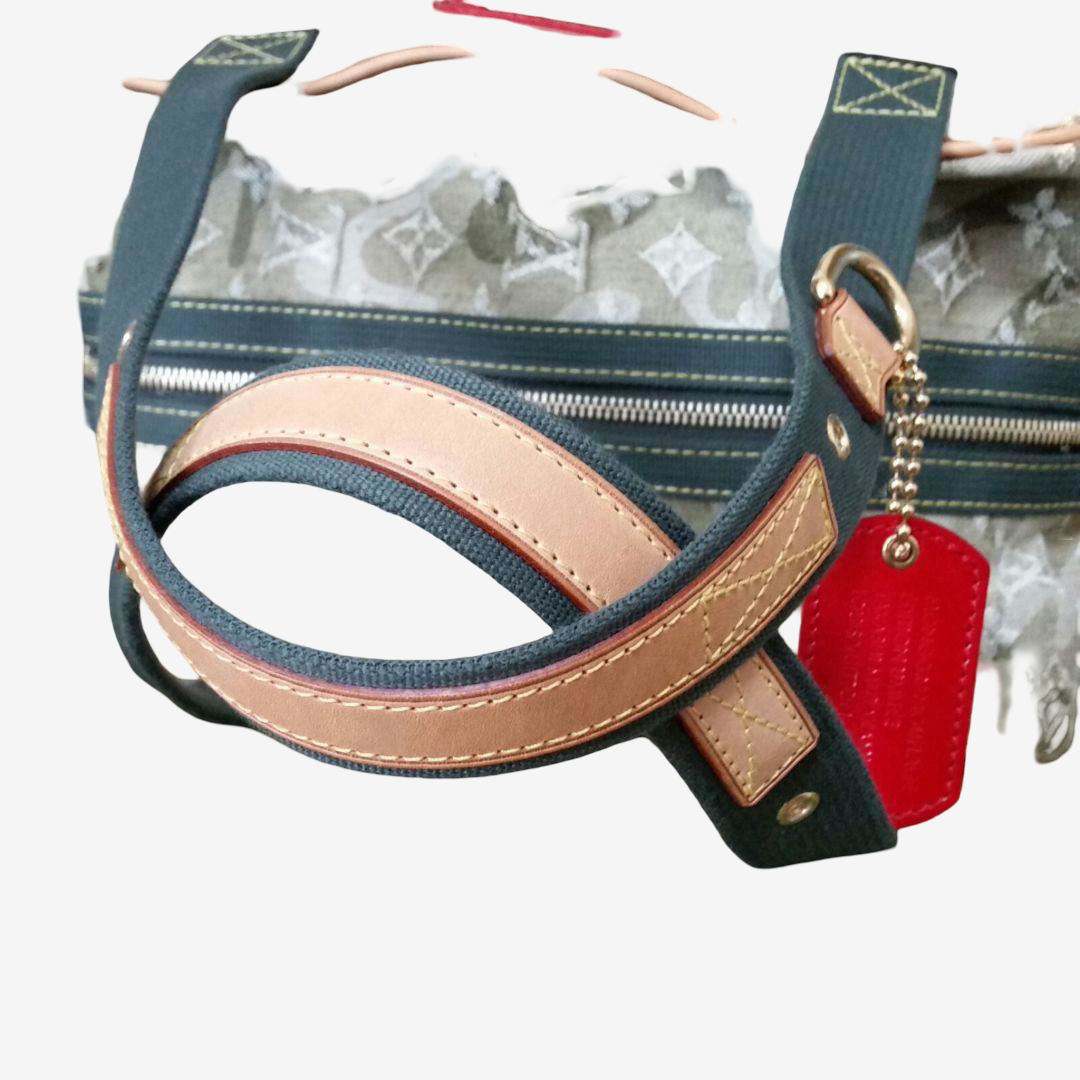
The frontal pocket architecture and webbed handles introduce a distinct utility inflection, shifting the object away from purely decorative handbag conventions and toward a more tactical, design-oriented identity. Contrasting red leather accents and natural trim provide precise interruptions within the subdued palette, reinforcing the balance between concealment and declaration.
Collector’s example from a less overexposed branch of the Murakami-Vuitton collaboration; significant for its tonal sophistication, textile presence, and the way in which it transforms monogram into camouflage rather than display.
Object
Louis Vuitton × Takashi Murakami camouflage mini Boston / tote-style bag
House
Louis Vuitton
Artist / Collaboration Layer
Takashi Murakami
Construction Type
Mini Boston / tote hybrid with frontal utility-pocket architecture
Material Language
Monogram denim / jacquard-style camouflage textile body with leather piping and trim, webbed handles, contrast red leather plaque and tag accents, metallic hardware
Visual Identity
Muted khaki-gray camouflage field overlaid with LV monogram repetition, softened into textile rather than canvas aggression
Color Family
Khaki / sage / gray camouflage with navy handles, natural leather trim, red accent tag and plaque
Country of Manufacture
France
Condition Context
Pre-owned but visually strong, with especially important retention of textile body integrity, form, pocket structure, and overall silhouette
Rarity Type
Murakami-era collaboration object from a less overexposed branch of the partnership, combining utility-bag architecture with camouflaged monogram textile language
A Murakami Object in a Lower Register
Some Murakami-Vuitton objects arrive with fanfare. They announce themselves immediately through color, sweetness, spectacle. This one does something more elusive. It withholds.
At first glance, it reads almost like a field object, something closer to utility than ornament. The camouflage softens the monogram rather than amplifying it. The palette collapses excess into atmosphere. What emerges is a bag that speaks in a lower register, quieter, more coded, but no less intentional.
And that restraint is precisely what gives it depth.
When the Monogram Learns to Disappear
Louis Vuitton’s monogram was designed to be recognized. Murakami’s great intervention into the house was often to make that recognizability louder, stranger, more pop-conscious. Here, however, the opposite occurs.
The monogram does not erupt. It dissolves.
It becomes embedded in the camouflage field, legible only through duration and attention. This is what makes the bag so compelling. It turns brand language into texture. The eye does not land on the logo first. It wanders. It adjusts. It finds the pattern slowly.
This is a much more sophisticated form of visual control than overt branding. It rewards familiarity rather than demanding it.
Camouflage as Misdirection
Camouflage has always carried a double meaning in fashion. It suggests concealment, but in luxury it often functions as a paradoxical form of display. Here, that paradox is sharpened.
The bag tries to disappear while remaining unmistakably itself.
The khaki-gray textile body blurs the surface into a military-adjacent field, but the leather piping, red plaque, and warm trim prevent full disappearance. These details interrupt the camouflage just enough to keep the object hovering between utility and performance.
It is this tension that gives the piece its charge.
A More Tactical Murakami
Murakami is frequently read through brightness, through repetition, through smiling surfaces. But this object reveals another Murakami tendency: his ability to infiltrate an existing structure without overwhelming it.
There are no cartoon faces here. No blossoms insisting on themselves. Instead, there is systemic intervention. He alters the visual temperature of the object. He changes how the monogram breathes. He shifts Vuitton from declarative luxury into something more tactical, more urban, more coded.
In that sense, this is one of the more conceptually interesting branches of the collaboration. It does not merely decorate Vuitton. It teaches Vuitton how to camouflage itself.
The Utility Bag as Cultural Form
The pocketed front is not incidental. It changes the meaning of the bag.
Where the classic Boston silhouette often signals travel or soft elegance, the frontal compartment language pulls the object toward utility. It begins to feel almost like equipment. Not in a rough sense, but in a refined, metropolitan one. It belongs to the same family of objects that translate storage into style and pragmatism into identity.
This is where the bag begins to drift away from accessory status and toward design object. The pocket architecture gives it posture. The red plaque gives it punctuation. The webbed handles reinforce that this is not a fragile ornament, but something meant to carry, move, and operate.
Textile Instead of Canvas
This difference matters more than many sellers understand.
The body does not read like traditional coated monogram canvas. It reads like fabric with memory. It has softness, tactility, and a subtle atmospheric quality that canvas lacks. That changes everything. Canvas tends to impose structure through surface certainty. Textile introduces nuance. It accepts light differently. It produces depth through weave rather than gloss.
That shift moves the object closer to fashion and further into collectible textile design. It becomes less of a handbag in the ordinary sense, and more of a portable composition.
Why Pieces Like This Age Well
The loudest collaboration pieces often rise first. The quieter ones last longer.
This is because over time, collectors begin to separate immediate recognizability from enduring intelligence. The camo Murakami pieces tend to migrate into the second category. They do not scream “icon” in the obvious way. Instead, they begin to feel more resolved with age, more atmosphere-rich, more subtly distinctive against the broader archive of Murakami-Vuitton output.
That is exactly the kind of object that becomes more important later than it seemed at first.
What the Market Still Gets Wrong
Many secondary sellers still frame these pieces as novelty bags with rare patterning. That is far too shallow a reading.
What you actually have here is a collaboration object where camouflage, monogram, and utility architecture are fused into a single language. Not a novelty. Not a side note. A properly developed sub-branch of one of the most important luxury-art dialogues of the century.
The market tends to reward what it already knows. Serious collectors reward what it finally learns.
This belongs to the latter category.
Authenticity & Stewardship
Each work is evaluated under the Japonista Luxury Archive Authentication Protocol™, incorporating:
• Date code verification and production alignment
• Monogram symmetry and canvas grain consistency review
• Hardware engraving precision and zipper typology analysis
• Stitch count consistency and leather trim evaluation
• Condition mapping and restoration disclosure
Guaranteed 100% Authentic.
All works are backed by the Japonista Lifetime Authenticity Warranty™.
On Heritage, Craft & Structured Permanence
Louis Vuitton originates in trunk construction—discipline of canvas, reinforced corners, and travel durability. Modern garments and accessories carry this structural logic forward.
At Japonista, LV works are evaluated as engineered luxury systems. Canvas resilience, leather oxidation, stitching precision, and hardware patina are examined as chronological evidence rather than surface ornament.
Natural aging—subtle vachetta darkening, canvas softening—is documented as part of material lifecycle when integrity remains intact.
Attribution, Rarity & Condition Integrity
Certain LV works correspond to artist collaborations, runway capsules, or discontinued silhouettes.
Restorations, if present, are disclosed transparently.
Collectors may request production-year clarification prior to acquisition.
Inquiries, Availability, and Private Consideration
Vintage and rare modern luxury works may include archival runway pieces, boutique-limited releases, discontinued silhouettes, or early-production constructions no longer replicated by the maison.
Restorations, when present, are disclosed transparently. Replacement hardware, re-lined interiors, or minor leather conditioning interventions are documented where observable.
“Rare” classification reflects documented scarcity, design discontinuation, or limited distribution—not speculative language.
Collectors are encouraged to request further clarification regarding era attribution, run history, or condition mapping prior to acquisition.
Concierge Support & White-Glove Handling
Japonista Concierge™ provides advisory services consistent with high-value fashion stewardship, including:
• Sizing calibration consultation across vintage pattern shifts
• Leather conditioning and textile preservation guidance
• Climate-controlled storage recommendations
• Archival garment rotation strategies
• Secure packaging and reinforced freight coordination for high-value items
For museum-level or investment-tier pieces, private consideration and structured acquisition arrangements may be available upon request.
Before Proceeding
We kindly encourage collectors to review our shop policies and preservation guidelines, available through the links in our website footer, outlining handling precautions, environmental considerations, and condition disclosure standards specific to fragile figurative and textile works.
Provenance, Documentation & International Considerations
Luxury garments are presented as collector-grade fashion archives, not affiliated with or endorsed by the originating maisons.
Buyers are responsible for reviewing international import duties, exotic material regulations (where applicable), and customs classifications prior to purchase.
Japonista does not facilitate transactions in violation of applicable law and may require additional documentation for certain materials or shipping destinations.
All provenance details provided reflect inspection-based assessment and available documentation at the time of listing.
A Closing Note
Louis Vuitton represents disciplined luxury engineering rooted in travel heritage. These works are preserved as structural artifacts of atelier authority and material permanence.
We steward them with institutional precision.
If you have questions or wish to explore related items, please feel free to contact Japonista Concierge™ at any time.