Louis Vuitton
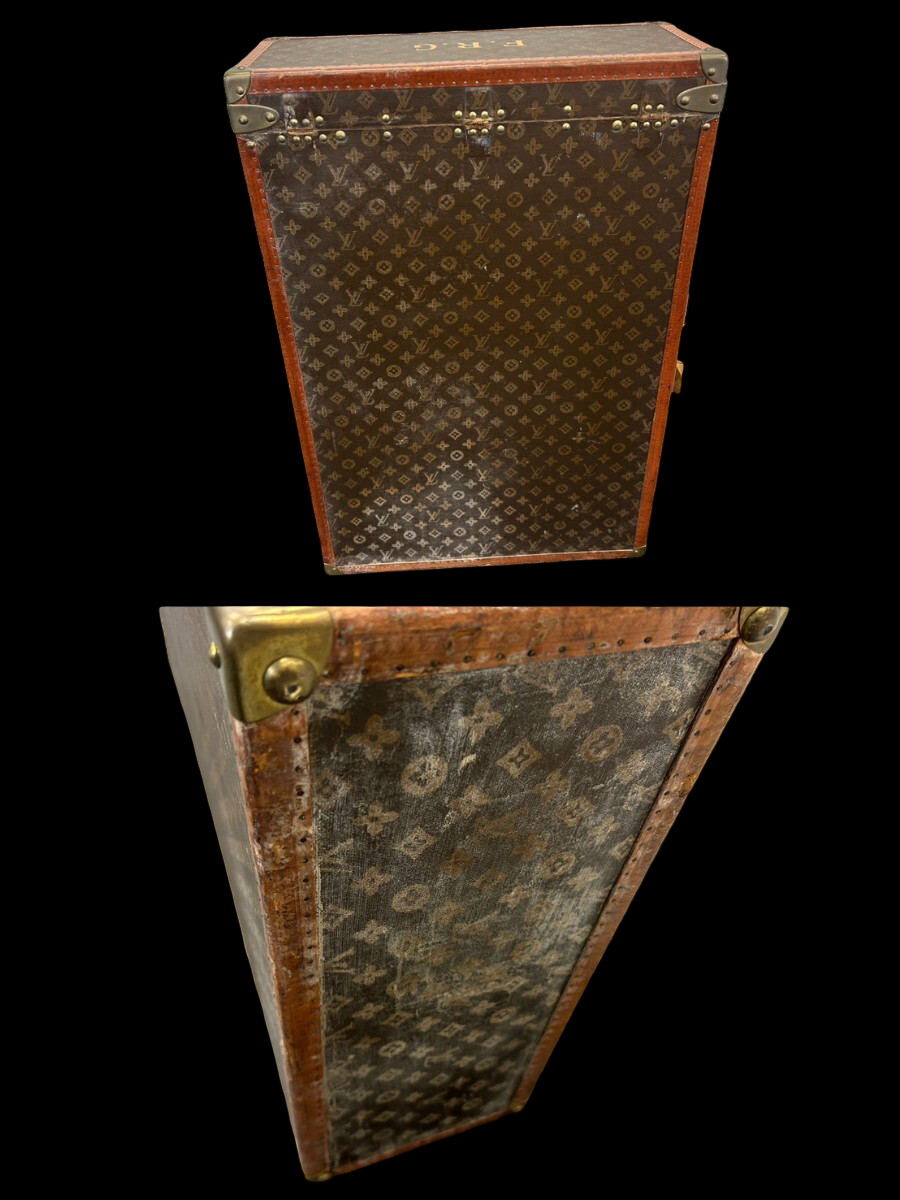
LOUIS VUITTON Antique Monogram Wardrobe Trunk Early 20th Century Large Upright Travel Cabin Chest Initialed F.R.G.
LOUIS VUITTON Antique Monogram Wardrobe Trunk Early 20th Century Large Upright Travel Cabin Chest Initialed F.R.G.
Couldn't load pickup availability
Have a reasonable price in mind? Submit your best offer and our concierge will review it personally.
Introduction
A monumental early Louis Vuitton Monogram wardrobe trunk, created during the period when the Maison’s luggage was designed for extended rail, steamship and hotel travel rather than simply as a decorative luxury object.
Unlike the low cabin trunks intended primarily for folded garments, this upright configuration transforms into a compact traveling wardrobe. Opened vertically, the interior reveals a hanging system with surviving wooden hangers, retaining straps and textile fittings designed to organize clothing while in transit.
The exterior carries Louis Vuitton’s historic brown Monogram canvas over a rigid trunk structure, framed by aged trim and metal hardware. More than a century of wear has produced a deep, irregular patina across the canvas, edging, leather and fittings.
A particularly evocative detail is the historic owner identification:
F.R.G.
Rather than weakening the piece, the initials connect it to the original culture of bespoke luxury travel, when owners routinely marked trunks so large collections of luggage could be identified at stations, ports and hotels.
This is furniture, luggage, sculpture and travel history compressed into one object.
The Wardrobe Trunk
The wardrobe trunk was one of the most sophisticated forms in Louis Vuitton’s early luggage vocabulary.
Its purpose was almost architectural.
Instead of merely storing clothing, the trunk created a portable closet.
When opened upright, the interior allows garments to hang vertically rather than being folded into layers. Wooden hangers and retaining straps organize clothing while the internal structure protects the contents during movement.
This form was developed for travelers whose journeys might last weeks or months.
Ocean crossings.
Grand hotels.
International rail travel.
Seasonal residences.
Long diplomatic, business or social journeys.
The wardrobe trunk turned a hotel room into something closer to home.
Monogram Canvas & Early Construction
The exterior is covered in Louis Vuitton’s historic Monogram pattern, the visual language introduced by the Maison in the late nineteenth century and already internationally recognized by the early twentieth century.
The surface is reinforced through a combination of:
Monogram canvas
rigid structural body
aged leather elements
metal fittings
rivets
locks and latches
protective edging
On an antique trunk, these materials do not age uniformly.
Canvas fades and abrades.
Leather darkens.
Metal oxidizes.
Edges soften.
Small separations and surface losses may develop.
Together, those changes create the unmistakable visual character of genuine period travel luggage.
Upright Interior Architecture
The strongest feature of this example is its surviving wardrobe interior.
Visible elements include:
wooden garment hangers
metal hanging rail
retaining straps
interior textile lining
upper storage area
lower hanging compartment
door-mounted textile panel
leather pull details
The internal arrangement illustrates how technically considered early luxury luggage could be.
This was not simply a large empty box.
It was designed as a transportable storage system.
Original-Style Wooden Hangers
The surviving wooden hangers are especially appealing.
Their broad shape reflects the need to support jackets, coats and tailored garments without excessive creasing during travel.
Period wardrobe trunks with surviving internal fittings generally possess greater collector interest than stripped examples because the original function remains visible immediately when the trunk is opened.
The hangers turn the interior into a tiny historical room.
F.R.G. Owner Initials
The exterior bears the initials:
F.R.G.
Personal initials were common on elite travel luggage.
A trunk was expensive, highly personal equipment and frequently formed part of a much larger coordinated luggage suite.
Painted initials, colored stripes and monograms allowed porters to identify individual pieces quickly.
Today these markings are valuable visual traces of ownership history.
Unless documentary provenance can be established, the identity behind F.R.G. should remain respectfully unidentified rather than guessed.
That unanswered question is part of the charm.
Early 20th-Century Travel Culture
Wardrobe trunks belonged to an extraordinary moment in transportation history.
International travelers were moving through an interconnected network of:
steamships
railways
grand hotels
ocean terminals
European capitals
resort destinations
Travel was slower than today, but luggage was often far more elaborate.
A substantial wardrobe trunk might travel alongside cabin trunks, hat boxes, shoe trunks and smaller cases.
The luggage itself became part of the traveler’s public identity.
Design Presence
Closed, the trunk has imposing vertical geometry.
Opened, it becomes dramatically more architectural.
That dual personality makes wardrobe trunks particularly successful as interior objects.
It can function as:
a freestanding collectible
a dressing-room statement piece
a boutique display
a gallery object
a private wardrobe feature
a hotel interior accent
a fashion archive centerpiece
a photographic prop
Even empty, the open interior has tremendous theatrical presence.
Condition
This is a genuinely old antique trunk with substantial age-related wear.
The source describes and photographs:
general rubbing
scratches
surface dirt
staining
metal oxidation
areas of Monogram wear
some cracking or lifting to portions of the exterior surface
interior staining
fabric wear
age-related discoloration
wear to wooden hangers
metal tarnish and oxidation
locks and hardware that may not operate with modern smoothness
These characteristics are consistent with a wardrobe trunk that has experienced prolonged use and storage.
The piece should not be understood as pristine.
Its value lies in its surviving historical material, form, interior fittings and extraordinary decorative presence.
Patina & Conservation
A trunk of this character should not be aggressively refinished.
The correct conservation philosophy is preservation rather than cosmetic rejuvenation.
Appropriate treatment may include:
gentle dry cleaning
careful dust removal
stabilization of loose surfaces
professional metal conservation
light leather conditioning where appropriate
structural reinforcement only where necessary
Over-restoration risks erasing precisely what makes an antique Vuitton trunk compelling.
The scratches are not random defects.
They are chronology.
Scale
This is a large upright wardrobe trunk, substantially different in scale and function from conventional Vuitton suitcases and cabin cases.
Because exact dimensions are not clearly provided in the available source material, measurements should be physically confirmed before final publication and international freight quotation.
Its proportions nevertheless place it firmly within Louis Vuitton’s historical wardrobe-trunk tradition.
Comparable early wardrobe trunks frequently exceed approximately one meter in height. Current specialist examples include an approximately 110 × 65 × 55 cm Monogram wardrobe trunk and another measuring roughly 104 × 56 × 34 cm.
Materials
Exterior:
Louis Vuitton Monogram canvas
Structural body:
Wood
Trim and reinforcing elements:
Leather / coated trim / metal hardware
Interior:
Textile-lined wardrobe compartment
Hangers:
Wood with metal hanging hardware
Included Interior Elements
Visible with the trunk:
wooden hangers
hanging mechanism
retaining straps
internal textile components
Any individual removable accessory should be confirmed against the final inventory before shipment.
Collector Appeal
This trunk brings together several characteristics particularly desirable in historical Vuitton collecting:
large wardrobe format
early Monogram canvas
surviving interior architecture
wooden hangers
historic owner initials
significant scale
century-old patina
functional travel design
strong decorative presence
Most Vuitton collectors begin with bags.
Trunks belong to another universe.
They connect directly to the Maison’s original métier.
Interior Design Potential
Placed closed against a wall, the trunk becomes monumental luggage.
Opened, it becomes an installation.
That distinction matters.
The wardrobe interior makes this piece particularly suitable for:
luxury boutiques
fashion studios
hotel interiors
private dressing rooms
collector libraries
heritage displays
editorial photography
It does not need to pretend to be furniture.
Its original function is already visually dramatic enough.
Authenticity & Stewardship
Each work is evaluated under the Japonista Luxury Archive Authentication Protocol™, incorporating:
• Monogram canvas pattern and aging review
• early trunk-construction analysis
• hardware typology
• rivet and lock architecture
• wood and trim inspection
• wardrobe-interior configuration
• hanger construction
• age-consistent patina mapping
• initials and personalization review
• evidence of restoration or component replacement
• structural integrity assessment
Guaranteed 100% Authentic.
All works are backed by the Japonista Lifetime Authenticity Warranty™.
On Heritage, Craft & Structured Permanence
Before Louis Vuitton became synonymous with handbags, it built architecture for travelers.
The wardrobe trunk makes that heritage unusually easy to understand.
The shell is architecture.
The hanging rail is infrastructure.
The hangers are furniture.
The canvas is identity.
The brass and metal fittings are engineering.
Everything exists because someone once expected this object to cross countries and oceans while protecting an entire wardrobe.
Its scale is extravagant today precisely because its original purpose was practical.
JAPONISTA CURATORIAL NOTE
There is a delightful absurdity to modern carry-on culture when an object like this survives.
Today we negotiate over 7 kilograms and overhead-bin dimensions.
A century ago, someone essentially said:
“Bring the closet.”
And Louis Vuitton built one. 🧳