Rare Vintage, Antiques and Art Collector / Curator / Personal Shopper From Japan
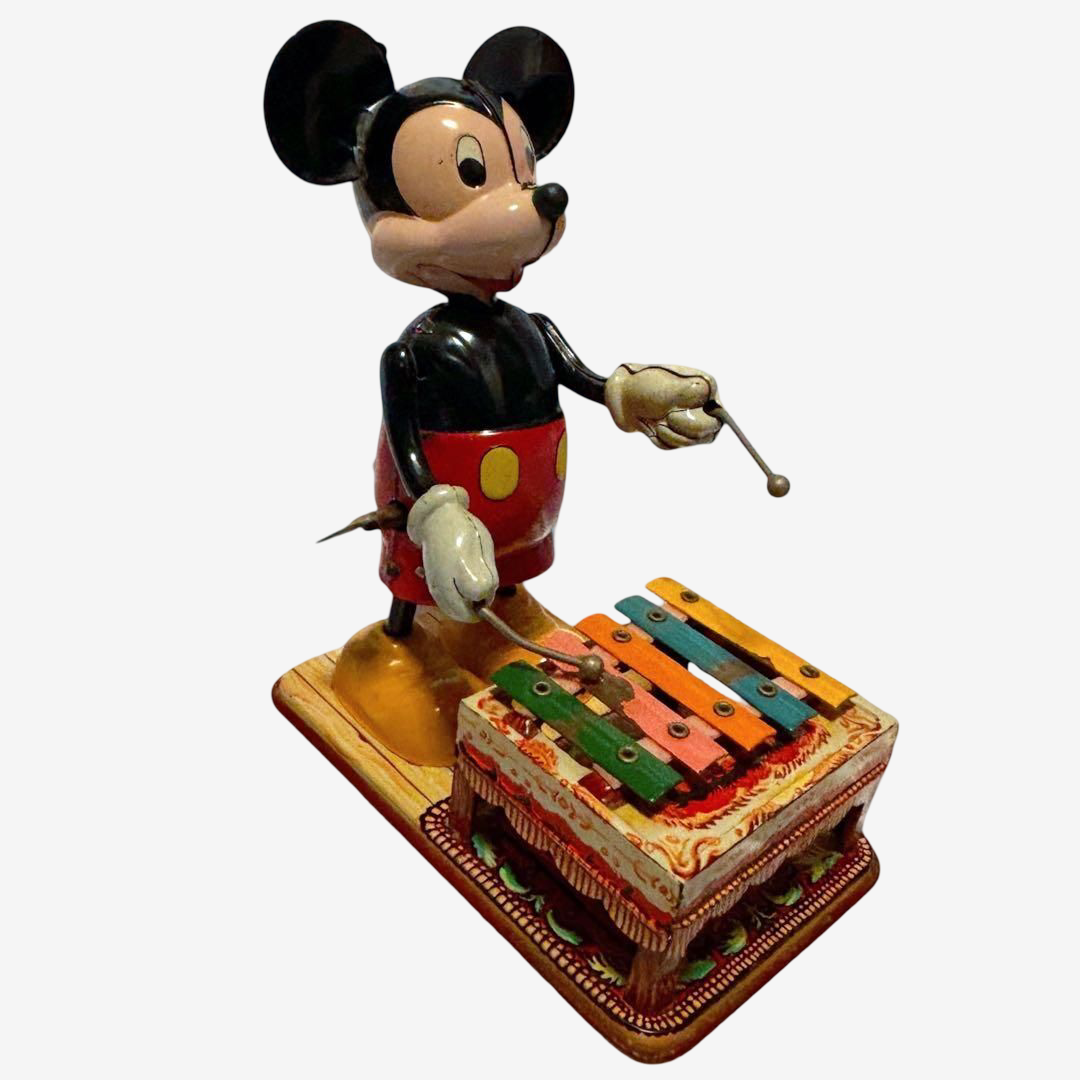
Linemar / Marx Mickey Mouse Xylophone Player · Walt Disney Productions · Wind-Up Tin Mechanical Toy · Japan, 1950s
Linemar / Marx Mickey Mouse Xylophone Player · Walt Disney Productions · Wind-Up Tin Mechanical Toy · Japan, 1950s
Couldn't load pickup availability
Have a reasonable price in mind? Submit your best offer and our concierge will review it personally.
Object: Mickey Mouse Xylophone Player
Character: Mickey Mouse
Maker / Trade Name: Linemar Toys / Louis Marx & Co. lineage
License: Walt Disney Productions
Origin: Japan
Period: 1950s
Object Type: Wind-up mechanical character toy
Primary Material: Lithographed / painted tinplate with mixed character components
Mechanism: Spring-driven zenmai / clockwork action
Action: Mickey rhythmically operates the mallets against the metal xylophone keys while the body moves during the mechanism cycle
Markings: LINEMAR TOYS JAPAN and WALT DISNEY PRODUCTIONS
Dimensions: Approx. H 18 × W 14.5 × D 8.5 cm
Operation: Wind-up mechanism presently operates
Condition: Authentic vintage condition with age-related rubbing, patina, oxidation and surface wear
Packaging: No original box included with the present ensemble
Collector Category: Disneyana / Linemar / Marx / Japanese tin toys / mechanical character toys / 1950s Disney collectibles
A specialist toy archive identifies the same model as a Japan-made Linemar/Marx “Mechanical Mickey Mouse with Xylophone,” marked Linemar and Walt Disney Productions and operating through a wind-up mechanism. AntiqueToys.com - Antique Toys for Sale
Gray’s Auctioneers catalogued another example in 2024 as a 1950s Line Mar Toys Mickey Mouse Mechanical Xylophone Toy, documenting the same basic action: wind the key, release the mechanism, and Mickey plays the xylophone with two mallets. Gray's Auctioneers
CHRISTIE’S-STYLE CATALOGUE LOT ESSAY
A LINEMAR / MARX MICKEY MOUSE XYLOPHONE PLAYER
Walt Disney Productions
Japan, 1950s
Wind-up mechanical tin toy
The most successful mechanical character toys do not merely depict their subject.
They give the character something to do.
In this charming postwar Japanese interpretation of Mickey Mouse, the world’s most recognizable animated figure becomes a musician.
Mickey stands upright behind a brightly colored xylophone, grasping a pair of slender mallets in his familiar gloved hands. Beneath the cheerful surface lies a compact clockwork mechanism. Once wound and released, the stored spring energy animates the figure, sending Mickey into a rhythmic performance as the mallets strike the metal bars.
The mechanism transforms illustration into theatre.
Mickey is no longer a static licensed image.
He performs.
That distinction helps explain why the great Japanese mechanical Disney toys of the 1950s occupy such a compelling territory between commercial merchandise, toy engineering and popular art.
The object was produced under the Linemar name, part of the Louis Marx toy network. Disney’s own D23 archive records Marx as a Disney licensee during the period and notes that many desirable wind-up and mechanical tin toys were sold under the LineMar trademark. D23
The Japanese manufacturing context is equally important.
Postwar Japan developed a remarkable industry around lithographed tinplate, clockwork mechanisms and export character toys. Linemar became one conduit through which that manufacturing expertise entered American and international markets, combining Japanese production with globally recognizable licensed characters.
Here, Mickey’s black body, red shorts and yellow shoes are paired with the geometric colors of the xylophone and the ornate printed base. The visual composition is unmistakably mid-century: cheerful, graphic and mechanical without attempting realism.
The surviving age-related surface wear gives the present example a distinctly authentic presence.
Paint loss, oxidation and rubbing reveal decades of handling rather than the uniform finish of a modern reproduction. More importantly, the clockwork mechanism remains active, preserving the element that originally transformed the toy from image into performance.
The result is an object that condenses several histories into one small machine:
Disney character culture,
postwar Japanese manufacturing,
American toy licensing,
tinplate production,
and the mechanical imagination of the 1950s.
CURATORIAL ESSAY
When Mickey Became a Machine
There is a peculiar magic to mechanical character toys.
Animation already gives life to a drawing.
A mechanical toy attempts to give life to the drawing again, but physically.
That is what happens here.
Mickey Mouse began as movement on film.
The Linemar toy translates that movement into gears, springs, metal and rhythm.
The mechanism does not reproduce cinematic animation perfectly.
It does something more charming.
It stutters.
It clicks.
It strikes.
It vibrates.
The imperfections make the movement tangible.
This is not cinema pretending to be life.
It is machinery pretending to be Mickey.
MICKEY MOUSE AND MUSICAL PERFORMANCE
Music has been central to Mickey’s identity from the beginning of his screen career.
His early animation emerged during the period when synchronized sound transformed animated film, and Mickey quickly became associated with music, rhythm and physical performance.
That makes the xylophone concept especially appropriate.
The toy does not simply attach a random activity to a famous character.
It places Mickey within one of the central traditions of early animation:
movement synchronized with sound.
The mechanical rhythm of the wind-up system becomes a crude physical counterpart to musical animation.
Mickey moves.
The mallets strike.
Sound emerges.
The toy becomes a miniature stage.
WHY LINEMAR MATTERS
Linemar occupies an important position in postwar toy history.
The company functioned within the Louis Marx manufacturing and import network, using Japanese production to create toys for international distribution. D23 confirms Marx’s long Disney licensing relationship and specifically notes that some of the more valuable mechanical tin Disney toys were sold under the LineMar trademark. D23
Independent toy-history references describe Linemar as a Japanese manufacturing and import operation associated with Louis Marx & Co., producing both mechanical toys and licensed Disney characters. Toys NZ
That makes the Linemar name interesting for two reasons.
It is simultaneously:
American commercial history
and
Japanese manufacturing history.
The designs were intended for global consumption, but their physical character came from Japan’s extraordinary postwar tin-toy industry.
THE POSTWAR JAPANESE TIN-TOY INDUSTRY
Japan became one of the great centers of tin-toy production during the decades following the Second World War.
Thin sheet metal could be lithographed, pressed, folded and mechanically joined into surprisingly sophisticated forms.
Clockwork mechanisms added movement without requiring batteries.
For international buyers, the result was affordable mechanical spectacle.
Characters walked.
Animals danced.
Robots sparked.
Vehicles raced.
And Mickey played the xylophone.
These toys now preserve an industrial world that has largely disappeared.
Their seams, tabs, printed surfaces and mechanical sounds are all artifacts of a manufacturing system built around stamped metal and compact mechanical ingenuity.
DESIGN AND CONSTRUCTION
The composition is built around a small theatrical platform.
Mickey stands behind the instrument, leaning slightly into the performance.
His familiar circular ears create the strongest silhouette at the top of the figure.
The pale face contrasts strongly with the black head and body.
Red shorts establish the central color accent.
Yellow shoes anchor the figure against the decorative base.
In front sits the xylophone.
Its colored metal bars create a horizontal counterpoint to Mickey’s vertical body.
The mallets connect figure and instrument.
This relationship is visually important.
Without the instrument, Mickey would simply be a standing character toy.
With it, the figure becomes a scene.
THE XYLOPHONE
The xylophone is not merely decorative.
It is the central mechanical destination of the toy.
As the mechanism operates, Mickey’s hands animate the mallets, producing a sequence of percussive strikes.
The resulting sound belongs to the mechanism as much as the instrument.
There is no hidden digital audio.
No speaker.
No sound chip.
The noise is physical.
Metal strikes metal.
The machine produces its own soundtrack.
That directness is one of the great pleasures of mechanical toys.
CLOCKWORK ACTION
Stored Energy as Performance
The toy is powered by a traditional wound spring.
Turning the key stores mechanical energy.
Releasing the mechanism allows that energy to travel through gears and linkages.
The figure begins to move.
The mallets strike.
The sequence continues until the spring unwinds.
This produces an entirely different relationship with the object than modern electronic toys.
The collector initiates the performance manually.
The machine then spends the energy that has been physically placed inside it.
There is something wonderfully legible about that process.
You wind it.
It plays.
CHARACTER MODELING
Mickey’s sculpted head gives the toy a distinctly three-dimensional personality beyond its tinplate mechanical structure.
The broad face, large ears, black nose, smiling mouth and small red tongue retain the character’s classic mid-century appearance.
Age has softened the finish.
Rather than diminishing the figure, this surface history now helps differentiate the toy from later reproductions and purely decorative Disney objects.
The expression remains unmistakably Mickey.
That recognizability is one reason these Linemar character toys continue to cross beyond specialist tin-toy collecting into broader Disneyana.
COLOR & GRAPHIC LANGUAGE
The object relies on a classic Disney palette but adds the brightness of a mid-century mechanical toy.
Black defines Mickey’s silhouette.
Cream tones shape the face and gloves.
Red animates the shorts.
Yellow shoes stabilize the figure visually.
The xylophone introduces additional bands of color.
Beneath everything, the printed base incorporates ornamental graphics that turn the mechanism into a decorative stage.
The effect is festive without becoming visually chaotic.
SURFACE, PATINA & AGE
The present example carries visible evidence of its age.
Rubbing, oxidation, scratches, tonal variation and surface patina appear throughout the piece.
On an object from this category, those characteristics should be interpreted carefully.
They are neither invisible nor insignificant.
But neither do they erase the historical value of an original mechanical survivor.
The object has not been made to resemble the 1950s.
It has lived through them.
That distinction matters.
AUTHENTICITY MARKINGS
The reverse bears the markings associated with the licensed production:
LINEMAR TOYS JAPAN
and
WALT DISNEY PRODUCTIONS
These marks place the object within the recognized Linemar Disney manufacturing lineage.
Comparable specialist examples are likewise documented with Linemar and Walt Disney Productions markings. AntiqueToys.com - Antique Toys for Sale
For serious Disneyana and Japanese toy collectors, such markings are an important part of object identification.
WALT DISNEY PRODUCTIONS LICENSING CONTEXT
Disney character merchandise did not emerge as a peripheral phenomenon.
Licensing became one of the principal ways Mickey Mouse moved beyond the screen and into domestic life.
D23 records Louis Marx & Co. as a Disney licensee beginning in 1936, continuing through 1961 before a later renewal. D23
By the 1950s, Mickey could therefore exist simultaneously as:
film character,
comic character,
advertising figure,
household image,
and mechanical toy.
The Linemar Xylophone Player belongs directly to that expansion of Mickey from screen personality into material culture.
MECHANICAL CHARACTER TOY AS PERFORMANCE ARTIFACT
Seen today, the piece almost behaves like a miniature automaton.
The scale is small.
The mechanism is simple.
But the conceptual structure is the same.
A stored source of mechanical energy animates a recognizable figure through a repeated performance.
The action is choreographed.
Mickey does not move randomly.
He performs a task.
That task creates sound.
The toy therefore occupies a fascinating territory between character figurine and mechanical automaton.
CONDITION
This Linemar Mickey Mouse Xylophone Player survives in authentic vintage condition and retains its working spring-driven mechanism.
The toy displays extensive age-related surface character including rubbing, scratches, oxidation, patina, paint loss, discoloration and other traces accumulated through long-term handling and preservation.
The principal Mickey figure, xylophone, mallets, base and mechanical structure remain visually coherent as an ensemble.
The wind-up mechanism presently operates and animates Mickey’s xylophone-playing action.
As with any approximately seven-decade-old mechanical object, continued indefinite future operation cannot be guaranteed. The mechanism should be exercised conservatively and appreciated primarily as part of a historic collectible.
No original retail box accompanies the present piece.
Please examine all photographs carefully for the most complete visual record of surface preservation and age.
DIMENSIONS
Approx.
Height: 18 cm / 7.1 in
Width: 14.5 cm / 5.7 in
Depth: 8.5 cm / 3.3 in
These dimensions align closely with documented examples of the model, including specialist records around 5¾ × 3½ × 6¾ inches and auction examples around 6½ inches in height. AntiqueToys.com - Antique Toys for Sale
COLLECTOR SIGNIFICANCE
The Mickey Mouse Xylophone Player crosses several collecting disciplines:
Disneyana,
Mickey Mouse,
Japanese tin toys,
Linemar,
Louis Marx,
mechanical toys,
wind-up toys,
1950s character merchandising,
postwar Japanese manufacturing,
music toys,
animation history,
and mid-century popular design.
That crossover gives the model significantly broader appeal than an anonymous Japanese clockwork toy.
It is both a mechanical object and a licensed cultural icon.
BOXED VERSUS UNBOXED COLLECTING
Original packaging has substantial importance within the Linemar market.
A boxed near-mint working example sold through Morphy Auctions in 2009 for $400 hammer / $480 including premium. That example retained its original box, original rubber parts and minimal wear. iCollector
The present piece should therefore be valued as a strong working unboxed survivor rather than against the highest-grade boxed examples.
That distinction is important for transparent collecting.
Originality matters.
Function matters.
Condition matters.
Packaging matters too.
MUSEUM WALL LABEL
Mickey Mouse Xylophone Player
Linemar / Louis Marx lineage
Walt Disney Productions
Japan
1950s
Wind-up mechanical tin toy
Approx. H 18 × W 14.5 × D 8.5 cm
Produced in Japan under Disney license, the Linemar Mickey Mouse Xylophone Player transforms Mickey from animated character into physical mechanical performer.
Once wound, the spring-driven mechanism moves the figure’s arms so that the mallets strike the metal xylophone bars.
The toy belongs to the remarkable postwar Japanese tin-toy industry, in which printed sheet metal and compact clockwork mechanisms were combined with internationally recognizable licensed characters.
Linemar operated within the Louis Marx toy network, and Disney’s own historical archive records Marx as a significant licensee whose mechanical tin Disney toys were often marketed under the LineMar trademark. D23
The result is both toy and miniature automaton: an object in which Mickey’s animated identity is translated into gears, springs, metal and sound.
COLLECTOR’S NOTE
Animation gave Mickey movement.
Linemar gave him gears.
That is the small miracle of this object.
The screen character becomes a machine.
The machine becomes a performer.
And nearly seventy years later, the spring can still make Mickey raise his mallets and play.
Authenticity & Collectible Stewardship
Evaluated under the Japonista Collectibles Authentication Framework™:
-
Period, manufacturer, and production-era assessment
-
Material, paint, lithography, and surface-wear analysis
-
Mechanical, structural, and component integrity review (where applicable)
-
Design, iconography, and cultural-context verification
Guaranteed 100% Authentic.
Every piece is backed by the Japonista Lifetime Authenticity Warranty™ and curated with collector-grade scrutiny.
A Note on Collecting & Preservation
At Japonista, we approach vintage and modern toys not merely as nostalgic objects, but as design artifacts, cultural touchstones, and expressions of their era—from postwar ingenuity and Showa imagination to contemporary pop and designer movements.
Each work is carefully examined, researched, and presented with respect for its original intent, historical context, and collector relevance, balancing preservation with the honest character earned through time and play.
Our role is not only to offer access to meaningful collectibles, but to act as thoughtful custodians—connecting the right pieces with collectors who value history, originality, and lasting significance.
Inquiries, Availability, and Private Consideration
Some collectible works may allow room for discussion, while others are held firmly due to rarity, condition, provenance, or cultural importance. All inquiries are reviewed personally and discreetly, and we welcome thoughtful questions or expressions of interest.
If you are exploring a specific theme, franchise, maker, era, or mechanical category—or seeking guidance in building a focused collection—our team is always available to assist with informed, quiet expertise.
Concierge Support & Collector Guidance
Japonista Concierge™ offers personalized assistance for collectors seeking deeper understanding, strategic acquisitions, or long-term curation across vintage and modern collectibles.
Whether your interest lies in nostalgia, design history, mechanical fascination, or pop-culture legacy, we are here to support your collecting journey with clarity, care, and discretion.
For select high-value or historically significant pieces, private reservation or structured payment arrangements may be available on a case-by-case basis. Please contact us to discuss eligibility and options.
Before Proceeding
We kindly encourage collectors to review our shop policies and house guidelines, available through the links in our website footer, which outline shipping, handling, and condition standards specific to vintage, mechanical, and collectible works.
A Closing Note
Thank you for exploring Japonista’s collection of vintage and modern toys, robots, and cultural collectibles. We are honored to share these enduring objects of imagination and design—and to help place them where they may continue to be appreciated, studied, and enjoyed.
If you have questions or wish to explore related works, please feel free to contact Japonista Concierge™ at any time.