Rare Vintage, Antiques and Art Collector / Curator / Personal Shopper From Japan
Life-Size Tetsujin 28 Standing Figure — 1:1 Scale Iron 28 Display Statue, Japanese Giant Robot Icon
Life-Size Tetsujin 28 Standing Figure — 1:1 Scale Iron 28 Display Statue, Japanese Giant Robot Icon
Couldn't load pickup availability
Have a reasonable price in mind? Submit your best offer and our concierge will review it personally.
This is not a toy. It is a full-scale sculptural embodiment of Tetsujin 28, Japan’s first giant robot archetype and the conceptual ancestor of all subsequent mecha culture. Produced as a display-grade figure, this piece occupies the boundary between industrial sculpture, media history artifact, and experiential exhibition object.
At nearly two meters tall including raised arms, the figure recreates the iconic triumphant stance associated with Iron 28’s postwar symbolism: power reclaimed, technology disciplined, and human command reasserted. Its presence is architectural rather than decorative — it dominates space in the manner of museum lobby installations, not private shelving.
Object Name
Life-Size Tetsujin 28-go Standing Figure (Iron 28)
Production Attribution
Likely ATS Production (刻印あり / attribution inferred)
Edition / Rarity
Event-limited / Exhibition-grade display figure
Scale: ~1:1 (approx. 180–203 cm total height)
Era
Contemporary production, referencing classic Showa-era iconography (original IP: 1950s)
Materials
Painted composite (likely FRP/fiberglass + internal metal armature), detachable base
Configuration
Main body + base + wired remote unit
(Arms, legs, torso modular for transport)
ICONOGRAPHY & THEMATIC ANALYSIS
Tetsujin 28 predates Gundam, Evangelion, and all modern mecha morality debates. Conceived in the shadow of WWII, the character represents ambivalence toward power — a robot that can protect or destroy depending entirely on its human controller.
This statue emphasizes:
-
Raised fists → postwar optimism and strength
-
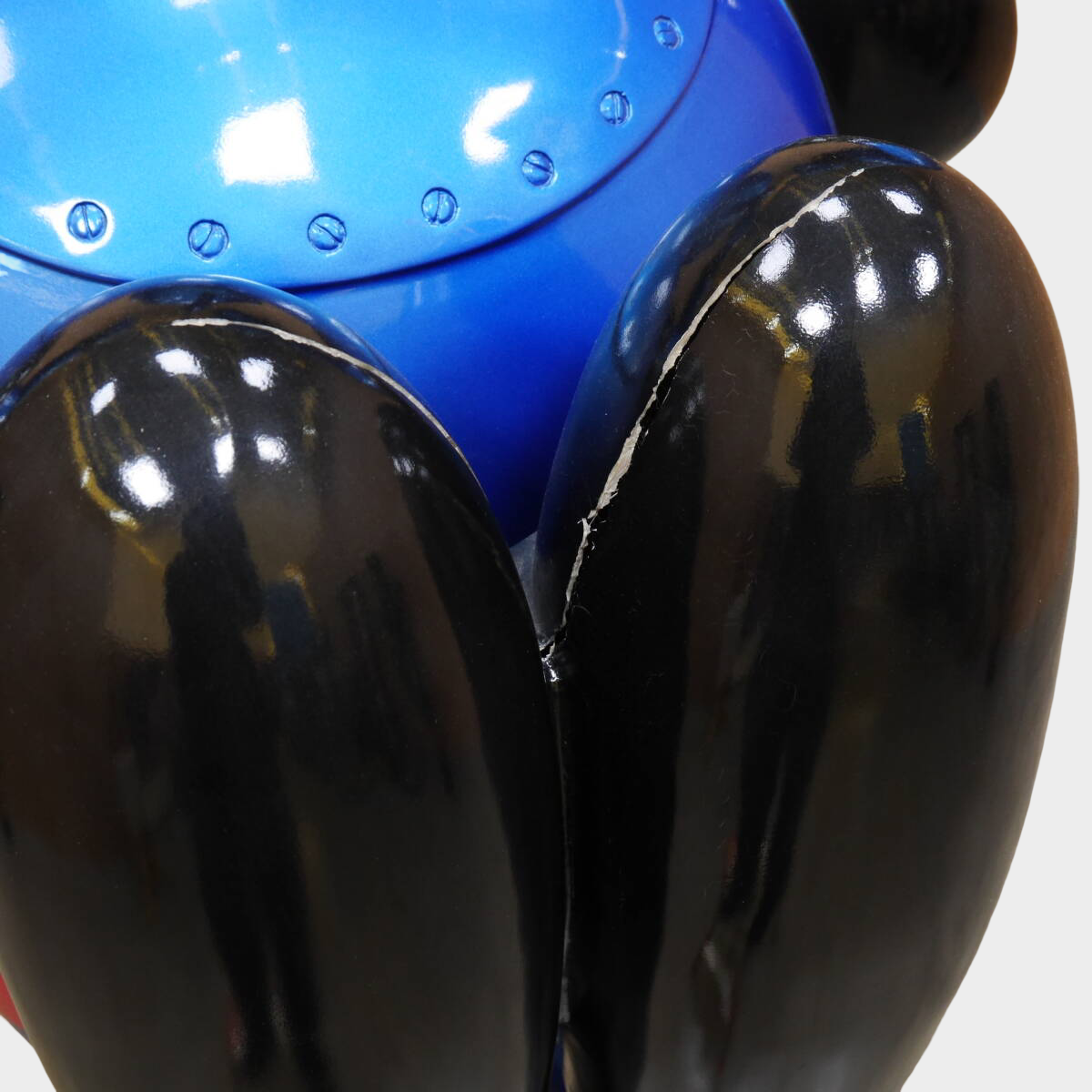
Barrel torso + riveted limbs → industrial realism, not fantasy
-
Remote controller inclusion → absolute theme of external human control
Unlike later autonomous mecha, Iron 28 is obedient machinery, making this figure a physical thesis on early Japanese techno-ethics.
MATERIAL & CRAFT ASSESSMENT
The surface finish shows automotive-grade gloss paint, consistent with FRP display fabrication. Color blocking (deep cobalt, red belt band, black joint segments) adheres closely to classic anime reference without modern reinterpretation.
Construction notes:
-
Modular limbs → required for freight handling
-
Reinforced base plate → long-term stability
-
Weight estimated 65–85 kg assembled
Minor surface wear is consistent with event use, not abuse.
HISTORICAL CONTEXT — WHY THESE SURVIVE AT ALL
Life-size figures from Japanese IPs are rarely preserved because they are:
-
Produced for short-term exhibitions
-
Logistically expensive to store
-
Often destroyed post-event
Survival implies intentional retention, likely by production staff or venue partners. This places the object closer to ex-museum infrastructure than commercial merchandise.
-
Why fans who “kind of know Iron 28” should suddenly care deeply
EXPANDED LEGACY & CULTURAL BACKGROUND — THE ORIGIN OF ALL GIANT ROBOTS
Before Gundam questioned war.
Before Evangelion questioned identity.
Before robots had souls, trauma, or autonomy—
There was Tetsujin 28-go.
Created in 1956 by Mitsuteru Yokoyama, Tetsujin 28 is widely recognized as the very first giant robot in Japanese popular culture. Not the first robot, but the first giant robot — a machine whose scale alone transformed how audiences imagined power, technology, and responsibility.
Crucially, Tetsujin 28-go was not a hero by nature.
He had no will, no emotions, no ethics.
He moved only because a human told him to.
This distinction matters. Tetsujin 28-go emerged in a Japan still reckoning with the aftermath of World War II — a society grappling with the consequences of industrial power wielded without restraint. In that context, Iron 28 was less a fantasy weapon and more a cautionary symbol: technology itself is neutral; the morality lies entirely with the person holding the controls.
That idea — that overwhelming power must be guided by human judgment — became the philosophical DNA of every mecha story that followed.
WHY Tetsujin 28-go LOOKS THE WAY HE DOES (AND WHY THIS STATUE GETS IT RIGHT)
Unlike later sleek or biomechanical robots, Iron 28 is intentionally industrial:
-
Cylindrical torso
-
Exposed joint segmentation
-
Rivet-like detailing
-
Heavy, almost locomotive proportions
He resembles factory machinery scaled into a humanoid form, not a warrior designed for elegance. This is not accidental. Yokoyama’s design reflects a postwar visual language where steel, engines, and infrastructure symbolized both rebuilding and latent danger.
This life-size figure preserves that design philosophy faithfully. The stance — arms raised, fists clenched — echoes the classic triumphant pose seen in manga panels and early animation, a visual shorthand for “power under command.”
Standing at nearly two meters tall, the figure does something smaller collectibles simply cannot:
it restores Tetsujin 28-go’s original psychological impact.
At this scale, he stops being “cute” or “retro” and becomes what he always was meant to be:
Impressive. Intimidating. Awe-inducing.
THE REMOTE CONTROLLER — THE MOST IMPORTANT DETAIL MOST PEOPLE MISS
Included with the figure is the wired remote controller — a small object, easy to overlook, yet arguably the most important artifact in the entire Tetsujin 28-go mythos.
The controller represents:
-
Human agency
-
Moral responsibility
-
The danger of misuse
In early stories, control of the remote often changes hands, and Tetsujin 28’s allegiance shifts accordingly. Heroes, villains, and opportunists alike can command him. The robot never chooses — people do.
For fans accustomed to autonomous mecha, this is a strikingly different paradigm. Tetsujin 28-go is not a character with inner conflict; he is a mirror, reflecting the intentions of whoever holds the device.
Displaying the statue with the controller restores this narrative context and elevates the piece from “giant robot statue” to storytelling object.
WHY A LIFE-SIZE Tetsujin 28-go IS RARE — AND WHY THAT MATTERS
Most Iron 28 merchandise exists at:
-
Toy scale
-
Model kit scale
-
Decorative statue scale
Life-size figures, by contrast, are typically produced only for:
-
Anniversary exhibitions
-
Promotional events
-
Temporary museum displays
They are expensive to fabricate, difficult to store, and often destroyed after use. That makes surviving examples exceptionally uncommon — especially those that remain structurally intact and display-ready.
This piece’s survival strongly suggests it was:
-
Professionally fabricated
-
Intended for public display
-
Retained deliberately rather than discarded
That places it closer to exhibition infrastructure than commercial merchandise — a category most collectors never get access to.
EDUCATIONAL & FAN-FACING CONTEXT — WHY THIS IS MORE THAN NOSTALGIA
For newer fans, Tetsujin 28 can appear charming or even simplistic.
For seasoned fans, he is foundational.
This figure bridges that gap.
Displayed in a private collection, gallery, retail flagship, or themed space, it naturally invites questions:
-
“What came before Gundam?”
-
“Why do robots need pilots?”
-
“When did mecha stories start asking moral questions?”
Tetsujin 28-go answers all of them silently — through scale, presence, and design.
COLLECTOR RELEVANCE
This piece is relevant to:
-
Institutional collectors (media museums, pop-culture archives)
-
High-end private collectors with architectural space
-
Commercial venues (themed hotels, flagship stores, galleries)
It is not a nostalgia object — it is a statement artifact.
SUMMARY — WHY THIS PIECE MATTERS
This is a physical anchor to the birth of giant robot mythology. Its scale, rarity, and cultural gravity elevate it beyond fandom into material history.
Cargo Shipping & Handling Notice
Due to the final packaged weight and/or dimensional requirements of this piece, standard parcel services such as Japan Post EMS, DHL, FedEx, or UPS are not applicable. This item will be shipped via cargo or freight-based shipping methods.
Cargo shipments require additional preparation time to ensure proper handling, which may include custom crating, reinforced packing, coordination with domestic logistics providers, and scheduling with international freight consolidators and export brokers. As a result, estimated delivery timelines typically range from 6 to 10 weeks, depending on routing, carrier availability, and customs clearance procedures in the destination country.
Please note that actual shipping costs may differ from automated shipping calculator estimates. By default, a portion of the expected shipping cost may be reflected in the listing price. Any difference or discrepancy will be quoted separately once destination, delivery method, and handling requirements are confirmed.
We kindly ask that collectors contact us prior to purchase to request an exact, customized shipping quotation for their destination. This ensures full transparency and allows us to arrange the most appropriate, secure, and efficient shipping solution for this piece.
Thank you for your understanding and patience as we take the necessary care to deliver this work safely.
🚚 SHIPPING & LOGISTICS INTELLIGENCE (CARGO-LEVEL)
* ESTIMATESD COSTS TO USA ~ $8500 more or less (for door to door, please inquire directly)
📦 PACKING ASSUMPTIONS
| Component | L (cm) | W (cm) | H (cm) | Est. Weight |
|---|---|---|---|---|
| Torso + Head | 110 | 80 | 70 | 35 kg |
| Legs (pair) | 120 | 60 | 50 | 25 kg |
| Arms (pair) | 100 | 50 | 40 | 15 kg |
| Base Plate | 110 | 60 | 10 | 15 kg |
Total Actual Weight: ~90 kg
Total Volumetric Weight: ~140–160 kg
Freight Class: Oversize / Cargo (not parcel-eligible)
Authenticity & Stewardship
Evaluated under the Japonista Authentication Framework™:
- Material, carving, and surface-study comparison
- Iconographic and stylistic verification
- Condition and stability review (surface integrity)
- Construction assessment and handling-risk evaluation
Guaranteed 100% Authentic. Covered by the Japonista Lifetime Authenticity Warranty™.
A Note on Stewardship and Collecting
At Japonista, we approach Buddhist statues, sacred images, and ritual objects not merely as collectibles, but as cultural and spiritual artifacts deserving of respect, understanding, and careful presentation. Every piece we offer is thoughtfully examined, researched, and curated with sensitivity to its origin, meaning, and historical role.
Our role is not only to offer access to rare and meaningful objects, but to serve as responsible custodians—connecting the right works with collectors who value depth, intention, and authenticity.
Inquiries, Availability, and Private Consideration
Some of the cultural and heritage works may allow room for discussion, while others are held firmly due to rarity, condition, or cultural importance. All inquiries are reviewed personally and discreetly, and we welcome thoughtful questions or expressions of interest.
If you are exploring a particular theme, deity, lineage, or period—or seeking guidance in building a focused collection—our concierge team is always available to assist with quiet expertise and care.
Concierge Support & Collector Guidance
Japonista Concierge™ provides personalized assistance for collectors seeking deeper understanding, thoughtful acquisition, or long-term curation strategies. Whether your interest is devotional, scholarly, or aesthetic, we are here to help guide your journey with clarity and respect.
For select high-value or historically significant works, private reservation or structured payment arrangements may be available on a case-by-case basis. Please reach out to discuss eligibility and discreet options.
Before Proceeding
We kindly encourage collectors to review our shop policies and house guidelines, available through the links in our website footer, which outline shipping, handling, and conditions specific to vintage, sacred, and collectible works.
A Closing Note
Thank you for exploring Japonista’s collection of Oriental Cultural Heritage and arts. We are honored to share these meaningful works and to help place them where they may continue to be appreciated, studied, and respected.
If you have questions or wish to explore related works, please feel free to contact Japonista Concierge™ at any time.