Rare Vintage, Antiques and Art Collector / Curator / Personal Shopper From Japan
Life-Size Japanese Anime Hero Tiger Mask Wrestler Display Figure — 183cm FRP Exhibition Statue, Showa Wrestling Icon
Life-Size Japanese Anime Hero Tiger Mask Wrestler Display Figure — 183cm FRP Exhibition Statue, Showa Wrestling Icon
Couldn't load pickup availability
Have a reasonable price in mind? Submit your best offer and our concierge will review it personally.
CURATORIAL OVERVIEW — WHAT THIS OBJECT ACTUALLY IS
This is not a commercial toy, nor a modern licensed collectible.
This object belongs to a vanishing category of Japanese cultural artifacts: the theatrical-scale display figure, produced for department store windows, cinema lobbies, regional exhibitions, and promotional installations during the height of Tiger Mask’s cultural dominance.
At 183 cm, this piece crosses the threshold from “collector item” into environmental object — designed to command space, visibility, and emotional recognition from across a room. These figures were never intended for private ownership; survival into the secondary market typically reflects store closures, regional exhibit dismantling, or liquidation of legacy assets.
Its scale, FRP construction, and hand-finished paint align precisely with Showa-era display sculpture practices, especially those tied to anime-wrestling crossover icons.
Object Type
Oversized display-grade Tiger Mask figure (approx. life-size torso / near full-body scale)
Attribution
Attributed to ATS / theatrical display lineage (shopfront / exhibition class)
Era
Late Shōwa → Early Heisei production window (circa 1980s–1990s)
Material
FRP (fiber-reinforced plastic), reinforced internal structure, painted finish
Dimensions (approx.)
-
Height: 183 cm
-
Width: 117 cm
-
Depth: 76 cm
Weight (estimated)
-
Net object: 70–85 kg
-
Crated weight: 110–130 kg
ICONOGRAPHY & THEMATIC ANALYSIS
Tiger Mask is not merely a character — he is a moral archetype.
Originating from Tiger Mask, the character fused professional wrestling spectacle with ethical absolutism. Unlike villains or antiheroes, Tiger Mask represented:
-
Sacrifice over fame
-
Justice without reward
-
Violence restrained by conscience
The tiger mask itself is symbolic:
-
Animal ferocity restrained by human ethics
-
The mask as burden, not disguise
-
Strength in service, not dominance
This figure’s posture — upright, grounded, frontal — reinforces that mythology. It is not aggressive. It is watchful. That alone distinguishes it from kaiju or villain statuary.
MATERIAL & CRAFT ASSESSMENT
FRP was the material of choice for Japanese display sculpture because it offered:
-
Structural strength at large scale
-
Resistance to humidity and temperature variation
-
Lightweight relative to solid resin or concrete
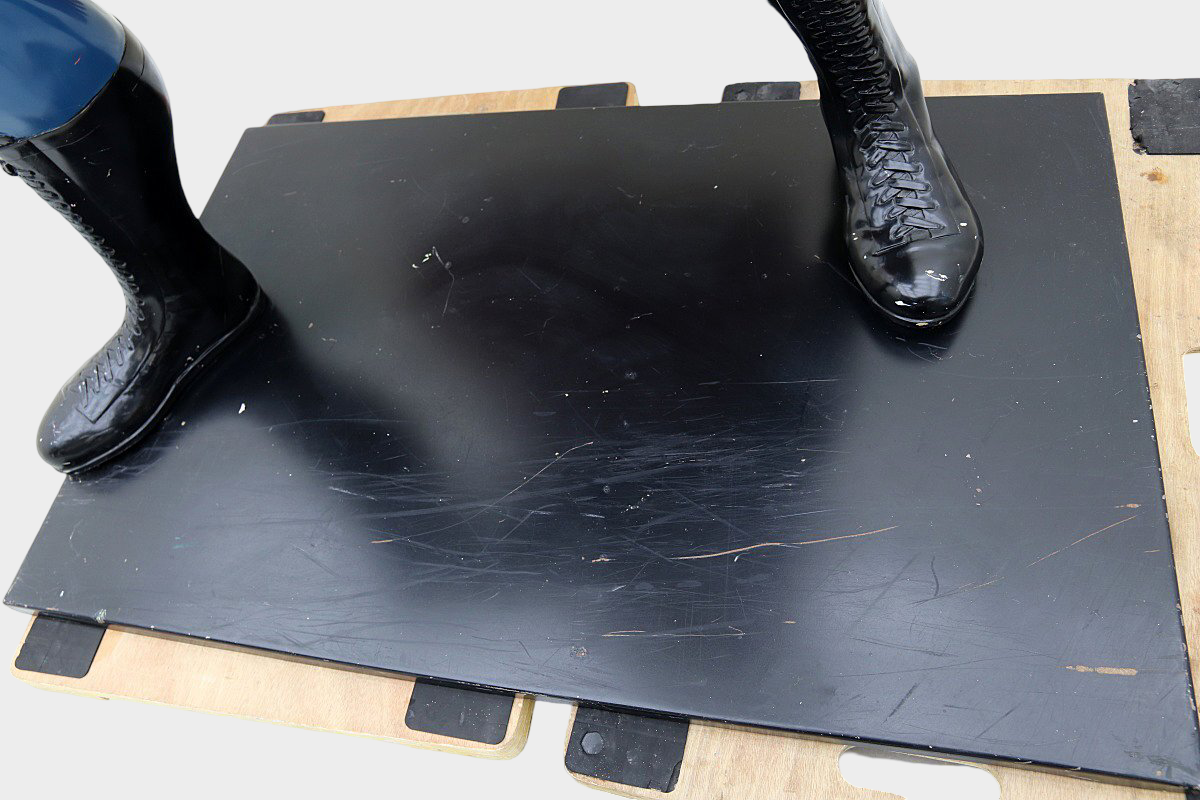
Evidence of hand-applied paint, surface wear, and aging is not a defect here — it is authentication by survival. Modern replicas rarely age this way because they are cast differently, sealed differently, and stored differently.
Crucially:
-
This object was never intended to be perfect
-
It was intended to be seen at distance, under lighting, in public space
That context explains both the construction and the finish.
HISTORICAL CONTEXT — WHY THESE SURVIVE AT ALL
The disappearance of such objects accelerated after:
-
Decline of large regional department store displays
-
Shift from physical exhibitions to digital promotion
-
Licensing consolidation in the 2000s
Most were discarded, broken down, or destroyed due to storage cost and size. Survivors tend to cluster in regional Japan, particularly outside Tokyo — aligning with this listing’s provenance.
In short: these were never meant to be archived, which is why they are now rare.
education blocks.
TIGER MASK — THE MASK AS MORAL BURDEN
A Cultural Essay on Justice, Violence, and Postwar Japanese Masculinity
Tiger Mask is often misunderstood outside Japan as “just another wrestling anime.”
In reality, it occupies a foundational position in postwar Japanese moral storytelling, sitting at the intersection of sports spectacle, ethical pedagogy, and national trauma recovery.
Tiger Mask is not remembered because he wins.
He is remembered because he chooses not to — at great personal cost.
ORIGINS: WHY TIGER MASK COULD ONLY BE BORN IN POSTWAR JAPAN
Tiger Mask emerged in the late 1960s, a period when Japan was:
-
Rapidly modernizing
-
Economically rebounding
-
Still psychologically processing wartime defeat and moral collapse
The country was searching for new heroic archetypes that did not rely on imperial power, divine right, or militarism.
Tiger Mask answered that need.
Unlike prewar heroes who embodied authority and dominance, Tiger Mask represents:
-
Self-restraint
-
Internalized ethics
-
Redemptive violence — strength used only when morally justified
This was radical.
THE MASK: IDENTITY AS PUNISHMENT, NOT POWER
In Western superhero traditions, masks often symbolize:
-
Freedom
-
Empowerment
-
Dual identity as escape
In Tiger Mask, the mask is a sentence.
The tiger mask:
-
Erases personal identity
-
Demands constant discipline
-
Separates the hero from normal life and recognition
Tiger Mask cannot remove the mask without betraying the role.
The audience understands that the mask hurts, physically and psychologically.
This framing aligns closely with Japanese concepts of:
-
義理 (giri, moral duty)
-
我慢 (gaman, endurance through suffering)
The mask is not worn to become someone else —
it is worn to erase the self entirely.
VIOLENCE WITH LIMITS: A UNIQUELY JAPANESE HEROIC CODE
Tiger Mask fights in a brutal environment — underground wrestling circuits, corrupt promoters, and morally compromised systems.
Yet he refuses:
-
Dirty victories
-
Humiliation of opponents
-
Harm to the innocent, even when it costs him wins
This introduces a crucial idea:
Strength without ethics is meaningless.
In Japanese pop culture, this theme later echoes through:
-
Kamen Rider
-
Gundam pilots
-
Gamera (protector, not conqueror)
Tiger Mask is an early template for the “suffering guardian” archetype.
WRESTLING AS MORAL THEATER
Professional wrestling in Tiger Mask is not sport — it is ritualized conflict.
Each match functions as:
-
A moral trial
-
A test of restraint
-
A public demonstration of values
The ring becomes a stage where:
-
Power is visible
-
Ethics are evaluated by the audience
-
Victory without honor is rejected
This is why Tiger Mask resonated so deeply with children and adults alike —
it taught how to be strong without becoming cruel.
TIGER MASK AS A SYMBOL OF SELF-SACRIFICING MASCULINITY
Crucially, Tiger Mask redefines masculinity.
He is:
-
Not rewarded materially
-
Not celebrated comfortably
-
Often misunderstood or vilified
His masculinity is expressed through:
-
Protection of orphans
-
Rejection of fame
-
Willingness to endure loneliness
This directly counters:
-
Militaristic masculinity
-
Corporate success masculinity
-
Dominance-based male ideals
In this sense, Tiger Mask becomes a moral counterweight to postwar anxieties about power and success.
WHY TIGER MASK TRANSCENDED MEDIA AND ENTERED REAL SPACE
Tiger Mask did not remain confined to manga or television.
He became:
-
A live wrestling persona
-
A department store display icon
-
A regional exhibition figure
Why?
Because Tiger Mask is visually legible even without context:
-
Upright stance
-
Animal ferocity held in check
-
Masked anonymity
Large-format statues and display figures — like the one you are listing — exist because Tiger Mask was meant to be seen physically, not just consumed narratively.
He is a presence, not an illustration.
DECLINE AND LEGACY: WHY THESE OBJECTS NO LONGER EXIST
As Japan moved into the late Heisei and Reiwa eras:
-
Moral absolutism gave way to ambiguity
-
Antiheroes replaced ethical paragons
-
Physical displays were replaced by screens
Tiger Mask, as an idea, became too sincere for modern media cycles.
But sincerity is exactly why he endures in memory — and why surviving physical artifacts matter.
WHY TIGER MASK STILL MATTERS TODAY
Tiger Mask speaks to something modern culture struggles with:
How to be powerful without becoming destructive.
In an age of:
-
Cynicism
-
Irony
-
Moral relativism
Tiger Mask remains unembarrassedly earnest.
That is not weakness —
it is cultural courage.
WHY A LIFE-SIZE TIGER MASK STATUE IS NOT DECOR
A large-format Tiger Mask figure is not nostalgia furniture.
It is:
-
A moral monument
-
A Showa-era value object
-
A reminder that heroes were once defined by what they refused to do
Placed in a space, it changes the emotional temperature of the room.
That is the mark of a true cultural artifact.
COLLECTOR RELEVANCE
This piece appeals to three serious collector profiles:
-
Showa-era cultural archivists
-
Wrestling + anime crossover historians
-
Commercial interior / gallery display collectors
It is especially compelling for:
-
Private museums
-
Themed retail flagships
-
Exhibition designers
-
High-end collectors seeking non-replicable presence
This is not something that can be “upgraded” later. There is no modern equivalent.
SUMMARY — WHY THIS PIECE MATTERS
This Tiger Mask figure is not nostalgic decoration.
It is physical proof of an era when pop culture occupied real space, demanded attention, and embodied moral storytelling at architectural scale.
Once lost, this category does not regenerate.
Cargo Shipping & Handling Notice
Due to the final packaged weight and/or dimensional requirements of this piece, standard parcel services such as Japan Post EMS, DHL, FedEx, or UPS are not applicable. This item will be shipped via cargo or freight-based shipping methods.
Cargo shipments require additional preparation time to ensure proper handling, which may include custom crating, reinforced packing, coordination with domestic logistics providers, and scheduling with international freight consolidators and export brokers. As a result, estimated delivery timelines typically range from 6 to 10 weeks, depending on routing, carrier availability, and customs clearance procedures in the destination country.
Please note that actual shipping costs may differ from automated shipping calculator estimates. By default, a portion of the expected shipping cost may be reflected in the listing price. Any difference or discrepancy will be quoted separately once destination, delivery method, and handling requirements are confirmed.
We kindly ask that collectors contact us prior to purchase to request an exact, customized shipping quotation for their destination. This ensures full transparency and allows us to arrange the most appropriate, secure, and efficient shipping solution for this piece.
Thank you for your understanding and patience as we take the necessary care to deliver this work safely.
🚚 SHIPPING & LOGISTICS INTELLIGENCE (CARGO-LEVEL)
* ESTIMATES TO USA ~ $6000 more or less (for door to door, please inquire directly)
PACKED SHIPPING ASSUMPTIONS
PACKING ASSUMPTIONS
-
Custom wooden crate
-
Internal foam blocking + strap restraint
-
Single-piece or partial disassembly (mask possibly removable)
Estimated Crate Dimensions
-
210 × 130 × 100 cm
-
Volume: 2.73 CBM
Volumetric Weight (Air)
-
~455 kg
Authenticity & Stewardship
Evaluated under the Japonista Authentication Framework™:
- Material, carving, and surface-study comparison
- Iconographic and stylistic verification
- Condition and stability review (surface integrity)
- Construction assessment and handling-risk evaluation
Guaranteed 100% Authentic. Covered by the Japonista Lifetime Authenticity Warranty™.
A Note on Stewardship and Collecting
At Japonista, we approach Buddhist statues, sacred images, and ritual objects not merely as collectibles, but as cultural and spiritual artifacts deserving of respect, understanding, and careful presentation. Every piece we offer is thoughtfully examined, researched, and curated with sensitivity to its origin, meaning, and historical role.
Our role is not only to offer access to rare and meaningful objects, but to serve as responsible custodians—connecting the right works with collectors who value depth, intention, and authenticity.
Inquiries, Availability, and Private Consideration
Some of the cultural and heritage works may allow room for discussion, while others are held firmly due to rarity, condition, or cultural importance. All inquiries are reviewed personally and discreetly, and we welcome thoughtful questions or expressions of interest.
If you are exploring a particular theme, deity, lineage, or period—or seeking guidance in building a focused collection—our concierge team is always available to assist with quiet expertise and care.
Concierge Support & Collector Guidance
Japonista Concierge™ provides personalized assistance for collectors seeking deeper understanding, thoughtful acquisition, or long-term curation strategies. Whether your interest is devotional, scholarly, or aesthetic, we are here to help guide your journey with clarity and respect.
For select high-value or historically significant works, private reservation or structured payment arrangements may be available on a case-by-case basis. Please reach out to discuss eligibility and discreet options.
Before Proceeding
We kindly encourage collectors to review our shop policies and house guidelines, available through the links in our website footer, which outline shipping, handling, and conditions specific to vintage, sacred, and collectible works.
A Closing Note
Thank you for exploring Japonista’s collection of Oriental Cultural Heritage and arts. We are honored to share these meaningful works and to help place them where they may continue to be appreciated, studied, and respected.
If you have questions or wish to explore related works, please feel free to contact Japonista Concierge™ at any time.