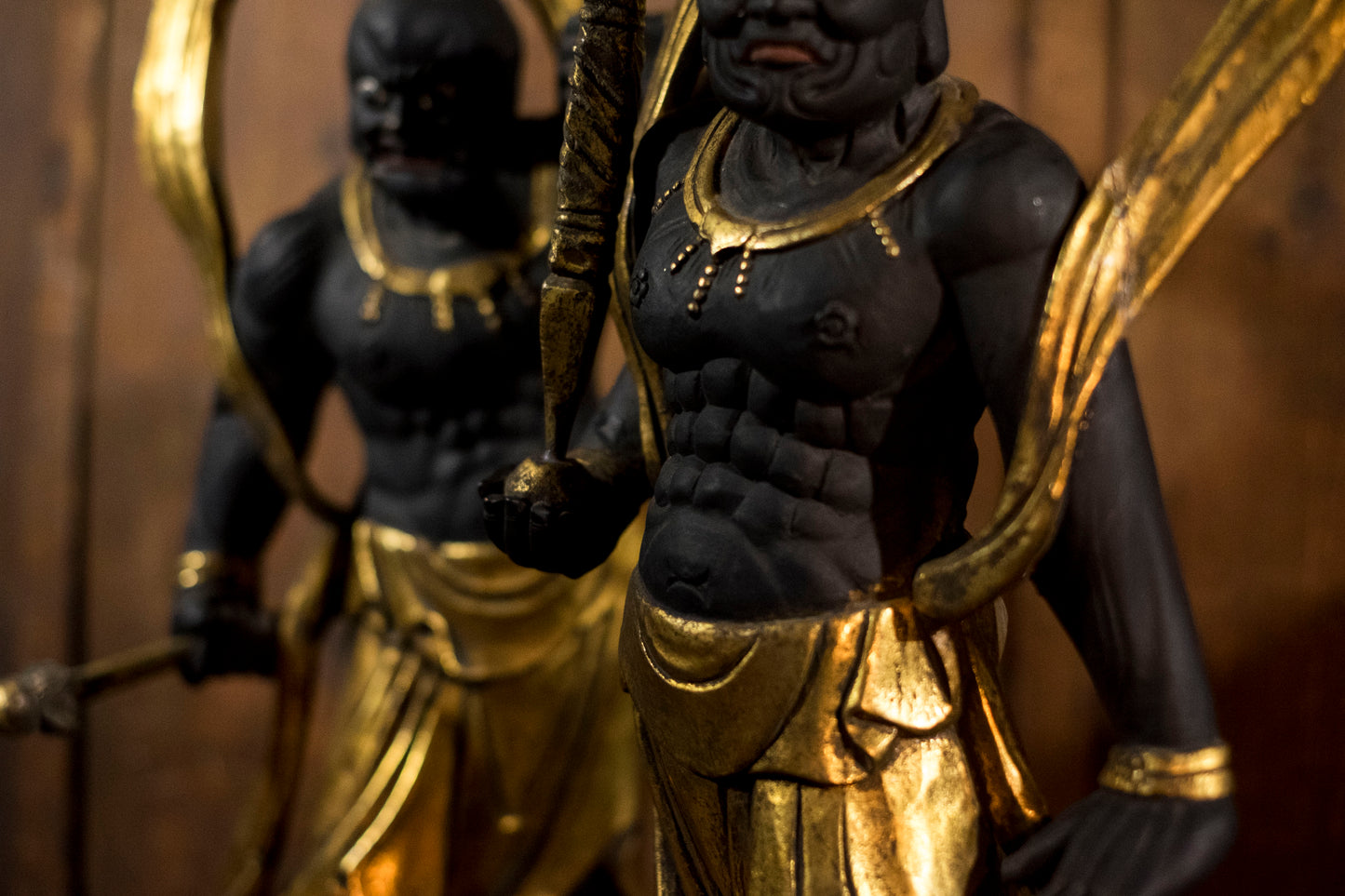
Mid‑to‑Late Shōwa Japanese Wooden Temple Guardians with Gilt Accents
Important: Public-facing copy intentionally does not include original Japan marketplace links.
What you are looking at
Monumental scale. Pure guardianship energy. This is a commanding paired presentation of Niō Deva Kings—the temple gate protectors also known as Kongōrikishi—rendered in bold mid‑to‑late Shōwa wood sculpture with dramatic black ground and luminous gilt accents. At approximately 69cm each, the pair reads as architectural: a true entry‑grade centerpiece for collectors building a Buddhist sculpture wall, a dojo‑like interior, or a museum‑style alcove installation.
This imposing pair of Nio Deva Kings — Agyō and Ungyō — represents one of the most powerful guardian iconographies in Japanese Buddhist sculpture. Standing at approximately 69 cm each, these figures occupy a monumental domestic–temple crossover scale.
Agyō (open mouth) embodies the primal utterance — the beginning of all things — while Ungyō (closed mouth) signifies the final breath, the end of manifestation. Together they represent the totality of existence.
Carved in solid wood and finished in blackened pigment with extensive gilt highlights, the figures echo Kamakura-period muscularity revived during the Shōwa era.
Niō at the gate
Niō are the fierce protectors traditionally stationed at the Niōmon (guardian gate) of Buddhist temples. They embody protective force—compassion expressed as strength. Displayed as a pair, they form a complete energetic “lock”: the opening and the closing, the beginning and the end—guardianship that frames the sacred space.
A‑Un pairing: Agyō & Ungyō
-
Agyō — the “open‑mouth” guardian (the initiating force; the gate opening).
-
Ungyō — the “closed‑mouth” guardian (completion; sealing the gate).
Together, A‑Un symbolizes totality: alpha and omega, sunrise and nightfall, initiation and completion. This is why collectors seek pairs rather than singles—the pair restores the original conceptual function of guarding the passage.
Why collectors want Niō—especially at this scale
-
Architectural presence: At ~69cm each, these are room‑defining objects.
-
Pair logic: A matched pair restores the “complete gate.”
-
Dynamic sculptural language: Niō are among the most expressive forms in Japanese Buddhist sculpture.
-
Display versatility: Perfect as threshold guardians or flanking a central devotional figure.
-
Shōwa compatibility: High‑contrast finishes read brilliantly in modern interiors.
Iconography & features
-
Black ground with gilded garments: maximum contrast and gallery legibility.
-
Sweeping ribbon arcs: intensify motion and “wind” around the figures.
-
Fierce facial pairing: A‑Un philosophy becomes instantly legible.
-
Rocky bases: visually grounding; strengthens the gate‑guardian presence.
-
Weapon-bearing stance: posture communicates readiness and protection.
Period note: mid‑to‑late Shōwa (approx.)
Shōwa spans 1926–1989. Mid‑to‑late Shōwa devotional sculpture often emphasizes strong silhouettes and high‑contrast finishes intended to read from distance (hall or gate placement), not only intimate altar scale. This explains the temple/dojo‑scale presence and photographic impact of the pair.
Museum‑grade rationale (collector‑safe)
“Museum grade” here refers to display authority and iconographic completeness, not a claim of institutional provenance. This pair qualifies for collectors because the scale is architectural, the A‑Un pairing is conceptually complete, the black‑and‑gilt contrast photographs with high legibility, and the matched style supports a curated presentation.
Measurements
-
Height: approx. 69 cm each
Condition (collector‑safe)
Expect honest age presence: light surface rubs, minor edge wear to gilding, small abrasions, and typical handling marks around protruding details. Please review images for exact condition—no restoration claims are made unless explicitly confirmed.
Display suggestions
- Best as a threshold pair flanking a doorway, wall, or entry to a collection room.
- In a shrine room, place them outside the main altar axis as guardians.
- In modern interiors, give negative space and directional lighting—these forms reward shadow.
Collector relevance
Niō are a cornerstone of Japanese Buddhist visual culture: the “gate” concept, protective energy, and muscular dynamism that defines the tradition. A strong Shōwa pair offers the feeling of that lineage with modern display compatibility.
Collector’s Resonance
For the collector who wants a room to feel protected—who understands that sacred objects are not always gentle in expression. If your collection is moving toward architectural scale, this is the kind of pair that makes the space click into place.
Confidence & Verification Notes
-
Maker / temple origin: not specified; no temple provenance claimed.
-
Wood species: not specified; treated as carved wood with applied finishes.
-
Agyō vs Ungyō: confirm via mouth position if you need strict catalog certainty.
-
Dating: “mid‑to‑late Shōwa” is a stylistic estimate; treat as approximate.
HS Code (international shipping)
-
HS 9703.00 — Original sculptures and statuary, in any material
-
Alternate sometimes used: HS 4420.10 — statuettes/ornaments of wood (broker preference dependent)