Rare Vintage, Antiques and Art Collector / Curator / Personal Shopper From Japan
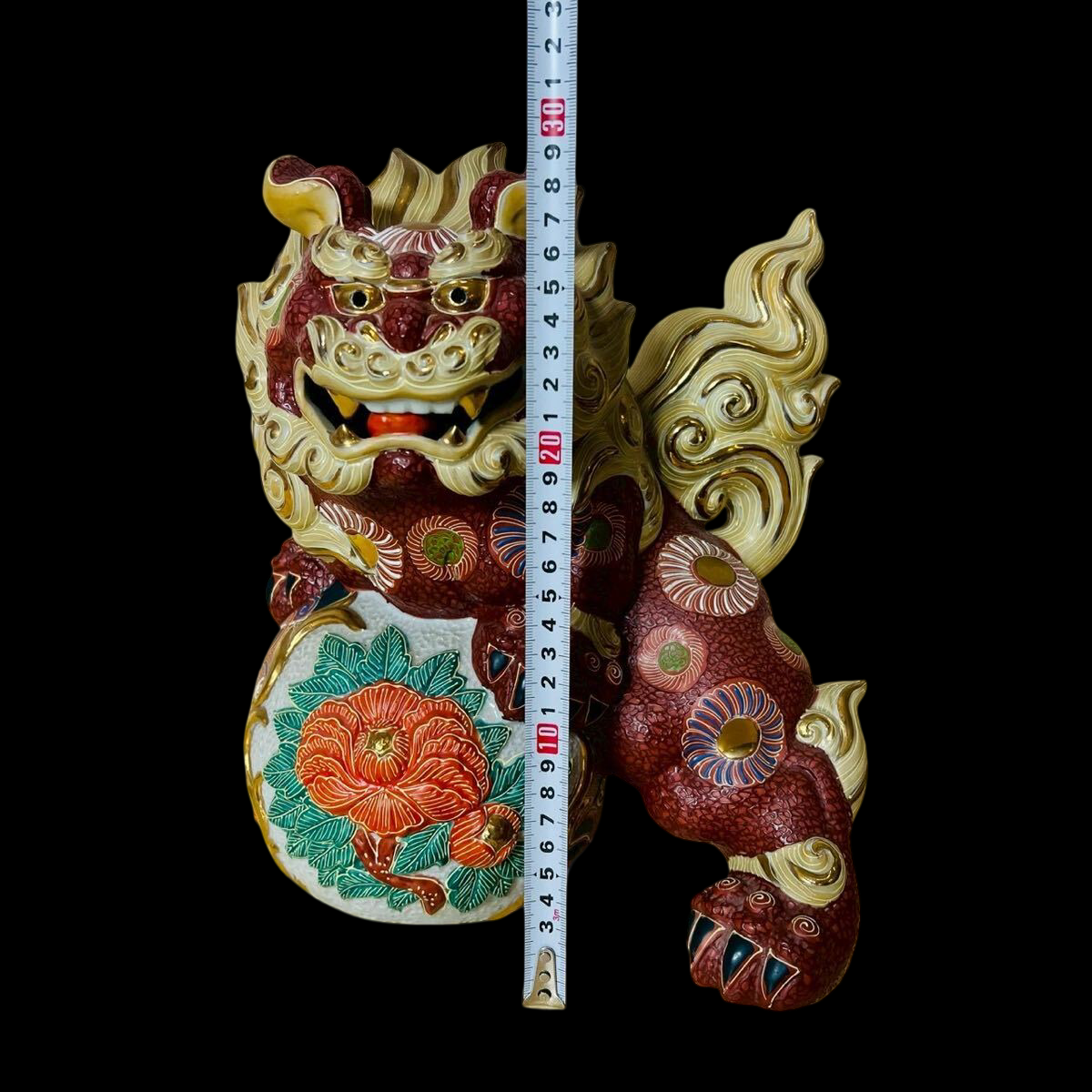
Kutani Ware Jewel-Ball Shishi Lion (Tama-nori Shishi) — Hand-Painted Polychrome Guardian Figure — Approx. 30 cm — Showa–Heisei Era Decorative Sculpture
Kutani Ware Jewel-Ball Shishi Lion (Tama-nori Shishi) — Hand-Painted Polychrome Guardian Figure — Approx. 30 cm — Showa–Heisei Era Decorative Sculpture
Couldn't load pickup availability
Have a reasonable price in mind? Submit your best offer and our concierge will review it personally.
Kutani Ware Shishi Lion Figure
This Kutani ware shishi figure depicts the iconic tama-nori shishi, the guardian lion dynamically poised atop a sacred jewel ball. Rendered in high-relief ceramic with dense overglaze enamels and sculptural flame mane detailing, the piece reflects the later Kutani tradition of expressive, decorative guardian figures produced for interior display and symbolic protection.
Unlike architectural komainu, this form belongs to the domestic and collector-oriented lineage of Kutani objects—intended for alcove display, shop guardianship, or festive interior placement. The vivid palette, heavy modeling, and animated facial expression place this work firmly within postwar Kutani decorative production, while still preserving iconographic continuity with Edo-period shishi symbolism.
The Shishi is shown in a protective stance with one paw placed upon a decorative sphere, symbolizing control, vigilance, and guardianship. The animated expression, flaring mane, and muscular posture convey strength and alertness.
The surface is finished in layered Kutani polychrome enamels, with deep red glaze tones complemented by patterned detailing. The richness of color and sculptural tension reflects skilled ceramic workmanship.
ICONOGRAPHY & CULTURAL CONTEXT
The shishi (guardian lion) is a protective beast of Buddhist and Daoist origin, transmitted through China and Korea before becoming fully naturalized in Japanese visual culture. The jewel ball (tama) beneath the paw symbolizes wisdom, cosmic authority, and the containment of spiritual power.
In Kutani ware, the tama-nori shishi became especially popular in the 20th century as a statement object—combining auspicious symbolism with technical bravura. This example emphasizes vitality and abundance through exaggerated musculature, curling mane flames, and dense floral ornamentation applied directly to the body.
Condition Report
The figure shows age-related surface wear, minor abrasions, and patina consistent with time and handling. No major structural cracks are observed. Condition should be evaluated with consideration of age.
Dimensions
- Height: approx. 30 cm
- Condition: Vintage; minor surface wear consistent with age. No major cracks or structural damage observed.
Object Details
- Type: Japanese ceramic okimono (guardian lion figure)
- Tradition: Kutani ware
- Materials: High-fired ceramic with polychrome enamels and gilt accents
Material & Craftsmanship
Crafted in Kutani ware, this sculpture demonstrates confident hand-modeling and controlled enamel application. The dynamic pose and detailed mane require advanced ceramic skill, indicating experienced workshop production.
What is a Shishi?
A Shishi is a guardian lion motif used to protect important spaces and ward off negative influence. In Japanese decorative arts, Shishi figures are associated with strength, vigilance, and protective presence, often positioned at entrances and liminal thresholds.
The Shishi is a guardian lion figure whose symbolism developed across Asia through the spread of Buddhism and court culture. In Japan, the Shishi becomes a liminal protector: a guardian associated with thresholds and transitional spaces, understood less as an animal depiction and more as a protective archetype representing vigilance, authority, and the warding of misfortune.
Kutani Shishi Okimono — Collector Deep Dive
This educational module expands on the cultural roots, stylistic identity, and collector relevance of Kutani Shishi okimono. Use it to enrich a listing, a collection page, or a brand editorial layer. (No claims of exact dating or kiln attribution are implied.)
Shishi in Japanese Decorative Arts
In Japan, Shishi imagery appears across stone, wood, bronze, and ceramics. Ceramic Shishi okimono occupy a distinctive role because they bring guardian symbolism into interior environments, where the object can function as a spatial anchor while still carrying protective meaning.
Why Kutani Shishi Stand Out
Kutani ware is celebrated for bold color language, enamel layering, and strong surface patterning. When those strengths are applied to a Shishi okimono, the result is a guardian figure with heightened visual authority: musculature reads more forcefully, facial expression becomes more animated, and symbolic details (such as the sphere motif) can be richly ornamented.
Kutani vs Other Shishi Okimono
- Kutani Shishi: Dense enamels, high visual impact, strong reds and gold accents, an emphasis on power and spectacle.
- Porcelain traditions (Arita / Imari): Whiter bodies and finer surfaces; often more refined and cabinet-scale, with a lighter visual footprint.
- Earthier ceramic traditions (Seto / Tokoname): More subdued palettes and folk-adjacent character; often quieter in presence.
- Bronze Shishi: Extremely durable and often higher-cost; frequently positioned as architectural or formal display objects.
Collectively, Kutani Shishi often appeal to collectors who want a presence closer to bronze-level impact while preserving the expressive surface richness of ceramic art.
Scale, Difficulty, and Rarity
Large-format ceramic Shishi are uncommon because ceramic sculpture at scale introduces technical constraints: firing risk increases, warping and cracking become harder to control, glaze behavior becomes less predictable, and transport risk rises sharply. As a result, many Shishi okimono historically remain at tabletop or altar scale, while larger examples tend to reflect higher ambition, more complex production, and a narrower historic demand.
Why Collectors Seek Kutani Shishi Today
- Immediate visual authority: A guardian object that reads strongly from across a room.
- Symbolic meaning: Protection, stability, and the character of a threshold guardian.
- Interior versatility: Works in both traditional and contemporary spaces as a focal anchor.
- Scarcity of large examples: Technical difficulty and survival bias make larger works harder to find.
- Distinct from mass decor: A collectible object with craft identity and cultural depth.
Placement as Meaning
Shishi guardians are traditionally associated with movement zones: entrances, corridors, and transitional areas where “threshold” symbolism is strongest. In an interior context, placing a Shishi okimono near a doorway or at the edge of a room can reinforce its intended role as a protective presence rather than a passive ornament.
Collector Takeaway
A Kutani Shishi okimono represents a convergence of trans-Asian guardian symbolism, Japanese decorative tradition, and regional Kutani enamel identity. Larger examples further signal technical ambition and rarity. For collectors who value cultural depth and spatial authority, Kutani Shishi remain among the most compelling guardian objects within Japanese ceramic art.
Condition Report
Described as unused old stock with long-term showroom display history. Light surface marks and minor patina consistent with display handling may be present. Please review photos for the most accurate condition assessment.
Collector Relevance
Best suited for collectors and institutions seeking an installation-grade guardian okimono: entry halls, hospitality interiors, curated retail environments, galleries, or ceremonial spaces. This is a room-defining object, not a shelf accessory.
Collector’s Resonance
For buyers who want protection symbolism with real spatial authority, an object that reads immediately as a guardian presence and holds its power over time. Appealing to collectors drawn to protection symbolism and dynamic form, this piece offers a sense of strength and watchfulness rooted in traditional visual language.
Confidence & Verification Notes
Attribution to Kutani ware is based on decorative style, glaze characteristics, and sculptural form. Exact kiln documentation is not currently available. All descriptions are provided in good faith using available listing information and visual assessment.
Authenticity & Stewardship
Evaluated under the Japonista Authentication Framework™:
- Material, carving, and surface-study comparison
- Iconographic and stylistic verification
- Condition and stability review (surface integrity)
- Construction assessment and handling-risk evaluation
Guaranteed 100% Authentic. Covered by the Japonista Lifetime Authenticity Warranty™.
A Note on Stewardship and Collecting
At Japonista, we approach Buddhist statues, sacred images, and ritual objects not merely as collectibles, but as cultural and spiritual artifacts deserving of respect, understanding, and careful presentation. Every piece we offer is thoughtfully examined, researched, and curated with sensitivity to its origin, meaning, and historical role.
Our role is not only to offer access to rare and meaningful objects, but to serve as responsible custodians—connecting the right works with collectors who value depth, intention, and authenticity.
Inquiries, Availability, and Private Consideration
Some of the cultural and heritage works may allow room for discussion, while others are held firmly due to rarity, condition, or cultural importance. All inquiries are reviewed personally and discreetly, and we welcome thoughtful questions or expressions of interest.
If you are exploring a particular theme, deity, lineage, or period—or seeking guidance in building a focused collection—our concierge team is always available to assist with quiet expertise and care.
Concierge Support & Collector Guidance
Japonista Concierge™ provides personalized assistance for collectors seeking deeper understanding, thoughtful acquisition, or long-term curation strategies. Whether your interest is devotional, scholarly, or aesthetic, we are here to help guide your journey with clarity and respect.
For select high-value or historically significant works, private reservation or structured payment arrangements may be available on a case-by-case basis. Please reach out to discuss eligibility and discreet options.
Before Proceeding
We kindly encourage collectors to review our shop policies and house guidelines, available through the links in our website footer, which outline shipping, handling, and conditions specific to vintage, sacred, and collectible works.
A Closing Note
Thank you for exploring Japonista’s collection of Oriental Cultural Heritage and arts. We are honored to share these meaningful works and to help place them where they may continue to be appreciated, studied, and respected.
If you have questions or wish to explore related works, please feel free to contact Japonista Concierge™ at any time.