Rare Vintage, Antiques and Art Collector / Curator / Personal Shopper From Japan
Monumental Kutani Ware Ebisu — Shichifukujin Fortune Deity | Large Polychrome Ceramic Sculpture | Japan
Monumental Kutani Ware Ebisu — Shichifukujin Fortune Deity | Large Polychrome Ceramic Sculpture | Japan
Couldn't load pickup availability
Have a reasonable price in mind? Submit your best offer and our concierge will review it personally.
Kutani Ware Polychrome & Gilt Ebisu Figure (Shichifukujin) — Signed “Minekō” — Height approx. 62 cm
OVERVIEW & CULTURAL CONTEXT
Ebisu is one of the most distinctive and culturally resonant figures within the Shichifukujin (Seven Lucky Gods) tradition, revered not only as a deity of wealth and prosperity, but more specifically as the patron of honest labor, commerce, fisheries, and sustained fortune earned through diligence rather than chance. Unlike other members of the Seven Lucky Gods whose origins trace to China or India, Ebisu is uniquely Japanese, making his iconography deeply embedded in local belief systems, merchant culture, and seasonal ritual life.
In Japanese visual culture, Ebisu figures were not created merely as decorative objects. They functioned as talismanic presences—placed in shops, homes, storehouses, and entrances—to invite continuity of business, safe harvests, and harmonious relationships between effort and reward. Larger-scale sculptural examples such as this were often commissioned to serve as focal icons rather than casual ornaments, signaling both aspiration and reverence.
This example, executed in Kutani ware with rich iro-e (polychrome enamels) and kinrande-style gilding, reflects the late development of Kutani as a medium capable of supporting bold figural expression. The surface density, saturated reds and greens, and generous use of gold articulate prosperity visually, reinforcing the symbolic function of the deity himself. The scale—approximately 62 cm in height—places this work well above common domestic figures, indicating its intended presence as a statement piece.
The figure’s joyful expression, relaxed posture, and association with the sea bream (tai) directly reference Ebisu’s role as a god of abundance and auspicious outcomes. Tai itself is a visual pun for “medetai,” reinforcing celebratory meaning. The sculptural modeling here prioritizes warmth and approachability over severity, aligning with Ebisu’s reputation as the most benevolent and accessible of the Seven Lucky Gods.
MATERIAL, TECHNIQUE & ARTISTIC CHARACTER
Kutani ware is distinguished by its vivid enamel palette, layered over a porcelain or ceramic body and often accented with gold to heighten visual richness. In figural works, this technique demands exceptional control: enamel thickness must be balanced to avoid pooling, while gilding must integrate with contour rather than sit superficially.
The present figure demonstrates confident handling of volume and surface articulation. Facial features are modeled with expressive clarity, while the robe patterns display careful segmentation of color fields, preventing visual overload despite the complexity. The gold detailing is used strategically to emphasize symbolic areas—garments, accessories, and auspicious motifs—rather than indiscriminately applied.
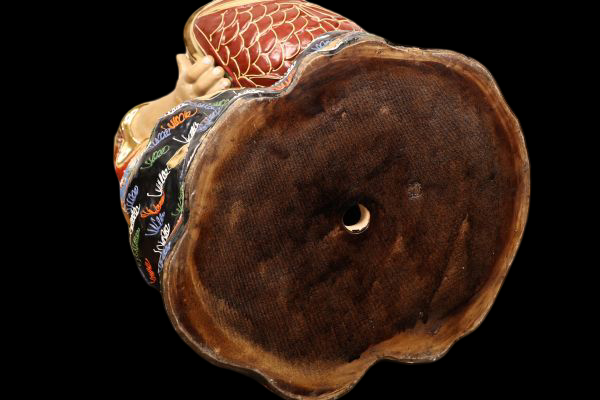
The underside bears a kiln mark consistent with Kutani attribution and the signed name “峰光 (Minekō),” indicating workshop authorship rather than anonymous mass production. While precise biographical data on Minekō remains limited, signed Kutani figural works of this scale are comparatively uncommon, particularly those retaining strong enamel saturation and structural integrity.
ICONOGRAPHY & SYMBOLIC FUNCTION
Ebisu’s role within the Shichifukujin pantheon centers on ethical prosperity—wealth achieved through perseverance, craftsmanship, and honest trade. This distinguishes him from more abstract fortune deities and explains his prominence in merchant households and coastal communities.
Large Ebisu figures such as this were often positioned deliberately:
• Near shop entrances to invite steady customers
• In interior alcoves as guardians of livelihood
• In communal or display spaces to affirm shared fortune
The presence of Ebisu holding or accompanied by a fish reinforces abundance derived from natural cycles, labor, and timing—key concepts in Japanese folk belief. The overall visual language is intentionally reassuring rather than imposing.
COLLECTOR SIGNIFICANCE & PLACEMENT
From a collecting standpoint, this piece occupies a meaningful intersection between religious iconography, folk belief, and decorative ceramic art. Its size, condition, and surface richness elevate it beyond souvenir-grade Shichifukujin figures into the realm of display-grade sculpture.
Ideal placement includes:
• Retail or hospitality interiors seeking cultural symbolism
• Private collections focused on Japanese folk deities
• Entry or threshold spaces where Ebisu’s symbolism resonates naturally
This is not a casual object; it commands space and attention, functioning as both visual anchor and symbolic presence.
CONDITION & NOTES
The figure presents in well-preserved condition overall, with minor surface wear consistent with age and long-term display. No major losses or structural damage are observed. Enamel colors remain vibrant, and gilding retains strong visual impact.
Please review all images carefully for detailed condition confirmation.
KEY FACTS (COLLECTOR SUMMARY)
• Object: Ebisu (Shichifukujin)
• Material: Kutani ware ceramic with polychrome enamels and gilt accents
• Height: approx. 62 cm
• Width: approx. 31 cm
• Depth: approx. 30 cm
• Weight (object): approx. 19.4 kg
• Period: 20th century Kutani production
• Cultural Context: Japanese folk religion / merchant iconography
• Display Type: Interior statement sculpture
CONFIDENCE & VERIFICATION NOTES
Attribution is based on material characteristics, stylistic features, kiln mark, and established Kutani figural conventions. While formal documentation is not present, the work’s physical and stylistic coherence supports the stated identification.
CURATORIAL PERSPECTIVE
Monumental folk-deity figures such as this serve as cultural thresholds—objects that bridge belief, labor, and art. This Ebisu exemplifies how Japanese ceramic traditions translated spiritual values into tangible form, creating works that endure not only as artifacts, but as carriers of meaning.
Collector’s Resonance
This piece is suited to collectors seeking bold visual impact—an interior-scale Japanese ceramic figure with strong color and presence.
If you would like white-glove packing, consolidation, and destination-specific courier planning, our Concierge Logistics team can assist.
Cargo Shipping & Handling Notice
Due to the final packaged weight and/or dimensional requirements of this piece, standard parcel services such as Japan Post EMS, DHL, FedEx, or UPS are not applicable. This item will be shipped via cargo or freight-based shipping methods.
Cargo shipments require additional preparation time to ensure proper handling, which may include custom crating, reinforced packing, coordination with domestic logistics providers, and scheduling with international freight consolidators and export brokers. As a result, estimated delivery timelines typically range from 6 to 10 weeks, depending on routing, carrier availability, and customs clearance procedures in the destination country.
Please note that actual shipping costs may differ from automated shipping calculator estimates. By default, a portion of the expected shipping cost may be reflected in the listing price. Any difference or discrepancy will be quoted separately once destination, delivery method, and handling requirements are confirmed.
We kindly ask that collectors contact us prior to purchase to request an exact, customized shipping quotation for their destination. This ensures full transparency and allows us to arrange the most appropriate, secure, and efficient shipping solution for this piece.
Thank you for your understanding and patience as we take the necessary care to deliver this work safely.
Explore the Collection
To browse related sacred works and Buddhist articles curated under the same standards, explore our Buddhist Statues & Sacred Art collection.
Authenticity & Stewardship
Evaluated under the Japonista Authentication Framework™:
- Material, carving, and surface-study comparison
- Iconographic and stylistic verification
- Condition and stability review (surface integrity)
- Construction assessment and handling-risk evaluation
Guaranteed 100% Authentic. Covered by the Japonista Lifetime Authenticity Warranty™.
A Note on Stewardship and Collecting
At Japonista, we approach Buddhist statues, sacred images, and ritual objects not merely as collectibles, but as cultural and spiritual artifacts deserving of respect, understanding, and careful presentation. Every piece we offer is thoughtfully examined, researched, and curated with sensitivity to its origin, meaning, and historical role.
Our role is not only to offer access to rare and meaningful objects, but to serve as responsible custodians—connecting the right works with collectors who value depth, intention, and authenticity.
Inquiries, Availability, and Private Consideration
Some sacred works may allow room for discussion, while others are held firmly due to rarity, condition, or cultural importance. All inquiries are reviewed personally and discreetly, and we welcome thoughtful questions or expressions of interest.
If you are exploring a particular theme, deity, lineage, or period—or seeking guidance in building a focused collection—our concierge team is always available to assist with quiet expertise and care.
Concierge Support & Collector Guidance
Japonista Concierge™ provides personalized assistance for collectors seeking deeper understanding, thoughtful acquisition, or long-term curation strategies. Whether your interest is devotional, scholarly, or aesthetic, we are here to help guide your journey with clarity and respect.
For select high-value or historically significant works, private reservation or structured payment arrangements may be available on a case-by-case basis. Please reach out to discuss eligibility and discreet options.
Before Proceeding
We kindly encourage collectors to review our shop policies and house guidelines, available through the links in our website footer, which outline shipping, handling, and conditions specific to vintage, sacred, and collectible works.
A Closing Note
Thank you for exploring Japonista’s collection of Buddhist statues, sacred art, and spiritual artifacts. We are honored to share these meaningful works and to help place them where they may continue to be appreciated, studied, and respected.
If you have questions or wish to explore related works, please feel free to contact Japonista Concierge™ at any time.