Rare Vintage, Antiques and Art Collector / Curator / Personal Shopper From Japan
KOSHO Tailor Toyo TT10797 Reversible Sukajan Jacket Iwo Jima Tiger 2004 Japanese Souvenir Bomber F
KOSHO Tailor Toyo TT10797 Reversible Sukajan Jacket Iwo Jima Tiger 2004 Japanese Souvenir Bomber F
Couldn't load pickup availability
Have a reasonable price in mind? Submit your best offer and our concierge will review it personally.
2004 KOSHO Special Edition “Iwo Jima × Sasa Tiger” Velveteen and Quilted Acetate Yokosuka Jumper by Toyo Enterprise
COLLECTOR’S OVERVIEW
A highly collectible 2004 KOSHO Special Edition sukajan by Tailor Toyo, model TT10797, recreating an exceptional early postwar-style souvenir-jacket design through two historically and visually distinct wearable faces.
The deep navy velveteen face is embroidered with “IWOJIMA” lettering above a stylized rendering of United States Marines raising the American flag on Mount Suribachi. The reverse changes completely into a quilted blue-and-gold satin jacket dominated by a roaring tiger among sasa bamboo beneath a crescent moon, crowned by bright embroidered “Japan” script.
The jacket brings together the two forces that define the sukajan tradition. One side preserves the memory of a specific Pacific War location through American military souvenir imagery. The other expresses Japan through the tiger, bamboo, moon, bold color, and theatrical embroidery associated with classic Yokosuka jackets.
This is not an anonymous fashion interpretation. It belongs to KOSHO, the premium heritage line associated with Toyo Enterprise and Tailor Toyo, created to reproduce the materials, construction irregularities, embroidery character, reversible architecture, and hand-worked atmosphere of rare 1940s and 1950s souvenir jackets.
The extensive wear visible throughout the ribbing, velveteen, and quilted satin gives this particular example a powerful archive character. It is a genuine pre-owned collector garment with substantial age-related patina, not a pristine modern bomber.
IDENTIFICATION
Object Type
Reversible Japanese sukajan, also known as a Yokosuka jumper, souvenir jacket, tour jacket, or embroidered Japanese bomber.
Brand
KOSHO Special Edition.
Maker
Tailor Toyo by Toyo Enterprise.
Model
TT10797.
Design Pairing
Iwo Jima flag-raising scene on the velveteen face.
Sasa tiger, bamboo, crescent moon, and Japan imagery on the quilted acetate face.
Production Period
Origin
Japan.
Construction
Reversible velveteen and quilted satin-finish souvenir jacket with embroidery on both wearable faces, reversible metal zipper, raglan-style sleeves, striped wool ribbing, and welt pockets.
Primary Colors
Deep navy, faded indigo, steel blue, pale gold, cream, burgundy, yellow, orange, red, brown, green, white, and muted metallic tones.
Wearability
Unisex collector outerwear with a compact traditional sukajan silhouette.
KOSHO SPECIAL EDITION HERITAGE
The KOSHO Name
KOSHO refers to the heritage identity associated with 港商, Kōshō or KOSHO & CO., the predecessor connected with Toyo Enterprise’s early souvenir-jacket production.
The KOSHO Special Edition line occupies a particularly respected position within Tailor Toyo collecting. These garments were developed not simply as modern jackets decorated with retro motifs, but as close recreations of historic souvenir jackets preserved in the company archive and wider vintage collections.
The line is known for emphasizing period-style fabrics, old-fashioned embroidery character, special rib construction, reversible hardware, and intentional irregularities that evoke hand-finished postwar production.
Tailor Toyo and the Sukajan Tradition
Toyo Enterprise traces its souvenir-jacket history to the immediate postwar period, when embroidered jackets were produced for American service members stationed in Japan.
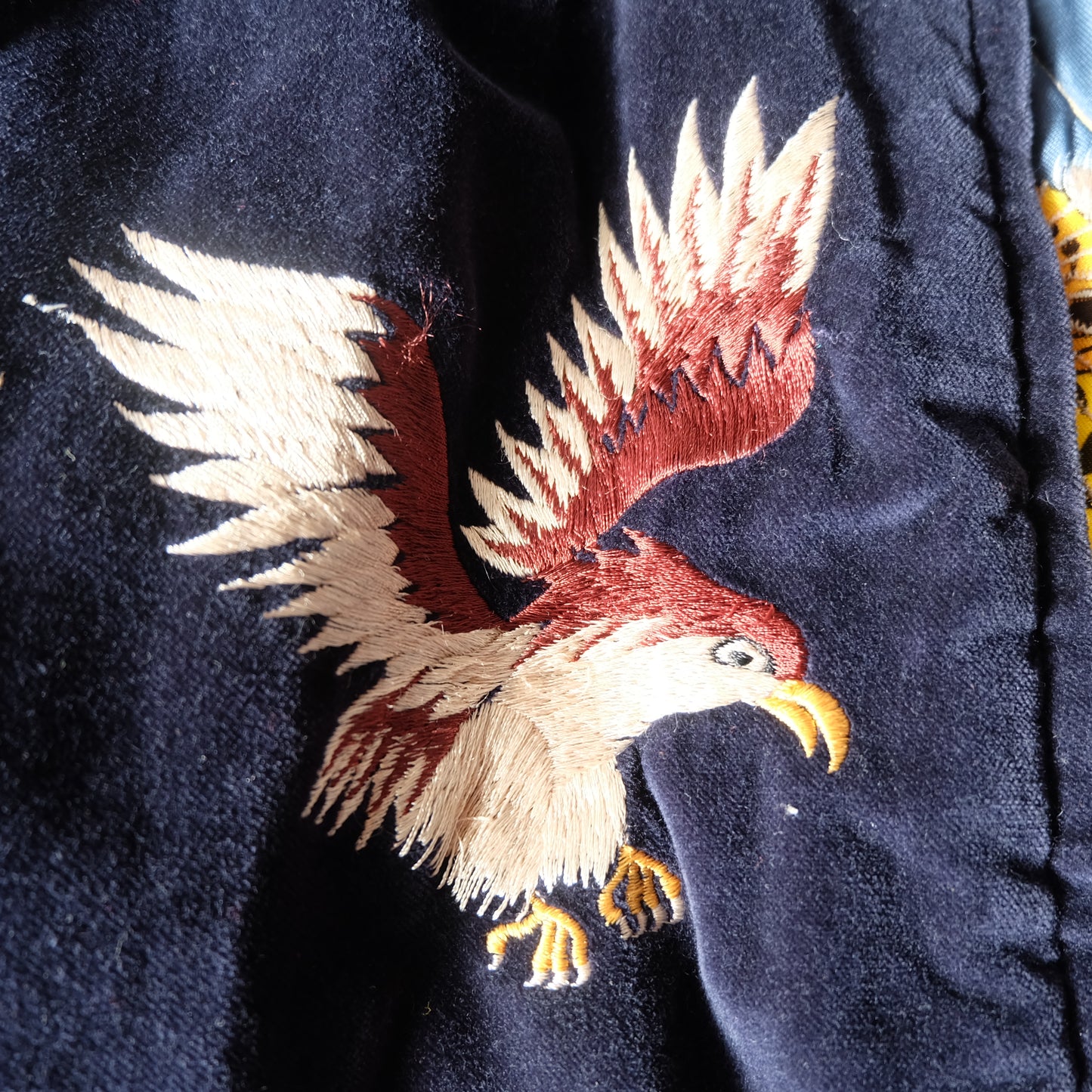
These garments combined American bomber construction with Japanese embroidery craftsmanship. Tigers, dragons, eagles, maps, mountains, military emblems, place names, and personalized scenes transformed utilitarian outerwear into portable souvenirs of service and travel.
Tailor Toyo later became one of the principal custodians of this garment tradition, preserving and recreating important historic designs rather than treating the sukajan as a passing fashion novelty.
Special Edition Construction Philosophy
KOSHO Special Edition jackets are valued for their deliberate closeness to vintage construction.
The textiles are intended to age visibly. The embroidery may possess irregular tension and directional character. The ribbing is often made to resemble the wool trim of early jackets rather than modern synthetic bomber rib. The zipper construction may feel more primitive and delicate than contemporary hardware.
These characteristics give the garment authenticity and atmosphere, but they also require careful handling. This particular example has developed substantial genuine wear in addition to the vintage-style character originally built into the jacket.
The 2004 Model
This TT10797 design was released in 2004 as a KOSHO Special Edition pairing the Iwo Jima composition with the celebrated sasa-tora, or tiger-and-bamboo, reverse.
The garment now carries more than two decades of age, placing it firmly within collectible early-2000s Japanese archive fashion while its visual language reaches back to the formative era of the Yokosuka jumper.
THE IWO JIMA VELVETEEN FACE
Deep Navy Velveteen Ground
The principal face is constructed from dark navy cotton velveteen.
Its pile absorbs light and shifts between midnight blue, blue-black, violet navy, and charcoal depending on the direction of the nap. This creates a quiet, shadowed surface against which the gold lettering, American flag, uniformed figures, and blue island contours remain visible.
The velveteen face is visually restrained compared with the reverse. Its palette is subdued, its subject is solemn, and its embroidery occupies the central back rather than filling every available area.
“IWOJIMA” Lettering
Large gold embroidered letters spell “IWOJIMA” across the upper back.
The lettering is arranged in a broad horizontal arc beneath the collar, creating immediate geographic identity before the pictorial scene is examined.
The word is presented as one continuous inscription, reflecting the historic English-language spelling commonly associated with the island and wartime image.
Its warm gold thread stands out against the dark pile while coordinating with the flagpole, scattered ground accents, and warmer tones used in the figures.
The Flag-Raising Composition
The lower back depicts a group of United States Marines raising the American flag on Mount Suribachi.
The figures lean together around the diagonal flagpole, forming a triangular movement from the lower right toward the flag in the upper left. Their bodies are rendered in tan, brown, cream, olive, and muted green thread, suggesting field uniforms and equipment without excessive pictorial detail.
The composition is based upon the internationally recognized flag-raising image associated with the Battle of Iwo Jima. The embroidery simplifies the original photographic subject into the compact visual language of a souvenir jacket.
The diagonal pole is essential to the design. It cuts dynamically across the otherwise broad, dark back and links the clustered figures with the small but highly recognizable American flag.
American Flag
The flag is embroidered in faded red, pale cream, and blue.
Its softened palette feels appropriate to the aged velveteen ground and the garment’s wider vintage-reproduction character. Rather than appearing bright and new, it reads as part of a weathered memorial image.
The flag folds away from the pole in an irregular shape, creating a sense of wind and movement above the figures.
Mount Suribachi and Island Ground
Blue, pale gray, turquoise, black, and gold stitching forms the volcanic ground beneath the figures.
The embroidery is abstracted into sharp ridges, uneven lines, and overlapping bands. These shapes suggest rock, surf, shadow, and the island’s rugged terrain without becoming a literal landscape panorama.
Small gold elements interrupt the blue contours, adding visual depth and connecting the lower embroidery with the lettering above.
Historical Character
The Iwo Jima face belongs to the military-souvenir lineage of the sukajan.
The Battle of Iwo Jima was one of the most devastating confrontations of the Pacific War, carrying immense loss for both the American and Japanese forces. On this garment, the famous flag-raising image functions as historic service imagery and as a record of the kinds of personalized military subjects ordered for postwar souvenir jackets.
The composition is best understood as material culture connected with remembrance, military history, American service identity, and Japan’s complex postwar relationship with the souvenir-jacket trade.
It is not presented merely as decorative combat imagery. Its power lies in the way a difficult historic memory has been preserved within a Japanese-made garment produced for an international cultural world.
THE SASA TIGER REVERSE
Quilted Steel-Blue Body
The reverse is constructed from steel-blue satin-finish acetate with broad pale-gold sleeves.
Diamond quilting extends across the blue torso, creating a strongly visible geometric framework beneath the tiger embroidery. The pale quilting thread forms a secondary pattern that becomes especially apparent where the pictorial embroidery leaves the blue ground exposed.
This side is much brighter and more theatrical than the velveteen face. The acetate reflects light across every fold, while the embroidered tiger and foliage introduce saturated color and dramatic movement.
Roaring Tiger
The back is dominated by a large tiger standing upon rocky ground.
Its head is thrown upward in a roar, mouth open, fangs exposed, tongue extended, and whiskers radiating around the muzzle. The tiger’s eyes are wide and intense, giving the creature the exaggerated expression associated with historic sukajan and Japanese tattoo imagery.
The animal’s body is built from yellow, gold, orange, brown, black, cream, white, and gray thread. Its stripes curve around the torso and raised tail, creating volume and directional force.
One foreleg is lifted while the other anchors the animal to the rocky ledge. This asymmetrical stance suggests motion rather than a static portrait. The tiger appears to be advancing through the bamboo, turning upward toward the moon as it roars.
Sasa Bamboo
Dense green sasa leaves surround the tiger and spread across the lower landscape.
Sasa refers to dwarf bamboo or bamboo grass, a recurring motif in Japanese decorative art. The narrow leaves are embroidered in multiple greens, pale blue-green, white, and darker shadow tones.
Their sharp diagonal forms contrast with the rounded muscularity of the tiger. They also create a layered environment around the animal, allowing sections of the body to emerge through the foliage.
The design pairing is traditionally known as sasa-tora, meaning a tiger among bamboo or bamboo grass.
Crescent Moon
A pale crescent moon appears behind the tiger’s head on the upper left.
The moon introduces a nocturnal atmosphere and provides a quiet geometric counterpoint to the roaring animal. Its cool white-gray tone stands apart from the tiger’s heat and the surrounding green vegetation.
The upward gaze of the tiger creates a direct relationship with the moon, turning the scene into something more evocative than a standard wildlife composition.
Rocky Ground
Brown, tan, black, white, and pale blue embroidery forms the uneven landscape beneath the tiger.
The rock is rendered through broad areas of warm color divided by dark contours. Green leaves cross over and around the ground, integrating the animal, bamboo, and landscape into a continuous design.
The rock gives the tiger a firm visual base while raising it above the lower waistband.
“Japan” Lettering
The word “Japan” is embroidered across the upper back in flowing red script outlined with bright yellow.
The lettering creates a vivid banner above the tiger and immediately identifies the jacket as a Japanese souvenir object.
Its curving hand-lettered quality contrasts with the rigid capital letters of “IWOJIMA” on the velveteen side. This difference reinforces the separate mood of each face.
The Iwo Jima side feels commemorative and restrained.
The Japan tiger side feels energetic, colorful, and proudly decorative.
FRONT TIGER HEADS
Mirrored Chest Composition
Two roaring tiger heads are positioned symmetrically across the quilted blue chest.
Each tiger faces inward toward the zipper, producing a heraldic arrangement that remains balanced whether the jacket is worn open or closed.
The heads repeat the intense expression of the larger rear tiger. Their mouths are open, red tongues extended, white fangs exposed, and long whiskers spread around the muzzle.
Embroidery Style
The chest tigers use yellow, orange, black, white, gray, pink, and red thread.
Fine pale stitches create the fur around the cheeks and jaw, while black curves articulate stripes and facial structure. The bright pink-red nose and tongue give each head an almost mask-like theatricality.
The design reflects the stylized character of vintage sukajan embroidery, where emotional force and distance legibility are favored over strict naturalism.
Front-to-Back Continuity
The paired chest heads establish the tiger theme immediately from the front.
When the wearer turns, the monumental full-body tiger completes the composition. This continuity gives the reverse a complete visual program rather than an isolated embroidered back.
Pocket Accents
Diagonal welt pockets are integrated below the tiger heads.
Their pale-gold trim echoes the sleeves and creates small directional accents against the blue quilted body.
TIGER SYMBOLISM
Courage and Authority
The tiger is associated with courage, command, physical strength, and decisive action.
Its intense gaze and predatory power made it an enduring motif within Japanese martial imagery, tattooing, painting, textiles, and souvenir jackets.
Protective Force
Within East Asian symbolic traditions, the tiger may function as a guardian capable of repelling harmful influence.
Placed across the back of a jacket, the animal carries a protective presence. Its roar faces outward while its body forms a powerful visual shield behind the wearer.
Independence
The tiger is a solitary animal and may represent self-reliance, personal authority, and independence from the group.
This symbolism aligns naturally with the sukajan’s later associations with youth culture, motorcycle fashion, rockabilly, punk, and personal rebellion.
Controlled Aggression
The tiger is shown roaring and advancing, but its body remains balanced.
The composition expresses strength with direction rather than uncontrolled violence. The animal’s authority comes from awareness, confidence, and physical command of its surroundings.
BAMBOO SYMBOLISM
Resilience
Bamboo bends beneath pressure without breaking.
It is therefore associated with resilience, flexibility, endurance, and the ability to survive difficult conditions while retaining essential character.
Growth
Its rapid upward growth connects bamboo with development, vitality, and forward movement.
Integrity
The hollow, segmented stem has also been associated with humility, clarity, and moral structure.
Tiger and Bamboo Together
The tiger and bamboo create a complementary symbolic pairing.
The tiger represents direct power.
The bamboo represents adaptive strength.
The tiger confronts.
The bamboo endures.
Together they create a broader statement about courage supported by flexibility, one of the reasons the sasa-tora composition has remained so compelling within Japanese visual culture.
THE CRESCENT MOON
Nocturnal Atmosphere
The moon transforms the tiger composition into a night scene.
Its quiet presence intensifies the theatrical roar while adding emotional distance and mystery.
Cycles and Renewal
The crescent moon may suggest transition, renewal, time, and the promise of further growth.
Its partial form implies that the scene belongs to an ongoing cycle rather than a final moment.
Visual Balance
The pale crescent balances the bright “Japan” inscription and the raised tiger tail.
It fills the upper-left negative space without competing with the animal’s head.
DUAL-FACE NARRATIVE
American Military Memory
The velveteen side looks outward toward a specific moment in American military history.
Its image is human, commemorative, and connected to the wartime experience of service members in the Pacific.
Japanese Symbolic Identity
The quilted reverse looks inward toward an idealized visual vocabulary of Japan.
Tiger, bamboo, moon, color, and the Japan inscription create a timeless symbolic landscape rather than a specific historic event.
Postwar Cultural Exchange
Together, the two sides embody the complex origin of the sukajan.
American military memory is rendered by Japanese embroidery specialists.
Japanese symbolic imagery is placed on an American-derived bomber silhouette.
The wearer can move between both cultural worlds simply by reversing the jacket.
Two Complete Collector Faces
Neither side functions merely as a lining.
The velveteen Iwo Jima face and quilted tiger face each possess their own back composition, front treatment, textile character, color system, and emotional atmosphere.
This “double A-side” quality is central to the jacket’s desirability.
TEXTILE AND CONSTRUCTION
Cotton Velveteen
The Iwo Jima face is made from deep navy cotton velveteen.
Its short pile creates the plush, shadowed surface historically associated with premium winter-weight sukajan. The fabric is softer and more light-absorbent than satin, allowing the embroidery to emerge with strong contrast.
Velveteen is sensitive to friction, pressure, moisture, and pile direction. Its appearance naturally changes with handling and age.
Quilted Acetate
The tiger face is made from satin-finish acetate with diamond quilting.
Acetate provides the fluid shine associated with classic souvenir jackets, while the quilting adds light insulation and gives the reverse a structured vintage appearance.
The blue body and pale-gold sleeves respond differently to light, producing tonal shifts from steel blue to slate, champagne, cream, and aged yellow.
Rayon Embroidery
The pictorial motifs are executed in lustrous embroidery thread consistent with the rayon embroidery traditionally used for sukajan work.
Rayon thread has a soft sheen distinct from the velveteen and acetate grounds. This contrast allows the embroidery to remain visible under changing light.
Wool Ribbing
The collar, cuffs, and waistband are finished with striped wool knit ribbing.
The trim changes appearance between the two faces.
The velveteen side shows aged cream ribbing with blue stripes.
The quilted face shows cream, navy, and burgundy stripes.
The wool construction contributes greatly to the jacket’s period character, although it is also the most visibly worn element of this example.
Reversible Zipper
A central metal zipper is configured for reversible use.
The hardware sits between the velveteen and quilted constructions and allows either side to be worn as the exterior.
The zipper belongs to the jacket’s vintage-style construction and should be handled more carefully than a modern heavy-duty synthetic zipper.
Raglan-Style Sleeves
The sleeves extend diagonally from the neckline toward the underarms.
This raglan-style construction provides freedom of movement and allows the broad back panels to carry uninterrupted embroidery without conventional shoulder seams cutting through the imagery.
Welt Pockets
Welt pockets are incorporated into both wearable presentations.
On the quilted face, the pocket openings are emphasized with pale-gold trim. On the velveteen face, the pockets are visually absorbed into the darker body.
Interior Structure
Because the jacket is genuinely reversible, there is no ordinary hidden lining.
The reverse of each shell supports the opposite wearable face, while the quilting and embroidery contribute body, weight, and insulation to the complete garment.
EMBROIDERY CHARACTER
Iwo Jima Scene
The flag-raising scene uses relatively restrained blocks of thread.
The figures are articulated through changes in tan, brown, olive, cream, and black rather than extremely fine facial detail. This keeps the group legible as a single collective action.
Sasa Tiger
The reverse tiger is more colorful and densely modeled.
Multiple shades of yellow, gold, orange, brown, white, and black create the animal’s coat, while thread direction follows the movement of the shoulders, chest, legs, tail, and facial fur.
Tiger Faces
The mirrored chest heads combine dense color with radiating whisker and cheek stitches.
Their almost mask-like expression is characteristic of sought-after vintage tiger-head designs.
Lettering
“IWOJIMA” is rendered in formal gold capitals.
“Japan” is rendered in fluid red script with a yellow outline.
The two lettering styles reinforce the different visual identities of the jacket.
Quilting and Embroidery Interaction
The reverse pictorial design sits over visible diamond quilting.
This interaction creates a layered surface in which geometric stitch lines remain visible beneath the organic forms of tiger, bamboo, rock, and moon.
Period-Style Irregularity
The embroidery is not intended to resemble contemporary computerized perfection.
Variations in stitch direction, density, tension, and outline contribute to the handmade atmosphere prized in KOSHO Special Edition garments.
COLOR ARCHITECTURE
Velveteen Face
The Iwo Jima side is dominated by deep navy and aged cream.
Gold lettering provides the strongest warm accent.
Tan figures and the subdued flag create a restrained military palette.
Blue and turquoise ground lines connect the embroidery to the dark body.
Quilted Face
The reverse combines steel blue with pale gold.
The tiger introduces saturated yellow, orange, black, white, pink, and red.
Bamboo contributes turquoise and green.
Burgundy, cream, and navy ribbing adds a final heritage accent around the openings.
Warm and Cool Contrast
Cool colors dominate the body and landscape.
Warm colors are concentrated in the tiger, lettering, figures, and flag.
This contrast allows the major motifs to remain visible despite the jacket’s extensive wear and surface variation.
PERIOD AND ERA ASSESSMENT
Confirmed 2004 Production
This KOSHO Special Edition TT10797 model dates to 2004.
It now represents an increasingly collectible early-2000s chapter of Tailor Toyo production, a period when Japanese heritage labels were intensively reconstructing mid-century Americana and postwar souvenir culture.
Early 1950s Design Language
Although produced in 2004, the jacket recreates the visual and structural language of early 1950s souvenir jackets.
The velveteen face, wool ribbing, reversible satin construction, period-style zipper, hand-worked embroidery character, and military personalization all refer back to that formative era.
Y2K Japanese Archive Fashion
The jacket also belongs unmistakably to the early-2000s Japanese heritage-fashion movement.
It bridges genuine postwar design history with Y2K collecting culture, making it relevant to several audiences at once:
Sukajan historians.
Tailor Toyo and KOSHO collectors.
Japanese Americana buyers.
Military-souvenir collectors.
Archive streetwear enthusiasts.
Tiger-jacket collectors.
Buyers interested in early-2000s Japanese reproduction craftsmanship.
CONDITION
Overall Condition
Heavily charactered vintage pre-owned condition with substantial visible wear, age toning, creasing, rib deterioration, textile variation, and signs of extended use or storage.
The jacket remains visually powerful and highly collectible, but it should not be interpreted as pristine, lightly worn, or near-new.
Its patina is an important part of its present identity.
Velveteen Condition
The navy velveteen shows widespread pile movement, pressure variation, surface haze, light fibers, and areas where the nap appears flattened or brushed in different directions.
These changes cause the jacket to shift between dark navy, blue-black, violet, and lighter blue areas.
The sleeves and central back retain their velveteen character, although the surface shows clear evidence of age and handling.
Fine lint and small pale fibers are visible against the dark pile.
Iwo Jima Embroidery
The “IWOJIMA” lettering and central flag-raising scene remain substantially complete and legible.
The figures, flag, pole, island contours, and gold accents retain their principal shapes.
Age-related thread wear, softened color, raised fibers, and isolated irregularities may be present within the embroidery.
The softened flag colors and muted figures suit the historic character of the design, although they also reflect genuine age.
Quilted Acetate Condition
The quilted blue-and-gold face shows extensive creasing, wrinkling, rippling, and uneven reflective sheen.
The pale-gold sleeves display visible age toning and surface variation. Their color shifts between cream, yellow, champagne, beige, and muted gold.
The blue body shows pressure lines, quilting-related puckering, and areas of lighter and darker sheen.
These characteristics are especially visible across the sleeves, shoulders, and lower body.
Sasa Tiger Embroidery
The large roaring tiger remains vivid and strongly defined.
Its body, stripes, face, mouth, claws, tail, and surrounding bamboo retain substantial color and visual impact.
The “Japan” script, moon, rock, and foliage remain clearly legible.
Minor thread wear, loose fibers, edge lifting, or embroidery irregularity may be present within the dense pictorial surface.
Chest Tiger Heads
Both mirrored tiger heads remain bright and visually striking.
Their eyes, whiskers, mouths, teeth, tongues, and fur divisions are clearly readable.
The embroidery sits over the quilted surface, producing natural puckering around the motif edges.
Ribbing
The collar, cuffs, and waistband show the most pronounced wear.
Visible condition includes heavy fuzzing, abrasion, loose fibers, fraying, age toning, softened stripe definition, waviness, stretching, and localized edge deterioration.
The waistband displays particularly noticeable fiber loss and fringe-like wear along portions of the lower edge.
The cuffs also show substantial abrasion and loosened wool fibers.
The collar has softened and worn surfaces, with fading and age toning across the cream, blue, and burgundy stripes.
This ribbing wear is prominent and forms a major part of the jacket’s condition.
Zipper
The central metal zipper and lower hardware are present in the photographs.
The zipper should be handled gently and aligned carefully before use. Period-style reversible hardware may feel less smooth and more delicate than a contemporary zipper.
No claim of factory-new operation is made for vintage hardware.
Seams and Panels
The principal body panels, sleeves, embroidery fields, and reversible construction remain present.
Natural seam waviness, thread movement, and tension changes are visible.
No catastrophic body-panel loss is apparent in the supplied photographs, although the jacket should be worn and stored with care because of the age and visible deterioration of the trim.
Authentic Patina
The wear is not limited to a single isolated flaw.
It is distributed across the ribbing, velvet pile, acetate surface, quilting, and embroidery, creating an unmistakably aged archive appearance.
Collectors who value patina, historic atmosphere, and visible material evolution may find this especially compelling. Buyers seeking pristine modern condition should regard the photographs and description carefully.
DIMENSIONS AND SIZING
Recommended Measurement Points
A: Pit-to-pit chest width.
B: Back length from the base of the collar to the lower waistband.
C: Sleeve length from the base of the collar along the upper sleeve to the end of the cuff.
D: Relaxed waistband width.
E: Cuff width or another relevant fit point.
Raglan Sleeve Measurement
Because the jacket uses raglan-style construction, it does not have a conventional shoulder seam.
Sleeve length is most accurately measured from the base of the collar to the cuff rather than from an assumed shoulder point.
KOSHO Special Edition Fit
KOSHO Special Edition jackets frequently follow compact vintage proportions.
The body may feel shorter than a contemporary bomber, while the raglan sleeves provide greater reach and volume.
Actual fit should be determined through flat measurements rather than modern Western size conversion.
Unisex Wear
The jacket may be worn across masculine, feminine, and gender-neutral wardrobes.
Its correct fit depends upon chest width, body length, sleeve reach, preferred layering, and whether the wearer favors a traditional compact silhouette or a more relaxed contemporary fit.
COLLECTOR DESIRABILITY
Specific Identifiable Model
The TT10797 model number and 2004 KOSHO Special Edition identity distinguish this jacket from generic or unbranded Iwo Jima and tiger sukajan.
Specific model recognition is especially important within serious Tailor Toyo collecting.
Scarce Design Pairing
The Iwo Jima and sasa-tiger pairing is unusual.
One face carries military memorial imagery, while the other presents one of the most celebrated Japanese animal motifs in a saturated nocturnal landscape.
This combination gives the jacket broader historic and artistic interest than a conventional tiger-and-dragon pairing.
KOSHO Construction
KOSHO Special Edition status places the jacket within Tailor Toyo’s premium heritage-reproduction tradition.
Collectors seek these models for their fabrics, ribbing, embroidery character, reversible construction, archival references, and deliberate resistance to modern factory uniformity.
Early-2000s Archive Value
The jacket is no longer merely a modern reproduction of a vintage object.
As a 2004 garment, it has acquired its own period identity and now belongs to the collectible history of Japanese Y2K heritage fashion.
Sasa Tiger Composition
The tiger among bamboo is a foundational sukajan motif.
Its crescent moon, full-body stance, dramatic roar, and extensive foliage make this version especially pictorial.
Historic Iwo Jima Face
The Iwo Jima composition gives the jacket a specific narrative and geographic identity.
It connects the garment to military history, postwar souvenir culture, and the complex relationship between American service imagery and Japanese textile production.
True Reversibility
Both faces are fully developed.
The garment can be displayed, photographed, or worn from either direction without one side appearing secondary.
Visible Age
The substantial patina may increase its appeal for collectors who prefer garments that visibly communicate age and use.
The worn ribbing, faded velveteen, softened flag, and creased quilting give the piece the atmosphere of a much older souvenir jacket.
DISPLAY AND CULTURAL VALUE
Wearable Historic Material Culture
This jacket documents several overlapping histories:
The development of the sukajan.
American military presence in postwar Japan.
Japanese embroidery made for foreign service members.
The preservation of early souvenir designs by Toyo Enterprise.
The Japanese heritage-fashion revival of the early 2000s.
The later emergence of sukajan as international archive streetwear.
Textile Display
Either back may be displayed as a large embroidered textile panel.
The Iwo Jima side offers a subdued museum-like presentation.
The tiger side offers vivid color, movement, and symbolic force.
A broad padded hanger will support the shoulders more safely than a narrow wire or plastic hanger.
Rotating Presentation
Collectors may alternate the displayed face periodically.
This allows both narratives to be appreciated while reducing prolonged light exposure to a single textile surface.
Conversation Piece
The jacket carries a deeper story than a purely decorative bomber.
Its military imagery, Japanese symbolism, 2004 KOSHO production, and advanced patina invite discussion about history, memory, fashion, and cultural exchange.
STYLING
Japanese Americana
Wear the velveteen face with selvedge denim, a plain T-shirt, engineer boots, or vintage workwear.
The dark navy pile, aged cream ribbing, and subdued embroidery suit a heritage wardrobe without appearing costume-like.
Archive Streetwear
Pair with wide black trousers, faded denim, heavy sneakers, or minimal monochrome layers.
The worn surfaces and compact shape give the jacket an authentic archive presence that does not require elaborate styling.
Tiger Face
The quilted tiger side works especially well with navy, cream, brown, faded blue, burgundy, or black.
Its pale-gold sleeves and bright embroidery are already visually dominant, so the surrounding outfit can remain restrained.
Military-Inspired Styling
The Iwo Jima face can be combined with fatigues, utility trousers, service boots, and simple knitwear.
The historic motif is strongest when treated respectfully as archival military-inspired clothing rather than theatrical costume.
Rockabilly and Biker Styling
The short bomber silhouette, tiger imagery, striped ribbing, and aged textiles align naturally with Japanese rockabilly and motorcycle-influenced wardrobes.
Cuffed denim, boots, a plain undershirt, and a strong belt allow the jacket to carry the look.
Gender-Neutral Styling
The jacket’s appeal lies in its construction, symbolism, and proportion rather than gender-specific tailoring.
It can be styled fitted, traditionally compact, or relaxed depending on the wearer’s measurements.
Editorial and Stage Use
The two faces respond very differently to light.
Velveteen creates deep shadow and saturated color.
Quilted acetate reflects highlights and reveals every fold.
This makes the garment especially effective for editorial photography, music styling, stage wardrobes, archive shoots, and cinematic Japanese Americana imagery.
CARE AND PRESERVATION
Professional Cleaning Only
Professional cleaning by a textile specialist experienced with vintage velveteen, acetate, rayon embroidery, wool ribbing, and reversible garments is strongly recommended.
Do not machine wash, hand soak, bleach, wring, scrub, or tumble dry.
The combination of aged pile fabric, acetate satin, wool trim, embroidery, quilting, and period-style hardware requires specialist handling.
Velveteen Care
Do not iron the velveteen face.
Direct pressure may crush the pile and create irreversible shine or flattened patches.
Do not brush aggressively. Gentle pile alignment should only be attempted with tools suitable for delicate velvet or velveteen.
Acetate Care
Acetate is sensitive to heat, friction, moisture, and certain solvents.
Do not press a hot iron directly against the blue or pale-gold satin.
Avoid attempting home stain removal, as liquid treatment may create tide marks, altered sheen, or permanent discoloration.
Embroidery Care
Do not pull or trim loose threads without understanding how they connect to the design.
Avoid rough bags, jewelry, hook-and-loop fasteners, sharp accessories, and abrasive walls that may catch the embroidery.
Ribbing Care
The wool ribbing is visibly fragile and should receive particular care.
Do not pull the jacket on or off by the cuffs, waistband, or collar.
Do not hang the garment from the ribbing.
Support the body evenly when handling, turning, or reversing the jacket.
Zipper Care
Align the lower zipper components carefully before fastening.
Keep the fabric and ribbing clear of the teeth.
Do not force the slider if resistance is encountered.
Reversing the Jacket
Turn the garment slowly and support the sleeves and body as the fabric passes through.
Avoid pulling one cuff sharply through the sleeve, as this places additional stress on the worn ribbing.
Storage
Store on a broad padded hanger with sufficient support beneath the shoulders.
For long-term preservation, flat storage in an acid-free textile box may be preferable if adequate space and conservation materials are available.
Use breathable protection rather than sealed plastic.
Keep the jacket away from direct sunlight, high humidity, smoke, perfume, dust, pests, and prolonged compression.
Display Light
Strong daylight may fade the velveteen, acetate, flag colors, tiger embroidery, and wool ribbing.
Display under controlled indirect light and allow the jacket periods of rest in dark storage.
SHIPPING, OFFERS, AND FINAL-SALE POLICIES
Shipping
Worldwide tracked shipping is available from Japan, generally through Japan Post EMS or another suitable tracked international service.
The jacket will be carefully folded with protective material placed between the embroidered faces, velveteen pile, quilted acetate, ribbing, zipper, and hardware.
Tracking information is normally provided approximately 3–5 business days after dispatch.
Delivery time depends upon destination, customs processing, postal conditions, and the international service available at the time of shipment.
Protective Packaging
Special care will be taken to reduce pressure on the Iwo Jima embroidery, tiger composition, chest motifs, velvet pile, and heavily worn ribbing.
The garment may retain gentle transit folds upon arrival. These should be allowed to relax naturally rather than treated with direct heat.
Additional Photographs
Additional photographs may be available upon request.
Please contact us before purchase should you wish to examine the ribbing, zipper, embroidery edges, quilted surface, velveteen pile, cuffs, waistband, collar, pockets, or other specific areas more closely.
Offers
Reasonable offers may be considered.
Because this is a recognized KOSHO Special Edition model with strong collector interest, price flexibility may be limited. Serious and respectful proposals will nevertheless be considered individually.
Product Representation
Every effort has been made to represent the jacket accurately through the photographs and description.
Velveteen and acetate can change dramatically according to lighting, pile direction, camera exposure, and screen calibration.
The dark face may appear navy, blue-black, charcoal, or violet-blue.
The reverse may appear steel blue, slate, cream, champagne, pale yellow, or aged gold.
Vintage Expectations
This is a heavily charactered pre-owned collector garment.
It is not factory-new, deadstock, pristine, or free from age-related deterioration.
Visible rib fraying, wool-fiber loss, pile variation, fading, wrinkles, acetate creasing, embroidery irregularity, discoloration, and textile wear are integral parts of its current condition.
Final Sale
The jacket is sold in its present condition as photographed and described.
All sales are final. No returns, claims, cancellations, or exchanges are accepted for accurately disclosed vintage wear, sizing, rib deterioration, discoloration, fading, velveteen nap variation, acetate creasing, embroidery tension, patina, or other age-related characteristics, subject to applicable Etsy rules and consumer law.
Please review all photographs, condition details, sizing information, and policies carefully before completing your purchase.
#KOSHO #TailorToyo #ToyoEnterprise #TT10797 #KOSHOSpecialEdition #VintageSukajan #IwoJimaJacket #SasaTiger #TigerSukajan #ReversibleSukajan #JapaneseSouvenirJacket #YokosukaJumper #VelveteenSukajan #QuiltedSukajan #JapaneseAmericana #MilitarySouvenir #JapaneseStreetwear #Y2KJapaneseFashion #2004Fashion #TigerEmbroidery #BambooEmbroidery #JapanJacket #ArchiveStreetwear #CollectorJacket #VintageBomber #WearableHistory #JapaneseEmbroidery #UnisexVintage #SouvenirBomber #Japonista
MATERIAL TAGS
cotton velveteen, acetate satin, rayon embroidery, wool ribbing, quilted padding, metal zipper