Japonista
Kitamura Seibō Signed Bronze Equestrian Samurai, Kumagai Naozane Raising His Fan, Shōwa Era, Original Box
Kitamura Seibō Signed Bronze Equestrian Samurai, Kumagai Naozane Raising His Fan, Shōwa Era, Original Box
Couldn't load pickup availability
Have a reasonable price in mind? Submit your best offer and our concierge will review it personally.
Kumagai Naozane lifting his open fan to recall Taira no Atsumori is among the most poignant scenes in The Tale of the Heike, and Kitamura Seibō, sculptor of the Nagasaki Peace Statue, gave it monumental form for Kumagaya. This signed cast, associated with Kitamura, carries that composition into the private collection, together with its original wooden storage box.
The Piece
This signed bronze, associated with Kitamura Seibō 北村西望, depicts the celebrated warrior Kumagai Jirō Naozane 熊谷次郎直実 mounted on horseback at a pivotal moment from The Tale of the Heike. The armored samurai sits upright in the saddle and raises an open folding fan above the horse, while the animal beneath him advances with concentrated physical energy, its body, harness and muscular movement integrated into a single equestrian group. The contrast between the warrior's controlled gesture and the horse's forward momentum gives the sculpture a vivid narrative presence.
This is not a generic mounted samurai. The raised fan identifies a specific episode at the Battle of Ichi-no-Tani in 1184, when Naozane, a warrior of Musashi Province whose life spanned the transition from the late Heian to the early Kamakura period, saw the young aristocratic warrior Taira no Atsumori attempting to escape toward the Taira ships and called him back to combat. Kitamura's monumental version, installed outside Kumagaya Station in 1974, was based on an earlier depiction by Watanabe Kazan; the official Kumagai Naozane digital archive identifies that monument as Naozane raising his fan to summon Atsumori.
The moment is poised between heroic action and moral consequence. After overpowering the younger warrior, Naozane is said to have discovered that Atsumori was close in age to his own son; surrounded by approaching allies and unable to release him safely, he carried out his duty but was deeply affected. The episode contributed to his withdrawal from military life and his embrace of Buddhist practice under the name Renshō or Rensei. The fan is therefore both signal and narrative hinge: it stops the fleeing warrior and leads toward an encounter that changed Naozane's spiritual life, so that the bronze carries themes of impermanence, remorse, duty and transformation alongside its martial vigor.
Compositionally, the horse supplies the physical rhythm. Its torso, legs and harness establish forward movement, its posture suggesting motion interrupted by command, while the warrior rises vertically above the saddle in layered armor, helmet and regalia, with reins and saddle equipment carefully articulated. The lifted fan extends the silhouette upward and outward, keeps the upper body from appearing static and draws the eye above the warrior's head; light, broad and immediately legible against the dense armor, it is the focal point around which the story turns. The textured surface and integrated sculptural base complete a group legible even from across a room.
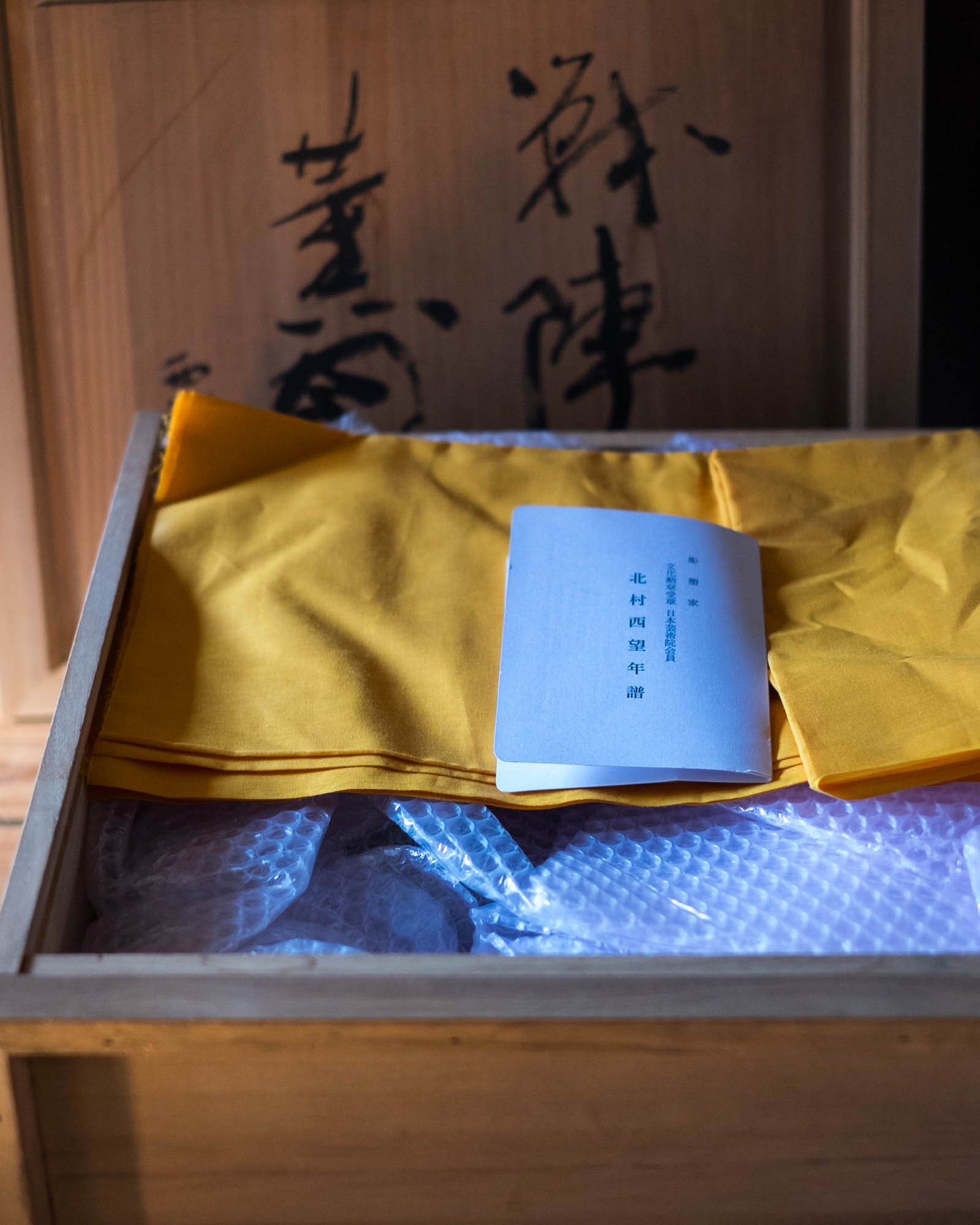
Cast bronze suits the subject, preserving the projecting fan, the horse's anatomy, the layered armor and the smaller harness elements while giving the work substantial physical presence. A darker patina or smoky gold-toned finish emphasizes the recesses between armor plates and the contours of the horse; under directional light the raised areas warm and the recesses deepen into shadow. The accompanying original signed or inscribed wooden storage box maintains the relationship between sculpture and attribution, preserves its Japanese written information and protects the work in storage and transit.
Details
- Artist: Kitamura Seibō 北村西望 (1884–1987), attribution
- Subject: Kumagai Jirō Naozane 熊谷次郎直実 raising his fan at the Battle of Ichi-no-Tani
- Model: Reduced cast derived from Kitamura's equestrian monument at Kumagaya Station (installed 1974)
- Era: Vintage Japanese work, likely later Shōwa-era production
- Origin: Japan
- Material: Cast bronze with patinated or gold-toned finish; metal signature plaque
- Composition: Armored samurai mounted on horseback raising a fan; integrated sculptural base
- Included: Original signed or inscribed wooden storage box
- Display: Freestanding sculpture / okimono
- Category: Modern Japanese sculpture, samurai art and decorative bronze
Condition
- Vintage pre-owned condition with age-related character appropriate to a Japanese bronze sculpture and its wooden box; the photographs form an essential part of the condition description.
- The bronze may show natural patina and tonal variation, light surface rubbing, small marks from handling or display, dust within recessed details, minor casting irregularities, gentle wear to raised areas and age-related changes to the base or finish.
- The original wooden box may display storage marks, natural wood variation, small scratches, tonal changes, softened corners or edges, and calligraphic fading or surface wear.
- These characteristics form part of the object's history and should not be judged by the standards of newly manufactured decorative wares.
Kitamura Seibō
Kitamura Seibō was born in Nagasaki Prefecture in 1884 and died in 1987, after a career extending across the Meiji, Taishō and Shōwa eras. He is most internationally recognized as the sculptor of the monumental Peace Statue in Nagasaki Peace Park, and official Japanese institutional sources note his particular strength in heroic male figures and equestrian military subjects, making the Naozane composition highly characteristic of his sculptural language.
His work frequently balances physical strength with symbolic purpose: warriors, animals and historical figures rendered with monumentality while carrying wider messages of courage, remembrance, peace or moral responsibility. That the sculptor of one of Japan's most important postwar peace monuments also created this image of a warrior whose battlefield experience led toward spiritual transformation gives the subject particular resonance.
Period and Edition
The bronze appears consistent with a vintage Japanese reduced cast produced during the later Shōwa period or in connection with Kitamura Seibō's established sculptural models. The monumental Kumagai Naozane equestrian statue, commissioned for Kumagaya and installed in 1974, provides a firm historical reference for the composition. Reduced casts based on prominent sculptural models were produced in multiple sizes and editions within modern Japanese bronze culture; the signature and original box support the attribution and presentation.
Display Suggestions
The sculpture has the presence to serve as a central display object in a Japanese art or samurai collection, a library or study, an executive office, a dojo, a tokonoma-inspired arrangement or a museum-style cabinet. For a restrained presentation, display it alone on a dark wood or stone surface; directional light from one side strengthens the outline of the fan, deepens the shadows within the armor and emphasizes the muscular modeling of the horse.
Authenticity & Care
Signed bronze with its original signed or inscribed wooden box; it is best understood as a signed reduced cast derived from Kitamura Seibō's larger equestrian composition, not the unique Kumagaya monument or a one-off lifetime casting unless further documentation establishes that status. Every piece is examined and documented in Japan before dispatch and is offered with the Japonista authenticity guarantee.
Delivery from Japan
Packed by hand in Japan and shipped insured and tracked by EMS or an equivalent express service. Import duties and taxes, where applicable, are payable on arrival. Returns follow our published policy.
Considered offers are welcome through Send an Offer, and each one is reviewed personally. Pieces over $1,000 may be reserved over several payments with Layaway Privilege™.
Continue browsing: Okimono
Related pieces: Meiji kabuto-form koro incense burner · Bizen-yaki oni kabuto okimono, 49 cm · Kawanakajima samurai bronze battle tableau
Cabinet of Curiosities
Okimono, netsuke and precious-metal miniatures surface rarely. Tell us the subject, material or carver you collect, and the Hunting Salon™ will search Japan for it. Begin a Hunting Salon™ request →
Collectors also search: kitamura seibo bronze · kumagai naozane statue · japanese bronze samurai on horseback · kumagaya station naozane monument · signed japanese equestrian bronze · tale of the heike sculpture · showa era bronze samurai okimono · atsumori naozane fan bronze