Rare Vintage, Antiques and Art Collector / Curator / Personal Shopper From Japan
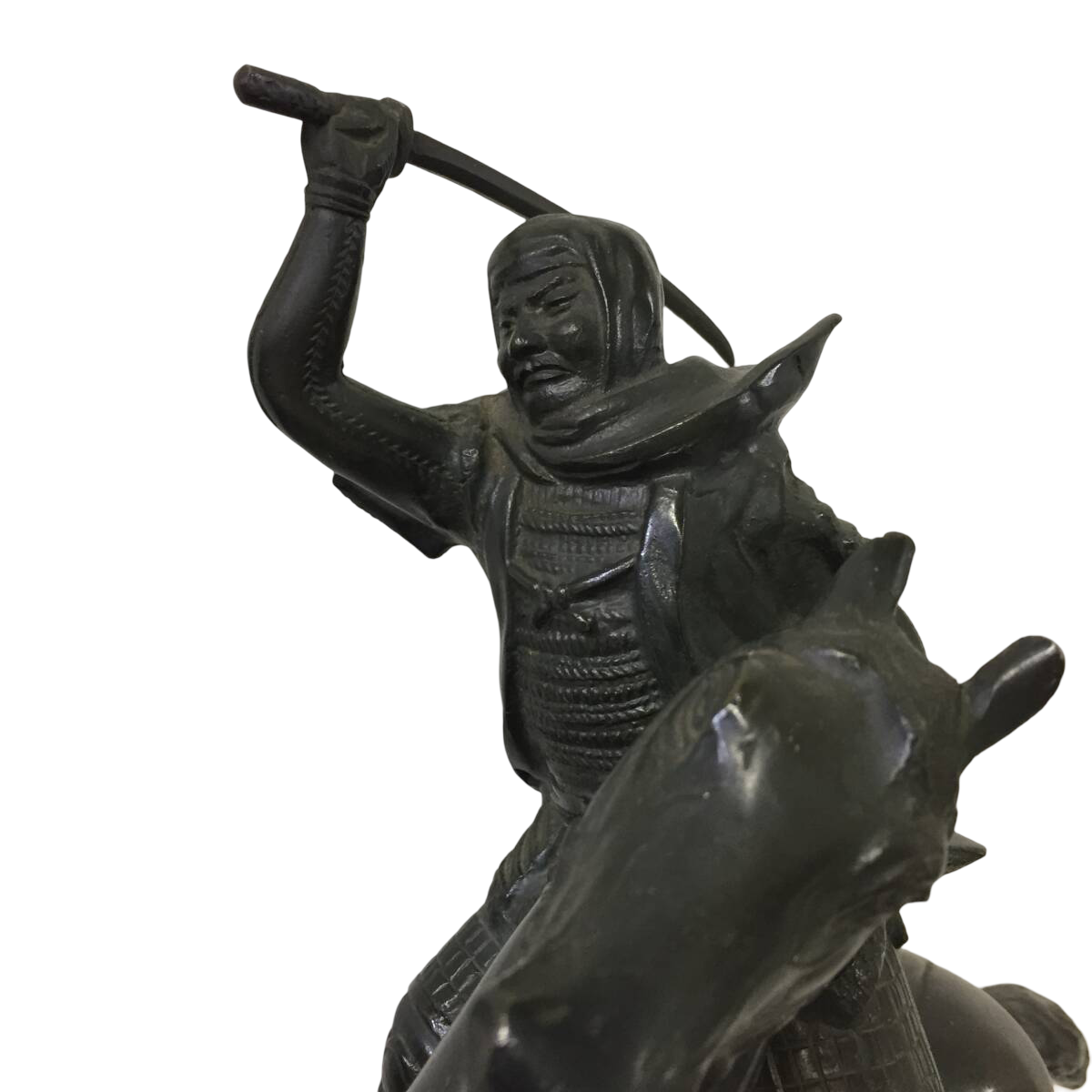
Japanese Bronze Samurai Battle Tableau, Takeda Shingen x Uesugi Kenshin - Mounted Warrior Combat Scene, Showa Period, After the Battle of Kawanakajima Tradition — 48cm
Japanese Bronze Samurai Battle Tableau, Takeda Shingen x Uesugi Kenshin - Mounted Warrior Combat Scene, Showa Period, After the Battle of Kawanakajima Tradition — 48cm
Couldn't load pickup availability
Have a reasonable price in mind? Submit your best offer and our concierge will review it personally.
Japanese Bronze Samurai Battle Tableau
This powerful bronze tableau presents a dramatic moment of mounted combat, rendered with theatrical clarity and muscular restraint. The composition—one armored warrior astride a rearing horse, blade raised mid-strike, confronting a fallen or kneeling opponent—belongs to a long Japanese visual tradition depicting the legendary martial encounters of the Sengoku period. In particular, the work aligns closely with imagery associated with the Battle of Kawanakajima, the storied clashes between Takeda Shingen and Uesugi Kenshin that came to symbolize the idealized ethos of the samurai.
Unlike Edo-period pictorial scrolls, which emphasized narrative continuity, sculptural battle scenes such as this condense history into a single suspended instant. The artist arrests motion at its most decisive point: the taut musculature of the horse, the forward surge of the mounted figure, and the compressed tension of the opposing warrior below. The result is not documentary realism, but moral theatre—a visual distillation of courage, resolve, and martial destiny.
This piece aligns closely with visual traditions associated with the Battle of Kawanakajima, a legendary series of engagements between Takeda Shingen and Uesugi Kenshin that later generations transformed into enduring symbols of samurai virtue.
Such bronzes emerged with particular force in the late Meiji to Taishō periods, when Japan sought to reconcile rapid modernization with reverence for its warrior past. Sculptural battle tableaux were collected as symbols of discipline, valor, and historical continuity. These type of historic battles representations became objects of patriotic reflection, collected for private interiors, offices, and institutional spaces as embodiments of discipline and national memory.
HISTORICAL & ICONOGRAPHIC CONTEXT
The Battle of Kawanakajima (1553–1564) was not a single engagement but a series of confrontations that later generations transformed into legend. By the modern era, these battles were remembered less for tactical outcomes than for their symbolic power. Artists repeatedly returned to the iconic image of mounted assault, emphasizing the personal valor of the warrior rather than massed armies.
This bronze reflects that tradition. The raised sword, forward-leaning posture, and dramatic opposition between mounted and grounded figures echo well-established visual formulas seen in Meiji-period prints, commemorative medals, and other sculptural works. While no explicit identification is inscribed, the composition draws unmistakably from the Shingen–Kenshin mythos rather than from anonymous combat.
Iconographic Identification: The Battle of Kawanakajima
This bronze composition is widely understood to evoke the legendary clashes at Kawanakajima, the series of five battles fought in the mid-16th century between two of Japan’s most iconic Sengoku-period rivals:
-
Takeda Shingen (lord of Kai Province), famed for cavalry warfare and the banner Fūrinkazan
-
Uesugi Kenshin (lord of Echigo), revered as a warrior-monk figure and later mythologized as the “God of War”
The sculptural arrangement—a mounted commander advancing while an opposing warrior confronts from the ground—closely mirrors Edo- and Meiji-period visual retellings of the most dramatic episode of the Fourth Battle of Kawanakajima (1561), in which Kenshin is said to have broken through Takeda lines to strike directly at Shingen.
Whether taken as a literal depiction or as a symbolic condensation, this moment became one of the most reproduced martial narratives in Japanese art.
Who Is Who in the Composition?
While no explicit inscription names the figures, traditional iconographic cues strongly suggest the following reading:
The Mounted Samurai
The mounted figure, raised above the battlefield and shown in forward momentum, aligns with conventional representations of Takeda Shingen:
-
Emphasis on command posture rather than reckless motion
-
Composure and weight suggesting authority and strategy
-
Horse rendered as a disciplined extension of leadership
In later historical imagination, Shingen came to embody military governance, logistics, and calculated force—qualities often emphasized in sculpture through stability and mass.
The Grounded Opponent
The opposing warrior—lower, aggressive, and confronting the mounted figure—corresponds to the archetype of Uesugi Kenshin:
-
Dynamic forward lean and assertive stance
-
Suggestion of personal combat rather than command distance
-
Visual tension emphasizing sudden breakthrough and moral ferocity
Kenshin’s legacy evolved beyond that of a general into a quasi-sacred figure, merging Buddhist devotion with martial resolve—an image repeatedly favored by Meiji-era sculptors.
Why This Scene Endured in Japanese Sculpture
The appeal of Kawanakajima imagery lies not in historical certainty, but in philosophical opposition:
-
Strategy vs. impulse
-
Governance vs. righteousness
-
Earthly power vs. divine mandate
By the late Meiji period, such scenes were no longer propaganda but cultural memory objects, produced for collectors, schools, exhibitions, and domestic display as embodiments of Japanese identity, loyalty, and martial ethics.
Bronze became the preferred medium because it:
-
Conferred permanence to legendary conflict
-
Allowed dynamic multi-figure compositions
-
Bridged fine art with historical commemoration
Collector & Cultural Significance
Rather than depicting anonymous warriors, works of this type function as compressed historical theatre—recognizable even without labels to audiences familiar with Japanese history.
For modern collectors, this gives the piece layered value:
-
Historical: referencing Sengoku-period rivalry
-
Artistic: sculptural storytelling in bronze
-
Cultural: Meiji–Taishō reinterpretation of national myth
-
Decorative: dramatic, narrative-driven object presence
Importantly, such bronzes are not battlefield relics, but interpretive monuments—objects that reveal how Japan remembered its past while entering modernity.
MATERIAL & CASTING
Cast in bronze, likely using the lost-wax method common to late 19th- and early 20th-century Japanese workshops, the sculpture demonstrates confident handling of form and surface. The modeling emphasizes anatomical clarity without excessive detail, allowing light to articulate the contours of horse and armor. The surface patina is consistent with age, exhibiting natural tonal variation rather than artificial uniformity.
The substantial weight (approx. 7.5kg) reinforces the object’s intended permanence and gravitas. This was not a casual decorative item, but a deliberate sculptural statement.
PERIOD ATTRIBUTION
Based on style, subject matter, and casting technique, the work is best situated within the Meiji to early Taishō period. During this time, bronze sculpture flourished as Japan embraced international exhibitions and modern fine art practices while retaining distinctly Japanese historical themes.
CONDITION
The sculpture shows signs of age consistent with its period, including minor surface wear and patina variation. No major losses or structural issues are apparent. These characteristics should be understood as evidence of age and authenticity rather than defects.
COLLECTOR RELEVANCE
This work will appeal to:
• Collectors of Japanese historical bronzes
• Samurai and Sengoku-period enthusiasts
• Meiji–Taishō industrial arts specialists
• Interior placements seeking museum-grade narrative objects
Authenticity & Stewardship
Evaluated under the Japonista Authentication Framework™:
- Material, carving, and surface-study comparison
- Iconographic and stylistic verification
- Condition and stability review (surface integrity)
- Construction assessment and handling-risk evaluation
Guaranteed 100% Authentic. Covered by the Japonista Lifetime Authenticity Warranty™.
A Note on Stewardship and Collecting
At Japonista, we approach Buddhist statues, sacred images, and ritual objects not merely as collectibles, but as cultural and spiritual artifacts deserving of respect, understanding, and careful presentation. Every piece we offer is thoughtfully examined, researched, and curated with sensitivity to its origin, meaning, and historical role.
Our role is not only to offer access to rare and meaningful objects, but to serve as responsible custodians—connecting the right works with collectors who value depth, intention, and authenticity.
Inquiries, Availability, and Private Consideration
Some of the cultural and heritage works may allow room for discussion, while others are held firmly due to rarity, condition, or cultural importance. All inquiries are reviewed personally and discreetly, and we welcome thoughtful questions or expressions of interest.
If you are exploring a particular theme, deity, lineage, or period—or seeking guidance in building a focused collection—our concierge team is always available to assist with quiet expertise and care.
Concierge Support & Collector Guidance
Japonista Concierge™ provides personalized assistance for collectors seeking deeper understanding, thoughtful acquisition, or long-term curation strategies. Whether your interest is devotional, scholarly, or aesthetic, we are here to help guide your journey with clarity and respect.
For select high-value or historically significant works, private reservation or structured payment arrangements may be available on a case-by-case basis. Please reach out to discuss eligibility and discreet options.
Before Proceeding
We kindly encourage collectors to review our shop policies and house guidelines, available through the links in our website footer, which outline shipping, handling, and conditions specific to vintage, sacred, and collectible works.
A Closing Note
Thank you for exploring Japonista’s collection of Oriental Cultural Heritage and arts. We are honored to share these meaningful works and to help place them where they may continue to be appreciated, studied, and respected.
If you have questions or wish to explore related works, please feel free to contact Japonista Concierge™ at any time.