Skip to product information
1 of 12

Rare Vintage, Antiques and Art Collector / Curator / Personal Shopper From Japan

Kimono Remake Silk Bomber Jacket Purple Floral Butterfly Sukajan Japanese Upcycled Textile Art Piece

Kimono Remake Silk Bomber Jacket Purple Floral Butterfly Sukajan Japanese Upcycled Textile Art Piece

Regular price $695.00 USD
Regular price Sale price $695.00 USD
Sale Sold out
Shipping calculated at checkout.
Quantity
SEND AN OFFER

Have a reasonable price in mind? Submit your best offer and our concierge will review it personally.

Share

A RECONSTRUCTED JAPANESE KIMONO SILK BOMBER JACKET

IN VIOLET WITH FLORAL AND BUTTERFLY DECORATION
CONTEMPORARY REMAKE, JAPAN


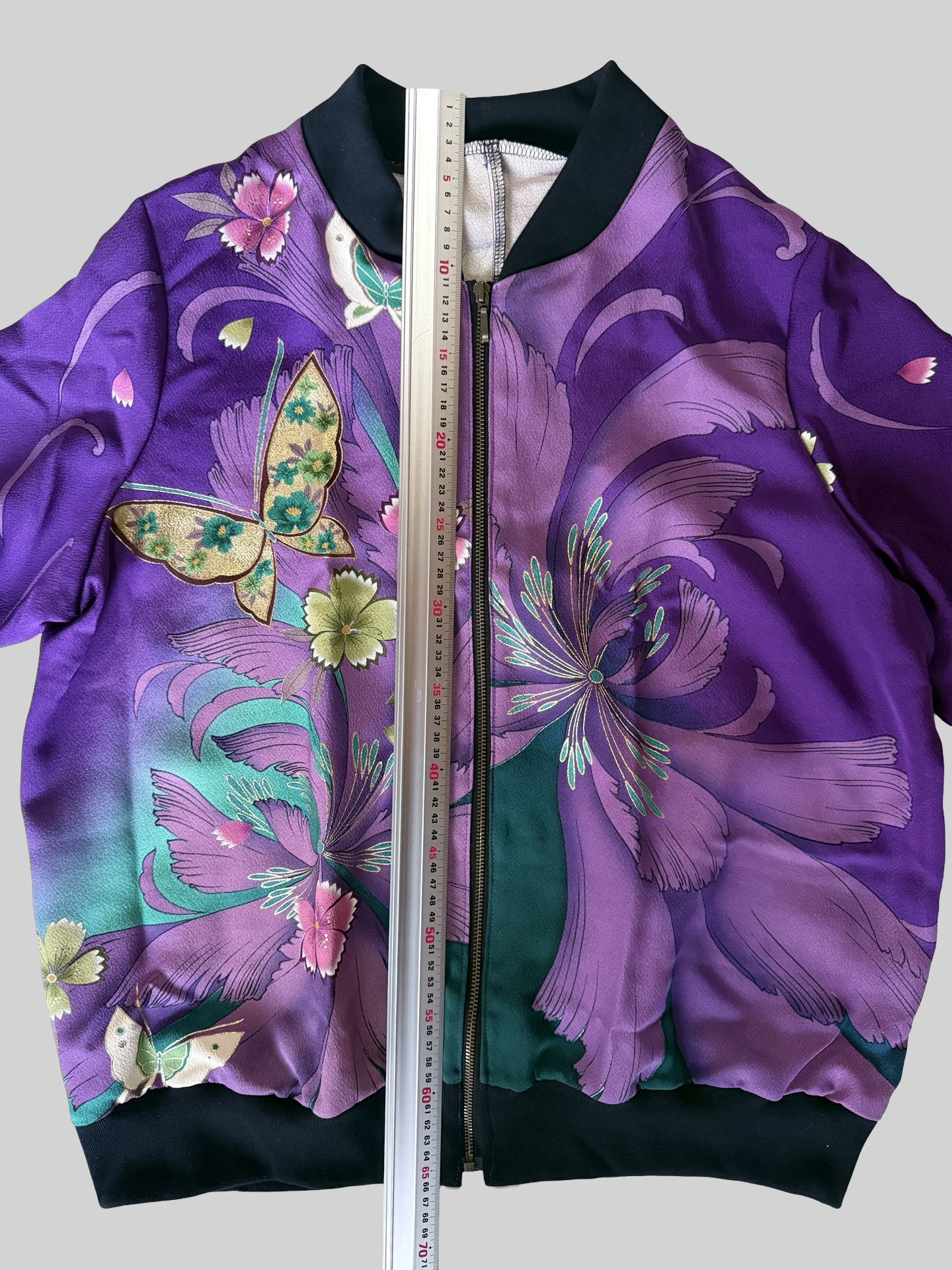
The present work constitutes a contemporary reconstruction of a traditional Japanese kimono textile, rearticulated into the form of a modern bomber jacket. In this transformation, the garment departs from its original function as a ceremonial or semi-formal robe and instead assumes a more immediate, mobile presence, while retaining the visual and material integrity of its source.

Rendered in a saturated field of violet silk, the surface is animated by an expansive floral composition, its forms unfolding across the body with a continuity that resists the segmentation of tailored construction. Blossoms, enlarged beyond naturalistic proportion, radiate outward in layered tonalities of lavender, magenta, and soft rose, their edges dissolving into one another in a manner reminiscent of hand-painted yuzen techniques. Interspersed among these forms, butterflies appear in mid-transition, suspended between states, their presence traditionally associated with ephemerality, seasonal passage, and transformation.

The textile itself operates as both image and structure. Unlike embroidered souvenir jackets, where decoration is applied onto a pre-existing ground, here the pictorial field is intrinsic to the fabric, and thus to the garment as a whole. The seams do not interrupt the composition so much as redirect it, producing a subtle tension between continuity and fragmentation. This tension is central to the work’s identity: it is neither fully traditional nor entirely contemporary, but exists in a state of negotiated coexistence.

The silhouette adopts the familiar proportions of the bomber jacket, with ribbed collar, cuffs, and hem providing a structural counterpoint to the fluidity of the silk surface. This juxtaposition introduces a dialectic between softness and containment, wherein the original drape of the kimono fabric is disciplined into a more compact, volumetric form. The interior lining, understated and functional, stabilizes the garment without competing visually with the exterior composition.

Such works emerge from a broader practice within Japanese reconstruction fashion, wherein historic or vintage textiles are neither preserved in static form nor discarded, but instead recontextualized through acts of cutting, reassembly, and reinterpretation. In this process, the garment becomes an index of multiple temporalities: the past embedded in the textile, the present articulated through its reconstruction, and the future implied in its continued wear.

Notably, the absence of overt branding situates the piece outside conventional systems of fashion authorship and market hierarchy. Its value resides instead in its singularity, the unrepeatable configuration of textile, pattern, and construction. As such, it aligns more closely with the category of wearable object than with standardized apparel.

The present example is distinguished by the coherence of its visual field and the richness of its chromatic palette. The violet ground, at once saturated and restrained, provides a unified stage upon which the floral and lepidopteran motifs unfold with measured dynamism. The overall effect is one of controlled exuberance, wherein decorative abundance is tempered by compositional balance.

In its totality, the garment may be understood as a portable surface of memory, carrying forward the aesthetic language of the kimono while relinquishing its original constraints. It does not seek to replicate tradition, but to extend it, translating a historically rooted textile into a form capable of inhabiting contemporary life without relinquishing its cultural resonance.

Item: Upcycled Kimono Remake Bomber / Sukajan Hybrid
Origin: Japan
Category: Reconstruction Fashion / Kimono Textile Garment
Material: Silk kimono textile (outer), synthetic lining
Color: Dominant violet / purple with multi-tone florals and butterflies
Motif: Large-scale seasonal florals, butterflies, flowing textile composition
Silhouette: Bomber / sukajan hybrid
Size: Free Size (fits approx. Small–Medium)
Closure: Zip front
Condition: Pre-owned / remade piece, excellent visual condition

Overview

This garment is not constructed in the conventional sense.
It is composed, like a painting that has chosen to become wearable.

Cut from a former kimono textile, the piece retains the visual logic of its origin: an uninterrupted field of color, movement, and symbolism, restructured into the compressed silhouette of a bomber jacket.

The result is a paradox.

A garment that carries the spatial memory of a robe designed for stillness, now reshaped into a form associated with motion, utility, and modernity.

Iconography

The surface is dominated by an orchestration of florals in full bloom, rendered in gradients of violet, magenta, and soft lavender, interwoven with accents of green and gold.

Butterflies appear not as decorative additions, but as transitional figures, moving between elements, suggesting seasonality, transformation, and impermanence.

Unlike embroidered sukajan jackets, where imagery is imposed onto fabric, here the imagery is intrinsic. It does not sit on the garment. It is the garment.

The composition flows continuously across seams, preserving the illusion of a single uninterrupted textile plane.

Material

The silk-derived surface produces a soft luminosity, capturing and diffusing light rather than reflecting it sharply.

This creates a living surface, where color appears to shift subtly depending on movement and angle.

The contrast with the ribbed collar, cuffs, and hem introduces structure against fluidity, anchoring the garment within the language of contemporary outerwear.

Internally, the lining provides practical balance, stabilizing a textile that was originally never intended for this silhouette.

Historical Context

Kimono textiles historically function as narrative surfaces, often encoding seasonal references, symbolic motifs, and aesthetic philosophies tied to transience and nature.

In its original form, such a textile would have existed within a system of ritualized wearing, folding, and preservation.

This piece removes that context entirely.

Through reconstruction, it enters the lineage of Japanese remake fashion, where garments are no longer preserved as static artifacts but are reactivated through transformation.

It is not restoration.
It is continuation through mutation.

Collector Relevance

This piece sits at the intersection of:

kimono textile preservation through transformation
Japanese reconstruction fashion
wearable art objects
one-of-one garments

It appeals to collectors who value:

non-replicable garments
textile-driven aesthetics over branding
pieces that exist outside mass production systems

Unlike branded streetwear, its value is not tied to recognition, but to singularity.

Summary

A former kimono reimagined as motion.
A textile that refuses to remain static.
A garment that carries memory, yet insists on being worn.


Kimono Remake, Aloha Shirts & Upcycled Garments

Reconstructed Textile, Cultural Translation & Wearable Archive


Authenticity & Stewardship

Evaluated under the Japonista Upcycled Textile Authentication Framework™:

• Source textile verification and material origin assessment
• Reconstruction technique and garment transformation review
• Structural integrity and wearability evaluation
• Stitching, reinforcement, and finishing analysis
• Condition transparency including textile age and variation

Guaranteed 100% Authentic.
All works are curated and backed by the Japonista Lifetime Authenticity Warranty™, with emphasis on transparency of source material and reconstruction method.


A Note on Transformation, Translation & Cultural Continuity

Upcycled garments represent the translation of traditional textiles into contemporary form. Kimono fabrics become aloha shirts, jackets, or hybrid garments—shifting from ceremonial or historical context into everyday wear.

At Japonista, these works are treated as acts of cultural reinterpretation rather than replication. Textile variation, pattern placement, and asymmetry reflect the constraints and creativity of working with existing material.

Visible inconsistencies are understood as part of the transformation process, preserving the narrative of the original garment within its new form.


Inquiries, Availability, and Private Consideration

Many upcycled garments are one-of-one due to the uniqueness of source textiles. Certain pieces are held firmly based on material rarity or design execution.

All inquiries are handled discreetly, and we welcome discussion regarding source textile, reconstruction process, or long-term wearability.


Concierge Support & Collector Guidance

Japonista Concierge™ provides guidance on textile care, washing considerations, storage, and preservation of mixed-age fabrics.

Whether intended for wear or collection, we guide each acquisition with clarity regarding material behavior and structural integrity.

For rare or highly detailed pieces, private consideration arrangements may be available.


Before Proceeding

We encourage collectors to review our shop policies outlining textile care, condition transparency, and handling considerations specific to upcycled and reconstructed garments.


A Closing Note

These garments carry two lives—their original form and their transformed identity. They stand as wearable records of continuity, adaptation, and creative reinterpretation.

We are honored to steward them between generations of material and design.

If you have questions or wish to explore related works, please feel free to contact Japonista Concierge™ at any time.

View full details