Rare Vintage, Antiques and Art Collector / Curator / Personal Shopper From Japan
Vintage Kimono Remake Bomber Jacket Blue Floral Camellia Silk Upcycled Japanese Wearable Art Jacket Unisex Free Size S M
Couldn't load pickup availability
Have a reasonable price in mind? Submit your best offer and our concierge will review it personally.
A JAPANESE KIMONO TEXTILE, RECONSTRUCTED AS A BOMBER JACKET
IN COBALT BLUE WITH FLORAL AND FOLIAGE DECORATION
CONTEMPORARY RECONSTRUCTION, JAPAN
────────────────────────
The present garment represents a contemporary reconstruction of a traditional Japanese kimono textile, here rearticulated into the form of a modern bomber jacket. In this translation, the cloth departs from its original function as a robe—likely positioned within a semi-formal or ceremonial context—and assumes a more immediate, mobile presence, while retaining the visual authority and material character of its source.
The surface is distinguished by a richly saturated cobalt ground upon which an elaborate botanical composition unfolds. Camellia-like blossoms, drifting maple leaves, and layered foliage are rendered in tones of celadon, turquoise, ivory, and vermilion, arranged not as isolated motifs but as a continuous field. This compositional density produces the effect of a seasonal garden in flux, further enhanced by subtle gradations of pale gold and misted white that introduce depth and atmospheric modulation across the textile.
Such painterly qualities, characteristic of refined dye and decorative traditions, are here preserved within a contemporary silhouette. The bomber construction—defined by its ribbed collar, cuffs, and hem, together with a central zip closure—provides a measured structural counterpoint to the fluidity of the silk-based cloth. The resulting balance between containment and movement allows the garment to maintain both clarity of form and visual dynamism, avoiding the reductive flattening often observed in less considered adaptations.
The interior, visible upon opening, reveals the logic of its reconstruction. Rather than obscuring its origins, the garment retains subtle indications of its prior configuration, affirming its status as a recontextualized textile rather than a newly manufactured imitation. Minor irregularities in weave, tone, or finish, where present, should be understood within this framework, as inherent to the nature of repurposed kimono fabric and indicative of its earlier life.
Within the broader trajectory of Japanese material culture, such works occupy a considered position between preservation and adaptation. As the daily use of kimono has diminished, the reconstruction of historic textiles into contemporary garments has emerged as a means of sustaining both material continuity and aesthetic relevance. The present example embodies this approach, offering a form that is readily wearable while preserving the atmospheric richness and cultural resonance of its origin.
It may thus be regarded not merely as an article of dress, but as a wearable fragment of textile history—one in which decorative tradition, material memory, and modern utility are brought into deliberate and coherent alignment.
────────────────────────
Collector’s Note — Garments of this type are increasingly recognized for their dual identity as both fashion and object. By preserving the visual complexity of historic kimono textiles while translating them into contemporary forms, such pieces extend the life of traditional cloth beyond its original context. The present example is particularly notable for its chromatic depth and compositional density, qualities that lend it both immediate visual presence and enduring appeal within a curated wardrobe.
Object Type: Remade kimono bomber jacket
Construction Type: Recut and reconstructed Japanese kimono textile made into a modern zip-front bomber silhouette
Material Impression: Vintage kimono silk or silk-blend outer, lightweight interior, rib-knit cotton or cotton-blend collar / cuffs / hem
Color Family: Saturated cobalt blue, lapis, turquoise, celadon, ivory, mist white, pale gold wash, vermilion red, soft sage, silver-grey contouring
Visual Language: Seasonal floral garden composition with layered foliage, blossoms, and drifting maple forms arranged across a luminous blue ground
Closure: Full-length metal zipper
Neckline: Soft rib bomber collar
Hem / Cuff Finish: Grey rib knit
Likely Wear Season: Spring, early summer, autumn layering, indoor statement wear year-round
Gender Expression: Unisex
Country of Make / Reconstruction: Japan
Textile Origin: Traditional Japanese kimono fabric repurposed into contemporary outerwear
Character of Piece: One-off wearable textile composition rather than standardized production fashion
Commercial Positioning: Artistic kimono remake / curated upcycled Japanese fashion / one-of-a-kind statement outerwear
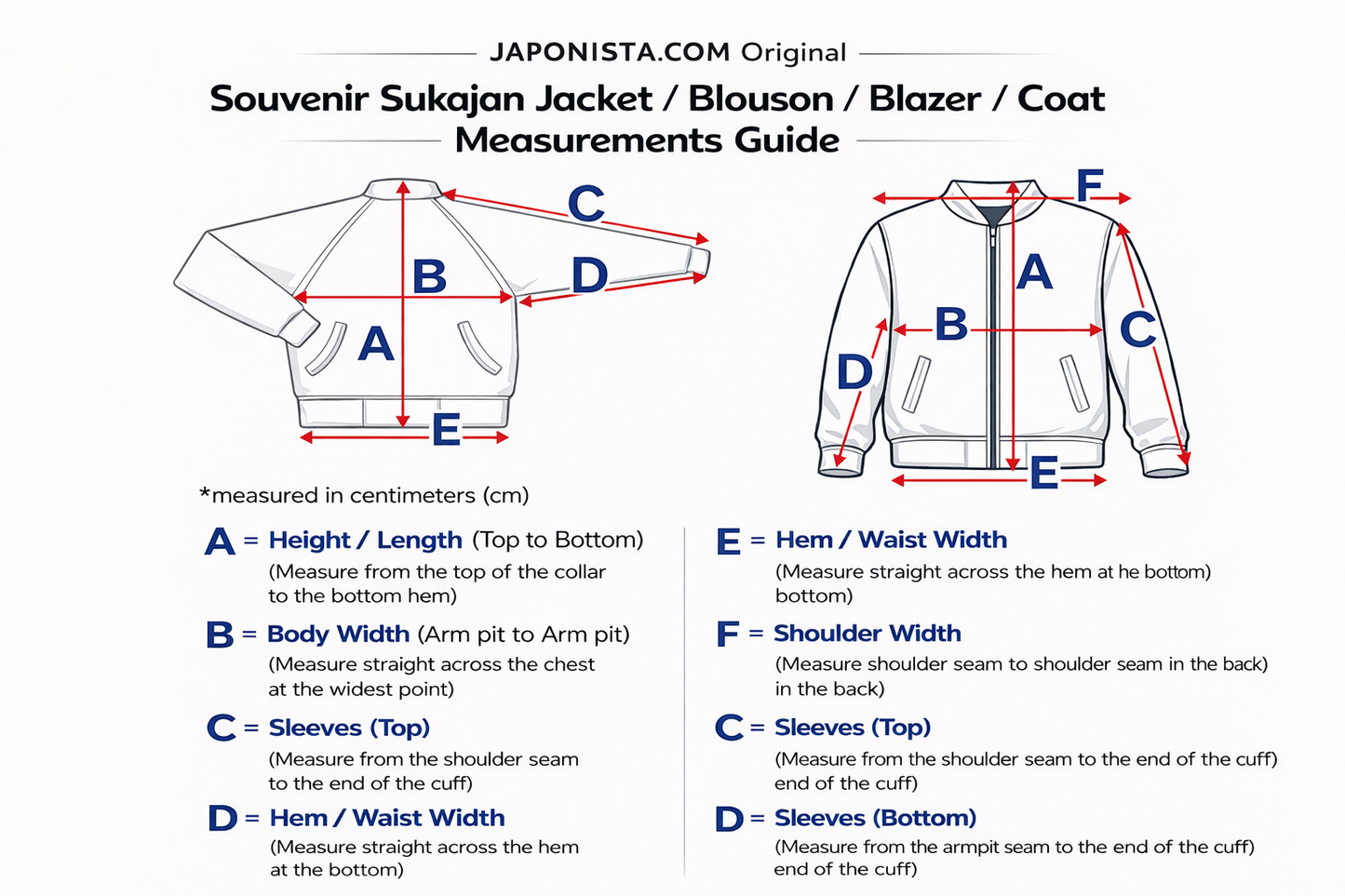
MEASUREMENTS, VISUAL ANALYSIS, AND EXTRAPOLATION
Using the ruler photos, body proportion, shoulder spread, sleeve extension, and pit-width image, the piece appears to sit in the Free Size / relaxed small-to-medium lane, with a slightly cropped body and comfortable width through the torso.
Estimated Flat Measurements
Length: approximately 52 to 54 cm
Measured from high shoulder / collar base to hem. The vertical ruler image suggests the full body including collar and rib lands around the low-50 cm zone, with slight variance depending on exact measuring points.
Pit to Pit: approximately 54 to 56 cm
The laid-flat width image suggests a moderate relaxed body, not oversized in an exaggerated way, but generous enough for a comfortable drape.
Shoulder Width: approximately 44 to 46 cm
The upper width image indicates a shoulder line that reads natural rather than dropped, with a soft bomber shoulder transition.
Sleeve Length: approximately 58 to 60 cm from shoulder seam equivalent
Because this is a kimono-remake / raglan-adjacent reconstruction, exact shoulder-seam logic may vary, but the sleeve appears moderately full and wearable for most S-M frames.
Approximate Center Back to Cuff / Yuki-Type Reading: approximately 76 to 79 cm
Hem Width: approximately 40 to 42 cm flat, stretchable due to ribbing
This suggests the hem will hug slightly and create the desirable bomber blouson effect.
Cuff Opening: standard fitted bomber cuff, likely around 8 to 10 cm flat unstretched
Fit Interpretation
This jacket does not read as oversized streetwear bulk. It reads as an art-piece bomber with a compact, feminine-neutral, gallery-friendly silhouette.
On a smaller wearer:
- relaxed through chest
- softly cropped
- sleeves slightly fuller and romantic
On a medium wearer:
- cleaner, closer bomber fit
- still enough space for a tee or light inner layer
- silhouette remains elegant rather than tight
On a taller frame:
- more cropped
- visually strong with high-waisted trousers or layered styling
- excellent for editorial dressing
Best Practical Size Call
Recommended listing size call:
Free Size (best for approx. S-M, depending on desired fit)
Suggested eBay / Etsy phrasing:
“Tagged / noted as Free Size. Please refer to measured dimensions for best fit.”
CONDITION & MATERIAL READING
From the images, this piece presents in very good remake vintage condition with the following characteristics:
- exterior fabric remains visually vibrant with high chromatic impact
- zipper appears intact and functional
- rib collar, cuffs, and hem show clean overall presentation
- interior construction visibly reflects handmade / small-batch remake character rather than factory luxury finishing
- inner seams and lining construction support the impression of a genuine kimono remake rather than a mass-produced print garment
Because this is created from repurposed kimono cloth, buyers should expect:
- minor tonal irregularity
- slight variation in weave tension or drape
- light age character consistent with reused textile origin
- artisanal rather than industrial standardization
That is not a flaw in category terms. It is part of the object’s identity.
Reusable Condition Text
Very good remake vintage condition with light signs consistent with upcycled textile origin and handmade reconstruction. Fabric remains vivid and visually striking, zipper functions well, and rib trim presents cleanly overall. As with many kimono remake garments, minor irregularities, soft age character, or subtle tonal variation may be present and should be understood as part of the charm and authenticity of repurposed Japanese textile work.
OVERVIEW
This jacket belongs to that rare category where the garment stops behaving like apparel alone and begins acting like a portable surface of image culture. It is not merely floral. It is composed. The textile carries the logic of a painted field: layers of leaves, blossoms, seasonal movement, and soft atmospheric transitions assembled into something closer to a Japanese screen fragment than a standard fashion fabric.
The cobalt ground gives the piece its force. It does not sit quietly behind the imagery. It creates depth, almost like twilight lacquer or a deep mineral dye bath, allowing the celadon and turquoise foliage to rise forward. Against that, the vermilion and coral blossoms work as visual punctuation marks, keeping the composition alive and preventing it from dissolving into decorative softness.
What makes the piece commercially strong is the balance between heritage textile memory and contemporary usability. Many remade kimono jackets lean either too costume-like or too simplified. This one escapes both traps. It has enough visual richness to feel special, yet the bomber construction, ribbed trims, and zip front give it immediate everyday readability.
In product-strategy terms, this is a jacket with unusually strong crossover appeal:
- textile collectors can appreciate the reuse of kimono fabric
- style buyers can wear it as an art-fashion statement
- editorial buyers can shoot it easily
- casual buyers can still understand it without needing cultural literacy
That is exactly why pieces like this punch above their technical simplicity. The value is not only in cut or brand. It is in surface intelligence.
ICONOGRAPHY & MOTIF ANALYSIS
The visible motif family suggests a seasonal Japanese floral garden composition rather than a single-mon motif or overtly formal ceremonial pattern. The textile appears to bring together several botanical registers:
Camellia-like Blossoms
The red and white blossoms, with rounded petal structure and distinct centered stamens, evoke camellia or camellia-adjacent floral language. In Japanese visual culture, camellia often carries associations of winter-to-spring elegance, restraint, and quiet beauty.
Maple Leaves
The red, angular leaves strongly evoke momiji, bringing a note of seasonality, movement, and transition. Maple imagery introduces emotional temperature. It adds rhythm. It keeps the composition from becoming merely floral and pushes it toward a broader seasonal landscape reading.
Layered Foliage and Grasses
The turquoise and celadon botanical massing suggests undergrowth, layered shrubs, and stylized seasonal plant life. This is important because it gives the jacket density. Instead of scattered motifs, we get an immersive field effect.
Silver-Grey Botanical Outlines
These quieter metallic-grey or pale silver plant forms create contour and hierarchy. They allow the vivid floral elements to breathe. Without them, the surface would be too loud. With them, it becomes orchestrated.
Atmospheric Washes
The pale gold and mist-white transitions across the body create a dyed-horizon effect, almost like light entering the garden. This is one of the reasons the jacket looks visually expensive even without embroidery. The textile already contains a painterly value structure.
MATERIAL & TEXTILE CHARACTER
This appears to be cut from a kimono fabric with a smooth, lightly lustrous hand. It most likely belongs in the silk / silk-blend family, though without burn test or label confirmation it is safest commercially to say:
“silk or silk-blend kimono textile”
or
“kimono textile with a silk-like hand and sheen.”
The reason this matters is that the garment’s value is not simply in pattern, but in how the surface catches light. That soft sheen allows the blues and pale golds to move as the body moves. In still photography, it creates visual richness. In real wear, it turns the garment into something almost animated.
The interior also tells a useful story. Rather than hiding its remake identity, the inside shows the transformed life of the cloth. This strengthens the object’s authenticity. It says plainly: this was once another form, and now it has been translated.
For buyers, that translation is the emotional hook.
They are not buying a floral jacket printed to look Japanese. They are buying a piece of Japanese textile history rerouted into contemporary wear.
CONSTRUCTION & SILHOUETTE ANALYSIS
This jacket uses the bomber as a practical vessel for a more delicate textile language. That contrast is what makes it effective.
The collar, cuffs, and hem give it a familiar outerwear grammar. The body, however, keeps the softness of kimono cloth. The sleeves have volume but not heaviness. The body is cropped enough to feel modern. The zipper grounds it in utility. Together, those elements create a silhouette that is easy to understand but visually uncommon.
It works because the maker did not overcomplicate the form. Too much intervention would fight the textile. Here, the garment lets the cloth speak.
The silhouette suggests:
- slightly cropped body
- comfortable torso width
- soft ballooning through sleeves
- light blousing at hem
- easy front-opening styling
It would pair well with:
- denim and boots
- black trousers and loafers
- soft neutral skirt or wide pants
- layered monochrome styling where the jacket becomes the image event
HISTORICAL AND CULTURAL CONTEXT
Kimono remakes occupy an interesting modern space within Japanese material culture. They are neither traditional kimono in the strict preservationist sense nor purely contemporary fashion divorced from origin. Instead, they represent a continuity through transformation.
As fewer people wear kimono in daily life, textiles that might otherwise remain folded, stored, or forgotten are sometimes reintroduced through reconstruction. This process can be commercially practical, but it can also be deeply aesthetic. It gives old cloth a second life while allowing present-day wearers to participate in the textile language of the past without needing to adopt the full formal system of kimono dressing.
That is one reason these pieces resonate globally. They lower the barrier to entry while preserving a strong trace of cultural materiality.
The best examples, like this one, do not erase their source. They carry it forward.
COLLECTOR RELEVANCE
This piece is stronger than a generic “kimono remake jacket” because it checks several premium boxes at once:
1. High-Impact Color
The cobalt and turquoise palette is immediately arresting and highly photogenic.
2. Dense Surface Composition
The textile does not rely on one motif floating on empty ground. It delivers real image density.
3. Easy Wearability
Bomber format makes it much more accessible than a more experimental pattern-cut remake.
4. One-of-One Energy
Even if not literally unique in a legal sense, it carries the emotional and visual force of a singular piece.
5. Broad Channel Flexibility
It can perform on Shopify, Etsy, and eBay without needing a brand name to justify attention.
6. Strong Styling Potential
This is exactly the kind of garment buyers imagine themselves “discovering,” rather than merely purchasing.
COLLECTOR’S RESONANCE
This is for the buyer who does not need a logo to feel they have found something good.
It is for the person who understands that surface can carry memory. For the stylist who sees the jacket as a frame for an outfit. For the collector who likes that Japanese textiles often communicate atmosphere rather than blunt spectacle. For the buyer who wants a conversation piece that still feels wearable and honest.
The emotional appeal of the piece lies in how it holds two moods at once:
- calm and vivid
- delicate and graphic
- historical and present
That tension is exactly what makes it elegant.

Kimono Remake, Aloha Shirts & Upcycled Garments
Reconstructed Textile, Cultural Translation & Wearable Archive
Authenticity & Stewardship
Evaluated under the Japonista Upcycled Textile Authentication Framework™:
• Source textile verification and material origin assessment
• Reconstruction technique and garment transformation review
• Structural integrity and wearability evaluation
• Stitching, reinforcement, and finishing analysis
• Condition transparency including textile age and variation
Guaranteed 100% Authentic.
All works are curated and backed by the Japonista Lifetime Authenticity Warranty™, with emphasis on transparency of source material and reconstruction method.
A Note on Transformation, Translation & Cultural Continuity
Upcycled garments represent the translation of traditional textiles into contemporary form. Kimono fabrics become aloha shirts, jackets, or hybrid garments—shifting from ceremonial or historical context into everyday wear.
At Japonista, these works are treated as acts of cultural reinterpretation rather than replication. Textile variation, pattern placement, and asymmetry reflect the constraints and creativity of working with existing material.
Visible inconsistencies are understood as part of the transformation process, preserving the narrative of the original garment within its new form.
Inquiries, Availability, and Private Consideration
Many upcycled garments are one-of-one due to the uniqueness of source textiles. Certain pieces are held firmly based on material rarity or design execution.
All inquiries are handled discreetly, and we welcome discussion regarding source textile, reconstruction process, or long-term wearability.
Concierge Support & Collector Guidance
Japonista Concierge™ provides guidance on textile care, washing considerations, storage, and preservation of mixed-age fabrics.
Whether intended for wear or collection, we guide each acquisition with clarity regarding material behavior and structural integrity.
For rare or highly detailed pieces, private consideration arrangements may be available.
Before Proceeding
We encourage collectors to review our shop policies outlining textile care, condition transparency, and handling considerations specific to upcycled and reconstructed garments.
A Closing Note
These garments carry two lives—their original form and their transformed identity. They stand as wearable records of continuity, adaptation, and creative reinterpretation.
We are honored to steward them between generations of material and design.
If you have questions or wish to explore related works, please feel free to contact Japonista Concierge™ at any time.