Rare Vintage, Antiques and Art Collector / Curator / Personal Shopper From Japan
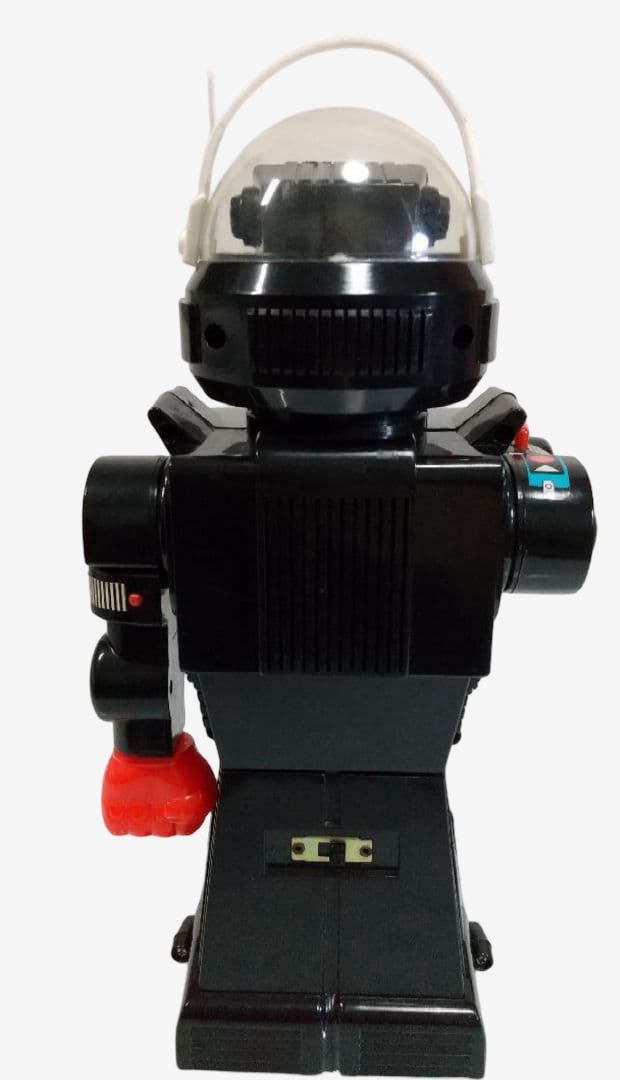
Kamco Cosmic Talking Robot · 12-Inch Battery-Operated Robot with Light-Up Eyes, Shooting Fists & Original Box · 1980s
Kamco Cosmic Talking Robot · 12-Inch Battery-Operated Robot with Light-Up Eyes, Shooting Fists & Original Box · 1980s
Couldn't load pickup availability
Have a reasonable price in mind? Submit your best offer and our concierge will review it personally.
Object: Cosmic Talking Robot
Trade Name: COSMIC TALKING ROBOT
Attributed Model: #8838
Maker / Brand: Kamco
Origin: China
Period: 1980s
Object Type: Battery-operated talking / sound-effect robot
Height: Approx. 12 in / 30 cm class
Construction: Molded plastic with electronic and mechanical components
Color: Black body, red illuminated eyes, red fists, clear head dome, printed control graphics
Power: Two C-cell batteries
Primary Actions: Bump-and-go movement, illuminated eyes, electronic voice / sound function, shooting fists
Additional Projectile Action: Model family documented with head-mounted missile action
Chest: Large circular speaker grille framed as a technological control surface
Head: Clear dome, twin illuminated red eyes and antenna elements
Packaging: Original illustrated cardboard box
Operation: Electrical function presently confirmed; several electronic firing/sound effects are produced
Speech Function: The model was originally designed with a talking function, although clear original speech output is not presently represented as confirmed
Condition: Vintage preserved condition with age-related marks and wear
Collector Category: 1980s space robots / talking robots / Kamco / battery-operated toys / electronic-era robots / retrofuturism
A KAMCO COSMIC TALKING ROBOT
China, 1980s
Battery-operated molded-plastic electronic robot
With original illustrated box
By the 1980s, the vocabulary of the mechanical robot had changed dramatically.
The polished tinplate machines of the postwar decades had given way to molded plastic, electronic sound, illuminated eyes and increasingly theatrical action features. The robot was no longer merely expected to walk.
It was expected to perform.
Kamco’s Cosmic Talking Robot captures that transition beautifully.
Standing approximately 12 inches high, the machine presents a deliberately imposing silhouette: a black mechanical body, broad shoulders, bright red fists, a transparent dome enclosing twin glowing eyes and a large central speaker grille occupying the torso.
The chest is particularly important.
Earlier robots displayed gears, gauges or imaginary television screens. Here, the central body becomes an audio device.
The robot does not merely suggest intelligence.
It attempts to speak.
The original model was engineered with electronic voice output, illuminated eyes, bump-and-go movement and projectile-firing fists, converting the robot into a compact multi-sensory spectacle.
Its front-facing speaker grille makes this functionality visually explicit.
The robot’s voice does not emerge invisibly from within the body.
The body has been designed around the idea of sound.
The original illustrated carton reinforces the theatrical effect.
Large metallic-style TALKING ROBOT typography dominates the dark cosmic background, while the robot is shown dramatically illuminated against outer-space imagery. Advertising text emphasizes light-up eyes and shooting fists, transforming the box almost into a movie poster for a machine that talks, moves and attacks.
The present example survives with that original graphic context intact.
Together, robot and packaging preserve a fascinating moment in 1980s toy culture, when inexpensive electronics allowed the old mechanical robot to acquire something that earlier tin machines could only imply:
a voice.
When the Robot Began to Speak
The Cosmic Talking Robot belongs to an important transitional generation.
Earlier robots communicated through movement.
They walked.
They sparked.
They flashed.
They spun.
The Cosmic Talking Robot adds another layer:
sound becomes personality.
That difference matters.
A walking robot can be understood as machinery.
A talking robot suggests character.
The moment a machine addresses the child directly, it stops feeling like a mechanism and begins behaving more like a companion.
That cultural shift would become enormously important in later electronic toys.
The Cosmic Talking Robot stands near the beginning of that mass-market transformation.
THE FACE
Light as Personality
The head is visually simple but extraordinarily effective.
A transparent plastic dome encloses twin red eyes.
The eyes glow when activated, giving the otherwise static face immediate character.
Rather than sculpt a human expression, the designers rely on light.
This creates a wonderfully machine-like personality.
The robot does not smile.
It illuminates.
That distinction preserves the technological fantasy.
The face remains unmistakably artificial.
THE CLEAR DOME
The transparent head cover belongs to a long lineage of science-fiction imagery.
Domes evoke:
astronaut helmets,
spacecraft canopies,
scientific equipment,
radio machinery,
and speculative electronics.
On the Cosmic Talking Robot, the dome acts almost like a protective laboratory shell around the robot’s optical system.
It also intensifies the illumination from the eyes, making the head appear more complex than its relatively simple molded structure.
THE CHEST AS SPEAKER
The most important graphic element is the large circular speaker opening in the center of the torso.
Earlier mechanical robots frequently placed decorative control panels in this area.
The Cosmic Talking Robot instead acknowledges its electronic function directly.
The chest becomes an acoustic device.
The robot’s “voice” physically emerges from its body.
This gives the object a strangely architectural quality.
The robot is not merely shaped like a human.
It is shaped around its electronics.
TALKING FUNCTION
The Cosmic Talking Robot was designed around electronic voice playback.
Collector documentation for model #8838 records a spoken phrase activated by pressing the head, accompanied by illuminated eyes.
A closely related K Toys / Robo Ace version uses the same basic idea and similarly combines talking, movement, light and projectile action.
The present example powers on and produces several electronic firing / sound effects.
The original full speech phrase should not be represented as currently confirmed unless separately demonstrated.
That distinction preserves the historical specification of the toy without overstating present function.
SHOOTING FISTS
The large red fists are not merely decorative.
They form part of the robot’s action system.
Projectile-firing fists were one of the great recurring motifs of Japanese and Asian robot toys during the 1970s and 1980s.
The idea transformed a simple arm into a weapon mechanism.
It also created a direct physical interaction between child and robot.
The fist could be loaded.
A control could be pressed.
The hand became a projectile.
The feature gave even relatively inexpensive plastic robots a dramatic action vocabulary associated with much grander science-fiction machines.
BUMP-AND-GO MOVEMENT
The robot belongs to the classic bump-and-go tradition.
Rather than simply walk forward until encountering an obstacle, bump-and-go mechanisms redirect the body after impact.
The effect creates an illusion of decision-making.
The machine appears to encounter the environment, reconsider its route and continue.
Of course the process is mechanical rather than intelligent.
But that illusion is precisely the charm.
A simple gear-and-wheel system produces behavior that feels almost autonomous.
SOUND AS SCIENCE FICTION
The electronic noises produced by toys of this period deserve attention in their own right.
They were rarely naturalistic.
Instead they belonged to a distinctive vocabulary of:
laser fire,
electronic pulses,
weapon noises,
synthetic speech,
warning signals,
and abstract machine sounds.
These noises helped define what “the future” sounded like to an entire generation.
The Cosmic Talking Robot is therefore not simply an object of visual design.
It belongs to the history of imagined electronic sound.
KAMCO AND THE 1980s ROBOT MARKET
Kamco produced a family of large plastic battery robots during the early 1980s, including models such as Saturn, Sentinel and Cosmic Talking Robot.
These machines shared several characteristics:
large molded-plastic bodies,
light-up eyes,
projectile features,
bump-and-go movement,
electronic effects,
and highly theatrical packaging.
They belonged to a period when the visual legacy of Japanese robot toys was being reproduced and transformed across a broader East Asian manufacturing network.
The result was a new generation of robots that were cheaper, larger and increasingly electronic.
DESIGN AND CONSTRUCTION
The Cosmic Talking Robot is built from strong, simple geometric masses.
The head is comparatively narrow and sits beneath a clear protective dome.
Two large red eyes dominate the face.
Below them, horizontal grille-like ridges create a mechanical mouth or ventilation structure.
The shoulders broaden dramatically from the neck.
Each arm is built from black cylindrical components and terminates in an oversized red fist.
The torso is rectangular, centered around the circular speaker.
Colored printed details across the shoulders and chest simulate switches, circuits and electronic controls.
The legs are broad and heavily molded, with printed technological graphics running down the front.
Large black feet stabilize the body.
The overall silhouette is unmistakably robotic without attempting realistic anatomy.
COLOR LANGUAGE
The palette is unusually disciplined.
Black dominates the structure.
Red is reserved for points of action:
eyes,
fists,
small electronic details.
That concentration gives the red components much more impact.
The glowing eyes and red fists become visual punctuation against the dark body.
It is a surprisingly effective design strategy for what was fundamentally a mass-market toy.
ORIGINAL BOX & GRAPHIC CULTURE
The original box is one of the strongest elements of the ensemble.
The packaging uses a black cosmic field punctuated by colored light.
Large metallic-style TALKING ROBOT typography dominates the upper half.
The robot stands centrally, raising one bright red fist toward the viewer.
Promotional text emphasizes its principal features:
12-inch giant talking robot
light-up eyes
shooting fists
battery-powered bump-and-go movement
The packaging is exuberant because the product itself is based on spectacle.
The carton does not attempt sophistication.
It sells the fantasy directly.
The robot talks.
Its eyes glow.
Its fists fire.
It moves on its own.
For collectors today, that unapologetic directness is part of the charm.
1980s ELECTRONIC FUTURISM
The Cosmic Talking Robot belongs to a different idea of the future than early tinplate robots.
The 1950s future was mechanical.
The 1960s future was orbital.
The 1970s future was technological and media-driven.
By the 1980s, the future had become electronic.
Sound chips, LEDs, plastic lenses and battery-powered circuits changed what toys could promise.
Robots could now appear to communicate.
The machine no longer needed gears visible behind a chest window.
It could simply make noise.
That shift is embodied perfectly in this object.
MATERIAL TRANSITION
The Plastic Robot Generation
The Cosmic Talking Robot is predominantly molded plastic.
That material allowed manufacturers to produce:
large bodies,
clear domes,
deep sculptural forms,
integrated projectile housings,
large speaker openings,
and brightly colored removable components
far more economically than would have been possible in traditional tinplate.
The result is visually different from earlier Japanese robots.
But it should not be treated as a lesser substitute.
It documents the next stage of the industry.
The robot became larger, more theatrical and more electronically expressive.
CONDITION
This Cosmic Talking Robot survives in strong vintage collectible condition with its original illustrated box.
The black molded body retains its distinctive printed control graphics, clear head dome, bright red fists and twin red eye lenses.
Age-related surface traces are present, including minor scratches, rubbing, small marks and other signs consistent with long-term preservation.
Electrical power has been confirmed.
The robot presently produces several electronic firing / action sounds.
The original model was designed with a talking function, illuminated eyes, movement and projectile action. Clear reproduction of the original complete speech sequence is not presently represented as confirmed.
The original illustrated box remains with the robot and exhibits visible age-related wear including edge wear, creasing, rubbing, corner wear and surface deterioration consistent with vintage cardboard packaging.
The piece should be regarded primarily as a vintage electronic collectible rather than a modern play toy.
Please examine all photographs carefully for the complete visual record of condition.
DIMENSIONS
Approx.
Height: 29–30 cm / 11.4–12 in
Collector references for both Kamco and closely related K Toys versions place the model in this approximately 12-inch scale.
The size gives the robot strong display presence while remaining comfortably cabinet-sized.
COLLECTOR SIGNIFICANCE
The Cosmic Talking Robot crosses several collecting categories:
1980s robots,
Kamco toys,
talking toys,
electronic robots,
battery-operated toys,
projectile robots,
space toys,
retrofuturism,
vintage electronics,
Asian toy manufacturing,
original packaging,
and science-fiction material culture.
Its strongest attribute is conceptual simplicity.
It is exactly what its box promises:
a robot that lights up, makes sound, moves and fires its fists.
That directness makes the object highly readable even to collectors who do not specialize in robots.
FROM MACHINE TO COMPANION
The model’s original voice function also places it within a larger cultural transformation.
Mechanical robots had traditionally been demonstrations of movement.
Electronic talking toys introduced a more emotional idea.
The robot could address the child.
That small technological change altered the relationship between toy and owner.
The machine was no longer simply watched.
It could appear to respond.
Later interactive toys would develop this idea enormously.
The Cosmic Talking Robot preserves an early, wonderfully primitive version of that ambition.
MUSEUM WALL LABEL
Cosmic Talking Robot
Kamco, model #8838
China
1980s
Molded plastic with electronic and mechanical components
Battery-operated talking / sound-action robot
Original illustrated cardboard box
Approx. 30 cm / 12 in high
The Cosmic Talking Robot represents the electronic evolution of the postwar mechanical robot toy.
Its design combines illuminated red eyes, bump-and-go movement, sound output and projectile-firing fists within a large molded-plastic body.
The broad circular speaker grille built into the chest makes sound itself part of the robot’s visual identity.
Rather than simply simulate machinery, the robot was designed to communicate.
Its original illustrated box celebrates these functions through dramatic cosmic graphics and promotional typography, preserving the exuberant visual language of 1980s electronic toy culture.
COLLECTOR’S NOTE
Earlier robots impressed children by moving.
This one wanted to introduce itself.
That difference is deceptively important.
The Cosmic Talking Robot belongs to the generation in which electronic toys began crossing the line from object to character.
The voice may be primitive.
The lights are simple.
The movement is mechanical.
But together they create something more than the sum of those parts:
the impression that the machine has noticed you.
Authenticity & Collectible Stewardship
Evaluated under the Japonista Collectibles Authentication Framework™:
-
Period, manufacturer, and production-era assessment
-
Material, paint, lithography, and surface-wear analysis
-
Mechanical, structural, and component integrity review (where applicable)
-
Design, iconography, and cultural-context verification
Guaranteed 100% Authentic.
Every piece is backed by the Japonista Lifetime Authenticity Warranty™ and curated with collector-grade scrutiny.
A Note on Collecting & Preservation
At Japonista, we approach vintage and modern toys not merely as nostalgic objects, but as design artifacts, cultural touchstones, and expressions of their era—from postwar ingenuity and Showa imagination to contemporary pop and designer movements.
Each work is carefully examined, researched, and presented with respect for its original intent, historical context, and collector relevance, balancing preservation with the honest character earned through time and play.
Our role is not only to offer access to meaningful collectibles, but to act as thoughtful custodians—connecting the right pieces with collectors who value history, originality, and lasting significance.
Inquiries, Availability, and Private Consideration
Some collectible works may allow room for discussion, while others are held firmly due to rarity, condition, provenance, or cultural importance. All inquiries are reviewed personally and discreetly, and we welcome thoughtful questions or expressions of interest.
If you are exploring a specific theme, franchise, maker, era, or mechanical category—or seeking guidance in building a focused collection—our team is always available to assist with informed, quiet expertise.
Concierge Support & Collector Guidance
Japonista Concierge™ offers personalized assistance for collectors seeking deeper understanding, strategic acquisitions, or long-term curation across vintage and modern collectibles.
Whether your interest lies in nostalgia, design history, mechanical fascination, or pop-culture legacy, we are here to support your collecting journey with clarity, care, and discretion.
For select high-value or historically significant pieces, private reservation or structured payment arrangements may be available on a case-by-case basis. Please contact us to discuss eligibility and options.
Before Proceeding
We kindly encourage collectors to review our shop policies and house guidelines, available through the links in our website footer, which outline shipping, handling, and condition standards specific to vintage, mechanical, and collectible works.
A Closing Note
Thank you for exploring Japonista’s collection of vintage and modern toys, robots, and cultural collectibles. We are honored to share these enduring objects of imagination and design—and to help place them where they may continue to be appreciated, studied, and enjoyed.
If you have questions or wish to explore related works, please feel free to contact Japonista Concierge™ at any time.