Rare Vintage, Antiques and Art Collector / Curator / Personal Shopper From Japan
Kajikawa-School Gold Maki-e Inro Pendant — Gold Lacquer Landscape Scene — With Ojime & Netsuke (Edo–Meiji Japan)
Kajikawa-School Gold Maki-e Inro Pendant — Gold Lacquer Landscape Scene — With Ojime & Netsuke (Edo–Meiji Japan)
Couldn't load pickup availability
Have a reasonable price in mind? Submit your best offer and our concierge will review it personally.
Kajikawa-School Gold Maki-e Inro Pendant
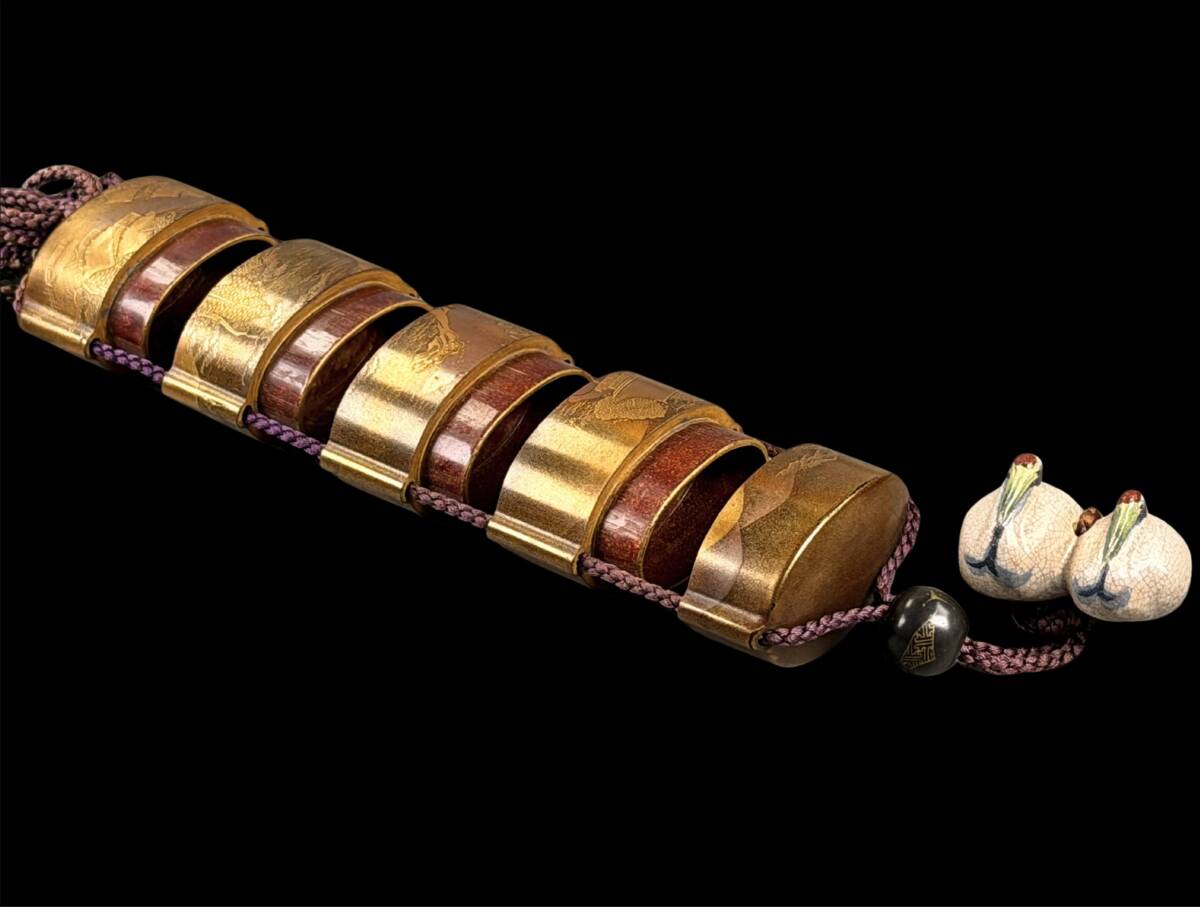
A compact Japanese inro pendant executed in luminous gold maki-e lacquer, featuring a continuous landscape tableau designed to unfold as the piece turns in the hand. Presented with cord, ojime, and netsuke elements as pictured, restoring the object’s identity as wearable equipment as well as miniature portable art.
MATERIAL, PERIOD & ATTRIBUTION
- Object: Inro (pendant container), cylindrical form
- Material (body): lacquered core typical for inro; exact core cannot be confirmed without inspection
- Surface: gold maki-e decoration over lacquer ground; layered finishing possible
- Fittings: cord, ojime, and netsuke elements included as pictured (materials of the white animal-form elements require verification)
- Attribution: Kajikawa-school / workshop association (signature/hallmark confirmation recommended)
- Period: Edo to Meiji Japan (estimated)
DESIGN, ICONOGRAPHY & TECHNIQUE
The cylindrical format turns the landscape into a narrative device: the viewer rotates the object and the scene unfolds sequentially, producing a rhythm of shoreline, architecture, and distant horizon. Japanese lacquer landscapes often evoke celebrated places through a shared visual vocabulary rather than literal labeling, allowing the work to feel historically grounded while remaining poetically open in interpretation.
In refined maki-e, gold functions as atmosphere as much as ornament. Powder density and grading can imply light, mist, and water movement, while layered finishing and selective polishing can make the image appear integrated into the lacquer surface rather than simply applied on top.
ITEM SUMMARY
Object: Inro (pendant container), cylindrical form
Technique: Gold maki-e lacquer (likely hiramakie with selective polishing; nashiji-style ground possible)
Motif: Continuous landscape with architecture and distant horizon (classical scenic view)
Includes: Cord; ojime; netsuke / bead components (as pictured)
Period: Edo to Meiji (estimated; see Confidence & Verification Notes)
Primary appeal: Kajikawa-school association; elegant continuous scene; complete wearable set
WHAT IS THIS (MICRO GLOSSARY)
Inro:
A small container worn suspended from the sash. Historically used for seals, medicines, or personal items; collected today as miniature “portable art.”
Maki-e:
A lacquer technique in which metal powders (often gold) are placed into wet lacquer to form images, then protected and polished to create depth and luminosity.
Ojime:
A sliding bead that tightens the cord and helps keep the inro closed; both functional and decorative.
Netsuke:
A toggle that anchors the cord at the sash. Netsuke are widely collected in their own right; paired with inro they form a complete wearable system.
MATERIAL, PERIOD & ATTRIBUTION
Material (body):
Most inro of this type are lacquered over a wood core; exact core material cannot be confirmed without direct inspection.
Surface:
Gold maki-e decoration over a dark lacquer ground. The scene appears to rely on controlled gold density and layered finishing; a nashiji-like “pear-skin” sparkle in the ground is possible (verify with close-ups).
Fittings:
Cord and bead components as pictured. The white animal-form elements appear ceramic/composite in the screenshot, but material cannot be confirmed from the provided image alone.
Attribution:
Kajikawa-school / workshop association based on listing language and the object category. Strict attribution requires clear close-ups of any signature/mark and the quality of technique at macro scale.
Period:
Edo to Meiji Japan (estimated). Precise dating requires construction details, signature verification, and condition/finish analysis under raking light.
Curatorial note on “Kajikawa”:
In collecting practice, “Kajikawa school” can indicate direct workshop production, an affiliated hand, or later works made in the Kajikawa taste. Treat name-association as a collecting category unless documentary or signature evidence is clearly legible.
DESIGN, ICONOGRAPHY & TECHNIQUE
The cylinder as narrative device:
Unlike flat surfaces, a cylinder forces the composition to become time-based: the viewer must rotate the object, and the landscape unfolds sequentially. This format is inherently demanding—continuity must be maintained, transitions must remain elegant, and the scene must “close” seamlessly without awkward breaks.
Landscape iconography:
Japanese lacquer landscapes often evoke celebrated places through a shared vocabulary (pavilion architecture, shoreline rhythms, open water, distant peaks). These motifs function like poetry: recognizable grammar, deliberately suggestive content. The best examples feel specific enough to be credible while remaining open enough to be emotionally universal.
Gold as atmosphere:
In high-grade maki-e, gold is used to describe air and light, not just outline. Powder grading matters: finer particles read as haze; denser application reads as highlight or proximity. When polished under clear layers, the image can appear embedded within lacquer rather than sitting on top—one of the strongest visual signals of care and finishing discipline.
Collector technique checklist:
- Multiple gold particle sizes used intentionally (not monotone “flat gold”)
- Clean architectural edges with controlled lacquer boundaries
- Polished transitions where highlights feel integrated, not sprayed-on
- Wear logic consistent with honest handling (high-point softening vs random patchy loss)
- No obvious later overcoating that dulls contrast or “plastics” the surface
DIMENSIONS
- Size (approx.): about 9.5 cm tall; about 5 cm diameter
Collector Relevance
Why collectors pursue this category: Kajikawa-school associations sit at the top of inro collecting language; continuous landscape compositions display exceptionally well; and a complete suspension set reads as authentic wearable equipment rather than an isolated fragment.
Collector’s Resonance: For collectors who want portable Japanese art with museum-grade presence in the hand—an object that can sit in a vitrine like sculpture yet still carries the intimacy of daily life and personal ritual.
Authenticity & Stewardship
Evaluated under the Japonista Authentication Framework™:
- Material, carving, and surface-study comparison
- Iconographic and stylistic verification
- Condition and stability review (surface integrity)
- Construction assessment and handling-risk evaluation
Guaranteed 100% Authentic. Covered by the Japonista Lifetime Authenticity Warranty™.
A Note on Stewardship and Collecting
At Japonista, we approach Buddhist statues, sacred images, and ritual objects not merely as collectibles, but as cultural and spiritual artifacts deserving of respect, understanding, and careful presentation. Every piece we offer is thoughtfully examined, researched, and curated with sensitivity to its origin, meaning, and historical role.
Our role is not only to offer access to rare and meaningful objects, but to serve as responsible custodians—connecting the right works with collectors who value depth, intention, and authenticity.
Inquiries, Availability, and Private Consideration
Some of the cultural and heritage works may allow room for discussion, while others are held firmly due to rarity, condition, or cultural importance. All inquiries are reviewed personally and discreetly, and we welcome thoughtful questions or expressions of interest.
If you are exploring a particular theme, deity, lineage, or period—or seeking guidance in building a focused collection—our concierge team is always available to assist with quiet expertise and care.
Concierge Support & Collector Guidance
Japonista Concierge™ provides personalized assistance for collectors seeking deeper understanding, thoughtful acquisition, or long-term curation strategies. Whether your interest is devotional, scholarly, or aesthetic, we are here to help guide your journey with clarity and respect.
For select high-value or historically significant works, private reservation or structured payment arrangements may be available on a case-by-case basis. Please reach out to discuss eligibility and discreet options.
Before Proceeding
We kindly encourage collectors to review our shop policies and house guidelines, available through the links in our website footer, which outline shipping, handling, and conditions specific to vintage, sacred, and collectible works.
A Closing Note
Thank you for exploring Japonista’s collection of Oriental Cultural Heritage and arts. We are honored to share these meaningful works and to help place them where they may continue to be appreciated, studied, and respected.
If you have questions or wish to explore related works, please feel free to contact Japonista Concierge™ at any time.