Rare Vintage, Antiques and Art Collector / Curator / Personal Shopper From Japan
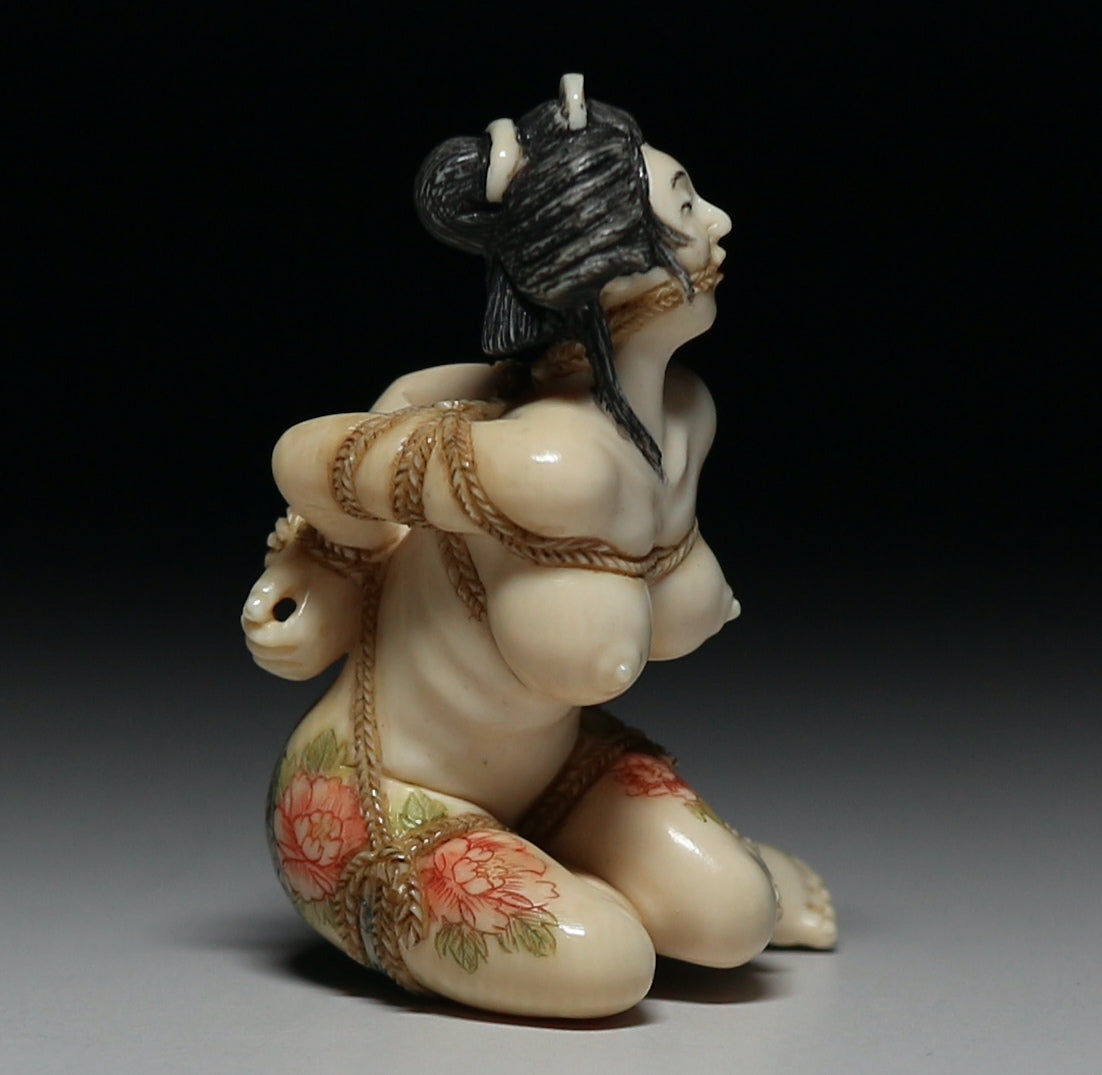
Japanese Shunga Erotic Sculpture in Mammoth Ivory — Rope-Bound Rope Bondage Shibari Art Female Figure, Hand-Carved Art Object
Japanese Shunga Erotic Sculpture in Mammoth Ivory — Rope-Bound Rope Bondage Shibari Art Female Figure, Hand-Carved Art Object
Couldn't load pickup availability
Have a reasonable price in mind? Submit your best offer and our concierge will review it personally.
CURATORIAL OVERVIEW — WHAT THIS OBJECT ACTUALLY IS
This sculpture is a contemporary, studio-grade reinterpretation of Japanese shunga, expressed through small-scale figural carving rather than printmaking. While shunga is most commonly associated with Edo-period woodblock prints, erotic three-dimensional objects occupy a far narrower, more discreet lineage, traditionally intended for private contemplation and connoisseurship.
The artist here adopts historical erotic iconography—female nudity, restrained posture, and theatrical expression—while executing the work in mammoth ivory, a material historically associated with luxury carving and now used as an ethical alternative to elephant ivory. The result is neither folk doll nor novelty object, but a collectible art sculpture, aligned with netsuke-level craftsmanship and modern erotic fine art.
Object Type
Erotic figural sculpture / shunga-inspired three-dimensional carving
Era
Modern hand-carved work (late 20th century–early 21st century), consciously referencing Edo–Taisho shunga aesthetics
Origin
Japan
Material
Woolly mammoth ivory (kenaga mammoth tusk)
Dimensions
Approx. H 50 mm × W 31 mm × D 30 mm
Condition (Truth State)
Excellent condition; clean, glossy surface; no visible cracks or losses; natural grain variation consistent with mammoth ivory
ICONOGRAPHY & THEMATIC ANALYSIS
The kneeling female figure is depicted in a rope-bound pose, referencing kinbaku and restraint imagery that emerged visually in late Edo shunga and later developed in Japanese erotic culture. The tension between exposed form and controlled posture emphasizes psychological intensity rather than explicit action.
Surface-engraved floral motifs on the lower body echo traditional tattoo and kimono patterning, visually linking the figure to shunga body decoration. The facial expression—eyes half-closed, mouth slightly parted—draws from classical erotic sculpture tropes that prioritize suggestion and emotional state over anatomical exaggeration.
The sculpture is designed for 360-degree viewing, encouraging slow rotation and intimate inspection.
MATERIAL & CRAFT ASSESSMENT
Mammoth ivory is a technically demanding medium:
-
denser and more fibrous than elephant ivory
-
unforgiving at small scale
-
prone to visible grain if mishandled
At approximately 5 cm in height, this piece demonstrates:
-
controlled anatomical proportions
-
smooth transitions between limbs and torso
-
confident handling of negative space around the arms and rope
The polish is even and deliberate, suggesting experienced, intentional carving, not experimental work.
HISTORICAL CONTEXT — WHY THESE SURVIVE AT ALL
Three-dimensional erotic sculpture has always existed on the margins of Japanese art due to:
-
historical censorship
-
private circulation
-
high material cost
Modern works such as this are typically produced in extremely limited numbers, often sold quietly to collectors rather than publicly exhibited. Unlike prints, there is no established mass market; unlike folk dolls, there is no workshop system producing multiples. Survival rates are therefore inherently low, and documentation is sparse.
Scarcity here is structural, not accidental.
COLLECTOR RELEVANCE
This piece is relevant to collectors of:
-
shunga beyond woodblock prints
-
erotic art as fine sculpture
-
mammoth ivory carving
-
contemporary Japanese artisan work
-
taboo or private-culture artifacts
It aligns well with high-end netsuke, contemporary erotic bronzes, and curated shunga collections rather than decorative curios.
SUMMARY — WHY THIS PIECE MATTERS
This sculpture demonstrates how shunga persists as a living visual language, translated into modern materials and refined carving rather than replicated as historical pastiche. Its value lies in craft discipline, controlled eroticism, and scarcity, making it a connoisseur object rather than a provocative novelty.
PRIVATE CULTURE ARCHIVE
Shunga & Hidden Arts
Japanese erotic art objects, concealed craft traditions, and quiet connoisseur pieces — presented with museum-grade context and restraint.
CURATORIAL OVERVIEW — WHAT THIS COLLECTION ACTUALLY IS
Shunga & Hidden Arts is a private-culture archive: objects made for discreet viewing, intimate humor, and coded storytelling—where craft carries what polite society refuses to say out loud.
Shunga is most often reduced to Edo-period woodblock prints, but the lived tradition is far broader. Alongside prints existed sculptural works, concealed objects, narrative figurines, and intimate curios whose meaning revealed itself only to those who handled them closely. These were not made for display rooms or formal halls. They were made for drawers, boxes, trusted friends, and moments of private curiosity.
This collection focuses on three-dimensional and material culture. Here, the hand of the maker matters as much as the theme. Carving discipline, surface aging, textile bases, micro-scale detailing, and the physics of concealment all become part of the story. The goal is not shock. It is clarity: how intimacy was expressed, preserved, and quietly enjoyed as lived culture.
Every object is presented with context-first writing—what it is, why it exists, how it fits Japanese visual language, and what collector lane it belongs to. Where attribution or dating is uncertain, that uncertainty is stated openly. In this category, credibility is the real luxury.
SCOPE OF THE COLLECTION
This archive includes:
-
Sculptural shunga objects beyond prints
-
Concealed or “hidden-image” works (ura-kakushi)
-
Erotic folk figures and vernacular carvings
-
Studio-grade artisan pieces referencing classical erotic iconography
-
High-material works (ceramic, textile, mammoth ivory) produced in limited numbers
These objects are framed as cultural artifacts, not novelty items.
HISTORICAL CONTEXT — WHY THESE OBJECTS EXIST
Erotic imagery has always existed in Japanese culture, but its physical forms were shaped by censorship, social codes, and private circulation. While prints could be produced in quantity, three-dimensional erotic objects were far riskier to make, own, and preserve. As a result, sculptural and concealed erotic works were typically produced in small numbers, circulated discreetly, and rarely documented.
Many were destroyed. Others were hidden, passed down quietly, or absorbed into private collections without records. What survives today does so not by accident, but because someone chose to preserve it despite social pressure.
This collection exists to document that survival.
COLLECTOR POSITIONING
Shunga & Hidden Arts is intended for collectors who value:
-
Context over provocation
-
Craft over gimmick
-
Rarity over mass appeal
-
Cultural literacy over shock value
These pieces sit comfortably alongside netsuke, vernacular folk sculpture, contemporary erotic bronzes, and archival shunga albums. They are connoisseur objects, meant to be understood slowly and cataloged thoughtfully.
ETHICAL & PRESENTATION NOTE
Adult themes appear throughout this archive. They are presented in a museum and academic tone, prioritizing cultural history, craftsmanship, and visual language rather than explicit instruction or sensationalism.
Viewer discretion is advised, but the intent is educational and curatorial.
CONCIERGE NOTE
If you are searching for a specific motif, material, era, or scale—or wish to build a coherent sub-collection within this archive—we can curate discreetly and professionally within your collector lane.
SUMMARY — WHY THIS COLLECTION MATTERS
Shunga & Hidden Arts preserves what official histories often omit: intimacy as lived experience, humor as social release, and eroticism as cultural language rather than spectacle.
These objects matter because they show how people actually lived, laughed, desired, and created—quietly, privately, and with remarkable craft.
Authenticity & Stewardship
Evaluated under the Japonista Authentication Framework™:
- Material, carving, and surface-study comparison
- Iconographic and stylistic verification
- Condition and stability review (surface integrity)
- Construction assessment and handling-risk evaluation
Guaranteed 100% Authentic. Covered by the Japonista Lifetime Authenticity Warranty™.
A Note on Stewardship and Collecting
At Japonista, we approach Buddhist statues, sacred images, and ritual objects not merely as collectibles, but as cultural and spiritual artifacts deserving of respect, understanding, and careful presentation. Every piece we offer is thoughtfully examined, researched, and curated with sensitivity to its origin, meaning, and historical role.
Our role is not only to offer access to rare and meaningful objects, but to serve as responsible custodians—connecting the right works with collectors who value depth, intention, and authenticity.
Inquiries, Availability, and Private Consideration
Some of the cultural and heritage works may allow room for discussion, while others are held firmly due to rarity, condition, or cultural importance. All inquiries are reviewed personally and discreetly, and we welcome thoughtful questions or expressions of interest.
If you are exploring a particular theme, deity, lineage, or period—or seeking guidance in building a focused collection—our concierge team is always available to assist with quiet expertise and care.
Concierge Support & Collector Guidance
Japonista Concierge™ provides personalized assistance for collectors seeking deeper understanding, thoughtful acquisition, or long-term curation strategies. Whether your interest is devotional, scholarly, or aesthetic, we are here to help guide your journey with clarity and respect.
For select high-value or historically significant works, private reservation or structured payment arrangements may be available on a case-by-case basis. Please reach out to discuss eligibility and discreet options.
Before Proceeding
We kindly encourage collectors to review our shop policies and house guidelines, available through the links in our website footer, which outline shipping, handling, and conditions specific to vintage, sacred, and collectible works.
A Closing Note
Thank you for exploring Japonista’s collection of Oriental Cultural Heritage and arts. We are honored to share these meaningful works and to help place them where they may continue to be appreciated, studied, and respected.
If you have questions or wish to explore related works, please feel free to contact Japonista Concierge™ at any time.