
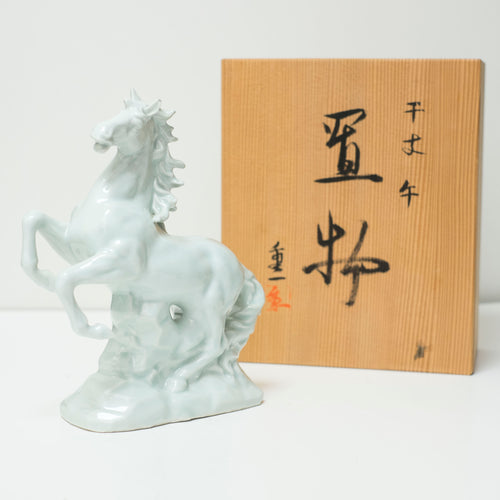


Japanese Seiji Celadon Porcelain Rearing Horse Okimono, Eto Uma Zodiac, with Inscribed Wooden Box
Japanese Seiji Celadon Porcelain Rearing Horse Okimono, Eto Uma Zodiac, with Inscribed Wooden Box
- Dispatch
- Prepared and sent from Tokyo within 7–14 days, often sooner, or as arranged
- Arrival
- United States · usually 4–7 days after dispatch, insured and tracked Check the Shipping Flowchart here
- Shipping
- EMS recommended, with FedEx, DHL and UPS compared ·
- Import
Duties and customs · View the estimate
A guide for this piece: about $32, based on the 10% US charge on the declared value of goods made in Japan.
The final figure is set by US Customs and depends on where the piece was made and the kind of object it is. Many antiques over a century old carry no ordinary duty; most jewellery and leather goods add a single-digit rate.
With EMS, any charge is collected by your postal service on delivery. For pieces of significant value we can often arrange duties prepaid before dispatch.
Your customs authority: U.S. Customs and Border Protection (CBP), CBP Information Center · +1 877 227 5511 within the United States; +1 202 325 8000 from abroad (Monday to Friday, 8:30 to 17:00 Eastern)
These figures are estimates for your guidance; the charge set by customs may come in over or under them.
How the estimate is reached · Ask for a figure on this piece
- Character
- Scoring underway ·
- Replies
- Within one Tokyo business day · Ask the curator team
- Guarantee
- Authenticity guaranteed · How we grade
Every piece is measured by hand, in centimetres as Japan measures. Please allow 1–2 cm (about ½ inch) for the give of the material and the hand that held the tape.
Where each figure is taken · View the plate

Object, sculpture and ceramics
Couldn't load pickup availability
All sales are final. Please read our refund policy before purchase.
Considered offers only. The Desk replies personally to figures made in good faith; those set far below the asking price receive no reply.
Examined in Tokyo, one price, insured to your door. How buying from Japonista works · Join the Circle, free
Finished in a single pale blue-green seiji glaze, this Japanese porcelain horse rises from a rocky base with both forelegs lifted and its mane breaking into curling locks. Its signed and sealed wooden box names it an eto uma okimono, a display sculpture of the Horse of the Japanese zodiac.
The Piece
The horse is captured at the instant its energy leaves the ground: both front legs raised, neck arched, head turned slightly, mouth open and ears alert, while the tail falls in a broad flowing movement toward the base to balance the lifted forequarters. It is not standing, grazing or reduced to a simplified zodiac emblem; it rises. The silhouette changes with the viewing angle. From the front three-quarter view the chest and raised forelegs dominate; from the opposite side the long sweep of back and hindquarters comes forward; in profile, the open passages beneath the body and around the raised legs give the figure air, so a compact porcelain sculpture never feels heavy.
Because the sculpture is essentially monochrome, its character comes entirely from form. The muzzle projects forward with the nostrils modeled into the face, and the ears rise independently above the head. Behind them the mane is modeled into projecting locks that rise and curl down the neck rather than forming a single ridge; their edges catch the light and, seen from the opposite side, read almost as a decorative crest. Across the torso the surfaces are kept broad and smooth so that reflected light describes the anatomy: the shoulders swell into the chest, the belly narrows toward the hindquarters, and the rear legs are planted firmly enough to carry the upward motion. The rocky base rises into the underside of the horse as part of the landscape rather than as an obvious brace, and open areas are kept around the legs and belly, so the support remains present but subordinate and the animal still feels airborne.
The glaze is seiji, the Japanese name for celadon, part of a long East Asian ceramic tradition in which subtle iron-bearing glazes develop cool green, blue-green or jade-like tones in the firing. Here the color is especially restrained. It moves from an almost luminous white to a cool, misty blue-green, appearing slightly stronger in the recesses of the mane, legs and rockwork, so the form gains depth without painted outlines. There is no painted pattern competing with the horse: thin areas look light and nearly translucent, rounded muscles catch bright highlights, and the surface changes as the piece moves relative to a window or lamp. Bright daylight makes it appear almost icy; warmer interior light brings out the green-blue undertone, sometimes toward ivory-green; a directional spotlight dramatizes the rearing form, while soft ambient light makes it quiet and almost jade-like.
The Horse, uma, is one of the twelve animals of the traditional Japanese zodiac and has long carried associations with forward movement, vitality, independence, speed and determination; the upward posture, alert expression and raised chest make this an apt and optimistic interpretation. Horse years include 1966, 1978, 1990, 2002, 2014 and 2026, with earlier years repeating on the twelve-year cycle. For someone born in a Horse year the piece becomes personal; it equally suits New Year display, a gift marking a new home, business, graduation, career advance, journey or milestone birthday, or simply a collection of equestrian art. A Horse-year figure may be displayed for its year and then preserved until the cycle returns twelve years later, and a vintage example shown in a later Horse year, such as 2026, carries that sense of recurrence.
In Japanese visual culture horses were long associated with transport, warfare, ceremony, status and sacred offering, and appear in sculpture, painting, shrine culture, festival traditions, warrior imagery and the decorative arts. This figure needs none of that context to succeed. There is no saddle, rider or narrative scene, only the animal, and the celadon surface sets it apart from the brown, black and metallic finishes that dominate equestrian sculpture: a horse rendered in mist. For the collector of Japanese ceramics it brings together seiji-style porcelain, animal sculpture, zodiac imagery, the okimono tradition, signed box presentation and twentieth-century Japanese decorative culture.
Details
- Origin: Japan
- Era: Vintage, twentieth century
- Material: Porcelain with seiji (celadon) glaze; wooden presentation box with ink calligraphy, red seal and braided cord
- Color: Pale blue-green celadon
- Subject: Rearing horse on a rocky base; eto uma, the Horse of the Japanese zodiac
- Measurements: Height 23 cm · Width 21 cm · Depth 8 cm (approx.)
- Included: Original inscribed, signed and sealed wooden presentation box
- Box wood: Catalogued as paulownia
Condition
- Presents beautifully: the glossy pale celadon surface appears clean and well preserved, with the ears, mane, raised forelegs, tail and projecting details intact in the available views.
- No obvious major crack, large chip or significant repair is visible in the photographs.
- As with any vintage glazed ceramic, minor firing characteristics, tiny glaze irregularities, faint surface marks or light age-related wear may be present.
- The wooden presentation box shows natural age toning and minor handling consistent with storage and use.
- The raised legs, ears and mane are projecting porcelain elements, so careful handling is strongly recommended.
- Measurements are approximate; the photographs form an important part of this condition description.
Box Inscription
The large central calligraphy identifies the object as an okimono, a decorative object or display sculpture. A smaller inscription names the subject as eto uma, the Horse of the zodiac, and a smaller handwritten artist or workshop inscription with a red seal appears along the lower portion of the box.
Earlier descriptive material read the central inscription as shunma, or swift steed. On closer reading it identifies the work as an okimono; the horse interpretation stands, and the box more precisely presents the piece as a zodiac Horse display sculpture.
In Japanese collecting, a purpose-made wooden box is not disposable packaging: when it carries a work's title with a maker or workshop signature and seal, it accompanies the object through storage, gifting and inheritance and becomes part of its identity. The box belongs with the sculpture, and together the cool, reflective porcelain and the warm, calligraphic wood form a small Japanese ensemble.
Display Notes
Substantial enough to hold visual space yet easy to place on a shelf, console, cabinet or in a tokonoma-inspired arrangement, the horse needs very little assistance.
- Alone, for maximum simplicity, or with the signed box set slightly behind so the calligraphy can be read
- Dark timber, charcoal or black lacquer for a dramatic, formal presentation
- Natural oak or paulownia for a softer Japanese-modern atmosphere
- An indigo textile beneath to complement the cool celadon
- An off-white wall with ample negative space for a quiet contemporary setting
Authenticity & Care
The wooden box carries the title okimono, the subject eto uma and a handwritten artist or workshop inscription with a red seal along its lower portion; no maker is named in the present description. Every piece is examined and documented in Japan before dispatch and is offered with the Japonista authenticity guarantee.
Delivery from Japan
Packed by hand in Japan and shipped insured and tracked by EMS or an equivalent express service. Import duties and taxes, where applicable, are payable on arrival. Every sale is final; please ask anything you wish to know before you buy, and see our published policy.
Considered offers are welcome through Send an Offer, and each one is reviewed personally.
Continue browsing: Ceramics & Porcelain · Okimono
Kiln & Crate
Large chargers, vases and paired pieces travel in custom crates with insured freight through our Museum-Grade Logistics Suite™. For a piece not shown here, Otoriyose™ examines it, quotes one considered price and sends it to you. Open a case file →
Collectors also search: japanese celadon horse figurine · seiji porcelain horse · year of the horse okimono · japanese zodiac horse statue · rearing horse porcelain sculpture · eto uma okimono · 2026 year of the horse gift · japanese porcelain horse with wooden box


Chosen for you