Rare Vintage, Antiques and Art Collector / Curator / Personal Shopper From Japan
Japanese Golden Dragon Sculpture Crystal Orb Ganpo Ryu Wish Jewel Statue Feng Shui Prosperity Decor Original Kiri Box
Japanese Golden Dragon Sculpture Crystal Orb Ganpo Ryu Wish Jewel Statue Feng Shui Prosperity Decor Original Kiri Box
Couldn't load pickup availability
Have a reasonable price in mind? Submit your best offer and our concierge will review it personally.
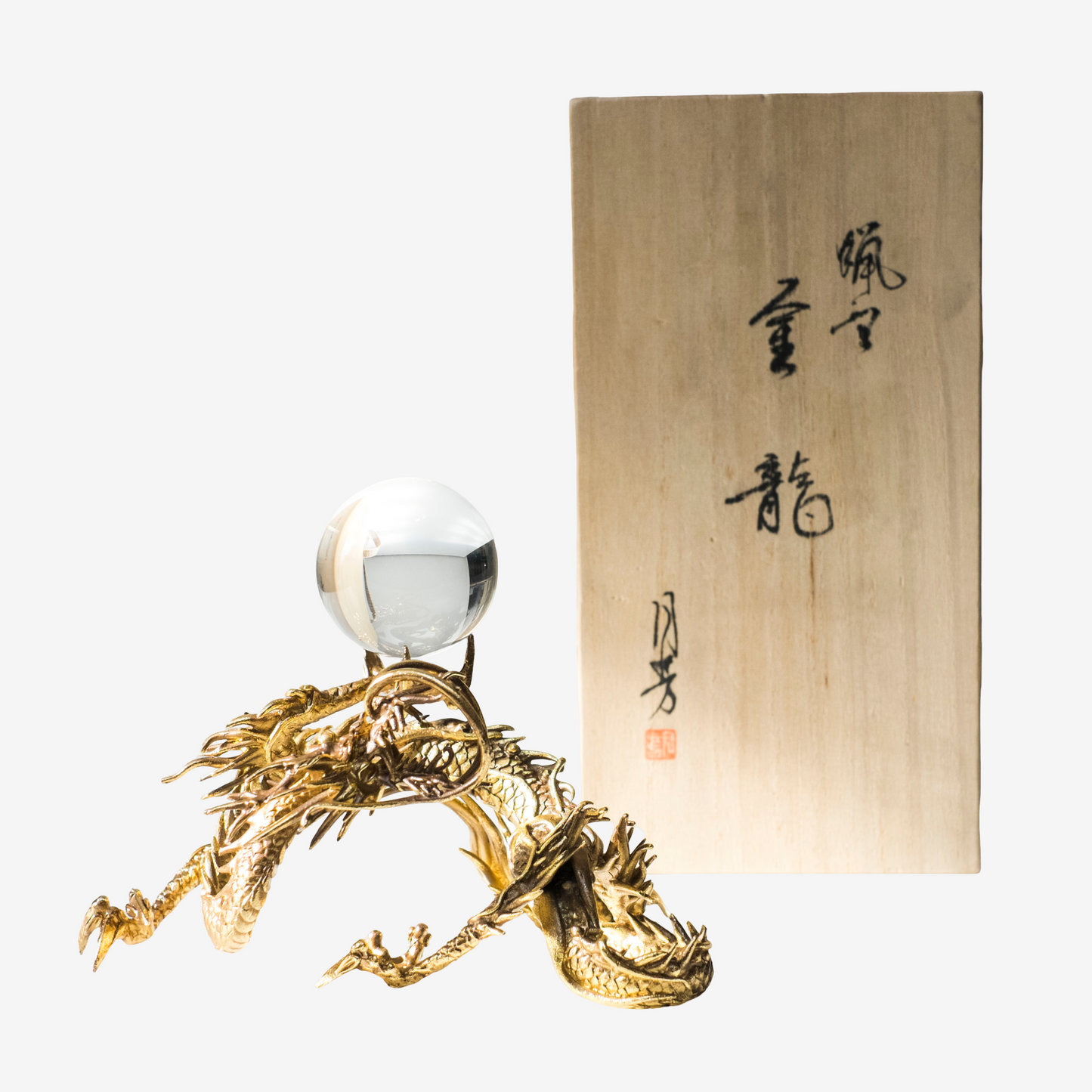
Gold-Finished Japanese Dragon Okimono with Sacred Jewel, Dynamic Coiled Form and Inscribed Paulownia Storage Box
A powerful Japanese decorative sculpture portraying a celestial dragon coiled around a clear orb, the legendary treasure associated with fulfilled wishes, spiritual wisdom and auspicious transformation.
Presented under the inscribed title Ganpō Ryū, this dramatic work captures the dragon at the height of its mythical authority. Its serpentine body twists through a compact, energetic composition while claws, scales, horns and flowing details create a sense of movement from every viewing angle. The warm golden finish amplifies the sculpture’s commanding presence, while the transparent sphere introduces an element of light, purity and mystery.
The dragon does not merely accompany the jewel. It guards, commands and activates it. This relationship between creature and treasure gives the sculpture its central visual tension: immense earthly power gathered around a single luminous symbol of possibility.
Accompanied by its original inscribed wooden storage box, the sculpture has the completeness and ceremonial presentation valued in Japanese decorative arts. It makes a striking addition to a private collection, executive office, meditation room, reception area or Japanese-inspired interior.
Visual Presence
This sculpture is compact in scale yet remarkably theatrical.
The dragon’s body appears to gather around the orb in a continuous spiral, producing a circular rhythm that invites the viewer to move around the piece. Projecting claws, the sweeping tail, textured scales and an animated expression give the sculpture a restless, living quality. The clear sphere becomes the still center of that motion, creating a striking contrast between concentrated calm and surrounding energy.
Its golden surface responds dramatically to changing light. In soft daylight, the sculpture reveals its overall silhouette and layered modeling. Under directional evening illumination, the raised scales, facial features and coiled contours produce deeper shadows and stronger highlights.
The result is not a passive figurine but a concentrated statement object, almost a pocket-sized storm wrapped around a crystal moon.
Identification
Object type: Japanese dragon sculpture / decorative okimono
Japanese title: 願宝 龍
Reading: Ganpō Ryū
Interpretive translation: Wish-Treasure Dragon / Dragon of the Treasured Wish
Subject: Celestial dragon holding or guarding a sacred orb
Country of origin: Japan
Primary construction: Cast metal with gold-toned surface treatment
Orb: Clear sphere described as crystal
Presentation: Original inscribed wooden storage box
Box type: Kiri-style paulownia storage box
Artist attribution: Lower inscription appears to contain a maker’s name or signature
Date: Undated
Style: Japanese mythological and auspicious decorative sculpture
Display category: Okimono, symbolic interior art and collector’s object
The inscription appears to function as the individual title of the sculpture rather than the name of a universally standardized category of dragon. It may be understood poetically as a dragon connected with treasured wishes, auspicious aspirations or the protection of a sacred jewel.
Box Inscription
The principal inscription on the wooden box reads:
願宝 龍
願宝
Read here as Ganpō, combining the idea of a wish, aspiration or prayer with that of treasure or a precious object.
龍
Ryū, meaning dragon.
A natural English rendering is:
“Dragon of the Treasured Wish”
or
“Wish-Treasure Dragon”
The smaller inscription beneath the title appears consistent with a maker’s signature, studio designation or dedicatory inscription. It remains preserved as an integral part of the work’s presentation.
The original box adds important context. In Japanese collecting culture, the storage box is not merely packaging. It helps preserve the relationship between the object, its title and its maker while protecting the sculpture during periods when it is not displayed.
The Dragon and Sacred Jewel
Japanese dragons are often associated with water, clouds, rainfall and elemental forces. Historical Japanese artworks also depict dragons holding a jewel known as a tama. The Metropolitan Museum of Art, for example, records an eighteenth-century Japanese “Jewel-Holding Dragon” and describes the dragon as a water-associated cosmological figure frequently shown amid clouds and vapor.
The sphere in this sculpture may be interpreted through the symbolism of the hōju or nyoi hōju, the Buddhist wish-fulfilling jewel. The Sendai Daikannon temple identifies the 如意宝珠 held by Kannon as a jewel associated with granting wishes, illustrating the continuing place of this symbol within Japanese Buddhist visual culture.
Together, the dragon and jewel form one of East Asian art’s most potent symbolic pairings: untamed cosmic energy gathered around concentrated wisdom and precious possibility.
The Dragon in Japanese Symbolism
Unlike many European dragons portrayed primarily as destructive monsters, the Japanese dragon is frequently understood as a powerful, intelligent and spiritually charged being.
It is associated with:
- Water, rain and the movement of clouds
- Transformation and renewal
- Authority and leadership
- Protection of sacred places and treasures
- Wisdom acquired through experience
- Vitality and dynamic life force
- Courage in periods of uncertainty
- Prosperity, advancement and fortunate change
The dragon’s serpentine form suggests energy that cannot be contained within rigid boundaries. It moves between water, sky and earth, occupying a liminal realm between the visible and invisible worlds.
In this sculpture, that energy is disciplined by the orb. The dragon’s strength is not presented as random aggression. It is focused around something precious.
Meaning of the Crystal Orb
The clear sphere serves as both the physical and symbolic center of the composition.
Within the visual language of the sacred jewel, it may represent:
Wisdom: clarity beyond confusion or illusion
Aspiration: a sincere wish or spiritual intention
Potential: possibility held before it takes physical form
Wholeness: the completeness of the unbroken circle
Purity: light passing through a transparent form
Prosperity: treasure not merely as wealth, but as opportunity
Guidance: an illuminated center around which power is organized
Fulfillment: the completion of a deeply held intention
The orb should be understood symbolically rather than as a guarantee of supernatural or financial results. Its value lies in the cultural narrative it carries and the personal meaning assigned to it by its keeper.
Dynamic Sculptural Composition
The sculpture’s energy comes from its coiled construction.
Rather than presenting the dragon in a flat profile, the artist has arranged its body through multiple planes. The viewer encounters different relationships between head, limbs, tail and orb depending upon the angle of observation.
The form may reveal:
- Strongly modeled facial features
- A flowing mane or flame-like crest
- Layered scales across the body
- Extended claws surrounding the jewel
- Twisting anatomical transitions
- Deep recesses that create natural shadow
- Projecting horns, whiskers or fins
- A compact but highly dimensional silhouette
This creates an object that continues to offer new visual information after repeated viewing.
Gold-Toned Surface
The golden coloration gives the dragon an immediate association with treasure, sunlight and ceremonial richness.
Gold has long carried connotations of value, radiance and incorruptibility. In this sculpture it also serves a practical visual function, separating the dragon’s intricate body from the transparent sphere and intensifying the contrast between solid metal and captured light.
The finish may display variations in tone, including brighter raised areas and darker recesses. Such changes help articulate the scales and sculptural depth. Depending upon age and handling, the surface may also possess patina, rubbing or subtle tonal irregularities that contribute to its individual character.
Japanese Okimono Tradition
The term okimono refers to an object created principally for display.
An okimono may portray animals, legendary beings, historical figures, Buddhist subjects or scenes from everyday life. Unlike a functional vessel or utensil, its primary purpose is visual, symbolic and sculptural.
This dragon belongs naturally within that tradition. It is substantial enough to command attention yet compact enough for domestic display. Its original box, titled subject and highly articulated surface elevate it beyond ordinary novelty decor.
It may be appreciated simultaneously as:
- A Japanese decorative sculpture
- A representation of dragon mythology
- An auspicious symbolic object
- A collector’s metalwork piece
- A meditation or intention-setting focal point
- A dramatic interior accent
Material and Craftsmanship
The sculpture appears to be formed in cast metal and finished in a rich golden tone.
Casting permits the preservation of intricate relief across the dragon’s scales, claws, face and flowing anatomical details. The substantial boxed weight of approximately 1.2 kilograms gives the work a satisfying physical presence despite its compact dimensions.
The clear orb is described as crystal. No gemological testing is represented, and it should be appreciated principally as the sculptural embodiment of the sacred jewel.
The combination of dense metal, reflective gold coloration and a transparent sphere produces a carefully balanced material language:
Metal: permanence, strength and earthly substance
Gold tone: value, illumination and prosperity
Clear orb: purity, wisdom and possibility
Wooden box: protection, continuity and Japanese presentation
Artist or Workshop Inscription
The smaller writing beneath the title on the box appears likely to identify the artist, workshop or person responsible for the work.
Because the inscription has not been connected to a documented artist biography or independently verified workshop history, the sculpture is offered conservatively as an inscribed Japanese work rather than attributed to a specific celebrated master.
The inscription remains valuable even without a complete reading. It demonstrates that the object was presented with an individual title and accompanying calligraphic context rather than distributed anonymously.
Period Assessment
The sculpture is undated.
Its decorative golden finish, compact cast construction, clear orb and fitted wooden presentation box appear consistent with later twentieth-century or contemporary Japanese decorative metalwork. It is not represented as a Meiji-period antique without documentary or inscriptional evidence supporting that date.
This careful dating allows the sculpture to be appreciated for what can be established directly: Japanese origin, titled presentation, substantial construction, elaborate craftsmanship and a deeply rooted mythological subject.
Dimensions and Weight
Sculpture
- Width: approximately 18 cm / 7.09 in
- Depth: approximately 14 cm / 5.51 in
- Height: approximately 12 cm / 4.72 in
Weight
- Approximately 1.2 kg / 2.65 lb, including the wooden box
Measurements are approximate and may vary slightly according to the points measured.
The sculpture’s broad, low proportions make it particularly suitable for a desk, console, shelf, cabinet, altar-style display or recessed architectural niche.
Condition
The sculpture and original wooden box are offered in their present pre-owned condition.
The metal surface may display natural patina, slight rubbing, small marks, accumulated tonal variation or minor changes to the gold-toned finish. The clear orb may show tiny surface marks or natural inclusions depending upon its material. The wooden box may exhibit storage wear, age-related marks, softened corners, inscriptional variation or changes in the tone of the wood.
These characteristics are part of the history of a previously owned Japanese decorative object.
Please examine all photographs carefully. The photographs form an essential part of the description and show the exact sculpture, orb, box, inscriptions, finish and condition included with the purchase.
Display Suggestions
The sculpture has sufficient visual strength to stand alone but can also become the center of a larger Japanese-inspired arrangement.
It would display beautifully in:
- An executive office or business reception area
- A study, library or private workspace
- A meditation or contemplation room
- A Japanese-inspired living room
- A home entrance or console arrangement
- A collector’s cabinet of Asian art
- A martial arts dojo
- A tea room or incense space
- A prosperity or intention-setting corner
- A modern maximalist interior
- A dark wood or lacquer display shelf
- A room incorporating stone, bronze and natural textiles
For a restrained presentation, place the dragon on a plain dark surface with open space around it.
For a more theatrical arrangement, illuminate it from one side so the gold-toned scales catch the light while the orb glows against the darker recesses of the body.
Direction and Placement
This sculpture may be positioned according to personal taste, architectural balance or individual Feng Shui practice.
A few visually effective placements include:
Office: facing inward from a shelf or console, suggesting energy entering the workspace
Entrance hall: placed securely where its silhouette can be viewed without frequent handling
Study: positioned near books, calligraphy or objects associated with knowledge
Meditation room: used as a focal symbol for disciplined intention
Display cabinet: illuminated through glass to emphasize the orb and gold surface
Because traditions and schools of Feng Shui differ, no single placement is presented as universally required. The strongest arrangement is one that feels respectful, stable and visually balanced within the room.
A Symbolic Gift
The Ganpō Ryū sculpture makes a meaningful gift for occasions associated with ambition, transformation or new beginnings.
It may be especially suitable for:
- Opening a new business
- Promotion or professional advancement
- Graduation
- Retirement into a new chapter
- Housewarming
- Milestone birthday
- Lunar New Year celebration
- Recovery after a difficult period
- Beginning a creative project
- Establishing a meditation practice
- A dragon enthusiast or mythology collector
- A collector of Japanese art
The dragon communicates courage and momentum, while the jewel introduces the quieter message that power is most valuable when directed toward wisdom and meaningful purpose.
Collector Appeal
This piece brings together several features desirable in the international Japanese decorative-art market:
- Dramatic Japanese dragon subject
- Sacred-jewel iconography
- Highly dimensional coiled composition
- Clear crystal-style orb
- Rich gold-toned surface
- Compact but substantial 1.2 kg boxed weight
- Original inscribed wooden storage box
- Individual Japanese title
- Possible artist or workshop inscription
- Strong display value from multiple angles
- Broad appeal across Asian art, mythology and symbolic decor collections
Its combination of sculptural drama and original presentation gives it considerably more collector interest than a generic unboxed dragon ornament.
Offers
Some pieces in our collection allow room for negotiation, while others are offered at firmer prices.
Respectful and reasonable offers are welcome and considered individually. Please feel free to submit your proposed amount or contact us directly with questions. We are always pleased to hear from serious collectors and will accommodate a suitable budget whenever the character, rarity and market position of the object permit.
Product Representation and Questions
We make every effort to represent our items accurately through detailed photographs and descriptions.
Please contact us before purchase with any questions concerning condition, dimensions, weight, materials, inscriptions, surface finish, orb or wooden box. We would rather clarify every detail before payment than leave uncertainty afterward.
Color and surface tone may appear slightly different depending upon lighting, photography and individual screen settings.
Condition and Final-Sale Policy
This is a previously owned collectible object offered as is and as photographed.
Vintage and pre-owned works should not be expected to possess the uniform surfaces of newly manufactured merchandise. Patina, handling traces, storage wear and minor age-related characteristics may be present.
All sales are final. Returns, exchanges, cancellations and condition-related claims are not accepted. Completion of payment confirms that the buyer has reviewed and accepted the photographs, description, dimensions and store policies.
Worldwide Shipping
Worldwide shipping is available through Japan Post EMS wherever service is offered.
Shipping and handling charges are calculated through the checkout shipping calculator. For destinations not automatically listed, please contact us for an individual quotation.
The dragon, projecting details, clear orb and original wooden box will be packed carefully for international transit. Tracking information is normally supplied after dispatch and may take approximately 3 to 5 business days to become active in the carrier’s system.
Customs duties, import taxes, brokerage charges and local handling fees remain the responsibility of the buyer where applicable.
#JapaneseDragon #GoldenDragon #DragonSculpture #GanpoRyu #GanpōRyū #CrystalOrbDragon #WishFulfillingJewel #NyoiHoju #JapaneseOkimono #JapaneseMetalwork #AsianMythology #MythicalCreatureArt #FengShuiDecor #ProsperityDecor #FortuneDragon #DragonCollector #JapaneseArt #AsianArtCollectible #GoldDragonDecor #ZenHomeDecor #MeditationDecor #SpiritualSculpture #SymbolicGift #BusinessGift #ExecutiveOfficeDecor #KiriBox #PaulowniaBox #JapaneseInterior #DragonStatue #Japonista
Material Tags
Cast metal, gold-toned finish, clear crystal-style orb, transparent sphere, wood, kiri wood, paulownia storage box, embroidered or painted box inscription