Rare Vintage, Antiques and Art Collector / Curator / Personal Shopper From Japan
Japanese Bronze Usubata Ikebana Vessel with High-Relief Dragon | Edo–Meiji Period Sculptural Metalwork
Japanese Bronze Usubata Ikebana Vessel with High-Relief Dragon | Edo–Meiji Period Sculptural Metalwork
Couldn't load pickup availability
Have a reasonable price in mind? Submit your best offer and our concierge will review it personally.
Japanese Bronze Usubata with High-Relief Dragon
Ikebana Flower Vessel · Late Edo to Early Meiji Period (c. 19th century)
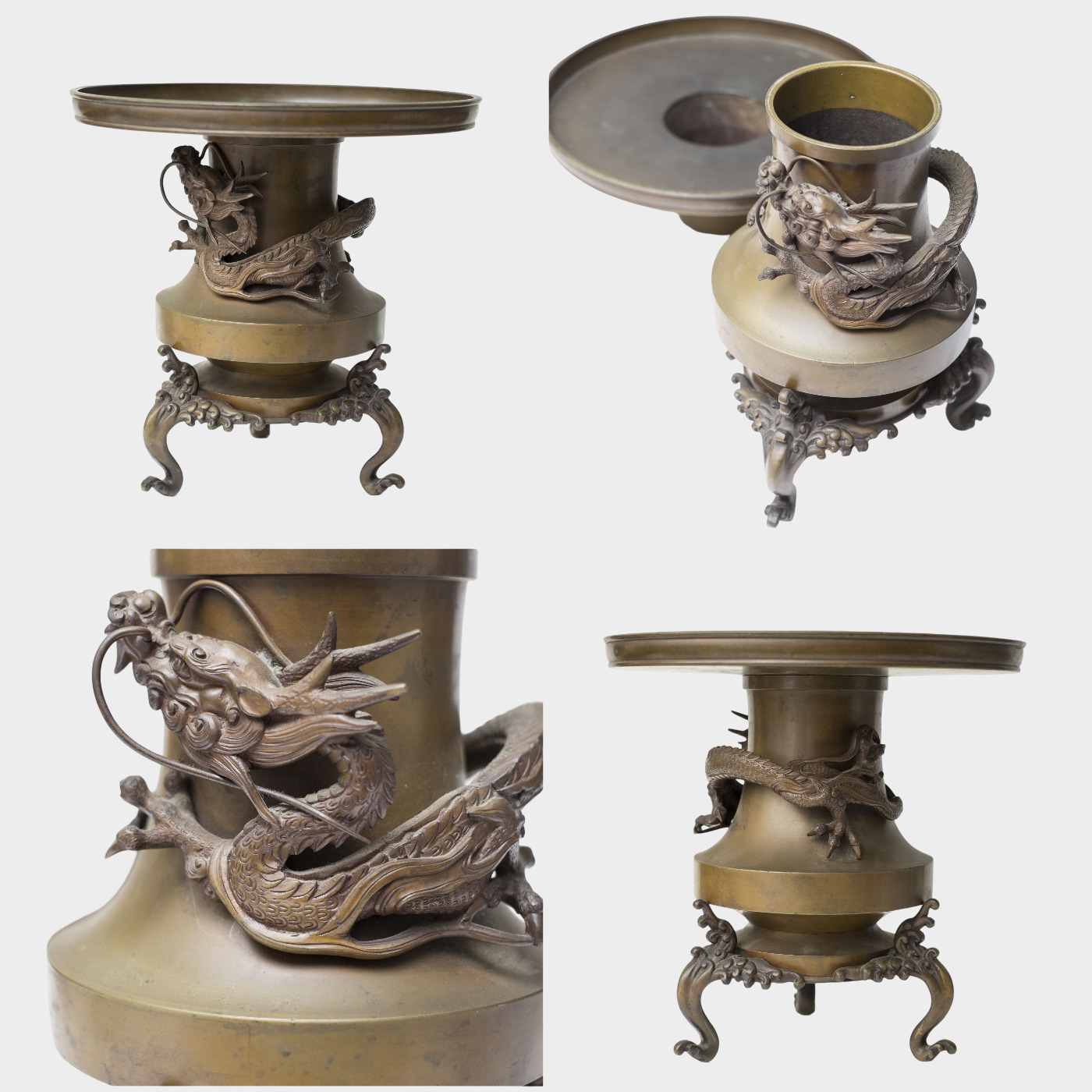
This imposing bronze usubata represents a high point of Japanese metal artistry, combining architectural form with sculptural dynamism. Cast in heavy bronze with a broad, shallow dish supported by a flared pedestal body, the vessel is conceived not merely as a functional ikebana implement, but as a symbolic object meant to command visual authority within a formal interior or alcove setting.
Encircling the central column is a fully sculpted dragon rendered in deep, high relief, its body coiling sinuously around the vessel as though emerging from the metal itself. The dragon’s anatomy is articulated with exceptional precision: individually chased scales, sharply defined claws gripping the surface, expressive musculature, and a fiercely animated head with open mouth, curling whiskers, and elongated horns. The sinuous curve of the dragon’s body creates a continuous visual rhythm that guides the eye upward toward the offering plate, reinforcing the verticality of the form.
The dragon motif is not merely decorative. In Japanese visual culture, dragons are associated with water, rain, fertility, protection, and spiritual authority, making their presence especially appropriate for an ikebana vessel, where water, plant life, and cosmic balance intersect. The dragon’s placement—wrapping protectively around the vessel’s core—suggests guardianship over the floral arrangement placed above, a subtle but powerful symbolic gesture rooted in both Buddhist and Daoist cosmology.
The usubata rests on three sculptural feet, each modeled in scrolling, cloud-like forms that echo classical Chinese-inspired motifs absorbed into Japanese metalwork during the Edo period. These feet lift the vessel slightly off the ground, giving it a ceremonial presence and architectural stability. The underside reveals careful finishing and proportional balance, indicating professional workshop production rather than utilitarian casting.
The bronze surface displays a rich, naturally aged patina, shifting from warm golden-brown to deeper umber tones, with subtle mottling consistent with age and oxidation rather than artificial treatment. This patina enhances the sculptural depth of the dragon relief, accentuating shadows within the carved recesses and lending the piece a dignified, time-worn character prized by collectors.
Structurally, the vessel is composed in the classic usubata format: a wide, flat upper plate designed to support a shallow water basin or floral mount, ideal for formal ikebana schools and large-scale arrangements. Such vessels were historically used in temple settings, elite residences, and ceremonial displays, rather than casual domestic environments. The scale and weight of this example further support its intended role as a statement object rather than a purely functional flower container.
Stylistically, the piece aligns with late Edo to early Meiji bronze traditions, a transitional period when technical mastery reached its peak while aesthetic tastes began to favor bold sculptural expression. The confident modeling of the dragon, the harmonious integration of structure and ornament, and the restraint shown in allowing the form itself to carry authority all point to a skilled metalworking atelier operating at a high level.
Today, such usubata vessels are increasingly sought after not only by ikebana practitioners, but by collectors of Japanese decorative arts, interior designers seeking sculptural anchors, and scholars of Buddhist and symbolic metalwork. This example, with its powerful dragon iconography and commanding presence, stands as both a functional art object and a sculptural embodiment of Japanese cosmological aesthetics.
DESIGN & AESTHETICS ANALYSIS
• Dragon rendered in true three-dimensional relief, not surface chasing
• Deep undercutting beneath limbs and jaw indicates skilled mold work
• Balanced proportions between pedestal mass and sculptural dynamism
• Warm bronze tone with mottled patination enhances depth perception
• Architectural feet stabilize visual weight and ritual presence
WHO IS THIS FOR? — COLLECTOR RESONANCE
This usubata is suited for collectors who seek objects that function simultaneously as sculpture, cultural artifact, and interior anchor. Ideal for advanced ikebana practitioners, Asian art collectors focusing on bronze, and designers sourcing statement antiques with historical integrity.
WHY THIS IS PRICED THIS WAY
This piece is priced according to its position within the bronze hierarchy—not as décor, and not as temple-scale bronze, but within the narrow band of sculptural usubata that combine functional lineage with true three-dimensional metalwork.
Unlike mass-produced bronze vases, this example carries:
• High-relief sculptural modeling rather than surface decoration
• Substantial bronze weight and architectural construction
• A form historically tied to elite ikebana and ritual aesthetics
• Visual complexity that rewards long-term ownership and study
The price reflects craftsmanship density, sculptural ambition, and rarity within its functional category, rather than size alone.
-
Category: Sculptural Ikebana / Architectural Bronze
-
Recommended for:
-
Ikebana practitioners (high-end metal usubata)
-
Asian art collectors (dragon iconography)
-
Interior designers sourcing statement antiques
-
Bronze specialists priced out of temple censers
-
Key value drivers:
-
True high-relief dragon sculpture (not chased / shallow cast)
-
Heavy bronze mass + deep natural patina
-
Three-legged architectural base (ritual-derived form)
-
Functional and sculptural (dual utility premium)
Authenticity & Stewardship
Evaluated under the Japonista Authentication Framework™:
- Material, carving, and surface-study comparison
- Iconographic and stylistic verification
- Condition and stability review (surface integrity)
- Construction assessment and handling-risk evaluation
Guaranteed 100% Authentic. Covered by the Japonista Lifetime Authenticity Warranty™.
A Note on Stewardship and Collecting
At Japonista, we approach Buddhist statues, sacred images, and ritual objects not merely as collectibles, but as cultural and spiritual artifacts deserving of respect, understanding, and careful presentation. Every piece we offer is thoughtfully examined, researched, and curated with sensitivity to its origin, meaning, and historical role.
Our role is not only to offer access to rare and meaningful objects, but to serve as responsible custodians—connecting the right works with collectors who value depth, intention, and authenticity.
Inquiries, Availability, and Private Consideration
Some of the cultural and heritage works may allow room for discussion, while others are held firmly due to rarity, condition, or cultural importance. All inquiries are reviewed personally and discreetly, and we welcome thoughtful questions or expressions of interest.
If you are exploring a particular theme, deity, lineage, or period—or seeking guidance in building a focused collection—our concierge team is always available to assist with quiet expertise and care.
Concierge Support & Collector Guidance
Japonista Concierge™ provides personalized assistance for collectors seeking deeper understanding, thoughtful acquisition, or long-term curation strategies. Whether your interest is devotional, scholarly, or aesthetic, we are here to help guide your journey with clarity and respect.
For select high-value or historically significant works, private reservation or structured payment arrangements may be available on a case-by-case basis. Please reach out to discuss eligibility and discreet options.
Before Proceeding
We kindly encourage collectors to review our shop policies and house guidelines, available through the links in our website footer, which outline shipping, handling, and conditions specific to vintage, sacred, and collectible works.
A Closing Note
Thank you for exploring Japonista’s collection of Oriental Cultural Heritage and arts. We are honored to share these meaningful works and to help place them where they may continue to be appreciated, studied, and respected.
If you have questions or wish to explore related works, please feel free to contact Japonista Concierge™ at any time.