Rare Vintage, Antiques and Art Collector / Curator / Personal Shopper From Japan
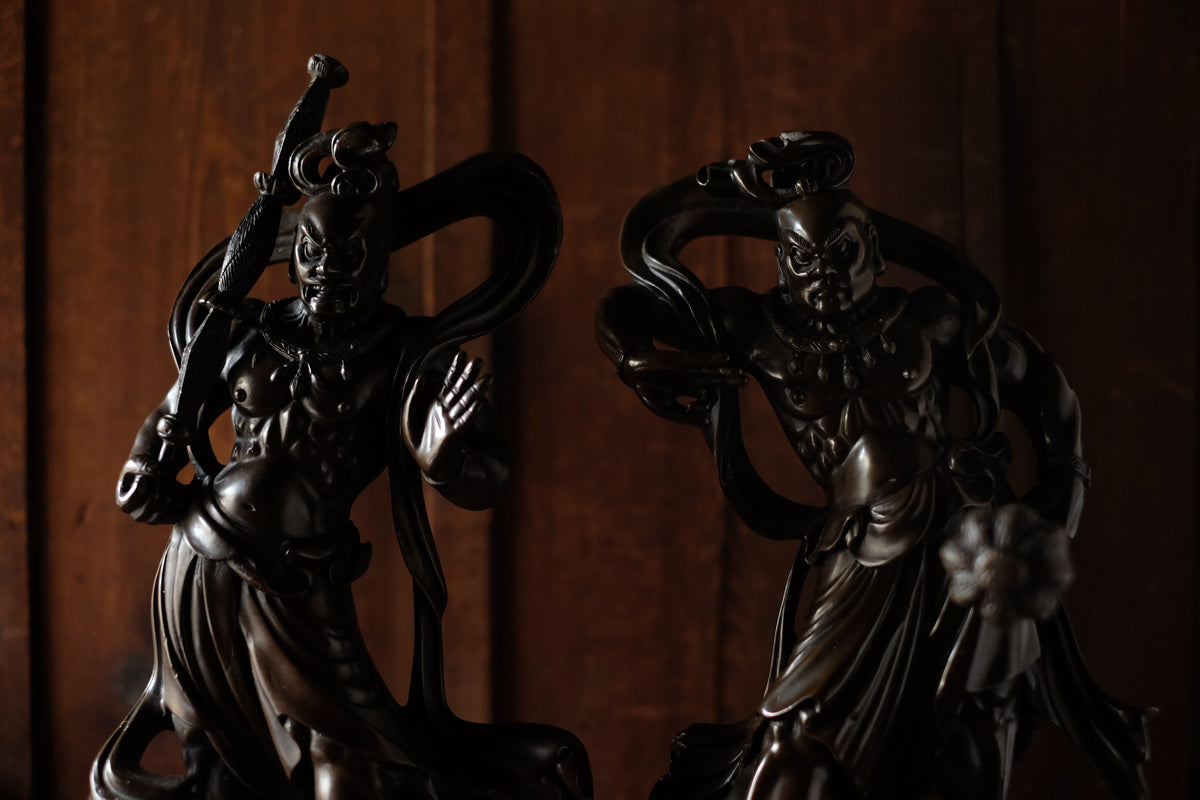
Japanese Bronze Nio Guardian Statues Pair, Agyo Ungyo Kongo Rikishi Buddhist Temple Sculpture, Vintage Protective Deity Art
Japanese Bronze Nio Guardian Statues Pair, Agyo Ungyo Kongo Rikishi Buddhist Temple Sculpture, Vintage Protective Deity Art
Couldn't load pickup availability
Have a reasonable price in mind? Submit your best offer and our concierge will review it personally.
A Pair of Guardians in Motion
Power, movement, and protection are captured in this dramatic matched pair of Japanese Nio guardian sculptures, traditionally known as Kongo Rikishi. With muscular bodies, fierce expressions, wind-swept drapery, and commanding stances, the two figures form a visually powerful representation of the guardians historically associated with Buddhist temple entrances throughout Japan.
Rather than the still serenity found in many Buddhist figures, Nio imagery is intentionally charged with physical energy. These guardians confront rather than retreat. Their expressions are fierce, their bodies are tense with movement, and their presence communicates vigilance, courage, and the defense of sacred space.
Rendered in dark-patinated bronze with a beautifully developed brown-black surface, this pair has tremendous sculptural depth. Highlights move across the polished musculature, robes, facial features, jewelry, feet, and rocky bases as the viewing angle changes, giving the figures an almost cinematic presence under directional lighting.
Displayed together, they create an especially strong architectural statement and would suit a Japanese art collection, meditation room, study, entryway, gallery display, Buddhist-inspired interior, or carefully curated eclectic space.
Agyo and Ungyo
Nio guardians traditionally appear as a complementary pair.
Agyo is associated with the open-mouth expression and the beginning of sound.
Ungyo is associated with the closed-mouth expression and the completion of sound.
Together, they are commonly understood through the concept of A-Un, expressing beginning and ending, outward force and inward strength, birth and completion, and the totality existing between two opposites.
This symbolic pairing gives the sculptures meaning beyond their considerable visual impact. They are not simply two matching warrior figures. They function as counterparts, each completing the presence of the other.
For collectors who appreciate Japanese Buddhist iconography, this duality is one of the most compelling aspects of a genuine Nio composition.
Sculptural Presence
The craftsmanship becomes especially impressive when viewed closely.
Both guardians are modeled with powerfully defined torsos and limbs, yet the compositions remain fluid rather than static. Long scarves and garments curve around the figures, visually echoing the vigorous movement of their poses.
One guardian holds a long ritual weapon or staff across the body while extending the opposite hand outward. The second figure takes a broader stance, framed by sweeping ribbons and carrying another ceremonial implement. Together they form a highly balanced composition, with each silhouette distinct but clearly designed to function as part of a pair.
The faces are particularly expressive.
Furrowed brows, forceful eyes, pronounced cheek structures, stylized hair, and wrathful expressions convey the protective character traditionally associated with these deities. In Buddhist art, such ferocity is not simply aggression. Wrathful protectors visually represent the strength required to overcome ignorance, fear, and destructive forces.
The dark bronze surface gives these expressions remarkable depth. In softer light the statues appear almost black; under stronger illumination, warm brown and bronze tones emerge across the raised surfaces.
Bronze Craftsmanship and Patina
The pair appears to be executed in cast bronze or a closely related copper-alloy metal, finished with a deep dark patina.
The material contributes significantly to the visual weight of the sculptures. Unlike lighter decorative figures, bronze allows the modeling to carry a sense of permanence and physical authority particularly suited to guardian imagery.
The surfaces show subtle variation rather than an artificially uniform finish. Areas of deeper brown, near-black patination, lighter rubbed highlights, small casting textures, and age-related surface character create an attractive sense of depth.
The rocky bases are integrated into the compositions and include expressive subordinate faces or demonic forms beneath the guardians' feet. This is an important iconographic detail. Such imagery symbolizes the subjugation of disorder and harmful forces beneath the guardians' protective authority.
From the carefully modeled toes and anklets to the ribbons, jewelry, weapons, and facial details, these are sculptures intended to reward close viewing.
Japanese Buddhist Guardian Tradition
Nio imagery traveled through the Buddhist world before developing into one of the most recognizable forms of Japanese temple guardian art.
In Japan, monumental Nio figures became strongly associated with temple gateways. Visitors passing through a traditional Nio-mon encounter the two guardians standing on opposite sides of the entrance, visually marking the transition from ordinary space into sacred space.
Some of the most famous Japanese examples are monumental wooden guardians, but the same imagery has also been interpreted in bronze and other materials for smaller devotional, decorative, temple, and collector-scale works.
Bronze examples are particularly compelling because the material allows for dramatic modeling while retaining the monumental feeling of much larger wooden temple sculptures.
This pair translates that architectural guardian presence into a scale suitable for private display.
A Powerful Interior Statement
These sculptures are especially effective when positioned together with a small amount of space between them.
They can anchor:
a meditation or contemplation room
a Japanese-inspired interior
a Buddhist altar or spiritual display
a library or private study
an entry console
a gallery cabinet
a collection of Japanese bronzes
an Asian art collection
a wabi-sabi or dark minimalist interior
a dramatic hospitality or design environment
Their dark finish works beautifully against warm timber, stone, plaster, black cabinetry, or lighter neutral backgrounds.
Directional lighting can completely transform them. A narrow beam from one side catches the shoulders, cheekbones, garments, weapons, and feet while allowing the recesses to remain dark, emphasizing the muscular modeling and giving the pair exceptional visual drama.
Symbolism
The symbolism of the Nio makes this pair particularly meaningful as more than decoration.
They are traditionally associated with:
Protection
Guarding sacred spaces and standing against harmful influences.
Strength
The muscular body represents uncompromising spiritual determination.
Courage
Their confrontational posture suggests the willingness to face danger rather than avoid it.
Beginning and Completion
Agyo and Ungyo form a complementary pair associated with the beginning and ending of sound.
Balance
External power is paired with internal strength.
Guardianship
Their role is fundamentally protective rather than destructive.
For that reason, a pair of Nio can make a particularly meaningful addition to an entrance, study, meditation room, or personal collection.
Collector Appeal
What gives this set particular presence is that the sculptures survive as a matched pair.
Individual guardian figures are visually striking, but Nio iconography reaches its full meaning when the two figures remain together. Their gestures, mouth expressions, weapons, and opposing poses form a dialogue across the space between them.
The dark patina, substantial sculptural modeling, strong anatomical detail, expressive faces, flowing ribbons, rocky bases, and complementary compositions make the pair highly suitable for collectors of Japanese Buddhist sculpture and decorative bronze.
They also offer considerable crossover appeal for collectors interested in:
Japanese temple art
Buddhist iconography
Asian bronze sculpture
guardian figures
Japanese mythology
spiritual antiques
architectural sculpture
martial imagery
dark-academia interiors
wabi-sabi design
museum-inspired decorative art
Item Details
Subject: Pair of Nio / Kongo Rikishi Buddhist guardians
Figures: Agyo and Ungyo
Origin: Japan
Material: Bronze / copper-alloy metal
Finish: Deep brown-black patina
Form: Freestanding matched sculptural pair
Decoration: Flowing garments, ceremonial implements, jewelry, rocky guardian bases
Style: Japanese Buddhist temple guardian sculpture
Period: Vintage / older Japanese production; exact dating not independently documented
Quantity: Two sculptures, sold together as one pair
Dimensions: To be added when measurements are available.
Condition
Vintage condition with natural surface variation, patina, minor marks, casting irregularities, and age-related wear consistent with an older decorative bronze object.
Please study all photographs carefully, as they form an important part of the description and provide the best representation of the individual surfaces, bases, patina, sculptural details, and overall condition.
Due to the age and nature of collectible objects, minor imperfections should be considered part of their history rather than characteristics of modern factory-new merchandise.
Purchase, Shipping and Vintage Policy
Some pieces in our collection have a degree of price flexibility, while others are offered closer to a firm value. Respectful offers are always welcome and will be considered individually.
We make every effort to represent each item accurately through detailed photography and description. Please feel free to contact us before purchasing if you would like additional photographs, measurements, weight information, condition details, or clarification regarding any aspect of the piece.
Vintage and antique objects naturally display characteristics associated with age, previous ownership, traditional manufacturing processes, patination, oxidation, surface wear, minor irregularities, and historical handling. These qualities are part of the individuality of collectible objects.
Preparation, packing, shipping and handling normally require 5–10 business days or earlier. Sculptural and fragile items receive additional protective preparation before dispatch.
International shipping is available to many destinations using an appropriate tracked service from Japan. The shipping method may vary depending on destination, dimensions, weight, insurance requirements, and carrier availability.
Buyers are responsible for any applicable customs duties, VAT, import taxes, brokerage charges, or destination-country fees unless explicitly stated otherwise.
If you are looking for a similar Japanese Buddhist sculpture, guardian figure, bronze object, or related work in another size or configuration, please feel free to message us. Although availability cannot be guaranteed, we may be able to locate the same or a closely related piece through our sourcing network.
#JapaneseNio #NioGuardian #KongoRikishi #AgyoUngyo #JapaneseBronze #BronzeStatue #BronzeSculpture #BuddhistArt #JapaneseBuddhism #TempleGuardian #JapaneseTempleArt #JapaneseSculpture #AsianBronze #BuddhistGuardian #GuardianStatue #ProtectiveDeity #JapaneseArt #JapaneseCollectible #VintageJapanese #JapaneseAntiqueStyle #AsianAntiques #AsianArt #SacredArt #SpiritualDecor #MeditationDecor #ZenDecor #JapaneseInterior #WabiSabiDecor #JapaneseMythology #BuddhistIconography #TempleArt #JapaneseMetalwork #CopperAlloy #PatinatedBronze #DarkBronze #CollectorSculpture #AsianSculpture #JapaneseDecor #BuddhistSculpture #GuardianPair #TempleProtector #JapaneseHeritage #JapaneseCraftsmanship #DevotionalArt #MartialSculpture #StatementSculpture #ArtCollector #AsianArtCollector #JapaneseStatue #SacredGuardian
japanese nio, nio guardian pair, kongo rikishi, agyo ungyo, japanese bronze, buddhist statue, bronze sculpture, temple guardian, japanese antique, asian sculpture, buddhist decor, guardian statue, japanese art
Material Tags
bronze, copper alloy, cast metal, patinated bronze, dark patina, metal sculpture, traditional metalwork