Rare Vintage, Antiques and Art Collector / Curator / Personal Shopper From Japan
Japanese Bronze Dove Sculpture Signed Toshisaku Bird Statue Peace Symbol Zen Wabi Sabi Decor with Original Kiri Box
Japanese Bronze Dove Sculpture Signed Toshisaku Bird Statue Peace Symbol Zen Wabi Sabi Decor with Original Kiri Box
Couldn't load pickup availability
Have a reasonable price in mind? Submit your best offer and our concierge will review it personally.
Signed Japanese Bronze Okimono of a Dove Resting Among Rock and Wildflowers
A substantial Japanese bronze sculpture depicting a peaceful dove poised upon a naturalistic rock formation, surrounded by delicate flowering plants and enriched with warm gold-toned highlights.
Signed Toshisaku and preserved with its original wooden storage box, this finely composed bird sculpture brings together three enduring currents of Japanese decorative art: close observation of nature, expressive metal craftsmanship and a preference for quiet symbolism over theatrical display.
The dove stands calmly rather than taking flight. Its settled posture, gently modeled feathers and grounded relationship with the rocky base give the sculpture a feeling of stillness after movement, almost as though the bird has paused between one journey and the next. The surrounding blossoms soften the weight of the bronze, while the irregular stone-like foundation introduces the weathered, organic character associated with wabi-sabi interiors.
More than an ornamental bird figure, the work carries resonances of peace, fidelity, purity, hope and harmonious coexistence. It would make a meaningful centerpiece for a meditation space, Japanese-inspired interior, private study, office, memorial setting or carefully assembled collection of Asian bronze sculpture.
Visual Presence
The sculpture is built around a graceful contrast between weight and lightness.
Bronze gives the object physical substance and permanence, yet the dove itself is modeled with a soft, alert presence. Its body appears balanced naturally over the rock rather than rigidly attached to a decorative pedestal. The floral elements emerging around the base introduce a second rhythm, creating smaller points of movement around the central bird.
From a distance, the sculpture reads as a clear and elegant silhouette. At closer range, the viewer can appreciate the feather work, the transitions between the bird and stone, the modeling of the flowers and the interplay between darker patinated areas and brighter gold-toned accents.
The composition is calm without becoming static. The bird’s posture implies awareness of the surrounding world, but there is no visible tension or alarm. That quality makes the piece particularly suitable for rooms intended to encourage reflection, hospitality or emotional rest.
Object Identification
Object type: Japanese bronze bird sculpture / decorative okimono
Subject: Dove perched upon a flowering naturalistic rock
Artist signature: Toshisaku
Country of origin: Japan
Primary material: Bronze
Surface character: Dark patinated bronze with gold-toned highlights
Presentation: Original wooden storage box
Box type: Described as kiri wood storage box
Style: Naturalistic Japanese decorative metalwork
Likely period: Undated 20th-century Japanese work
Use: Fine art display, symbolic decor, meditation room accent or collector’s object
In Japanese decorative arts, the term okimono refers to an object intended for display. Unlike a utilitarian vessel, an okimono is created principally to be observed and appreciated for its craftsmanship, symbolism and sculptural presence.
This piece belongs naturally within that tradition. It is compact enough for domestic display, yet sufficiently substantial in weight and scale to carry the visual authority of a freestanding sculpture.
The Dove as a Symbol of Peace
Across modern visual culture, the dove has become one of the world’s most recognizable emblems of peace.
Its pale plumage, gentle behavior and lifelong pair bonding have also led it to represent:
- Peace and reconciliation
- Love and emotional fidelity
- Purity and sincerity
- Freedom and safe passage
- Hope following hardship
- Domestic harmony
- Spiritual protection
- Renewal and new beginnings
Within this sculpture, the dove does not appear as an abstract emblem. It remains a living bird integrated into a natural environment. This gives the symbolism greater subtlety. Peace is presented not as a slogan, but as a condition of balance between living creature, earth, stone and growing flowers.
The Dove in Japanese Culture
The dove or pigeon is known in Japanese as hato, written 鳩.
In addition to its modern association with peace, the bird possesses an older place within Japanese religious imagery. At shrines dedicated to Hachiman, doves have traditionally been revered as divine messengers. Dove imagery can still be found at Hachiman shrines, including Miyake Hachimangū in Kyoto.
This connection adds another layer to the sculpture. The dove may be appreciated not only as a universal peace symbol, but also as a creature associated in Japan with communication between the sacred and human worlds.
The bird’s elevated position on the rock reinforces this feeling. It occupies a threshold between earth and open air, grounded in the landscape yet capable of flight.
Rock, Flowers and the Harmony of Nature
The naturalistic base is an essential part of the sculpture rather than a secondary support.
Its uneven rock-like contours create a small landscape beneath the dove. Flowers appear to emerge from the stone, introducing the familiar Japanese artistic dialogue between endurance and transience.
The rock suggests stability, patience and continuity. The flowers suggest seasonality, change and the brief beauty of living things. The dove occupies the space between them, becoming a symbol of life held in balance.
Together, the three elements can be read as:
Rock: endurance, grounding and permanence
Flowers: renewal, beauty and impermanence
Dove: peace, freedom and spiritual presence
This combination gives the work a contemplative quality particularly suited to Japanese interiors, Zen-influenced rooms and spaces designed around natural materials.
Wabi-Sabi Character
The sculpture carries a strong wabi-sabi sensibility through its patinated metal, irregular stone formation and quiet natural subject.
Wabi-sabi is not simply an aesthetic of age or rusticity. It involves an appreciation for natural variation, modest beauty, impermanence and surfaces that reveal the passage of time.
The darker bronze coloration, subtle tonal shifts and textured rock base allow the sculpture to develop character beyond its original manufacture. Small variations in patina or finish do not necessarily diminish the work. They may deepen its visual complexity and help it sit naturally alongside aged wood, handmade ceramics, linen, stone and other organic materials.
The sculpture would therefore work beautifully in an interior where objects are chosen for presence and material depth rather than uniform perfection.
Bronze Craftsmanship
The sculpture appears to have been conceived as a fully dimensional object intended to be viewed from multiple angles.
Bronze is especially effective for animal sculpture because it allows the artist to preserve fine detail while maintaining structural strength. The material can carry both delicate feather textures and the heavier visual mass of a rock formation within a single unified composition.
The darker patinated surface emphasizes recessed areas and sculptural depth. Gold-toned highlights draw the eye toward selected contours, floral details or areas of plumage, creating visual warmth without overwhelming the restrained natural palette.
Under changing light, the piece should reveal different aspects of its modeling. Softer daylight will emphasize the sculpture’s silhouette and patina, while directional interior lighting will bring out the feather work and relief.
Artist Signature: Toshisaku
The sculpture bears an artist’s signature read as Toshisaku.
The survival of a maker’s signature distinguishes the piece from anonymous mass-produced decorative bronze. It indicates that the work was intended to retain an identifiable relationship with its creator or workshop.
No dated certificate or securely documented artist biography accompanies the supplied information, so the sculpture is presented conservatively as a signed Japanese work rather than assigned to a specific school, foundry or historical movement.
This careful attribution allows the signature to remain an important part of the object without extending the identification beyond the available evidence.
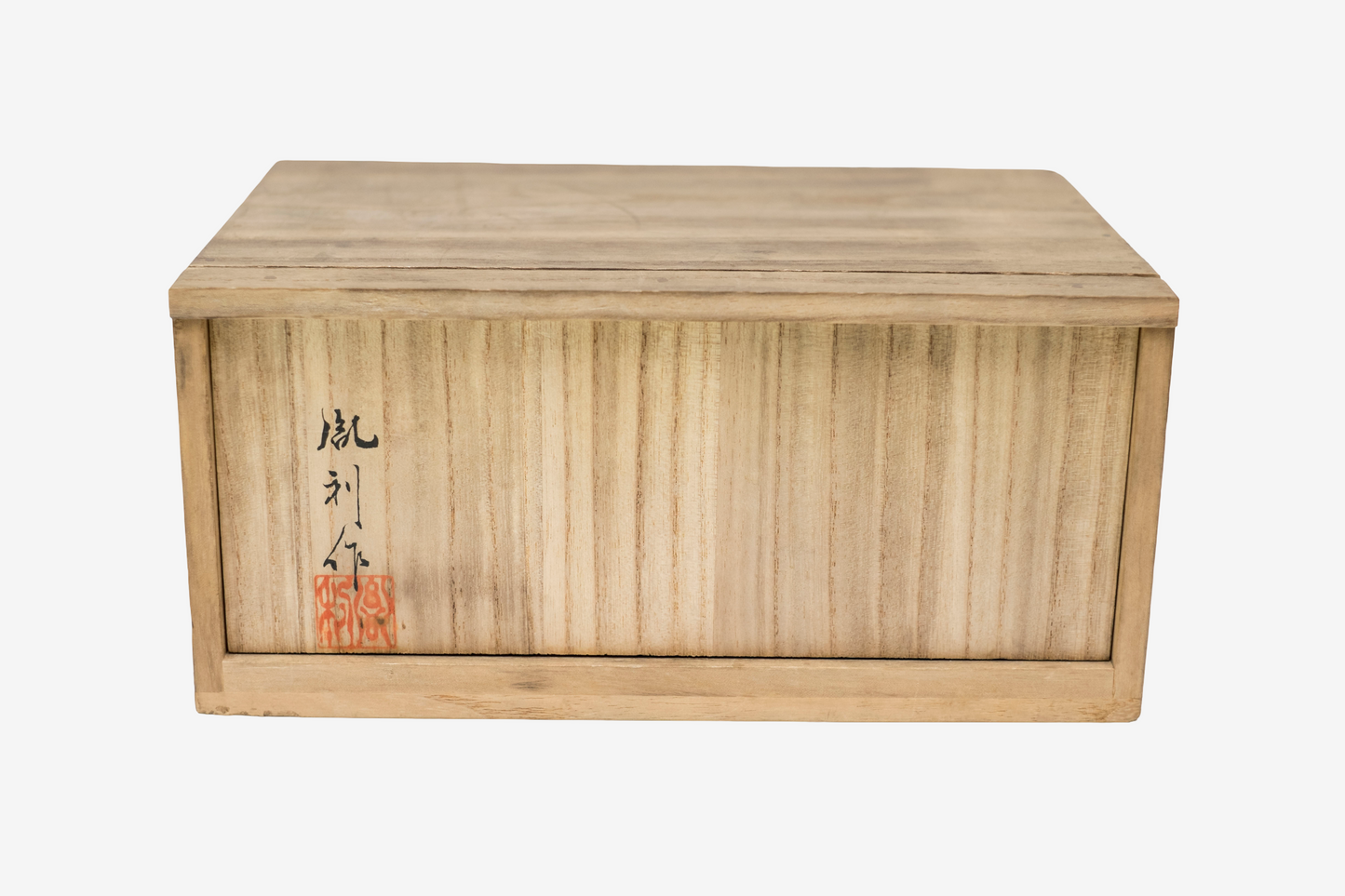
Original Kiri Wood Box
The sculpture is accompanied by its original wooden storage box, described as being made from kiri, or paulownia wood.
Kiri boxes are traditionally valued in Japan because the wood is lightweight, relatively stable and suitable for protecting works of art and craft. Such boxes may be used to house ceramics, bronzes, lacquerware, textiles, tea utensils and other collectible objects.
The original box contributes significantly to the sculpture’s presentation by:
- Protecting the bronze during storage
- Preserving the relationship between object and maker
- Strengthening its appeal to collectors
- Supporting careful international transport
- Providing a culturally appropriate form of presentation
- Distinguishing the work from an unboxed decorative figure
In Japanese collecting culture, an original storage box can become part of the history of the artwork itself. Any inscriptions, seals, labels, natural wood variation or age-related marks should be retained as part of that history.
Period Assessment
The sculpture is undated.
Its naturalistic bronze construction, decorative gold-toned detailing, signed presentation and original wooden box appear consistent with Japanese metalwork produced during the 20th century, possibly during the Shōwa period or later.
Without a dated inscription, exhibition record or artist documentation, no narrower date is assigned. It is offered as an authentic Japanese signed bronze sculpture rather than represented as a Meiji-period antique or another specific historical category that cannot presently be confirmed.
This calibrated dating preserves the object’s integrity while recognizing its evident Japanese craftsmanship and collector-facing presentation.
Dimensions and Weight
Sculpture
- Width: approximately 24 cm / 9.45 in
- Depth: approximately 13 cm / 5.12 in
- Height: approximately 13 cm / 5.12 in
Weight
- Approximately 1.9 kg / 4.19 lb, including the wooden box
Measurements are approximate and may vary slightly according to the exact points measured.
The sculpture’s nearly 24 cm width gives it a strong horizontal presence, while its modest height allows it to sit comfortably on a shelf, console, alcove or desk. Its weight contributes to a reassuring sense of substance and quality.
Condition
The sculpture and original wooden box are offered in their present pre-owned condition.
The bronze may display natural patina, tonal variation, small handling marks, light rubbing or subtle changes to the highlighted areas. The wooden box may show storage wear, surface marks, softened edges or natural variation associated with age and use.
These characteristics are consistent with a previously owned Japanese art object and contribute to its individual history.
Please examine all available photographs carefully. The photographs form an important part of the description and show the exact sculpture, signature, finish, floral details, naturalistic base and wooden box included with the purchase.
Display and Interior Styling
This bronze dove can serve as a quiet focal point without dominating its surroundings.
It would display particularly well in:
- A Zen meditation room
- A Japanese-inspired living room
- A private study or library
- A reception or counseling space
- A memorial or remembrance area
- A yoga or wellness studio
- A tea room
- A minimalist office
- A natural wood alcove
- A collector’s bronze cabinet
- A gallery shelf with ceramics or stoneware
- A peaceful bedroom or reading corner
For a restrained presentation, place the sculpture alone on a dark wood, stone or linen-covered surface.
For a seasonal Japanese arrangement, it may be combined with a small ceramic vase, a single flowering branch, an incense vessel or a hanging calligraphy work. Leaving open space around the sculpture will allow the bird’s silhouette and the horizontal rock formation to remain clearly visible.
A Meaningful Gift
The dove’s symbolism makes the sculpture suitable for many significant occasions.
It may be chosen as a gift for:
- A wedding or anniversary
- A housewarming
- A retirement
- A reconciliation
- A new business or office
- A spiritual milestone
- Recovery after illness or hardship
- A memorial remembrance
- A meditation practitioner
- A bird or nature enthusiast
- A collector of Japanese art
- Someone beginning a new chapter in life
Because the symbolism is gentle and broadly understood, the sculpture can carry personal meaning without requiring adherence to a particular religion or philosophy.
Collector Appeal
This piece offers a compelling combination of qualities sought by collectors of Japanese decorative art:
- Signed Japanese authorship
- Traditional bronze construction
- Substantial 24 cm scale
- Naturalistic bird and landscape composition
- Dove symbolism
- Gold-toned decorative accents
- Original kiri wood storage box
- Compact, display-friendly proportions
- Strong wabi-sabi character
- Appeal across both Eastern and Western interiors
- Symbolic as well as sculptural value
Signed Japanese animal bronzes are especially attractive when the subject, base and accompanying box remain together. The complete presentation allows the sculpture to be appreciated as a considered art object rather than simply as an isolated decorative figurine.
Offers
Some pieces in our collection allow room for negotiation, while others are offered at firmer prices.
Respectful and reasonable offers are welcome and will be considered individually. Please feel free to send your proposed amount or contact us directly with any questions. We are happy to work with serious collectors whenever possible while respecting the quality, rarity and international market position of the piece.
Product Representation and Questions
We make every effort to represent our items accurately through detailed photographs and written descriptions.
Please contact us before purchase with questions regarding condition, dimensions, weight, signature, materials, box inscriptions, patina or color. We would much rather clarify every detail before payment than leave uncertainty afterward.
Colors and surface tones may appear slightly different depending on lighting, photography and individual screen settings.
Condition and Final-Sale Policy
This is a pre-owned collectible object offered as is and as photographed.
Vintage and previously owned artworks should not be expected to have the uniform surfaces of newly manufactured items. Natural patina, handling traces, storage wear and minor age-related characteristics may be present.
All sales are final. Returns, exchanges, cancellations and condition-related claims are not accepted. Completion of payment confirms that the buyer has reviewed and accepted the photographs, description, dimensions and store policies.
Worldwide Shipping
Worldwide shipping is available through Japan Post EMS wherever service is currently offered.
Shipping and handling charges are calculated through the checkout shipping calculator. For destinations not automatically listed, please contact us for an individual quotation.
The bronze sculpture and wooden box will be packed carefully for international transit, with particular attention given to the projecting floral details and the relationship between the sculpture and its original box.
Tracking information is normally provided after dispatch and may take approximately 3 to 5 business days to become active in the carrier’s system.
Customs duties, import taxes, brokerage fees and local handling charges are the responsibility of the buyer where applicable.
#JapaneseBronze #BronzeDove #DoveSculpture #JapaneseSculpture #BirdSculpture #BirdStatue #Toshisaku #SignedBronze #JapaneseOkimono #PeaceSymbol #PeaceDecor #ZenDecor #WabiSabi #WabiSabiDecor #NatureArt #NatureSculpture #JapaneseArt #AsianArt #BronzeArt #BronzeFigurine #MeditationDecor #SpiritualDecor #SymbolicGift #OriginalWoodenBox #KiriBox #PaulowniaBox #JapaneseInterior #BirdCollector #VintageJapaneseArt #Japonista
Material Tags
Bronze, patinated bronze, gold-toned detailing, cast metal, kiri wood, paulownia wood, original Japanese storage box