Rare Vintage, Antiques and Art Collector / Curator / Personal Shopper From Japan
HOUSTON Japan U.S. Paratroopers 188 PIR 11th Airborne Sendai Dragon Sukajan Souvenir Jacket | Black Ivory Satin | Size M
HOUSTON Japan U.S. Paratroopers 188 PIR 11th Airborne Sendai Dragon Sukajan Souvenir Jacket | Black Ivory Satin | Size M
Couldn't load pickup availability
Rare HOUSTON Japan Military-Inspired Sukajan with 188 PIR Paratrooper Wings, Sendai Japan Lettering, Dragons & 11th Airborne Embroidery
Description
A striking HOUSTON Japan embroidered souvenir jacket combining the visual language of the classic Yokosuka sukajan with American airborne military iconography and Japanese dragon imagery.
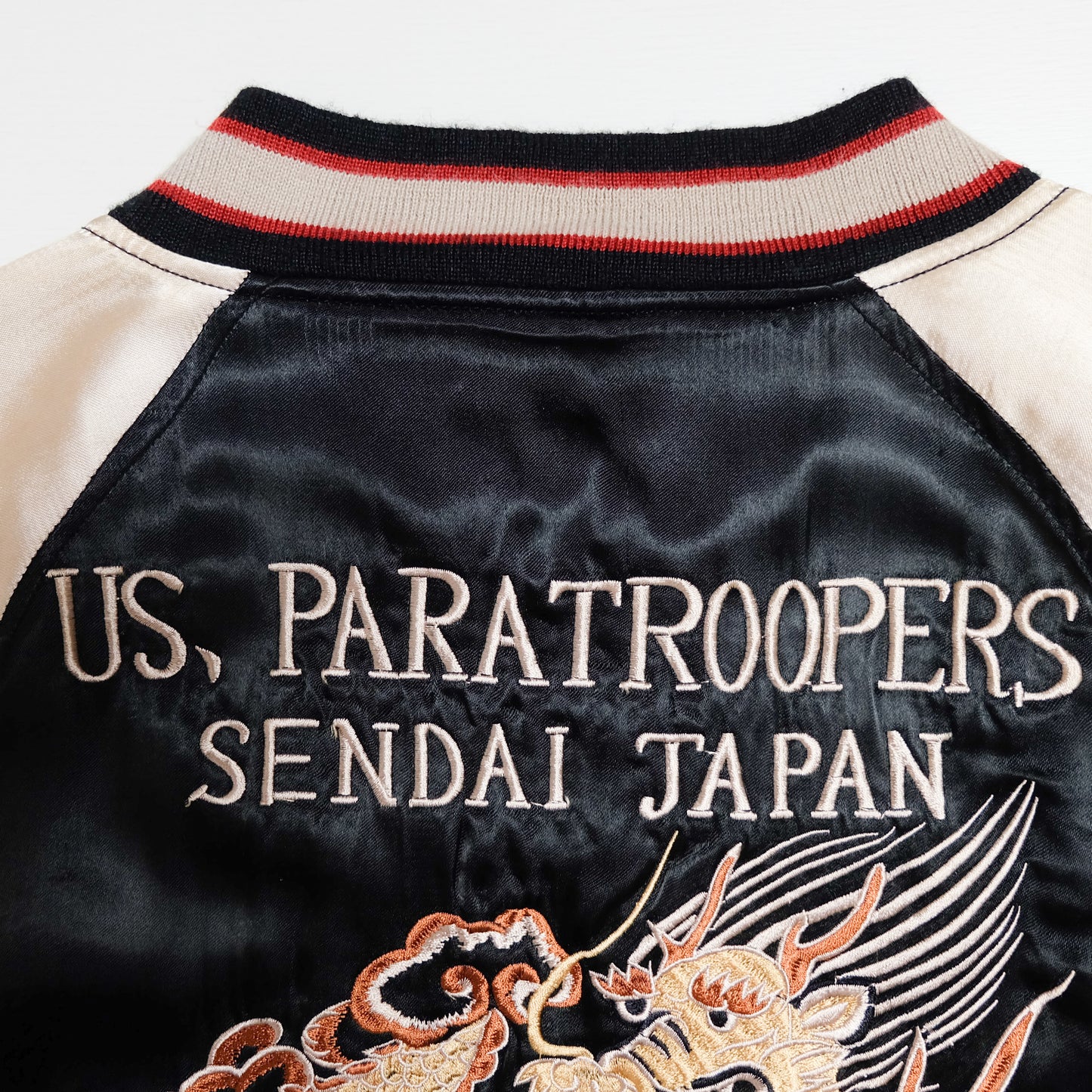
Executed in a sophisticated black and warm ivory / champagne satin combination, this piece carries a particularly elaborate back composition reading:
“U.S. PARATROOPERS”
“SENDAI JAPAN”
“188 P.I.R”
“11TH AIRBORNE”
At the center is a large embroidered airborne parachute-and-wings insignia, surrounded by scrolling cloud forms and a Japanese-style dragon. Rather than merely reproducing a military patch, the composition transforms airborne symbolism into the ornamental vocabulary of Japanese souvenir jackets.
The front is quieter but still richly worked, with symmetrical circular dragon emblems across the chest and additional pale gold / ivory dragons running along the sleeves.
Made by HOUSTON Japan, one of the long-running Japanese heritage and military-fashion labels closely associated with reproduction flight jackets, military outerwear and Americana-inspired clothing, this jacket sits perfectly at the intersection of sukajan culture, military reproduction style, Yokosuka fashion, Japanese streetwear and postwar souvenir-jacket aesthetics.
Manufacturer’s tagged size: Medium / M.
A Refined Military Sukajan with Strong Visual Presence
What makes this particular jacket especially compelling is the restraint of its palette.
Many sukajan rely on electric blue, scarlet, emerald or highly contrasting multicolor embroidery. Here, the visual language is more controlled:
black satin body
ivory / champagne sleeves
cream, tan, gold, rust and charcoal embroidery
black, beige and red-striped ribbing
That limited palette gives the jacket a mature, almost archival military character.
The embroidery remains dramatic, but the colors feel aged, muted and sophisticated rather than flashy.
It is an especially strong choice for collectors who appreciate sukajan construction but prefer militaria, heritage Americana, aviation imagery and subdued Japanese streetwear over brighter tattoo-art designs.
Identification
Brand: HOUSTON
Brand Origin / Market: Japan
Garment Type: Sukajan / Japanese souvenir jacket / Yokosuka jumper
Style: Military-inspired embroidered satin bomber
Tagged Size: Medium / M
Primary Color: Black
Sleeve Color: Ivory / champagne / light beige
Trim: Black, beige and red striped rib knit
Closure: Full front metal zipper
Pockets: Two angled hand pockets
Decoration: Extensive machine embroidery
Major Motifs: Japanese dragons, parachute wings, military lettering, airborne insignia
Back Lettering: U.S. PARATROOPERS / SENDAI JAPAN / 188 P.I.R / 11TH AIRBORNE
Front Decoration: Twin circular dragon medallions
Sleeve Decoration: Multiple embroidered dragons
General Aesthetic: Japanese military Americana / sukajan / heritage bomber / souvenir jacket
Brand: HOUSTON Japan
The neck label clearly identifies the jacket as:
HOUSTON JAPAN
The distinctive label combines a rising-sun-inspired graphic treatment with references including:
Sendai Yokohama
Hisaya Kobe
Sasebo
Yokosuka
These place names are deeply evocative of the geography associated with Japanese port cities, military bases and postwar souvenir culture.
HOUSTON has long occupied an important place within Japanese military-inspired fashion, particularly through flight jackets, field jackets, military reproductions and Americana-derived garments.
That background makes HOUSTON especially appropriate for a jacket such as this.
Rather than treating American airborne imagery as random decoration, the design belongs naturally within the Japanese tradition of reinterpreting military clothing through domestic craftsmanship and fashion culture.
Back Embroidery
The back is the centerpiece.
Across the shoulder area is the large inscription:
U.S. PARATROOPERS
Beneath that:
SENDAI JAPAN
This is followed by a densely embroidered central composition.
A Japanese-style dragon sweeps across the upper portion, surrounded by flame-like and cloud-like forms.
Below is an airborne parachute emblem framed by large wings.
The parachute canopy itself is divided into two circular fields bearing:
188
and
P.I.R
Below the central emblem appears:
11TH AIRBORNE
Together, the elements evoke the visual vocabulary of occupation-era and military souvenir jackets, where unit names, locations, insignia and local Japanese imagery were often combined into personalized wearable souvenirs.
This HOUSTON version translates that aesthetic into a carefully composed modern Japanese fashion piece.
188 P.I.R. Airborne Imagery
The embroidered 188 P.I.R. lettering forms one of the jacket’s strongest collector-facing details.
Rather than relying simply on generic “airborne” lettering, the design incorporates a specific regimental-style designation into the composition.
The large parachute-and-wing formation dominates the lower center of the back, giving the jacket an unmistakable paratrooper identity.
For collectors interested in:
- Japanese militaria fashion
- airborne imagery
- paratrooper jackets
- military souvenir jackets
- reproduction Americana
- postwar Japanese fashion
- Yokosuka culture
this detail substantially strengthens the garment’s visual and thematic interest.
The jacket should nevertheless be understood as a Japanese fashion / souvenir-style garment, not presented as military-issued equipment unless independent provenance establishing that fact exists.
11th Airborne Lettering
The large “11TH AIRBORNE” embroidery anchors the composition at the bottom.
Visually, this lettering completes the narrative:
Japan + American paratroopers + airborne insignia + Japanese dragon
That cultural overlap is precisely what makes sukajan so compelling.
The best examples are not simply “Japanese jackets.”
They are hybrids.
Military history, American iconography, Japanese embroidery, port-city culture, souvenir commerce and street fashion all overlap within a single garment.
This HOUSTON jacket expresses that hybrid identity unusually clearly.
Sendai Japan
The words “SENDAI JAPAN” add a strong geographical element.
Place names are among the most recognizable features of traditional souvenir-jacket design.
Vintage jackets may reference:
- Japan
- Yokosuka
- Okinawa
- Tokyo
- Korea
- individual military bases
- ports
- cities
- unit stations
Here, the presence of Sendai gives the design greater specificity than a generic “Japan” jacket.
For collectors, that specificity contributes visual character and gives the jacket the atmosphere of a personalized military souvenir, even though this example is a later HOUSTON fashion interpretation rather than being represented as an original occupation-period piece.
Japanese Dragon Imagery
The military elements are balanced by extensive Japanese dragon embroidery.
Back Dragon
A large dragon crosses the upper center of the back above the parachute wings.
Rendered predominantly in:
- ivory
- beige
- gold
- rust
- dark outline tones
it feels integrated into the restrained military palette.
The dragon is surrounded by scrolling cloud or flame forms, which visually link the Japanese mythological imagery with the airborne theme.
There is an almost poetic relationship here:
dragon in the clouds + paratroopers descending through the sky.
That parallel gives the design more conceptual unity than a typical collection of unrelated patches.
Front Dragon Medallions
The front presents two compact embroidered dragon roundels.
Positioned symmetrically on either side of the chest, they create an almost heraldic balance.
The motifs are relatively small compared with the back artwork, allowing the jacket to remain wearable from the front.
This is excellent design discipline.
From a distance, the jacket looks like a sophisticated black-and-ivory satin bomber.
Up close, the embroidery reveals substantially more detail.
Sleeve Dragons
Additional dragons decorate the ivory satin sleeves.
Their pale gold, cream and brown threadwork blends softly into the sleeve material rather than producing harsh contrast.
This creates a layered effect.
At first glance, the sleeves appear relatively clean.
Under stronger light, the dragons become much more visible.
This tonal embroidery is one of the jacket’s most attractive features.
It gives the piece texture and sophistication without overwhelming the silhouette.
Color Palette
The palette deserves special attention.
Body
Deep black satin
Sleeves
Warm ivory / champagne / pale cream satin
Embroidery
Cream, beige, tan, muted gold, rust, brown, black and subtle reddish accents
Ribbing
Black with beige and red stripes
This is significantly easier to style than brighter souvenir jackets.
The jacket works naturally with:
- black denim
- raw indigo denim
- military chinos
- olive cargo pants
- beige trousers
- work boots
- engineer boots
- heritage sneakers
- monochrome streetwear
It can move comfortably between Japanese streetwear, military Americana and contemporary casual styling.
Satin Construction
The shell uses the glossy satin-style textile associated with sukajan jackets.
This material is essential to the visual language of the garment.
The satin catches light differently across every fold.
Black areas move between:
- deep black
- charcoal
- graphite
- glossy near-black
while the sleeves shift between:
- cream
- ivory
- champagne
- pale beige
The embroidery then sits above that reflective surface, producing dimensional contrast.
This dynamic quality is one reason sukajan jackets photograph so dramatically while often appearing even richer in person.
Rib Knit Details
The collar, cuffs and waistband use striped rib knit.
The color combination appears to be:
black + beige + muted red
The red is particularly effective.
It appears only sparingly, giving the jacket a small amount of visual heat without disturbing the neutral palette.
The ribbing also reinforces the classic bomber silhouette.
Sukajan Heritage
The sukajan developed from the broader culture of souvenir jackets associated with postwar Japan.
Their visual identity became inseparable from combinations such as:
- dragons
- tigers
- eagles
- maps
- military units
- regional names
- Mt. Fuji
- Japanese landscapes
- service insignia
- American military symbolism
Over subsequent decades, Japanese fashion labels repeatedly reinterpreted these jackets.
Some remained faithful reproductions.
Others turned the sukajan into luxury streetwear, biker fashion, rockabilly clothing or contemporary wearable art.
This HOUSTON example remains unusually close to the military-souvenir spirit of the genre.
Japanese Americana
Japan has developed one of the world’s most sophisticated cultures around historical American clothing.
Japanese brands have spent decades studying:
- flight jackets
- workwear
- denim
- varsity jackets
- military uniforms
- motorcycle clothing
- sportswear
- souvenir jackets
Rather than simply copying those garments, Japanese makers often reconstruct them through a highly detail-conscious domestic fashion lens.
HOUSTON belongs naturally within that tradition.
This jacket is particularly successful because it allows the American and Japanese elements to remain simultaneously visible.
It is neither purely American military clothing nor purely traditional Japanese dress.
It exists in the fascinating middle territory where sukajan culture was born.
Military Americana Aesthetic
Several visual languages overlap here:
Flight Jacket
Compact bomber proportions, ribbing and satin construction.
Souvenir Jacket
Japanese embroidery and place-name lettering.
Military Insignia
Parachute wings and unit-inspired typography.
Japanese Mythology
Multiple dragons.
Streetwear
Highly graphic back artwork and wearable bomber silhouette.
This layered identity gives the garment considerably more character than a conventional embroidered bomber.
Style & Wearability
Despite the dense embroidery, the jacket remains surprisingly versatile.
The front is relatively restrained.
That means it does not immediately announce itself as a maximalist collector garment.
Turn around, however, and the full paratrooper composition appears.
That front/back contrast gives the jacket excellent visual drama.
It works particularly well with:
- black T-shirt + raw denim
- white T-shirt + black jeans
- military olive trousers
- engineer boots
- combat boots
- Japanese selvedge denim
- heritage sneakers
- layered Americana outfits
For a cleaner fashion look, pair it with all black and allow the ivory sleeves and embroidery to become the focal point.
Period & Collecting Context
This is best described as a later Japanese HOUSTON souvenir-jacket interpretation inspired by historical military sukajan traditions, rather than an original postwar occupation-era jacket.
That distinction matters.
Original period souvenir jackets are collected for historical provenance.
Later HOUSTON examples are collected for:
- design
- Japanese craftsmanship
- military-fashion culture
- vintage Japanese streetwear
- brand interest
- unusual embroidered themes
- wearability
This example is particularly attractive because the subject matter feels unusually faithful to the historical roots of souvenir-jacket culture.
Condition
The jacket appears to present very well from the supplied photographs.
Visible positives include:
- strong black satin
- clean ivory sleeve coloration
- clear embroidery
- intact lettering
- intact zipper
- defined ribbing
- attractive overall symmetry
- strong back presentation
- visible HOUSTON label
As with any pre-owned Japanese jacket, minor signs of previous wear, storage, textile aging or handling may be present.
Possible normal characteristics include:
- minor creasing
- light satin rubbing
- subtle thread wear
- small marks
- faint color variation
- minor rib wear
- light embroidery irregularities
Please inspect all supplied photographs carefully.
They form an important part of the condition description.
Size & Fit
Manufacturer’s Tagged Size: M / Medium
Japanese sizing may fit smaller or differently from modern Western sizing.
A Japanese M should therefore not automatically be assumed to correspond precisely to a contemporary US or European Medium.
Please compare actual garment measurements with a well-fitting jacket already in your wardrobe.
Actual flat measurements should always take priority over the letter size.
Approximate Measurements
Detailed flat measurements have not yet been supplied for this listing.
Please message us if measurements are required before purchase.
Recommended measurements to compare include:
A: Length
B: Chest / pit-to-pit
C: Sleeve length / center-back sleeve measurement depending on jacket construction
D: Shoulder reference
E: Hem width
Because sukajan frequently use raglan-style or modified shoulder construction, conventional shoulder measurements may not always correspond neatly to tailored jackets.
Why Collectors May Appreciate This Jacket
This piece brings together several desirable collecting categories:
HOUSTON Japan
Japanese sukajan
military souvenir jacket
paratrooper imagery
11th Airborne lettering
188 P.I.R. embroidery
Sendai Japan
Japanese dragons
black and ivory satin
heritage Americana
military streetwear
Most importantly, these elements are not randomly assembled.
The dragon, cloud imagery, airborne wings, paratrooper lettering and Japanese location all reinforce a coherent theme.
That makes the jacket visually stronger than many generic military-inspired bombers.
Display & Wearable Art Appeal
Displayed from the back, the jacket resembles a textile poster.
The design has a strong vertical hierarchy:
U.S. PARATROOPERS
↓
SENDAI JAPAN
↓
Dragon
↓
Parachute Wings
↓
188 P.I.R
↓
11TH AIRBORNE
This arrangement gives the back almost the structure of a military crest or commemorative insignia.
On a mannequin, wall display or collector rack, the jacket would immediately communicate its subject.
Worn, it becomes more interesting because that artwork remains concealed from the wearer’s own view and is revealed primarily to the people behind them.
That is one of the enduring pleasures of sukajan design.
Why Invest
The international market for Japanese vintage fashion increasingly values pieces that combine strong identifiable labels, distinctive imagery and culturally specific design.
This example benefits from all three.
It is HOUSTON rather than anonymous.
Its embroidered subject is specific rather than generic.
Its restrained black/ivory palette broadens wearability.
And its combination of Sendai, paratrooper insignia, dragons and 11th Airborne imagery gives it considerably more narrative character than a standard tiger or eagle souvenir jacket.
For collectors building a wardrobe around Japanese Americana, sukajan, military reproductions or embroidered outerwear, it is a particularly satisfying piece.
Purchase, Shipping and Vintage Policy
This is a pre-owned vintage / older Japanese fashion garment and is offered in its present condition.
Please inspect all photographs carefully before purchasing. Vintage and pre-owned clothing may naturally display age-related characteristics such as minor fading, creasing, light surface marks, thread wear, rib wear, storage traces and other evidence of previous ownership.
Sizing on Japanese clothing can differ considerably from contemporary Western standards. Please use actual measurements as your primary fit reference whenever available.
Unless materially misrepresented, vintage characteristics, subjective fit preference and photographed condition details are not grounds for return, exchange or claim.
Worldwide tracked international shipping is available, including EMS where appropriate.
Preparation, shipping and handling normally takes 5–10 business days or earlier.
Respectful offers may be considered.
If you are looking for this design or model in another size, please feel free to message us. Although availability cannot be guaranteed, we may be able to locate the same or a closely matching piece in a different size through our sourcing network.
#HoustonJapan #HoustonSukajan #Sukajan #SouvenirJacket #YokosukaJacket #JapaneseJacket #JapaneseVintage #JapanVintage #MilitaryJacket #ParatrooperJacket #AirborneJacket #11thAirborne #188PIR #SendaiJapan #DragonJacket #JapaneseDragon #EmbroideredJacket #SatinBomber #MilitaryFashion #JapaneseAmericana #AmericanaJapan #HeritageStyle #VintageStreetwear #JapanStreetwear #MilitaryStreetwear #Yokosuka #SouvenirBomber #EmbroideredBomber #VintageBomber #WearableArt
houston sukajan, japan souvenir, airborne jacket, paratrooper coat, japanese dragon, military sukajan, 11th airborne, embroidered bomber, yokosuka jacket, japan vintage, satin bomber, military jacket, houston japan
Material Tags
Satin, Polyester Satin, Embroidery Thread, Rib Knit, Metal Zipper, Woven Label, Synthetic Textile