Rare Vintage, Antiques and Art Collector / Curator / Personal Shopper From Japan
Horikawa New Action Toy Super Television Robot with Original Box · Vintage Japan Space-Age TV Robot
Horikawa New Action Toy Super Television Robot with Original Box · Vintage Japan Space-Age TV Robot
Couldn't load pickup availability
Have a reasonable price in mind? Submit your best offer and our concierge will review it personally.
Introduction
An extraordinary survivor from Japan’s vintage mechanical robot tradition, the Horikawa Super Television Robot combines Space Age imagination, television culture and mechanical toy design in one wonderfully eccentric machine.
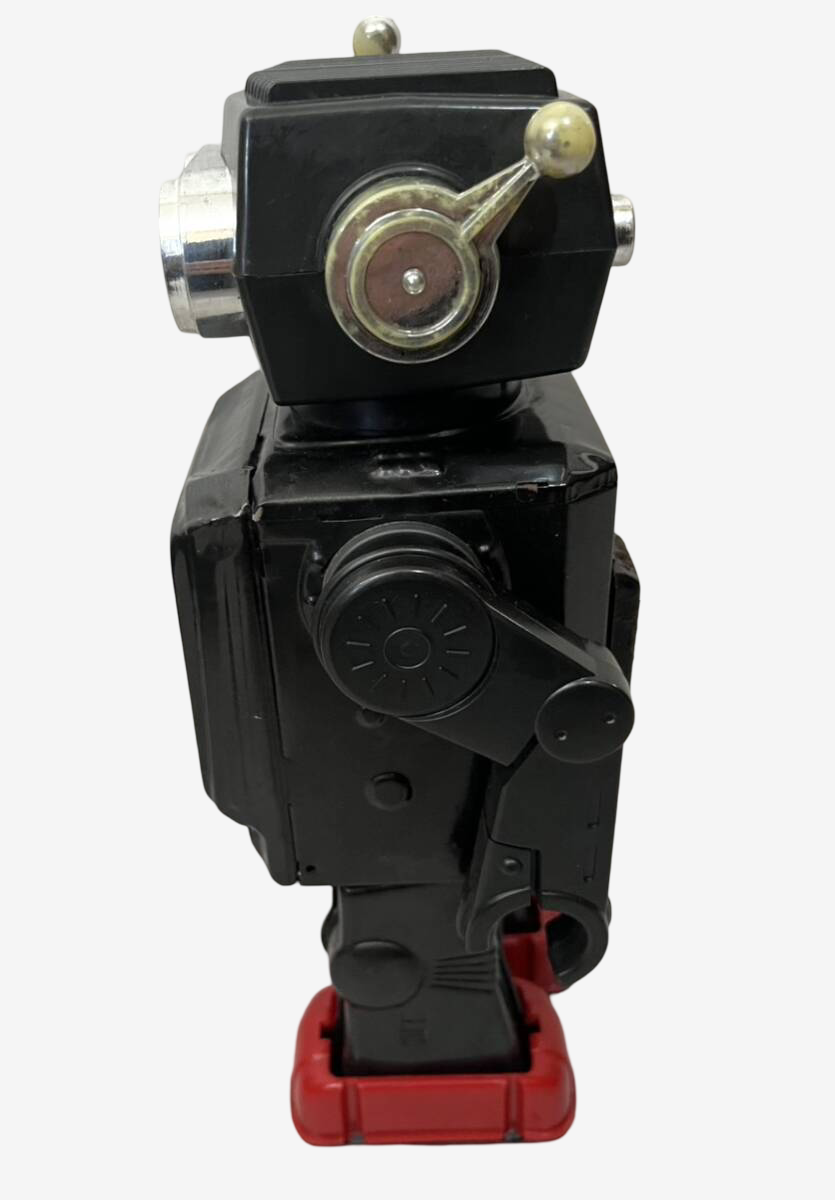
Standing approximately 29 cm tall, the robot has an unmistakable architectural presence. Twin circular optical eyes project from beneath a deeply ribbed mechanical crown, metallic terminals rise from either side of the head, and a television-style screen occupies almost the entire chest. Black bodywork and metallic details are dramatically grounded by deep red feet.
Even more compelling is the survival of its original illustrated presentation box, transforming the piece from an isolated vintage robot into a remarkably complete document of Japanese science-fiction toy culture.
HORIKAWA, JAPAN
SUPER TELEVISION ROBOT, “NEW ACTION TOY”
SHOWA PERIOD
WITH ORIGINAL ILLUSTRATED BOX
Approx. H 29 × W 14 × D 11 cm
Few objects express the technological imagination of postwar Japan more vividly than its mechanical robots.
Created during an era when television, automation and space exploration were rapidly altering perceptions of the future, Japanese robot toys translated those new technologies into fantastic mechanical characters that could enter the domestic world.
The present Super Television Robot embodies that phenomenon with unusual clarity.
Rather than disguising its technological identity beneath a human form, the design celebrates machinery. Two projecting circular optical units dominate the head. Ribbed mechanical detailing crowns the figure. The torso becomes a cabinet for a television-like screen, while metallic elements, substantial black bodywork and brilliant red feet create a powerful industrial silhouette.
The television chest is especially evocative.
Television itself represented technological modernity during the period in which such robots emerged. By incorporating a screen directly into the body, the designer effectively fused two symbols of the approaching future: the intelligent machine and the electronic image.
The surviving original carton adds another dimension to the object.
Against a predominantly dark field, its graphic program places the robot within a spectacular extraterrestrial universe of stars, planets, orbital imagery and rocky terrain. The packaging therefore performs a role far beyond simple protection. It provides the imaginative environment in which the machine was originally intended to exist.
Robot and carton together preserve a wonderfully concentrated vision of the technological future as it was once imagined in Japan.
The Future Had a Television in Its Chest
There is something wonderfully literal about the Super Television Robot.
It does not simply belong to the television age.
It carries television inside its body.
That distinction gives the design much of its historical charm.
Television was once an astonishing object in its own right, a luminous electronic window capable of bringing distant events and imagined worlds into the home. At roughly the same historical moment, satellites, rockets and space exploration were radically expanding the geographic boundaries of popular imagination.
Japanese mechanical toys brought those ideas together.
The robot became machine, television, astronaut and companion.
Its enormous optical eyes evoke cameras, telescopes and scientific instruments. The ribbed upper head resembles electronic cooling equipment rather than hair. Circular shoulder housings emphasize machinery rather than anatomy.
At the center sits the screen.
The result is not a robot attempting to resemble a human being. It is something much stranger and more compelling:
an imagined appliance that has learned to walk.
Horikawa Heritage
Horikawa occupies an important position within the history of Japanese mechanical and battery-operated robot toys.
Its robot designs explored movement, illumination, sound and mechanical spectacle while repeatedly drawing upon the visual language of electronics, space travel and futuristic machinery.
Television-screen robots became one particularly memorable expression of this design vocabulary. Instead of treating the torso merely as a body, the screen transformed it into a stage on which technology itself could become part of the performance.
Horikawa television robots are today represented within institutional and specialist collections, helping establish these machines not simply as nostalgic toys but as artifacts of Japanese industrial design and twentieth-century popular culture.
The Super Television Robot belongs naturally within that lineage.
Design and Construction
The robot is constructed around a strong sequence of geometric forms.
The head is dominated by twin circular optical housings positioned beneath a ribbed upper structure. Small metallic terminals rise from either side, giving the head the appearance of radio or scientific equipment.
A compact neck leads into broad mechanical shoulders. Long dark arms descend along either side of the rectangular torso.
The chest is visually dominated by the recessed television-style screen, framed within a dark cabinet and accompanied by small control details beneath.
Bright red feet provide the principal chromatic punctuation.
Viewed from across a room, the entire design can almost be reduced to a vocabulary of industrial geometry:
circle, rectangle, cylinder, screen, machine.
That simplicity gives the Super Television Robot its extraordinary graphic presence.
Original Illustrated Box
The original carton deserves to be regarded as part of the collectible itself.
Its predominantly black background creates the darkness of outer space, while vivid blue, white, red and yellow graphics introduce the visual excitement associated with Japanese science-fiction packaging of the period.
The illustrated robot is surrounded by cosmic imagery, planetary forms and rocky extraterrestrial terrain.
Packaging of this kind did far more than identify the toy inside.
It created its universe.
Before the robot was ever removed from the carton, the artwork had already established where the machine belonged: not on a shelf or bedroom floor, but somewhere among planets and distant worlds.
The survival of the original box therefore contributes both collector significance and graphic provenance, preserving an important part of the object's original presentation.
Condition
This vintage example is preserved in authentic age-related condition, retaining the surface character accumulated during decades of existence.
The robot displays scratches, rubbing, surface marks, oxidation, areas of rust and other wear associated with age and previous use or storage. The battery compartment has an area of material loss resulting in a hole.
The original illustrated cardboard box remains present and displays substantial age-related character, including tears, staining and soiling, abrasion, edge and corner wear, deformation and general structural wear.
The electrical and mechanical functions are presently untested, and functionality is therefore not included as part of the object's condition representation.
The piece is presented and valued primarily as a surviving vintage Japanese robot and display collectible, with its original packaging forming an important part of the ensemble.
Its preserved wear should be considered part of the object's history rather than the condition of a modern reproduction or newly manufactured collectible.
Please review the photographs carefully for the most complete visual record of condition.
Dimensions
Approx. H 29 × W 14 × D 11 cm
Approx. H 11.4 × W 5.5 × D 4.3 in
Measurements are approximate.
Collector Significance
The Super Television Robot sits at the intersection of several important collecting fields: vintage Japanese robots, mechanical toys, Japanese tin and mixed-material toys, Space Age design, science-fiction material culture, Showa-era popular design, television history and original Japanese toy packaging.
Its appeal extends beyond conventional toy collecting.
Viewed today, the robot becomes a small sculptural document of the technological future imagined by an earlier generation.
The television chest is particularly powerful in this context. What appears quaint today once represented an extraordinary convergence of advanced technologies: moving machines, electronic screens and imagined artificial beings.
The surviving original carton preserves the other half of that story.
The robot preserves the machine. The box preserves the world imagined around it.
Museum Wall Label
Super Television Robot
Horikawa, Japan
Showa period
Mixed metal and molded components, painted and mechanical/electrical elements
Original printed cardboard box
Approx. H 29 × W 14 × D 11 cm
Japanese toy makers transformed the technological developments of the twentieth century into miniature visions of the future. Television, automation, robotics and space exploration converged particularly vividly in mechanical robot toys.
Here, a television-style screen becomes part of the robot's anatomy. Twin optical eyes, metallic terminals and an architectural black body frame the central monitor, while brilliant red feet preserve the visual exuberance of a child's mechanical toy.
The original illustrated carton extends the object into an imagined extraterrestrial environment of stars, planets and rocky terrain.
Together, machine and packaging preserve a moment when the technologies of tomorrow were still strange enough to appear almost magical.
Collection Placement
Primary Collection: Vintage Japanese Robots & Space Toys
Secondary Collection: Japanese Tin & Mechanical Toys
Historical Collection: Showa-Era Design & Popular Culture
Design Collection: Space Age & Retrofuturist Objects
Archive Collection: Japanese Toy Packaging & Graphic Design
Authenticity & Collectible Stewardship
Evaluated under the Japonista Collectibles Authentication Framework™:
-
Period, manufacturer, and production-era assessment
-
Material, paint, lithography, and surface-wear analysis
-
Mechanical, structural, and component integrity review (where applicable)
-
Design, iconography, and cultural-context verification
Guaranteed 100% Authentic.
Every piece is backed by the Japonista Lifetime Authenticity Warranty™ and curated with collector-grade scrutiny.
A Note on Collecting & Preservation
At Japonista, we approach vintage and modern toys not merely as nostalgic objects, but as design artifacts, cultural touchstones, and expressions of their era—from postwar ingenuity and Showa imagination to contemporary pop and designer movements.
Each work is carefully examined, researched, and presented with respect for its original intent, historical context, and collector relevance, balancing preservation with the honest character earned through time and play.
Our role is not only to offer access to meaningful collectibles, but to act as thoughtful custodians—connecting the right pieces with collectors who value history, originality, and lasting significance.
Inquiries, Availability, and Private Consideration
Some collectible works may allow room for discussion, while others are held firmly due to rarity, condition, provenance, or cultural importance. All inquiries are reviewed personally and discreetly, and we welcome thoughtful questions or expressions of interest.
If you are exploring a specific theme, franchise, maker, era, or mechanical category—or seeking guidance in building a focused collection—our team is always available to assist with informed, quiet expertise.
Concierge Support & Collector Guidance
Japonista Concierge™ offers personalized assistance for collectors seeking deeper understanding, strategic acquisitions, or long-term curation across vintage and modern collectibles.
Whether your interest lies in nostalgia, design history, mechanical fascination, or pop-culture legacy, we are here to support your collecting journey with clarity, care, and discretion.
For select high-value or historically significant pieces, private reservation or structured payment arrangements may be available on a case-by-case basis. Please contact us to discuss eligibility and options.
Before Proceeding
We kindly encourage collectors to review our shop policies and house guidelines, available through the links in our website footer, which outline shipping, handling, and condition standards specific to vintage, mechanical, and collectible works.
A Closing Note
Thank you for exploring Japonista’s collection of vintage and modern toys, robots, and cultural collectibles. We are honored to share these enduring objects of imagination and design—and to help place them where they may continue to be appreciated, studied, and enjoyed.
If you have questions or wish to explore related works, please feel free to contact Japonista Concierge™ at any time.