Rare Vintage, Antiques and Art Collector / Curator / Personal Shopper From Japan
Horikawa Monster Robot · Battery-Operated Transforming Kaiju Robot · Original Box · Japan, circa 1980s
Horikawa Monster Robot · Battery-Operated Transforming Kaiju Robot · Original Box · Japan, circa 1980s
Couldn't load pickup availability
Have a reasonable price in mind? Submit your best offer and our concierge will review it personally.
Object: Monster Robot
Trade Name: MONSTER ROBOT
Maker / Brand: Horikawa / SH lineage
Origin: Japan
Period: Late Showa period, circa 1980s
Object Type: Battery-operated mechanical transformation robot
Construction: Predominantly molded plastic with metal and mechanical components
Color: Deep green body, amber-orange translucent head panels, yellow arms, silver-gray legs and feet
Power: Two batteries
Primary Action: Walking movement
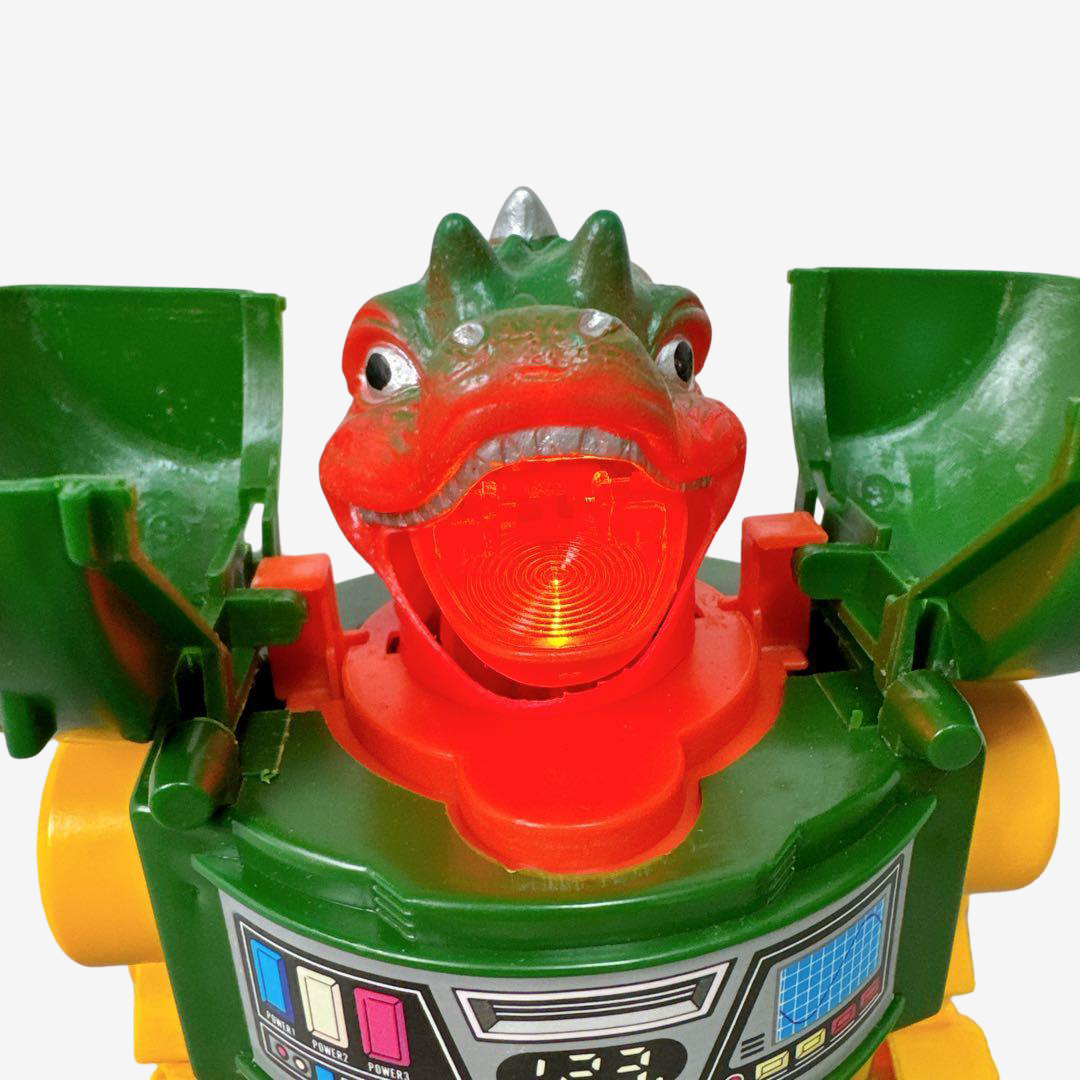
Transformation Action: Outer head opens to reveal an internal monster / kaiju head
Effects: Internal illumination and vibration during the monster-reveal sequence
Action Cycle: Walks, stops, opens its head, reveals and illuminates the monster, vibrates, closes and repeats
Chest Design: Applied retro-electronic control-panel graphics with numerical “123” display
Packaging: Original illustrated MONSTER ROBOT box
Operation: Core transformation sequence presently operates
Condition: Authentic vintage condition with age-related surface wear
Collector Category: Japanese robots / Horikawa / kaiju robots / transformation toys / late-Showa mechanical toys / retrofuturism
Collector documentation identifies an all-plastic Horikawa Monster Robot from around the mid-1980s with precisely this theatrical concept: walking action followed by a splitting outer head that reveals an illuminated dinosaur-like monster head, accompanied by trembling movement.
A separate auction-house record identifies a Horikawa Monster Robot from the 1980s at approximately 24 cm high, further anchoring the model family within late-Showa Japanese robot production.
CHRISTIE’S-STYLE CATALOGUE LOT ESSAY
A HORIKAWA MONSTER ROBOT
Japan, late Showa period, circa 1980s
Battery-operated mechanical transformation robot
With original illustrated box
The history of the Japanese robot toy is filled with machines that walk, illuminate, spark, rotate and simulate the technologies of an imagined future.
The Monster Robot, however, adds another possibility:
the robot itself contains a creature.
At rest, the figure presents the familiar vocabulary of late-Showa mechanical science fiction. A broad green torso carries printed electronic instrumentation across the chest. Large amber-orange translucent panels dominate the domed head. Bright yellow arms flank the body, while silver-gray legs support an exaggerated, architectural silhouette.
Then the machine begins to perform.
During its mechanical sequence, the robot walks forward before stopping. The outer head separates and opens. From within appears an entirely different presence: a vividly colored kaiju-like creature, illuminated and animated through vibration.
Machine gives way to monster.
The transformation is theatrical rather than subtle, and that is precisely its charm.
Horikawa’s robot designs had long explored ways of turning mechanical toys into miniature performances. Earlier machines emphasized exposed gears, television screens, sparking mechanisms and illuminated interiors. The Monster Robot pushes that philosophy toward spectacle, making the transformation of the robot’s identity itself the principal action.
The original carton captures the same drama.
Against a deep black field, the illustrated robot stands upright with its domed head glowing above an instrument-panel torso. A secondary image at the lower edge reveals the monster hidden inside, previewing the surprise before the machine has even been activated.
The box therefore performs an important narrative function.
It tells us that this is not simply a robot.
It is a robot with another being concealed inside it.
Together, the object and its packaging preserve a wonderfully exuberant moment in Japanese toy design, when mechanical movement, science-fiction imagery and kaiju culture could coexist within a single battery-operated machine.
CURATORIAL ESSAY
The Monster Inside the Machine
The Monster Robot is built around a wonderfully strange proposition:
what if the robot is merely the shell?
That idea distinguishes it from conventional mechanical robots.
Most toy robots establish their identity immediately. The viewer sees a machine and understands the character. Horikawa instead creates suspense.
The green outer body is deliberately technological. Printed displays, simulated electronic controls and the large “123” readout suggest processing equipment. The broad dome resembles the cockpit or sensor array of an imaginary machine.
Yet the architecture conceals something organic.
When the head opens, technological geometry gives way to the visual language of the kaiju.
The transformation changes the emotional character of the object.
The robot is orderly.
The monster is theatrical.
The robot walks.
The monster erupts.
The robot belongs to engineering.
The creature belongs to fantasy.
That tension is the heart of the design.
FROM ROBOT TO KAIJU
Japan’s postwar popular culture developed two extraordinary visual families almost simultaneously:
the giant mechanical being and the giant biological monster.
Robots represented technology, industry, automation and speculative futures.
Kaiju represented transformation, mutation, nature, fear and spectacle.
The Monster Robot collapses those traditions into a single object.
Its monster is literally contained inside technological armor.
The effect is playful rather than threatening, but conceptually it is unusually rich.
The robot becomes a mechanical chrysalis.
The head splits open.
Another identity emerges.
Then the machine closes again and continues walking.
What could have been a simple novelty gimmick becomes a miniature mechanical drama.
WHY HORIKAWA MATTERS
Horikawa holds an unusual position within Japanese robot collecting because its machines repeatedly treated technology itself as entertainment.
Across different generations of Horikawa robots, collectors encounter:
visible gear trains,
television-style screens,
illuminated panels,
moving internal scenes,
optical eyes,
sparking mechanisms,
walking actions,
rotating equipment,
and increasingly elaborate transformation effects.
The company’s designs frequently ask the same question:
how can a robot reveal its machinery to the viewer?
In the Gear Robot, the answer was a transparent chest.
In television robots, it was an illuminated screen.
In the Monster Robot, it becomes a concealed creature.
The mechanical effect is no longer simply visible machinery.
It is narrative.
Collector documentation of this version describes an all-plastic Horikawa Monster Robot from around 1985 whose action involves walking, stopping, splitting the head to reveal a lighted dinosaur-like creature and causing the opened shell to tremble during the sequence.
That makes the Monster Robot an intriguing late chapter in the same broader Horikawa philosophy.
The mechanical spectacle survived.
Its form simply became more theatrical.
DESIGN AND CONSTRUCTION
The Monster Robot has a remarkably architectural profile.
Its dominant form is the large rounded green body, almost cylindrical through the torso, with molded technological detailing running across the front and sides.
The chest carries a graphic electronic panel composed of colored indicators, simulated monitors and a central numerical display reading 123.
Above it rises the head.
The outer shell resembles a large green mechanical dome divided along a central seam. Amber-orange translucent sections create the impression of oversized sensors, observation windows or illuminated optical equipment.
Bright yellow arms interrupt the green body with bold blocks of color.
Below, silver-gray legs descend into oversized rectangular feet, giving the machine a broad stance suitable for mechanical walking.
The palette is wonderfully unapologetic:
industrial green, warning yellow, translucent amber and machine gray.
It belongs unmistakably to the exuberant technological imagination of late twentieth-century Japanese toy design.
THE TRANSFORMING HEAD
The head is the defining component.
At first glance it appears to be a conventional domed robot head.
The central seam hints otherwise.
During the mechanical sequence, the outer shell separates and opens, transforming the robot’s smooth technological dome into a stage.
Inside sits the monster.
The reveal radically alters the silhouette of the toy. A disciplined geometric machine suddenly becomes a creature-display apparatus.
This distinction matters because the transformation is not dependent on removable accessories or manual assembly.
The surprise is integrated into the robot’s mechanical identity.
The toy performs the reveal itself.
THE KAIJU REVEAL
Inside the opened head is the visual climax of the machine.
The creature emerges in vivid red-orange tones, contrasting dramatically with the subdued green outer body.
Illumination intensifies the transformation.
Vibration introduces another layer of physical movement, making the revealed monster appear less like a static hidden figure and more like a struggling living presence inside the robot.
Then the head closes.
The creature disappears.
The technological shell is restored.
The action repeats.
This cyclical structure gives the Monster Robot an almost theatrical rhythm:
machine → transformation → monster → machine.
MOVEMENT AND MECHANICAL THEATRE
The core action sequence presently operates.
The robot advances through its walking cycle before the head opens. The monster becomes visible, illuminates and vibrates, after which the mechanism continues through its programmed sequence.
This is important because the Monster Robot was designed less as a static figure than as a compact mechanical performance.
Walking alone does not explain the object.
The transformation does.
The illumination does.
The shaking movement does.
The robot only becomes fully legible when these elements are understood together.
As with all vintage electromechanical objects, long-term continuous operation should not be assumed. It is best appreciated as a historic mechanical collectible whose original performance survives, rather than as a modern electronic toy intended for sustained play.
THE CHEST AS CONTROL PANEL
The chest graphics deserve attention of their own.
Where earlier tin robots often used lithographed gauges, meters and fictional circuitry, the Monster Robot translates that tradition into applied late-Showa electronic graphics.
Colored indicator bars flank a prominent central numerical panel.
A grid-like blue display sits on one side.
The effect resembles an imagined hybrid of calculator, computer terminal, television monitor and spacecraft instrumentation.
It gives the robot a technological face below its biological surprise.
Even before the monster appears, the toy communicates that something is happening inside.
ORIGINAL BOX AND GRAPHIC CULTURE
The original box is essential to the object’s presentation.
A black ground allows the robot’s red title typography and colorful body to appear almost luminous.
MONSTER ROBOT is printed prominently across the upper portion.
The main illustration presents the complete machine standing upright in its ordinary robot state.
But the packaging contains another clue.
A secondary image reveals the creature hidden inside the head.
The package therefore performs the same basic narrative as the mechanism:
first the robot,
then the monster.
This is one reason original Japanese robot boxes deserve to be regarded as historical design objects rather than disposable packaging.
They frequently explain movement that a static toy cannot communicate.
In this case, the carton preserves the surprise.
LATE-SHOWA FUTURISM
The Monster Robot belongs to a different technological world from Horikawa’s earliest tin robots.
Earlier machines emerged from a culture of rockets, radar dishes, television sets and visible mechanical engineering.
By the 1980s, the visual vocabulary had changed.
Plastic construction allowed increasingly sculptural bodies.
Electronics had become familiar enough that imaginary computers and digital readouts could replace simple gauges.
Robot design had become more expressive, colorful and transformational.
The Monster Robot reflects that transition beautifully.
Its futuristic identity does not depend on chrome.
It depends on transformation.
MATERIAL TRANSITION
From Tinplate Machine to Molded Mechanical Character
This robot also records an important change in Japanese toy manufacturing.
Earlier postwar robots were often constructed predominantly from lithographed or painted tinplate.
Later generations increasingly adopted molded plastics.
That shift changed what designers could do.
Bodies became rounder.
Moving shells became easier to engineer.
Colors could be molded directly into individual components.
Complex transformation gimmicks could be incorporated without relying exclusively on folded sheet metal.
The Monster Robot belongs to this later material vocabulary.
Its molded construction is not a lesser imitation of earlier tin robots.
It documents the industry's evolution.
CONDITION
This vintage Monster Robot is preserved in authentic age-related collectible condition with its original illustrated box.
The body retains its deep green coloration, amber-orange translucent head panels, vivid yellow arms, silver-gray legs, electronic chest graphics and distinctive transformation mechanism.
Age-related signs of handling and storage are present, including light scratches, rubbing, surface marks, minor discoloration and other traces consistent with vintage preservation.
The principal mechanical sequence presently operates: the robot walks, the outer head opens, the concealed monster appears, illumination activates and the creature assembly vibrates before the sequence continues.
Only the principal action sequence has been evaluated. Secondary or subsidiary functions, if any, should not be considered independently guaranteed.
The mechanism requires two batteries, which are not included.
The original illustrated cardboard box remains with the robot and exhibits age-related storage wear consistent with vintage packaging, including edge wear, rubbing, creasing and surface marks.
As with any vintage battery-operated mechanical object, continued future operation cannot be guaranteed indefinitely. The piece should be regarded primarily as a historic collectible rather than a modern play toy.
Please review the photographs carefully for the most complete visual record of condition.
SIZE & SCALE
Documented examples of Horikawa Monster Robot variants are approximately 24 cm / 9.4 in in height. An auction-house record specifically describes a Horikawa Monster Robot from the 1980s at approximately 24 cm.
The model therefore belongs to the classic cabinet-scale Japanese robot category, substantial enough for its transforming mechanism to have real visual impact while remaining easy to display alongside other Horikawa machines.
COLLECTOR SIGNIFICANCE
The Monster Robot crosses several collecting disciplines:
Japanese robot toys,
Horikawa,
late-Showa design,
kaiju culture,
transforming robots,
battery-operated mechanical toys,
vintage science fiction,
retrofuturism,
Japanese packaging design,
mechanical novelty toys,
and the transition from tinplate to molded-plastic robot manufacture.
Its original box and functioning core transformation sequence considerably strengthen its display and collecting appeal.
More importantly, its concept is memorable.
Collectors encounter many walking robots.
Far fewer conceal a monster inside their own head.
HORIKAWA ROBOT LINEAGE
Within a Horikawa-focused collection, the Monster Robot is particularly useful because it demonstrates how the company's mechanical vocabulary evolved.
An earlier Gear Robot transforms internal machinery into spectacle.
A television robot transforms the chest into a screen.
The Monster Robot transforms the entire head into a stage.
Seen together, these machines trace a fascinating conceptual arc:
mechanism → media → transformation.
The technology changes.
The desire to surprise the viewer remains constant.
THE ROBOT AS KINETIC OBJECT
Even inactive, the Monster Robot communicates potential movement.
The seam dividing the helmet signals transformation.
The translucent panels imply illumination.
The broad feet imply locomotion.
The oversized mechanical body suggests machinery waiting to activate.
Once operating, those expectations become physical.
The machine moves.
Its architecture separates.
Light appears.
A creature emerges.
The object therefore occupies an appealing territory between toy, kinetic sculpture and mechanical theatre.
MUSEUM WALL LABEL
Monster Robot
Horikawa lineage, Japan
Late Showa period, circa 1980s
Molded plastic, metal and electrical/mechanical components
Battery-operated walking and transformation mechanism
Original illustrated cardboard box
Horikawa’s Monster Robot belongs to the later development of Japan’s celebrated mechanical robot tradition.
The robot walks before its domed outer head separates, revealing an illuminated kaiju-like creature within. Vibration animates the revealed monster before the mechanism returns to its original robot configuration.
Its unusual design brings together two major strands of Japanese postwar popular culture: the technological robot and the biological kaiju.
The surviving original box preserves the same narrative visually, presenting both the mechanical exterior and the creature concealed within.
Rather than merely simulating technology, the Monster Robot turns transformation itself into spectacle.
COLLECTOR’S NOTE
A good mechanical toy moves.
A memorable one changes what you think you are looking at.
The Monster Robot begins as a machine.
Then its head opens.
The machine becomes a container.
The creature becomes the protagonist.
Seconds later, the monster disappears and the robot walks again.
That little mechanical drama is why the object survives in memory long after simpler walking toys have been forgotten.
Authenticity & Collectible Stewardship
Evaluated under the Japonista Collectibles Authentication Framework™:
-
Period, manufacturer, and production-era assessment
-
Material, paint, lithography, and surface-wear analysis
-
Mechanical, structural, and component integrity review (where applicable)
-
Design, iconography, and cultural-context verification
Guaranteed 100% Authentic.
Every piece is backed by the Japonista Lifetime Authenticity Warranty™ and curated with collector-grade scrutiny.
A Note on Collecting & Preservation
At Japonista, we approach vintage and modern toys not merely as nostalgic objects, but as design artifacts, cultural touchstones, and expressions of their era—from postwar ingenuity and Showa imagination to contemporary pop and designer movements.
Each work is carefully examined, researched, and presented with respect for its original intent, historical context, and collector relevance, balancing preservation with the honest character earned through time and play.
Our role is not only to offer access to meaningful collectibles, but to act as thoughtful custodians—connecting the right pieces with collectors who value history, originality, and lasting significance.
Inquiries, Availability, and Private Consideration
Some collectible works may allow room for discussion, while others are held firmly due to rarity, condition, provenance, or cultural importance. All inquiries are reviewed personally and discreetly, and we welcome thoughtful questions or expressions of interest.
If you are exploring a specific theme, franchise, maker, era, or mechanical category—or seeking guidance in building a focused collection—our team is always available to assist with informed, quiet expertise.
Concierge Support & Collector Guidance
Japonista Concierge™ offers personalized assistance for collectors seeking deeper understanding, strategic acquisitions, or long-term curation across vintage and modern collectibles.
Whether your interest lies in nostalgia, design history, mechanical fascination, or pop-culture legacy, we are here to support your collecting journey with clarity, care, and discretion.
For select high-value or historically significant pieces, private reservation or structured payment arrangements may be available on a case-by-case basis. Please contact us to discuss eligibility and options.
Before Proceeding
We kindly encourage collectors to review our shop policies and house guidelines, available through the links in our website footer, which outline shipping, handling, and condition standards specific to vintage, mechanical, and collectible works.
A Closing Note
Thank you for exploring Japonista’s collection of vintage and modern toys, robots, and cultural collectibles. We are honored to share these enduring objects of imagination and design—and to help place them where they may continue to be appreciated, studied, and enjoyed.
If you have questions or wish to explore related works, please feel free to contact Japonista Concierge™ at any time.