Rare Vintage, Antiques and Art Collector / Curator / Personal Shopper From Japan
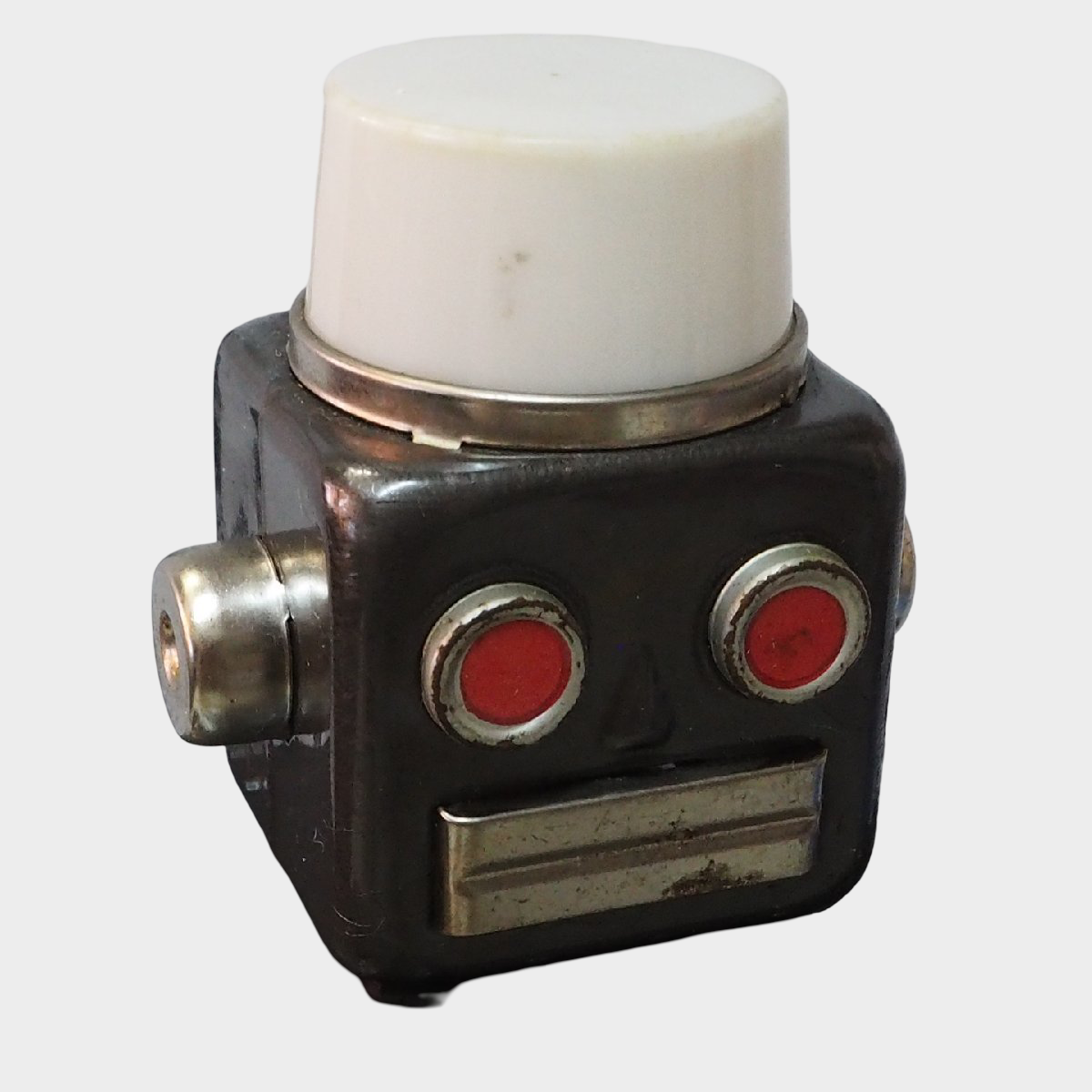
Horikawa MACHINE ROBOT Tin Walking Robot Japan — 1960s Gear-Driven Display Space Robot
Horikawa MACHINE ROBOT Tin Walking Robot Japan — 1960s Gear-Driven Display Space Robot
Couldn't load pickup availability
Have a reasonable price in mind? Submit your best offer and our concierge will review it personally.
Object Type:
Japanese Tin Walking Robot — Gear-Driven Display Robot
Maker:
Horikawa Toys (Japan)
Model / Trade Name:
“MACHINE ROBOT” (market name; period generic branding)
Era:
Mid–Late 1960s (Showa-era tin robot peak)
Material:
Tinplate body with transparent chest window, exposed gear mechanism, plastic head cap, metal limbs
Dimensions:
Approx. 26–27 cm height (based on scale ruler shown)
Drive System:
Battery-powered walking mechanism (gear-driven)
Operation described as unstable / irregular (functional but unreliable)
Condition Summary:
-
Surface wear, scratches, age patina consistent with use
-
Transparent chest intact with visible internal gears
-
Walking action present but unstable
-
No box, no accessories
-
Display-grade with mechanical interest
Market Tier (Initial Read):
Mid Collector Tier (mechanical display robot with exposed movement)
🧠 Horikawa “Machine Robot” — Japan, circa mid-1960s
Mechanical Transparency as Toy Theatre
This Horikawa Machine Robot exemplifies one of the most collectible design philosophies of the Showa robot era:
the exposed mechanism as spectacle.
Rather than concealing its motion, this model places its gear train front and center behind a clear chest window. The result is less a character robot and more a mechanical exhibit — a moving diagram of postwar Japanese ingenuity aimed squarely at children who wanted to see how machines worked.
The squared torso, cylindrical arms, and oversized red feet give the robot a grounded, industrial stance. Its walking mechanism — described as unstable — reflects the reality of early battery robotics: motion was experimental, imperfect, and thrilling precisely because of that unpredictability.
From a curatorial standpoint, this is not a “toy failure.”
It is an authentic mechanical survivor, retaining its most important element: visible internal life.
Surface wear and age marks reinforce its originality. The robot has not been cosmetically restored or overly cleaned, preserving the honest texture that collectors increasingly value over artificial perfection.
🧭 CURATORIAL PLACEMENT
Collection Axis:
Japanese Tin Robots → Mechanical Transparency → Gear-Driven Forms
Sub-Section:
1960s Horikawa Engineering Robots
Narrative Role:
-
Bridges play object and educational machine
-
Emphasizes motion mechanics over character branding
-
Represents peak tin robot engineering before plastic simplification
Comparative Context:
-
Sits between boxed Horikawa Radar Robots and later 1970s display giants
-
More mechanically interesting than static figures
-
Less character-driven than TV tie-in robots — purer design object
This robot anchors a collection by showing the inside, not just the silhouette.
🎯 COLLECTOR’S RESONANCE
This robot is for the collector who values mechanics over mythology.
It does not need a character name or a TV show. Its appeal lies in motion, exposure, and honesty — a machine built at a time when toys were allowed to be strange, imperfect, and educational all at once.
On a shelf, this robot does something most cannot:
it explains itself.
As part of a Horikawa-focused collection or a broader Showa robot lineup, it functions as the mechanical heart — the piece that reminds viewers that these were once marvels of engineering, not just nostalgia.
Why Collect Horikawa?
The Most Conceptual Robot Maker of the Showa Era
When collectors think of Japanese tin robots, they often picture action: rockets firing, legs marching, gears turning. But Horikawa occupies a different and far rarer intellectual lane. Horikawa did not merely build toys — they built ideas in metal.
To collect Horikawa is to collect the moment when Japanese post-war imagination asked not what a robot does, but what a robot is.
1. Horikawa Robots Are About Concept, Not Power
Unlike contemporaries who emphasized strength, weapons, or heroic narratives, Horikawa focused on abstract machine identity.
Signature traits include:
- Box-shaped torsos
- Screen-like chest panels
- Minimal limb articulation
- Simplified, almost architectural forms
These robots feel less like characters and more like machines designed to observe, process, or communicate — an astonishingly early vision of media-centric technology.
In hindsight, Horikawa robots resemble:
- Proto-television objects
- Early cybernetic thought experiments
- Physical metaphors for information systems
This places them closer to industrial design artifacts than conventional toys.
2. The Screen-Chest Robot: A Showa-Era Media Archetype
Horikawa’s most iconic contribution is the screen-chest robot — a robot whose torso resembles a television or monitor.
This matters more than it first appears.
In the 1950s–60s:
- Television was new, mysterious, and transformative
- Robots were symbols of modernity and anxiety
- Combining the two created a cultural object, not a plaything
Long before screens dominated daily life, Horikawa imagined the robot as a viewing machine — one that watches or transmits, rather than fights.
This is why modern collectors often describe Horikawa robots as:
- “Eerily modern”
- “Proto-digital”
- “Strangely artistic”
3. Horikawa vs Other Showa Giants
Understanding Horikawa requires contrast.
| Maker | Core Focus | Collector Reading |
|---|---|---|
| Horikawa | Concept, abstraction, media | Intellectual / art-object |
| Masudaya | Motion, spectacle, space fantasy | Visual drama, nostalgia |
| Yonezawa | Mechanics, export reliability | Engineering, completeness |
Where Masudaya excites the eye and Yonezawa satisfies the hand, Horikawa engages the mind.
4. Condition Is Read Differently for Horikawa
One of the most important (and misunderstood) aspects of collecting Horikawa is condition tolerance.
For Horikawa:
- Surface wear often adds authenticity
- Oxidation reinforces industrial character
- Non-working status is commonly acceptable
- Original paint and structure matter more than motion
Collectors value untouched Showa presence over restoration.
This is why many Horikawa robots are described as:
“Display-grade, original surface, as-found”
And still command strong international interest.
5. Why the International Market Values Horikawa More Each Year
In Japan, Horikawa robots were once overlooked — perceived as simple or odd compared to flashier competitors.
Internationally, the reading is very different.
Western collectors see Horikawa as:
- Early media theory in tin
- Precursor to cyberpunk aesthetics
- Physical artifacts of post-war futurism
As a result:
- US and EU buyers often pay 2×–3× domestic Japanese pricing
- Museum and design-focused collectors actively seek them
- Horikawa has shifted from “quirky” to essential
This trend continues upward.
6. Horikawa and the Broader Robot Lineage
Horikawa sits in a crucial evolutionary position between:
- Early humanoid optimism (e.g. Astro Boy)
- Later action-driven super robots
- Modern screen-centric digital culture
They represent the quiet middle chapter — when robots stopped being fairy tales and started becoming interfaces.
7. Who Should Collect Horikawa?
Horikawa is ideal for collectors who:
- Appreciate design over play
- Collect with an art-historical lens
- Value originality and surface integrity
- Understand robots as cultural symbols, not just toys
If Masudaya is for the thrill-seeker and Yonezawa for the completist, Horikawa is for the thinker.
🧭 Showa Tin Robot Makers — Comparative Matrix
Horikawa vs Masudaya vs Yonezawa
| Axis | Horikawa | Masudaya | Yonezawa |
|---|---|---|---|
| Core Identity | Conceptual / experimental robot maker | Spectacle & motion-driven innovator | Engineering-led mass exporter |
| Design Philosophy | Abstract, modular, idea-first robots | Dramatic silhouettes, space fantasy | Functional, mechanical realism |
| Signature Motif | Screen-chest / TV robots, box torsos | Domes, rockets, astronauts | Gear panels, vents, military cues |
| Visual Language | Industrial minimalism, bold geometry | Colorful futurism, cinematic flair | Utilitarian sci-fi, export-friendly |
| Narrative Role | “Thinking machine” / media robot | Space explorer / hero vehicle | Robot soldier / machine assistant |
| Movement Style | Simple walking, blinking, screen effects | Complex actions, sparks, motion | Reliable walking, spinning, actions |
| Target Market (1960s) | Domestic + limited export | Strong US export (space craze) | Heavy US / EU export focus |
| Typical Condition Today | Often worn, oxidized, display-grade | Mixed; many play-worn survivors | Higher survival, more intact units |
| Collector Appeal | High conceptual rarity | High nostalgia + visual impact | High availability + recognizability |
| Restoration Tolerance | Low (value favors originality) | Medium | Medium–High |
| Price Ceiling (Intl.) | Underrated → rising | Strong, established | Stable, volume-driven |
Authenticity & Collectible Stewardship
Evaluated under the Japonista Collectibles Authentication Framework™:
-
Period, manufacturer, and production-era assessment
-
Material, paint, lithography, and surface-wear analysis
-
Mechanical, structural, and component integrity review (where applicable)
-
Design, iconography, and cultural-context verification
Guaranteed 100% Authentic.
Every piece is backed by the Japonista Lifetime Authenticity Warranty™ and curated with collector-grade scrutiny.
A Note on Collecting & Preservation
At Japonista, we approach vintage and modern toys not merely as nostalgic objects, but as design artifacts, cultural touchstones, and expressions of their era—from postwar ingenuity and Showa imagination to contemporary pop and designer movements.
Each work is carefully examined, researched, and presented with respect for its original intent, historical context, and collector relevance, balancing preservation with the honest character earned through time and play.
Our role is not only to offer access to meaningful collectibles, but to act as thoughtful custodians—connecting the right pieces with collectors who value history, originality, and lasting significance.
Inquiries, Availability, and Private Consideration
Some collectible works may allow room for discussion, while others are held firmly due to rarity, condition, provenance, or cultural importance. All inquiries are reviewed personally and discreetly, and we welcome thoughtful questions or expressions of interest.
If you are exploring a specific theme, franchise, maker, era, or mechanical category—or seeking guidance in building a focused collection—our team is always available to assist with informed, quiet expertise.
Concierge Support & Collector Guidance
Japonista Concierge™ offers personalized assistance for collectors seeking deeper understanding, strategic acquisitions, or long-term curation across vintage and modern collectibles.
Whether your interest lies in nostalgia, design history, mechanical fascination, or pop-culture legacy, we are here to support your collecting journey with clarity, care, and discretion.
For select high-value or historically significant pieces, private reservation or structured payment arrangements may be available on a case-by-case basis. Please contact us to discuss eligibility and options.
Before Proceeding
We kindly encourage collectors to review our shop policies and house guidelines, available through the links in our website footer, which outline shipping, handling, and condition standards specific to vintage, mechanical, and collectible works.
A Closing Note
Thank you for exploring Japonista’s collection of vintage and modern toys, robots, and cultural collectibles. We are honored to share these enduring objects of imagination and design—and to help place them where they may continue to be appreciated, studied, and enjoyed.
If you have questions or wish to explore related works, please feel free to contact Japonista Concierge™ at any time.