Rare Vintage, Antiques and Art Collector / Curator / Personal Shopper From Japan
Handmade Japanese Tairyobata Remake Happi Jacket Warrior Horse Nebuta Style Festival Coat Wearable Art One of a Kind
Handmade Japanese Tairyobata Remake Happi Jacket Warrior Horse Nebuta Style Festival Coat Wearable Art One of a Kind
Couldn't load pickup availability
Have a reasonable price in mind? Submit your best offer and our concierge will review it personally.
One-of-a-Kind Japanese Festival-Textile Coat with Dramatic Warrior Portrait, Ceremonial Warhorse and Explosive Folk-Art Color
A thunderclap of color, folklore and reconstructed Japanese textile art, this handmade happi-style jacket transforms vintage festival-banner cloth into a singular piece of wearable visual culture.
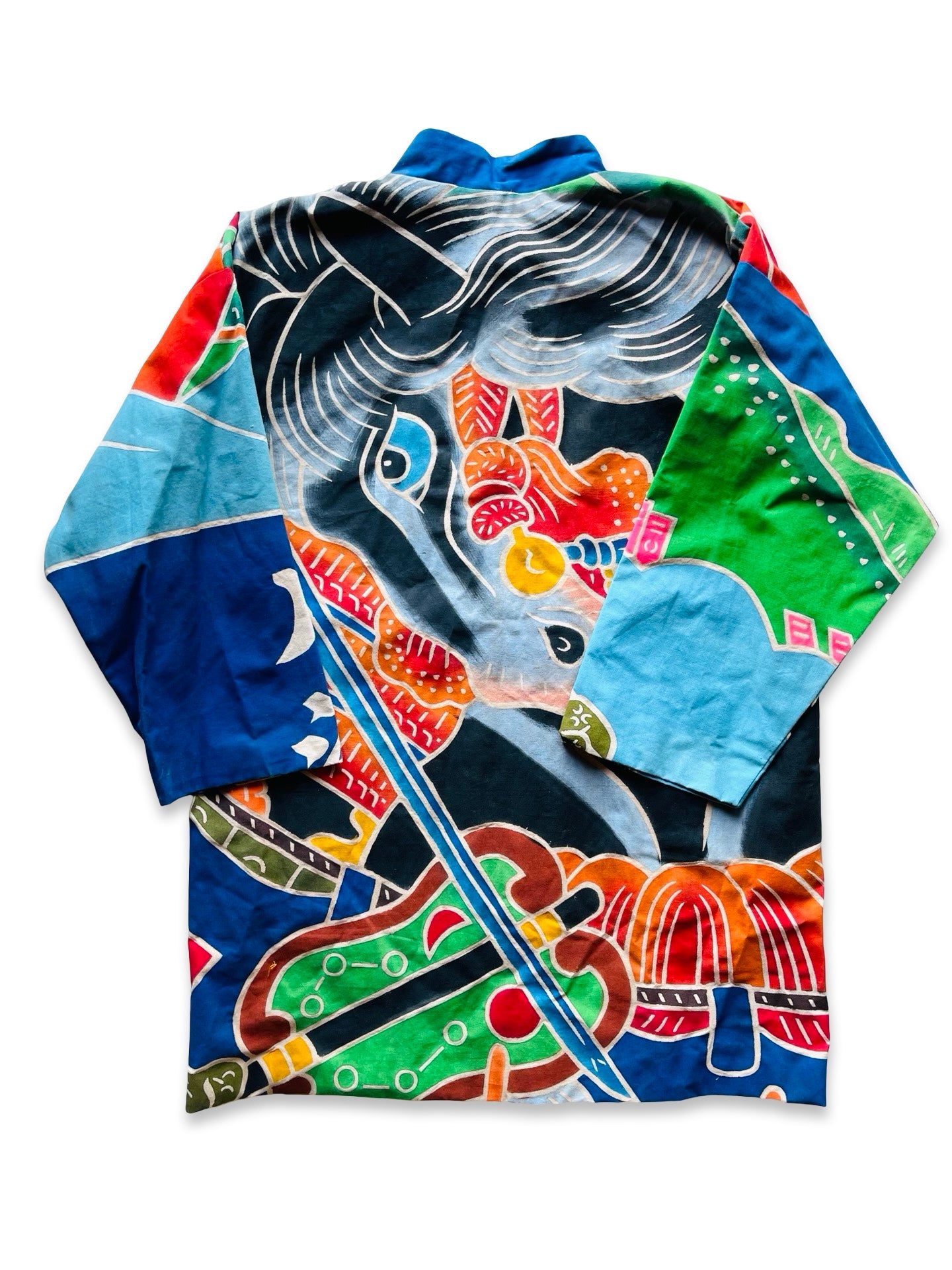
Across the garment, an intense warrior portrait meets the image of a richly decorated horse surrounded by energetic flags, waves and sweeping lines. The composition feels almost cinematic: a battlefield legend unfurling across cloth, reframed as contemporary outerwear.
The imagery appears consistent with textiles inspired by tairyō-bata, celebratory Japanese fishing banners, together with the bold theatrical character associated with Nebuta and festival art. Rather than preserving the cloth as a static wall hanging, the maker has reconstructed it into a relaxed coat that allows the original illustration to move with the wearer.
No two garments made from such textiles can ever be identical. The location of every face, hoof, wave, color field and fragment depends upon how the original banner was cut and assembled. This is not merely a jacket decorated with Japanese imagery. The textile itself forms the garment’s architecture.
Visual Presence
This piece has the scale and immediacy of a portable mural.
The front is dominated by a forceful warrior face rendered with exaggerated brows, a commanding mustache and an unwavering expression. The enlarged features recall the visual language of Japanese festival imagery, where bold faces must remain readable from a distance and amid movement, music and crowds.
The reverse presents a decorated warhorse surging through a field of flags, waves and color. The horse becomes the garment’s kinetic center, turning the back into a complete narrative panel rather than a conventional decorative motif.
The result is deliberately unapologetic: saturated, animated and almost electrically alive. It can be worn as avant-garde streetwear, displayed as textile art or collected as an unusual example of Japanese remake culture.
Identification
Object type: Handmade Japanese festival-textile remake jacket
Garment form: Happi-inspired coat / oversized art jacket
Textile source: Vintage or pre-loved Japanese banner-style cloth
Probable textile tradition: Tairyō-bata, festival banner or related pictorial cotton textile
Visual influence: Nebuta-style warrior imagery and Japanese folk illustration
Primary subjects: Warrior portrait, ceremonial horse, battle or festival flags, waves and decorative color fields
Construction: Reconstructed and adapted into contemporary outerwear
Closure: Buttoned front
Sleeves: Wide, relaxed sleeves
Length: Coat-like silhouette suitable for layered styling
Gender: Unisex design
Production: One-of-a-kind handmade or artisan-reconstructed garment
Country of origin: Japan
The precise original purpose of every textile panel cannot be confirmed independently, but the subject matter, scale and coloration are strongly aligned with Japanese ceremonial, fishing-banner and festival-art traditions.
Tairyō-Bata Heritage
Tairyō-bata literally refers to a “great catch flag.”
These highly visible banners were historically raised to announce a successful catch and were also displayed to express wishes for maritime safety, prosperity and an abundant fishing season. They could be associated with celebratory occasions, the launch of a new vessel or important transitions within a fishing community. Their imagery was therefore designed not for quiet understatement, but for recognition across wind, sea and distance.
That original purpose explains their remarkable visual language:
- Strong outlines
- Oversized figures
- Saturated contrasting colors
- Dynamic waves and clouds
- Auspicious animals
- Heroic or legendary characters
- Expansive compositions intended to be seen from afar
When reconstructed into clothing, this language becomes exceptionally powerful. The body replaces the mast, and the textile returns to movement.
Nebuta-Inspired Character
The warrior imagery also evokes the theatrical intensity associated with the Aomori Nebuta tradition.
Nebuta festival floats are monumental illuminated constructions frequently portraying ancient warlords, historical heroes, mythological figures and kabuki characters. Their enlarged eyes, dramatic facial expressions and sharply defined contours are designed to command attention while parading through streets accompanied by drums, flutes and dancers.
This jacket is not presented as an official Nebuta festival costume or documented float textile. Rather, its artistic energy is Nebuta-like: heroic, confrontational, brilliantly colored and built for spectacle.
The Warrior Portrait
The front-facing warrior operates almost like a protective mask.
His expression is not neutral. The raised brows, firm mouth and forceful facial lines communicate alertness, courage and resolve. The enlarged scale makes the face immediately legible, while the cropped placement across the front creates an almost surreal interaction between garment and figure.
Within the design, the warrior may be read as representing:
Courage: the willingness to confront uncertainty
Discipline: strength directed by purpose
Protection: a vigilant presence guarding the wearer
Authority: command expressed through posture and gaze
Resilience: endurance through conflict and transition
Identity: the unapologetic declaration of individual character
The motif gives the jacket a protective, armor-like quality without turning it into literal military clothing.
The Ceremonial Warhorse
The horse on the reverse introduces a second form of power.
Where the warrior is controlled and watchful, the horse is movement itself. Its raised body, decorative harnessing and surrounding flags suggest procession, departure or the charged instant before action.
In Japanese warrior imagery, the horse is inseparable from ideas of rank, mobility and martial presence. Within this particular composition, it functions less as a background animal and more as the heroic protagonist of the reverse panel.
The horse may evoke:
- Motion and forward momentum
- Loyalty between rider and animal
- Readiness for transformation
- Noble bearing
- Freedom and physical power
- The crossing of distance
- Ceremonial grandeur
The back becomes a complete visual field, ensuring that the jacket remains compelling from every direction.
Waves, Flags and Surrounding Motion
The surrounding imagery amplifies the garment’s sense of rhythm.
Flags cut diagonally through the composition. Waves curve through the textile. Lines appear to radiate outward from the main figures. These elements prevent the imagery from feeling boxed into isolated patches.
Instead, the entire garment appears caught in motion.
The jacket therefore works differently from ordinary printed outerwear. Its design is not centered neatly within predetermined borders. Figures and decorative fragments move across seams, sleeves, edges and closures, preserving the sprawling energy of the original banner.
Material and Construction
The garment is constructed from substantial Japanese cotton or cotton-rich festival-banner textile with a durable, canvas-like character.
The original imagery appears to have been created through traditional-style dyeing, pigment application, hand-brushed work or a combination of textile-printing techniques. Variations in color density, line quality and surface texture contribute to the handcrafted visual character.
The coat has been adapted into a practical contemporary structure featuring:
- Button-front construction
- Broad body panels
- Relaxed shoulder line
- Wide sleeves
- Layer-friendly proportions
- Substantial textile weight
- Integrated original pictorial sections
- Carefully positioned front and reverse imagery
- Functional outerwear silhouette
Because the garment was created from an existing textile, the maker had to work around the original illustration rather than beginning with blank cloth. This introduces a collage-like design process in which composition and tailoring must negotiate with one another.
One-of-a-Kind Construction
The most important quality of this piece is its irreproducibility.
Even when two jackets are made from similar Japanese banners, the final compositions will differ according to:
- The surviving condition of the original textile
- The position of the central figures
- The available length and width of cloth
- The placement of stains or age marks
- The maker’s cutting decisions
- The relationship between imagery and garment seams
- The balance between front, sleeves and back
Here, the warrior and horse have been given distinct visual territories. The front confronts the viewer, while the reverse releases the narrative into full motion.
This thoughtful placement turns the coat into a composed artwork rather than a random assemblage of colorful fabric.
Style and Wearing Character
The jacket combines several aesthetic worlds without belonging entirely to any one of them.
It carries the communal spirit of festival wear, the visual drama of Japanese folk painting, the relaxed shape of a happi coat and the singularity of contemporary reconstructed fashion.
It can be styled with:
- Black denim and boots
- Wide-leg trousers
- Raw indigo jeans
- Minimal monochrome layers
- Hoodies and modern streetwear
- Hakama-inspired pants
- Workwear and heritage garments
- Avant-garde Japanese fashion
- Festival or performance outfits
- Gallery and creative-industry wardrobes
Because the textile is visually complex, the jacket works especially well against simple garments in black, charcoal, cream, indigo or deep brown.
It can be worn open to preserve the full visual width of the front composition or closed for a more compact, armor-like appearance.
Display as Textile Art
This piece need not remain inside a wardrobe.
When not worn, it can be displayed on a broad wooden hanger or mounted within a textile-safe presentation arrangement. The front and back are sufficiently complete to function as alternating art panels.
Suitable display environments include:
- Japanese-inspired interiors
- Creative studios
- Fashion showrooms
- Music rooms
- Tattoo studios
- Restaurants and cultural spaces
- Private textile collections
- Festival-art displays
- Streetwear boutiques
- Gallery-style feature walls
Displayed beneath directional lighting, the varying pigments, weave and stitched construction become easier to appreciate.
Period Assessment
The source textile appears vintage or pre-loved, while the reconstruction into its present jacket form is likely later and may be contemporary.
This distinction is important. The garment is not represented as an unchanged historical happi coat from a documented festival. It is best understood as a Japanese remake garment combining an older pictorial textile with a newer wearable structure.
The exact age of the original banner remains undetermined.
Its value lies in the survival of the pictorial cloth, the strength of the imagery, the quality of the reconstruction and the successful transformation of ceremonial-style textile into contemporary artwear.
Condition
This garment incorporates vintage or pre-loved Japanese textile and is offered in its present condition.
Possible characteristics may include:
- Natural fading
- Pigment variation
- Small marks or stains
- Abrasion
- Softened fibers
- Uneven coloration
- Minor pulls
- Old fold lines
- Surface irregularities
- Slight distortion from previous use
- Small repairs or reinforced areas
- Variations in stitching and textile thickness
These qualities are inherent to genuine remake clothing constructed from older material. They are not the uniform flaws of mass production, but traces of the textile’s previous life.
The garment should not be expected to resemble newly manufactured factory clothing. Every visible variation contributes to its wabi-sabi character and one-of-a-kind composition.
Please examine all photographs carefully. The photographs form an essential part of the description and show the exact garment, textile placement, construction and condition included with the purchase.
Care
Due to the age, pigment, weight and reconstructed nature of the textile, gentle specialist care is recommended.
Avoid ordinary machine washing, aggressive detergents, bleach, tumble drying or prolonged soaking. Friction and moisture may affect pigments or older fibers.
Professional cleaning by a specialist experienced with vintage, hand-dyed or Japanese textiles is recommended. When not worn, store the garment in a cool, dry environment away from prolonged direct sunlight.
Why Collect This Piece
This jacket offers qualities rarely found together in a single garment:
- Genuine Japanese visual character
- Probable vintage festival-banner textile
- Tairyō-bata-inspired color and scale
- Nebuta-like heroic imagery
- Fierce warrior portrait
- Ceremonial horse composition
- Front-to-back narrative design
- Substantial cotton construction
- Handmade reconstruction
- Unisex styling potential
- Wearable and displayable format
- International streetwear appeal
- True one-of-a-kind textile placement
It sits between costume, folk artifact, contemporary art and fashion.
For the collector, it preserves a fragment of Japanese festival visual culture. For the wearer, it becomes something louder and more immediate: a moving banner, a painted legend and a coat with its own pulse.
Offers
Some pieces in our collection allow room for negotiation, while others are offered at firmer prices.
Respectful and reasonable offers are welcome and considered individually. Please feel free to submit your proposed amount or contact us directly with questions. We are always pleased to work with serious collectors whenever the rarity, condition and market position of the garment permit.
Product Representation and Questions
We make every effort to represent our garments accurately through detailed photographs and descriptions.
Please contact us before purchasing with any questions concerning condition, construction, textile weight, color, measurements or fit. We would rather clarify every detail before payment than leave uncertainty afterward.
Colors may appear slightly different depending upon lighting conditions, photography and individual screen settings.
Condition and Final-Sale Policy
This is a pre-owned, handmade and reconstructed garment offered as is and as photographed.
Vintage and remake clothing may exhibit natural irregularities that would not appear in newly manufactured garments. These characteristics are part of the material history and visual identity of the piece.
All sales are final. Returns, exchanges, cancellations and condition-related claims are not accepted. Completion of payment confirms that the buyer has reviewed and accepted the photographs, description and store policies.
Worldwide Shipping
Worldwide shipping is available through Japan Post EMS wherever service is offered.
Shipping and handling charges are calculated through the checkout shipping calculator. For destinations not automatically listed, please contact us for an individual quotation.
The garment will be folded carefully, protected from moisture and packed securely for international transit.
Tracking information is normally supplied after dispatch and may take approximately 3 to 5 business days to become active in the carrier’s system.
Customs duties, import taxes, brokerage charges and local handling fees remain the responsibility of the buyer where applicable.
#Tairyobata #TairyobataRemake #HappiJacket #JapaneseFestivalWear #JapaneseStreetwear #WarriorJacket #HorseArtJacket #NebutaStyle #JapaneseFolkArt #WearableArt #OneOfAKindFashion #UpcycledJapanese #VintageBanner #FestivalTextile #JapaneseTextileArt #SamuraiStyle #ModernJaponisme #ArtJacket #StatementCoat #SlowFashion #ReconstructedFashion #JapaneseOuterwear #AvantGardeFashion #UnisexStreetwear #HeritageWear #JapaneseCraft #FestivalCoat #CollectorFashion #WabiSabiStyle #Japonista
Material Tags
Vintage Japanese festival-banner textile, heavyweight cotton, cotton canvas, dyed textile, painted textile, pigment decoration, metal buttons, cotton thread, reconstructed vintage fabric, upcycled Japanese textile