Rare Vintage, Antiques and Art Collector / Curator / Personal Shopper From Japan
Hand-Painted Tibetan Thangka of Buddha’s Life – Gold-Embellished Buddhist Scroll Wall Art | Himalayan Spiritual Home Decor
Hand-Painted Tibetan Thangka of Buddha’s Life – Gold-Embellished Buddhist Scroll Wall Art | Himalayan Spiritual Home Decor
Couldn't load pickup availability
An exceptionally detailed Tibetan Buddhist narrative painting portraying Shakyamuni Buddha at the center of a sacred landscape filled with scenes of awakening, teaching, miracles, pilgrimage, devotion, and final liberation.
Description
A complete sacred biography unfolds across this remarkable Himalayan painting.
At its center sits Shakyamuni Buddha, radiant and immovable upon an elaborate lotus throne. His right hand reaches toward the earth in the classic gesture of awakening, while his left supports a monastic bowl. Around him, the world of the Buddha’s life opens in hundreds of jewel-like details: temples rise from mountains, disciples gather in devotion, elephants cross the landscape, celestial beings appear within clouds, teachers deliver sermons, and the reclining Buddha enters final nirvana.
This is not a simple portrait.
It is a visual scripture.
The composition belongs to the Tibetan Buddhist tradition of narrative thangka painting, in which sacred biography is presented not as a sequence of separate illustrations, but as a single interconnected universe. Episodes unfold above, beside, and below the central Buddha, inviting the viewer to move slowly through the painting and discover one story after another.
Rich mineral-style colors, deep blue skies, luminous gold-toned outlining, white clouds, green landscapes, red temples, elephants, lotus thrones, monks, celestial beings, and architectural sanctuaries create an astonishing density of spiritual storytelling.
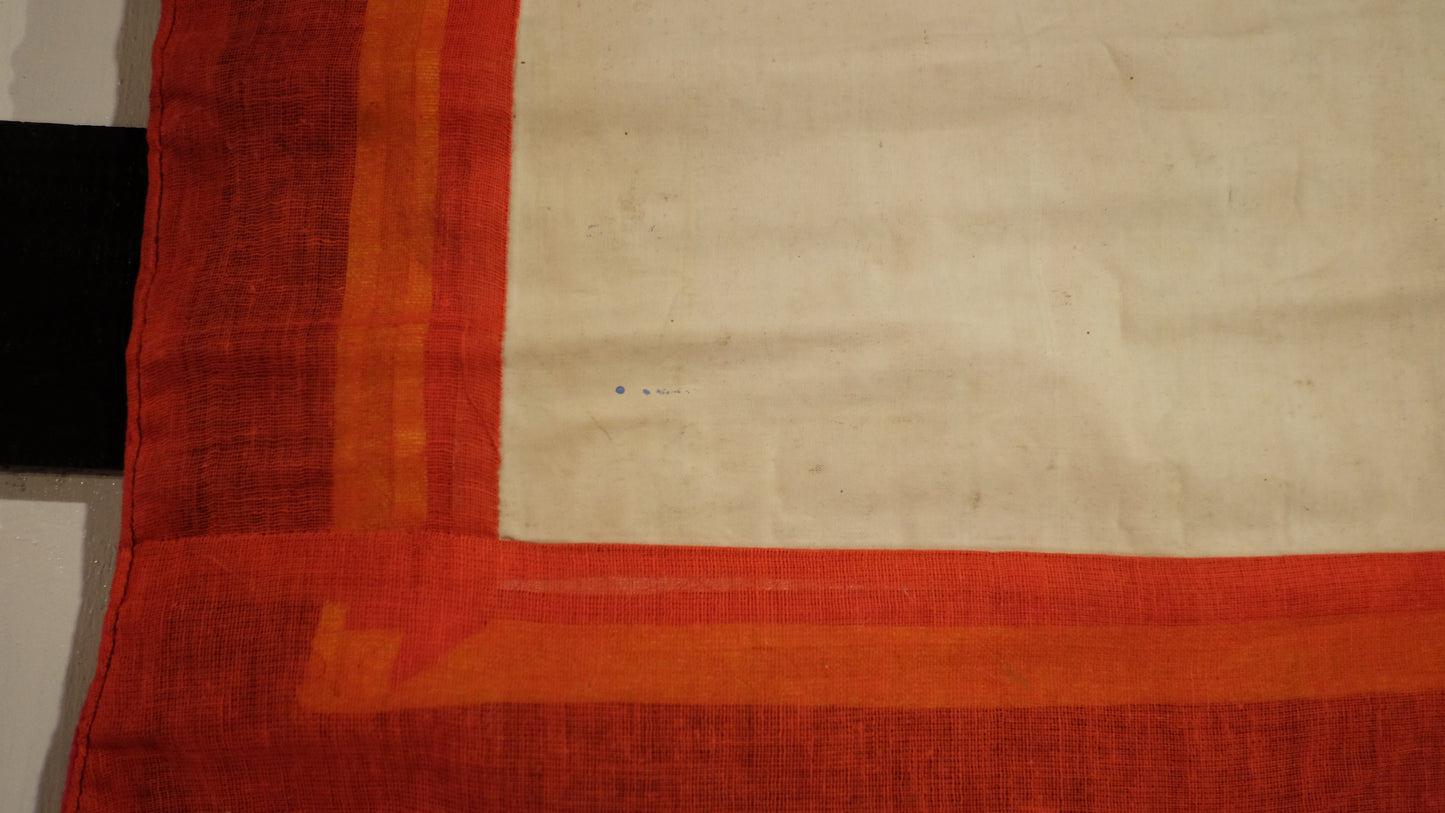
The central painting is surrounded by red and golden-yellow textile borders and mounted within a broad black fabric field. A fabric-wrapped upper hanging rod completes its dramatic presentation.
Whether displayed in a meditation room, Buddhist altar space, library, yoga studio, contemplative interior, or private collection, this thangka brings enormous visual presence and spiritual depth.
It rewards both distance and intimacy.
From across the room, the central Buddha commands the composition.
Up close, an entire sacred world reveals itself.
Artwork Identification
The principal subject is:
Shakyamuni Buddha
Sanskrit: Śākyamuni
Tibetan: Shākya Thubpa
Meaning: The Sage of the Shakya Clan, the historical Buddha
The broader subject is best described as:
The Life of Shakyamuni Buddha
The Twelve Great Deeds of the Buddha
Buddha Life-Story Narrative Thangka
The painting includes numerous episodes traditionally associated with the Buddha’s life and teaching career. These appear to include imagery connected with:
- His birth and early royal life
- Encounters that inspired renunciation
- Departure from palace life
- Ascetic practice
- Meditation beneath the Bodhi tree
- Victory over Māra and the forces of illusion
- Enlightenment
- The first teaching
- Miracles and sacred encounters
- Travels and teaching assemblies
- Disciples and monastic communities
- Stupas, temples, and pilgrimage sites
- The reclining Buddha and parinirvana
- Subsequent veneration and preservation of the Dharma
Some smaller scenes may also draw upon teaching stories, previous-life narratives, later Buddhist tradition, or regional devotional interpretation.
Because the painting contains an unusually dense narrative program, identifying every miniature scene would require direct specialist study and a closer reading of the Tibetan inscription.
The Central Shakyamuni Buddha
Shakyamuni occupies the visual and spiritual heart of the painting.
He is seated cross-legged upon a richly ornamented lotus throne, enclosed by a multicolored circular aureole. His golden body contrasts with dark blue, green, black, and red fields surrounding him.
His right hand reaches downward in the bhūmisparśa mudrā, the earth-touching gesture. This recalls the decisive moment before enlightenment when Siddhartha called the earth to witness his accumulated merit and his right to attain awakening.
His left hand rests in his lap supporting a monastic alms bowl.
Together, these attributes identify him as Shakyamuni, the historical Buddha, rather than Amida, Medicine Buddha, or another Buddhist figure.
The Buddha wears layered monastic robes rendered in warm red, orange, gold, and brown. Fine gold-toned highlights trace the folds of the fabric, lotus throne, halo, and sacred architectural structures.
His face remains calm and symmetrical while activity surges around him.
This contrast is central to the composition.
The world moves.
The Buddha does not.
The Twelve Great Deeds
Tibetan Buddhist tradition frequently organizes the life of Shakyamuni around a sequence known as the Twelve Great Deeds.
Different textual traditions may enumerate or group the events slightly differently, but the cycle generally includes:
- Descent from the heavenly realm
- Entry into Queen Māyā’s womb
- Miraculous birth at Lumbini
- Education and mastery of worldly arts
- Life within the royal palace
- Renunciation and departure
- Years of ascetic practice
- Meditation beneath the Bodhi tree
- Defeat of Māra
- Complete enlightenment
- Turning the Wheel of Dharma
- Passing into parinirvana
In this painting, those foundational episodes appear to be expanded into a much richer visual biography containing temples, teachers, monks, animals, heavenly figures, miracles, devotional gatherings, and scenes of pilgrimage.
Rather than placing each event inside a rigid box, the artist connects them through mountains, trees, clouds, rivers, palace walls, monasteries, and pathways.
The result resembles memory itself: layered, interconnected, and unfolding in many directions.
A Sacred Landscape of Teaching
This thangka transforms geography into spiritual biography.
Mountains separate one episode from another. Clouds carry Buddhas and celestial assemblies across the upper sky. Temple compounds emerge from forests. Monks gather at terraces and gateways. Elephants, horses, birds, and fantastic creatures animate the lower landscape.
Each area functions as a small world.
The upper register suggests celestial realms, divine assemblies, miraculous events, and sacred architecture.
The central register focuses upon the enthroned Buddha and the moment of awakening.
The lower register presents temples, communities, the reclining Buddha, devotional gatherings, animals, and scenes associated with teaching, death, remembrance, and the continuation of the Buddhist path.
Architectural forms are not painted according to ordinary earthly perspective. Buildings, mountains, thrones, and figures expand or contract according to spiritual importance.
This is sacred geography rather than literal geography.
The Enlightenment Scene
The principal Buddha is shown at the moment of awakening.
The earth-touching hand recalls the defeat of Māra, whose temptations, armies, fears, and illusions failed to disturb Siddhartha’s meditation.
Above the Buddha appears a dramatic winged and wrathful figure, surrounded by energetic forms and supernatural imagery. This area may represent Māra, protective forces, or the turbulent spiritual drama surrounding enlightenment.
White mythical creatures flank the throne. Elephants appear below. Celestial attendants, monks, and seated Buddhas gather across the surrounding landscape.
The painting therefore presents awakening not as an isolated personal moment, but as a cosmic event witnessed across multiple realms.
The Reclining Buddha
Below the central throne lies a smaller image of the Buddha resting upon his side.
This is the traditional representation of parinirvana, the Buddha’s final passing beyond the cycle of birth and death.
The reclining figure is surrounded by disciples, attendants, sacred architecture, and devotional scenes. His peaceful posture contrasts with the grief, movement, and continuing activity of the world around him.
The inclusion of both the awakened Buddha and the reclining Buddha gives the composition a complete spiritual arc:
- Birth
- Renunciation
- Enlightenment
- Teaching
- Final liberation
- Continuation of the Dharma
The story does not end with death.
Temples, teachers, devotees, and sacred communities continue below and around him, suggesting the preservation and transmission of his teachings.
Celestial Realms and Sacred Assemblies
The upper portion of the painting is crowded with cloud-borne figures, radiant Buddhas, divine assemblies, temples, stupas, and heavenly beings.
Small golden Buddhas sit within circular halos.
Groups of attendants gather on clouds.
Sacred buildings rise among mountains and trees.
A larger circular assembly appears above the central figure, surrounded by smaller Buddhas and framed by rolling clouds. Such imagery evokes the vast spiritual cosmology of Tibetan Buddhism, where awakened beings, bodhisattvas, protectors, teachers, disciples, and celestial realms coexist within a single sacred vision.
The painting does not represent the Buddha as belonging solely to the distant past.
It portrays his presence as enduring throughout the universe.
Elephants, Animals and Symbolic Creatures
Elephants appear repeatedly throughout the lower and middle areas.
Within Buddhist tradition, the elephant may evoke:
- Strength
- Mental discipline
- Royal authority
- The Buddha’s miraculous conception
- Stability
- The gradual training of the mind
- Spiritual power brought under control
The painting also includes horses, birds, deer-like animals, mythical creatures, guardian beasts, and other animals woven into scenes of pilgrimage and teaching.
These creatures bring rhythm and narrative movement into the composition. They also connect the life of the Buddha with the natural world and with the broader universe of Buddhist teaching stories.
Artistic Character
This painting is extraordinarily dense.
Every portion contains another figure, building, cloud, animal, shrine, throne, flower, or symbolic event.
The color palette includes:
- Deep midnight blue
- Black
- Golden yellow
- Burnished orange
- Crimson red
- Mineral green
- Turquoise
- Soft blue-gray
- Ivory white
- Rose
- Brown
- Gold-toned detailing
The artist uses bright outlines and carefully controlled color zones to keep the miniature figures legible.
Gold-colored lines illuminate halos, robes, temples, clouds, architectural edges, ornaments, and sacred objects. Against the dark ground, these details catch the light and create a subtle shifting radiance.
The composition is highly symmetrical around the principal Buddha, yet the surrounding narrative remains lively and irregular.
One side contains palaces and forest episodes.
Another presents teachers, monks, sacred beings, and devotional gatherings.
Above, the sky opens into celestial activity.
Below, earthly history and ritual life continue.
This balance between hierarchy and abundance is one of the painting’s greatest strengths.
Tibetan Inscription
A horizontal panel of Tibetan script appears along the lower edge of the painted composition.
The inscription may contain a title, dedication, prayer, mantra, artist’s statement, patron’s name, lineage reference, or summary of the subject.
It has not been translated or independently authenticated.
Its presence nevertheless strongly supports the identification of the work as belonging to a Tibetan-language Buddhist artistic tradition.
The painted border around the inscription includes auspicious decorative motifs, cloud forms, and a wheel-like emblem.
A specialist photograph taken in even, high-resolution lighting may allow the text to be transcribed and translated more precisely.
Is This a Mandala?
This is better described as a narrative thangka than as a mandala.
A mandala normally presents an ordered sacred palace or cosmic diagram arranged around a central deity according to a highly structured geometric system.
This painting instead tells a story through many interconnected scenes.
Its central Buddha provides the spiritual axis, but the surrounding imagery functions as sacred biography, teaching narrative, pilgrimage landscape, and visual scripture.
For Etsy search purposes, phrases such as “Buddhist mandala wall art” may attract some related buyers, but the historically more accurate description is:
- Life of Buddha thangka
- Shakyamuni narrative painting
- Twelve Deeds thangka
- Tibetan Buddhist teaching painting
- Himalayan sacred scroll
Textile Mounting
The painted panel is mounted within a strong sequence of colored textile borders.
Visible elements include:
- A narrow patterned inner border
- A broad red textile band
- A golden-yellow outer band
- A large black fabric surround
- Fine red piping along the outer sides
- A fabric-wrapped upper wooden hanging rod
- A red suspension cord
The mounting is simpler than the elaborate brocade structures found on some monastery thangkas, but it provides a bold and effective frame.
The black field concentrates attention on the luminous painted center.
The red and yellow borders carry strong associations with Tibetan Buddhist monastic colors and create a ceremonial transition between the painting and the surrounding room.
The broad lower black area allows the work to hang with a dramatic banner-like presence.
No separate lower roller is visible in the supplied photographs.
Estimated Origin and Period
A suitable working attribution is:
Tibetan Buddhist or Himalayan-region production
Possible places of manufacture include:
- Tibet
- Nepal
- Bhutan
- Northern India
- A Tibetan Buddhist workshop elsewhere in the Himalayan cultural region
The Tibetan-language inscription and iconographic style support a Tibetan Buddhist cultural identification, but they do not prove manufacture within the modern geographic borders of Tibet.
Based upon the condition, color intensity, textile mounting, visual style, and apparent materials, the work is most plausibly:
Late twentieth century
A reasonable provisional date range is:
Circa 1980s–1990s
A slightly earlier or later date remains possible.
This estimate is based on photographs and should not be treated as documented provenance.
Materials and Technique
The central image appears to be executed on prepared textile, most likely cotton canvas.
The technique appears consistent with traditional or traditional-style thangka production involving:
- Prepared cloth support
- Carefully drawn iconographic outlines
- Opaque color application
- Fine brush detailing
- Mineral-style or gouache-like pigments
- Gold-colored or metallic pigment embellishment
- Textile mounting
- Wooden hanging rod
The painting appears handmade, although no laboratory testing or direct microscopic inspection has been performed.
The metallic decoration may be gold pigment, gold-colored paint, metallic powder, or another decorative medium.
It should not be represented as tested solid gold or verified gold leaf unless independently examined.
Why This Thangka Matters
A Complete Spiritual Narrative
Rather than portraying only one deity, the painting presents an entire sacred biography and cosmology.
Extraordinary Density
Hundreds of individual figures, buildings, animals, temples, clouds, thrones, and narrative details fill the composition.
Shakyamuni at the Center
The historical Buddha appears in the iconic earth-touching gesture associated with enlightenment.
Twelve Deeds Tradition
The painting is closely connected with the traditional Tibetan cycle of the Buddha’s principal life events.
Rare Decorative Presence
Its saturated colors, dark background, gold-toned highlights, and monumental black textile mounting create exceptional impact.
Educational and Meditative Value
The work can function as a devotional image, visual teaching aid, contemplative object, or detailed study piece.
Collector Appeal
Narrative life-story thangkas offer more iconographic complexity than simpler single-figure paintings.
Why You Will Love It
- Hand-painted Tibetan Buddhist narrative art
- Shakyamuni Buddha in earth-touching mudra
- Extensive Life of Buddha imagery
- Twelve Great Deeds iconography
- Parinirvana scene
- Celestial Buddhas and heavenly assemblies
- Sacred temples and pilgrimage landscapes
- Elephants and symbolic animals
- Rich mineral-style colors
- Gold-colored detailing
- Tibetan inscription
- Dramatic red, yellow, and black textile mounting
- Extraordinary miniature storytelling
- Strong visual presence from across a room
- Endless details for close contemplation
- Suitable for spiritual and secular interiors
- One distinctive vintage work available
Ideal Display Spaces
This thangka would be particularly effective in:
- A Buddhist altar room
- A meditation space
- A yoga studio
- A contemplative library
- A spiritual counseling room
- A private Asian-art collection
- A Himalayan-inspired interior
- A sacred music room
- A monastery-style interior
- A wellness retreat
- A temple-inspired room
- A mindfulness studio
- A collector’s cabinet room
- A dramatic gallery wall
- A quiet reading space
- A ceremonial reception area
The rich colors would pair especially well with dark wood, cream plaster, charcoal walls, natural stone, brass, warm lighting, antique textiles, or minimalist interiors.
Ideal For
- Collectors of Tibetan Buddhist art
- Shakyamuni Buddha devotees
- Thangka collectors
- Students of Buddhist iconography
- Meditation practitioners
- Yoga teachers
- Buddhist centers
- Himalayan art enthusiasts
- Collectors of sacred narrative painting
- Interior designers
- Scholars of Buddhist visual culture
- Spiritual counselors
- Mindfulness practitioners
- Those creating a home altar
- Buyers seeking a meaningful spiritual gift
- Collectors of hand-painted textile art
Item Details
Cultural Tradition: Tibetan Buddhist / Himalayan
Principal Figure: Shakyamuni Buddha
Subject: Life of the Buddha and sacred teaching narratives
Probable Iconographic Cycle: The Twelve Great Deeds of Shakyamuni Buddha
Artwork Type: Narrative Buddhist thangka
Format: Textile-mounted hanging painting
Medium: Appears to be opaque pigments and gold-colored detailing on prepared cloth
Support: Most likely cotton canvas
Mounting: Red, yellow, and black textile surround with fabric-wrapped wooden hanging rod
Inscription: Tibetan script at the lower edge of the painted panel
Estimated Period: Late twentieth century
Working Date: Approximately 1980s–1990s
Specific Place of Manufacture: Unconfirmed
Artist: Unidentified
Primary Colors: Blue, black, gold, orange, red, green, white, turquoise, brown, and rose
Principal Motifs: Shakyamuni Buddha, enlightenment, Bodhi tree, temples, monks, elephants, celestial realms, parinirvana, stupas, sacred architecture, disciples, and Tibetan inscription
Quantity: One vintage thangka
Condition
This is a vintage religious textile painting with visible signs of age, handling, folding, storage, and display.
The supplied photographs show:
- Noticeable creasing and waviness across the black outer textile
- General wrinkling in the red and yellow borders
- Surface undulation across the painted panel
- Minor tonal variation within the painting
- Small scattered marks and age-related surface irregularities
- Gentle wear along textile edges and seams
- Minor distortion from rolling or folding
- Wear and wrinkling to the fabric covering the upper rod
- Natural variation in the gold-colored detailing
- Possible light rubbing in isolated painted areas
- Slight unevenness in the shape of the textile mounting
The painted imagery remains exceptionally strong, colorful, detailed, and highly legible.
The central Shakyamuni Buddha, halo, lotus throne, temples, animals, celestial assemblies, parinirvana scene, architectural elements, and Tibetan inscription remain visually clear.
The colors appear rich and vivid in the photographs.
The textile mounting is present and functional, although it shows visible creasing and should not be expected to hang with the rigid flatness of a framed painting.
No separate lower roller is visible.
No claim is made that the work has undergone professional conservation, pigment testing, gold analysis, textile analysis, translation, scientific dating, or formal authentication.
Please inspect all photographs carefully. They form an essential part of the condition description.
Additional photographs and measurements may be requested before purchase.
Care and Display
Thangkas are sensitive to light, moisture, dust, and prolonged tension.
For long-term care:
- Avoid direct sunlight
- Avoid damp or humid walls
- Keep away from kitchens and smoke
- Do not expose to strong heat
- Handle with clean, dry hands
- Support the textile when moving it
- Do not sharply fold the painted panel
- Avoid pressing the painted surface
- Consider professional textile conservation for flattening or remounting
- Store loosely rolled around a suitable support when not displayed
- Consult a professional before cleaning
Natural wrinkling may soften after careful hanging, but no aggressive steaming, ironing, wetting, or pressing should be attempted on the painted area.
Final Words to the Collector
This thangka contains more than a single moment.
It contains a life.
At its center, Shakyamuni touches the earth and awakens.
Around him, palaces rise and disappear. Monks gather. Elephants move through sacred landscapes. Celestial beings descend through clouds. Temples preserve the teachings. The Buddha travels, teaches, rests, and finally enters parinirvana.
Yet the world of the painting continues.
Disciples remain.
Communities gather.
Shrines are built.
Stories are remembered.
The Dharma moves onward.
Every small scene becomes part of a larger truth: awakening is not isolated from life. It is discovered within birth, struggle, renunciation, discipline, fear, compassion, teaching, death, and remembrance.
From a distance, this thangka is majestic.
At close range, it becomes intimate.
One can return to it repeatedly and continue discovering new gestures, animals, buildings, teachers, offerings, and sacred encounters hidden within its extraordinary landscape.
For the practitioner, it may serve as a visual companion for reflection.
For the scholar, it offers a dense field of Tibetan Buddhist iconography.
For the collector, it presents remarkable craftsmanship and narrative richness.
For the interior, it creates a window into a complete sacred world.
Bring the life of the Buddha into your space, not as a distant story, but as a luminous landscape that continues to unfold with every viewing.
Offers
Some objects in our collection allow limited room for negotiation, while others are offered at a firm price.
Respectful and reasonable offers are welcome. Should you have a particular figure in mind, please send us a message. Every proposal will be considered carefully, although acceptance cannot be guaranteed.
We are also happy to assist with questions regarding measurements, condition, display, packing, combined purchases, or international shipping.
Product Representation and Questions
We make every reasonable effort to photograph and describe our items accurately.
Colors, textile textures, metallic details, and tonal variations may appear slightly different depending upon lighting, photography, screen settings, and viewing conditions.
Vintage pigment, fabric, thread, wood, and metallic decoration may contain subtle irregularities that cannot be fully represented in photographs.
Please contact us before purchasing should you have questions regarding condition, dimensions, materials, iconography, mounting, age, storage, display, provenance, or shipping.
We would much rather clarify any uncertainty before payment than leave a concern unresolved afterward.
Condition and Sales Policy
This item is vintage and is sold in its present condition, as photographed and described.
Please do not expect factory-new condition. Age-related wear, patina, creasing, marks, rubbing, fading, textile distortion, discoloration, historic repair, and other characteristics may be present.
All sales are considered final except where otherwise required by applicable law or Etsy policy.
By purchasing, the buyer confirms that they have reviewed the description, photographs, dimensions, estimated attribution, condition information, shipping terms, and shop policies.
Shipping
We ship worldwide from Japan using Japan Post EMS wherever service is available.
Shipping and handling charges are calculated through the listing’s shipping settings. Should your destination not appear among the available options, please contact us for assistance or a manual quotation.
The thangka will be carefully rolled or supported as appropriate, protected, and packed for international transport.
Import duties, customs taxes, brokerage fees, and destination-country charges are the responsibility of the buyer unless otherwise required by law.
Tracking
Tracking information will be provided after dispatch.
Please allow approximately three to five business days after shipment for tracking activity to become visible, depending upon postal processing and the destination country.
International delivery times may vary because of customs inspections, local postal conditions, holidays, weather, transport disruptions, or circumstances beyond our control.
Store Policies
Please review our complete shop policies before completing your purchase.
Payment confirms that the buyer understands and accepts the photographed condition, listing description, estimated attribution, shipping terms, and the natural limitations involved in purchasing vintage objects online.
#TibetanThangka #LifeOfBuddha #ShakyamuniBuddha #TwelveDeeds #BuddhaLifeStory #TibetanBuddhism #HimalayanArt #BuddhistWallArt #HandPaintedThangka #NarrativeThangka #SacredBuddhistArt #MeditationRoomDecor #BuddhistScroll #DharmaArt #BuddhaPainting #SpiritualWallArt #HimalayanPainting #ThangkaCollector #BuddhistIconography #EarthTouchingMudra #Parinirvana #TibetanSacredArt #YogaStudioDecor #MindfulnessDecor #MeditationWallArt #BuddhistHomeDecor #VintageThangka #AsianReligiousArt #SacredWallHanging #BuddhistCollector