Rare Vintage, Antiques and Art Collector / Curator / Personal Shopper From Japan
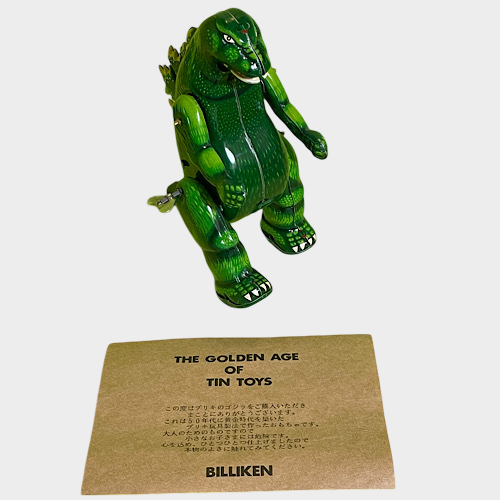
Godzilla Tinplate Figure — Biriken Billiken Shokai Zenmai Wind-Up with Box (Showa Style)
Godzilla Tinplate Figure — Biriken Billiken Shokai Zenmai Wind-Up with Box (Showa Style)
Couldn't load pickup availability
Have a reasonable price in mind? Submit your best offer and our concierge will review it personally.
CURATORIAL OVERVIEW — WHAT THIS OBJECT ACTUALLY IS
Character : (Godzilla)
Maker: (Biriken Billiken Shokai)
Series: The Golden Age of Tin Toy
Category: Tinplate figure
Material: Lithographed tinplate
Finish: Classic green Showa palette with bold highlights
Mechanism: Zenmai (spring-wind) — tested, working
Action: Arm-swing with forward walking motion
Packaging: Box included
Condition: Good vintage
– Minor scuffs and age wear (see images)
– No restoration; honest surface
– Includes all pictured contents
Overview
This piece is a compact thesis on why tin still matters: the object isn’t trying to be “screen accurate” the way modern vinyl or resin statues do. It is trying to be alive. Tin toys are kinetic folklore—printed metal, bright myth, and a spring mechanism that turns a character into a miniature ritual of motion. With Godzilla, that matters even more: the entire franchise began as a metaphor for unstoppable force, and tinplate’s clattering gait is the perfect mechanical translation of that idea.
Iconography
Godzilla in tin is not one image; it’s a language. This figure speaks “Showa” through a handful of visual signals collectors recognize instantly:
-
Green body palette: earlier-era toy translation (less charcoal realism, more pop-graphic monster)
-
White dorsal plates: simplified “spines” that read from across a room; an emblem, not anatomy
-
Open red mouth: a toy-era shorthand for roar + threat + play
-
Chunked limbs: tin’s sculpt limits become style—blocky power rather than detailed musculature
-
Stance + arm swing: the monster isn’t posed; it’s performing. Motion becomes identity.
In other words: this isn’t a sculpture of Godzilla; it’s Godzilla as a moving sign—a symbol engineered for shelves and childhood floors, not cinema frames.
Materials and Why Tinplate Feels “Different”
Tinplate is thin metal printed with lithography, then formed into volume. That means the “skin” is not paint applied by hand in the modern sense; it’s graphic printing. The charm comes from that union:
-
color fields and linework that behave like poster art,
-
surface reflections that make highlights feel “alive,”
-
and small scuffs that read like honest time, not “damage.”
Collectors don’t buy tin expecting perfection; they buy it expecting survival.
Historical Context
Godzilla’s cultural weight is obvious, but the collectible insight is subtler: the Showa period trained audiences to love characters not only through films, but through household objects. Tin toys are evidence of that shift—when a monster stopped being only cinema and became something you could wind up, chase, and display.
Biriken’s “Golden Age of Tin Toy” framing matters because it’s a deliberate act of preservation: modern collectors want the old mechanical grammar—the walk cycle, the tin sound, the illustrated box presence—without needing museum-grade fragile originals.
Collector Relevance
This is a “keystone” object because it satisfies three collector appetites at once:
-
IP certainty (universally recognized)
-
Material prestige (tinplate is historically loaded)
-
Mechanical authenticity (zenmai = the soul, not a gimmick)
And because it’s boxed, it becomes a “complete” display unit: figure + illustration + era-voice.
Summary
If you’re teaching a new collector what separates “vintage-style” from “collector-grade,” this is an ideal example: boxed, moving, tinplate, and iconographically Showa. It doesn’t need to be rarest on earth to be important—it needs to be correct, readable, and alive.
🧠 CONTEXT & WHY IT MATTERS
This Biriken Godzilla sits exactly where collectors want it: faithful Showa styling, mechanical authenticity, and box-backed credibility.
Why this configuration is strong:
-
Biriken Shokai is trusted for Showa-correct proportions and gait—no modern exaggeration
-
Green Godzilla reads immediately as early-era cinema, not later Heisei redesigns
-
Working zenmai elevates value; movement is half the experience
-
The Golden Age of Tin Toy framing places it within a curated revival lineage, not a random repro
This isn’t a fragile museum relic—it’s a display-forward kaiju that bridges tinplate history and modern collector reliability.
Placed next to Tetsujin and Biriken heroes (Super Jetter, Yusei Kamen), it completes the Showa power triangle: robot, hero, monster.
📐 DISPLAY NOTES
-
Display figure forward, box behind to show scale and art
-
Ambient lighting enhances green lithography without glare
-
Wind sparingly to preserve the spring
Authenticity & Collectible Stewardship
Evaluated under the Japonista Collectibles Authentication Framework™:
-
Period, manufacturer, and production-era assessment
-
Material, paint, lithography, and surface-wear analysis
-
Mechanical, structural, and component integrity review (where applicable)
-
Design, iconography, and cultural-context verification
Guaranteed 100% Authentic.
Every piece is backed by the Japonista Lifetime Authenticity Warranty™ and curated with collector-grade scrutiny.
A Note on Collecting & Preservation
At Japonista, we approach vintage and modern toys not merely as nostalgic objects, but as design artifacts, cultural touchstones, and expressions of their era—from postwar ingenuity and Showa imagination to contemporary pop and designer movements.
Each work is carefully examined, researched, and presented with respect for its original intent, historical context, and collector relevance, balancing preservation with the honest character earned through time and play.
Our role is not only to offer access to meaningful collectibles, but to act as thoughtful custodians—connecting the right pieces with collectors who value history, originality, and lasting significance.
Inquiries, Availability, and Private Consideration
Some collectible works may allow room for discussion, while others are held firmly due to rarity, condition, provenance, or cultural importance. All inquiries are reviewed personally and discreetly, and we welcome thoughtful questions or expressions of interest.
If you are exploring a specific theme, franchise, maker, era, or mechanical category—or seeking guidance in building a focused collection—our team is always available to assist with informed, quiet expertise.
Concierge Support & Collector Guidance
Japonista Concierge™ offers personalized assistance for collectors seeking deeper understanding, strategic acquisitions, or long-term curation across vintage and modern collectibles.
Whether your interest lies in nostalgia, design history, mechanical fascination, or pop-culture legacy, we are here to support your collecting journey with clarity, care, and discretion.
For select high-value or historically significant pieces, private reservation or structured payment arrangements may be available on a case-by-case basis. Please contact us to discuss eligibility and options.
Before Proceeding
We kindly encourage collectors to review our shop policies and house guidelines, available through the links in our website footer, which outline shipping, handling, and condition standards specific to vintage, mechanical, and collectible works.
A Closing Note
Thank you for exploring Japonista’s collection of vintage and modern toys, robots, and cultural collectibles. We are honored to share these enduring objects of imagination and design—and to help place them where they may continue to be appreciated, studied, and enjoyed.
If you have questions or wish to explore related works, please feel free to contact Japonista Concierge™ at any time.