Rare Vintage, Antiques and Art Collector / Curator / Personal Shopper From Japan
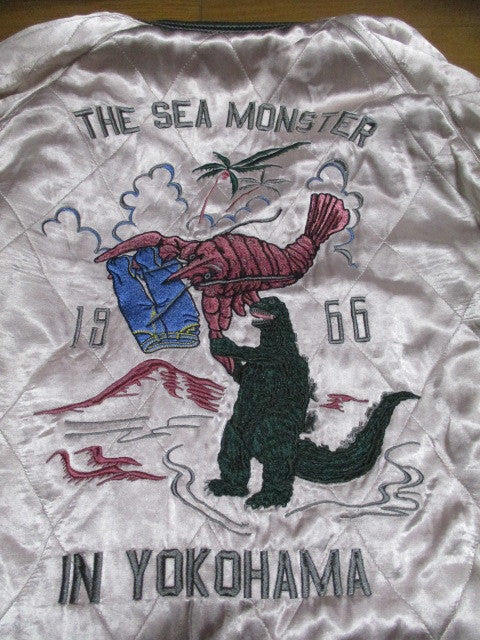
Godzilla × King Ghidorah Reversible Sukajan — Japanese Kaiju Souvenir Jacket, Size 42
Godzilla × King Ghidorah Reversible Sukajan — Japanese Kaiju Souvenir Jacket, Size 42
Couldn't load pickup availability
Have a reasonable price in mind? Submit your best offer and our concierge will review it personally.
CURATORIAL OVERVIEW — WHAT THIS OBJECT ACTUALLY IS
This jacket is not “merchandise” in the modern sense. It is a continuation artifact — a garment where three separate Japanese traditions intersect:
-
Kaiju mythology as postwar national narrative
-
Sukajan embroidery as wearable memory and identity
-
Souvenir culture as a translation layer between Japan and the world
Godzilla, born in 1954 as an embodiment of nuclear trauma, environmental anxiety, and postwar reconstruction, has long transcended cinema to become a national myth system. Sukajan jackets, originating from U.S. servicemen commissioning embroidered satin jackets in Yokosuka, evolved into Japan’s most powerful form of nonverbal cultural export.
This piece fuses the two: kaiju as myth, sukajan as vessel.
ICONOGRAPHY & THEMATIC ANALYSIS
Godzilla
Depicted not merely as a monster, but as a cyclical force — destruction, rebirth, inevitability. In sukajan language, Godzilla functions like a dragon: protector and annihilator simultaneously.
King Ghidorah
A three-headed adversary, often interpreted as foreign threat, cosmic imbalance, or external chaos. His inclusion signals conflict on a mythic scale — not a battle, but a cosmological event.
“Invasion of Astro Monster”
This reference roots the jacket directly in 1960s kaiju cinema, when Japanese sci-fi was grappling with Cold War paranoia, space-age anxiety, and identity beyond Earth.
The embroidery is narrative, not decorative. Every stitch participates in storytelling.
MATERIAL & CRAFT ASSESSMENT
-
Embroidery: High-density machine embroidery with layered thread depth, typical of premium sukajan production
-
Base Fabric: Satin/rayon blend designed for luster and movement
-
Reversible Construction: Two fully realized visual identities — a hallmark of serious sukajan craftsmanship
-
Color Discipline: Controlled palette balancing spectacle with wearability
This is not fast fashion embroidery. It reflects production discipline, pattern planning, and a lineage of skilled textile execution.
HISTORICAL CONTEXT — WHY THESE SURVIVE AT ALL
Sukajan jackets were historically worn hard, traded, altered, and discarded. Kaiju-themed examples were even more likely to be used casually, not preserved.
What survives today does so by accident, not design.
Modern licensed sukajan like this exist at the intersection of nostalgia revival and shrinking craft knowledge. As embroidery costs rise and skilled operators decline, pieces of this complexity are already becoming economically unrepeatable.
This jacket represents a closing window, not an open trend.
COLLECTOR RELEVANCE
This piece speaks simultaneously to:
-
Kaiju film collectors
-
Sukajan and Japanese streetwear archivists
-
Cross-cultural fashion historians
-
Buyers seeking wearable cultural artifacts rather than static memorabilia
The Size 42 is especially critical — most surviving sukajan skew small. This size tier dramatically increases real-world wearability and long-term desirability.
SUMMARY — WHY THIS PIECE MATTERS
This jacket is not loud. It is anchored.
It carries myth, craft, and history in a form meant to move through the world — not sit behind glass. It represents a moment where Japanese identity, global fascination, and textile mastery aligned.
That alignment is rare. And it is not being repeated.
Authenticity & Stewardship
Evaluated under the Japonista Amekaji & Vintage Fashion Authentication Framework™:
-
Brand, production-era, and origin verification
-
Fabric, weave, dye, and material composition analysis
-
Construction quality, stitching, hardware, and pattern assessment
-
Condition evaluation including wear, fading, repairs, and structural stability
Guaranteed 100% Authentic.
Every garment is curated under the Japonista Lifetime Authenticity Warranty™, with rigorous attention to provenance, originality, and material truth.
A Note on Amekaji, Translation, and Iconic Form
Amekaji—American casual as interpreted through Japan—is not imitation, but translation. Drawing from workwear, military surplus, denim, sportswear, and mid-century American style, Japanese makers refined these forms through superior materials, disciplined construction, and obsessive attention to detail.
At Japonista, we approach Amekaji and premium vintage fashion as cultural reinterpretation archives. Fading, patina, and wear are preserved as records of use rather than flaws, while quality of cut, fabric aging, and construction integrity are evaluated with the same seriousness given to historical artifacts.
Iconic garments—whether Japanese-made reinterpretations or original vintage pieces—are treated as design milestones, not trends. Our stewardship prioritizes authenticity over condition perfection and narrative accuracy over nostalgia.
Inquiries, Availability, and Private Consideration
Some garments may allow thoughtful discussion, while others are held firmly due to rarity, archival importance, or condition sensitivity. All inquiries are reviewed personally and discreetly, with clear communication regarding fit, wearability, and long-term care.
Collectors building focused Amekaji wardrobes, archival fashion collections, or study-based references are encouraged to consult with our team.
Concierge Support & Collector Guidance
Japonista Concierge™ provides informed guidance on brand lineages, production eras, fabric behavior, and long-term garment preservation.
Whether the intent is wear, archive, or hybrid use, we assist collectors in making acquisitions that align with both lifestyle and historical value.
For ome of our curated listings and works, private reservation or structured payment arrangements may be available on a case-by-case basis. Please reach out to discuss eligibility and discreet options.
Before Proceeding
We kindly encourage collectors to review our shop policies and house guidelines, available through the links in our website footer, which outline shipping, handling, and conditions specific to vintage, sacred, and collectible works.
A Closing Note
Thank you for exploring Japonista’s Amekaji clothing and premium vintage fashion archive. These garments stand at the intersection of global influence, Japanese discipline, and lived experience—and we are honored to help place them where their material history can continue with clarity and respect.
If you have questions or wish to explore related items, please feel free to contact Japonista Concierge™ at any time.