Rare Vintage, Antiques and Art Collector / Curator / Personal Shopper From Japan
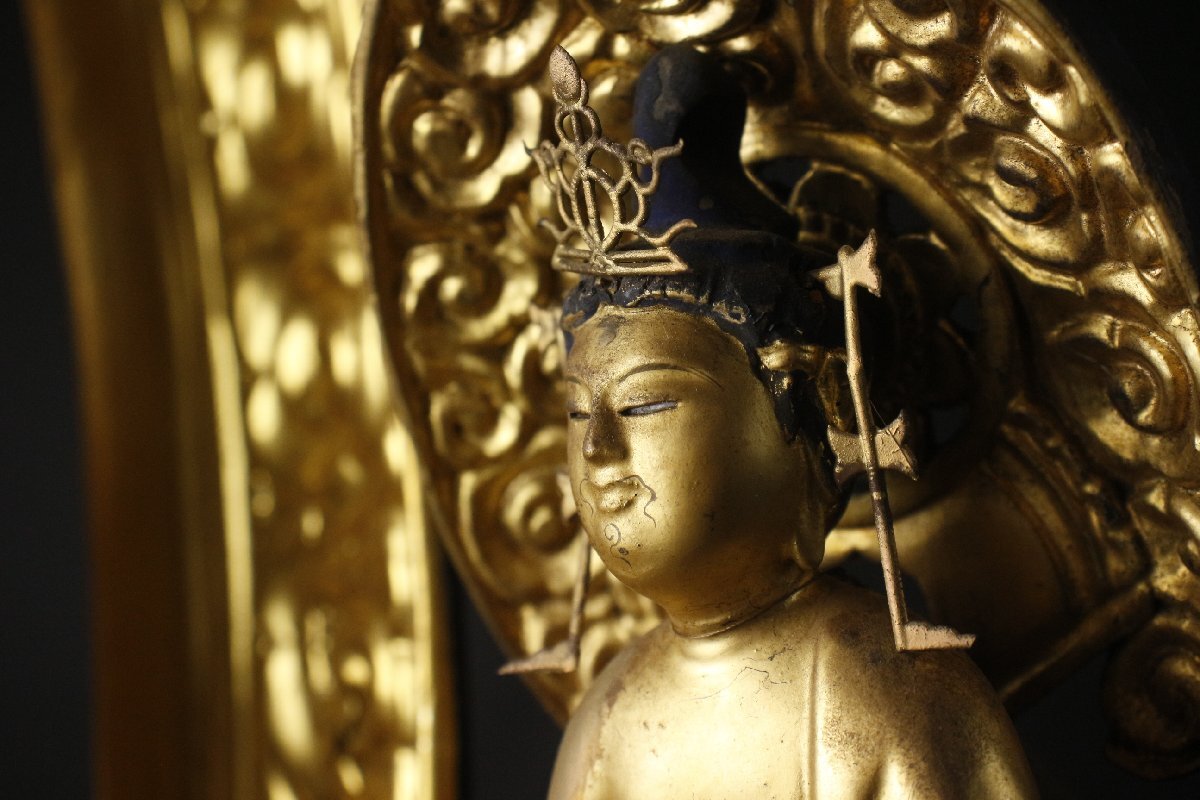
Extra-Large 70cm Giltwood Amida Sanzon Triad Zushi (Gyokugan Eyes) — Black Lacquer Portable Shrine, Edo-Period Style, Museum-Grade Butsuzo
Extra-Large 70cm Giltwood Amida Sanzon Triad Zushi (Gyokugan Eyes) — Black Lacquer Portable Shrine, Edo-Period Style, Museum-Grade Butsuzo
Couldn't load pickup availability
Have a reasonable price in mind? Submit your best offer and our concierge will review it personally.
A shrine that behaves like architecture: a deep black lacquered zushi whose doors open into a gold-lit interior, framing a complete Amida Sanzon (Amitabha triad). The ensemble reads instantly as temple-language rather than casual decor—the kind of devotional sculpture designed to be approached, opened, contemplated, and closed again as a small rite of attention.
At the center stands Amida Nyorai (Amitabha), the Buddha of Infinite Light, revered across Japanese Pure Land traditions as the compassionate guide who welcomes beings toward the Western Paradise. The triad format matters: it is not “one statue plus extras,” but a doctrinally complete iconographic set. The two attendants are bodhisattva presences that translate the central vow into lived qualities—boundless compassion on one side, protective wisdom on the other—forming a symmetrical, stabilizing geometry around the central figure.
The zushi itself is the second artwork. In Japanese practice, a shrine-cabinet protects sacred images from dust, touch, and light, but it also stages “revelation.” Black lacquer functions as visual silence. When the doors open, the interior gold becomes a sudden sunrise, turning the moment of viewing into ceremony. Collectors value shrine-format pieces precisely because they preserve this ritual logic: the object is not always “on,” it is intentionally unveiled.
This example is presented as extra-large, approximately 70 cm class. That scale shifts the category. Rather than a shelf object, it becomes a threshold piece: suitable for a tokonoma, meditation room, tea-room adjacent space, or a collector’s cabinet where it can act as the centerpiece around which smaller figures and implements orbit.
Gyokugan (inlaid eyes) is a crucial collector signal. Unlike painted eyes that can read flat at distance, inlaid eyes catch ambient light differently as you move, producing a living depth to the gaze. In Buddhist sculpture, that presence is not about realism for its own sake; it is about relationship. The figure feels like a calm witness—an effect many collectors seek when they describe a work as having “presence” or “spiritual gravity.”
The gilded surfaces and dense platform architecture support a temple-grade impression. Even when age and handling soften edges, those traces can deepen the aura: not “damage,” but evidence of use—especially common on lacquer corners, door edges, and gilded high points where contact occurs first. The listing notes light wear and age-related marks; this is consistent with shrine-format works of this scale.
Conservation is straightforward if handled with respect. Keep away from direct sun, high humidity, and heater airflow. Avoid wiping gilded areas with wet cloths; use a soft dry brush or microfiber. If any pigment is unstable, a conservator can stabilize it, and the zushi format makes controlled treatment practical because the figures are protected when the doors are closed.
For collecting, this is an anchor object: Pure Land iconography, triad completeness, shrine architecture, and the theatrical black-to-gold reveal. It works equally well as the spiritual heart of a devotional display or as a museum-grade interior statement piece where sacred art is treated with curatorial seriousness.
Who is this deity?
Amida Nyorai (Amitabha): Buddha of Infinite Light; central to Pure Land devotion, associated with compassion and vow.
Amida Sanzon attendants: bodhisattva presences completing the triad; together they form the complete devotional set.
Collector relevance
- Triad format: more desirable than single figures for completeness and symmetry.
- Zushi architecture: adds protection, display drama, and long-term stability.
- Gyokugan eyes: higher craftsmanship tier and a strong “presence” marker.
Collector’s Resonance
This piece is for the collector who wants a true portal-object—something that changes the atmosphere of a room the moment the doors open. It suits a Pure Land–focused cabinet, a cross-sect devotional collection, or a design-forward interior where sacred art is handled like museum material.
Confidence & Verification Notes
Attribution and dating are offered in good faith based on visible construction, iconography, and the listing’s claims. Exact period, workshop, and original context cannot be fully verified without in-hand examination. Treat period language as informed estimation unless accompanied by documentation.
WHAT IS A BUDDHIST TRIAD AND WHY DOES IT MATTER?
Across Japanese temple sculpture, a “triad” is the canonical format in which a principal deity is visually and ritually supported by two attendants. The triad is not “three separate statues.” It is one coherent statement: a central axis of salvation (the principal) and two flanking forces that translate that salvation into lived, human experience.
In Pure Land Buddhism, the Amida Triad is among the most recognizable triadic arrangements in Japan. Amida occupies the center as the Buddha of Infinite Light, while the attendants appear as bodhisattvas who embody and deliver Amida’s vow. In practice, triads function like an altar’s “complete sentence”: you do not need additional figures to understand the promise, the path, and the compassionate accompaniment.
WHO ARE THE DEITIES IN AN AMIDA TRIAD?
- Amida Buddha (Amitabha): the central Buddha of Pure Land, revered for the vow to receive beings into the Western Paradise.
- Kannon (Avalokiteshvara): the bodhisattva of compassion. In Pure Land context, Kannon appears as an attendant who comforts, protects, and guides the believer.
- Seishi (Mahasthamaprapta): the bodhisattva often associated with wisdom and the power of right mindfulness; in Pure Land imagery, Seishi supports the believer’s orientation toward Amida’s vow.
WHAT DOES THE TRIAD REPRESENT?
The triad represents salvation as a lived encounter. In Pure Land thought, Amida and the retinue descend to welcome the dying believer—a concept often visualized as the “welcoming descent.” The central Buddha is the promise; the attendants are the presence. Together, the three figures create an icon that is meant to be experienced frontally, at human eye level, as a reassurance rather than a spectacle.
WHY THIS READS AS MUSEUM-GRADE (NOT MARKETING, JUST CRITERIA)
Museum-grade is not a synonym for “expensive.” It is a convergence of criteria: completeness, iconographic correctness, coherent workmanship, scale appropriate to ritual use, and a surface history that indicates age and handling rather than modern decorative finishing.
1) Complete set integrity.
Triads are frequently separated over time. When the principal remains but attendants disappear, the theology collapses into a single object. A complete triad retains the original visual logic and is inherently rarer.
2) Coherent carving language.
The three figures share consistent modeling, proportional hierarchy, and a unified sense of line—signals that the group was conceived together rather than assembled later.
3) Architectural structure: lotus pedestals and halo logic.
The principal is presented with an architectural halo/mandorla structure that frames the figure as an axis, not a figurine. In temple sculpture, this halo is not decoration; it is the visual grammar of radiance and vow.
4) Temple-scale presence.
At approximately 68 cm for the assembled triad, with the central figure around 36 cm, this sits in a substantial devotional scale—large enough to anchor a space as a spiritual center, yet still compatible with private chapels and refined household altars.
5) Surface history (patina) consistent with age.
The surfaces read as accumulated presence rather than new lacquer gloss. Patina is not “damage” in this context; it is evidence of time and the kind of quiet handling expected of devotional objects.
WHY THIS IS A HERITAGE CENTERPIECE
A triad at this scale becomes the organizing heart of a collection. It is not an accent object. It is a spiritual architecture: a centerpiece around which smaller ritual objects, hanging scrolls, incense implements, and sutra texts can meaningfully orbit. In curatorial terms, it provides a complete iconographic anchor that allows you to build a coherent narrative of Japanese Pure Land devotion.
ESTIMATED PERIOD (BEST-EFFORT)
Based on construction logic, proportional discipline, and surface aging, the work is most consistent with late Edo to early Meiji-period temple or altar sculpture. Without inscriptions or temple documentation, this remains a conservative estimate.
CONDITION & CONFIDENCE NOTES
Age-related wear, patina, and surface variation are present and expected. Please review photographs closely for join stability, halo integrity, and base condition. All age/period statements are best-effort based on visual assessment.
Authenticity & Stewardship
Evaluated under the Japonista Authentication Framework™:
- Material, carving, and surface-study comparison
- Iconographic and stylistic verification
- Condition and stability review (surface integrity)
- Construction assessment and handling-risk evaluation
Guaranteed 100% Authentic. Covered by the Japonista Lifetime Authenticity Warranty™.
A Note on Stewardship and Collecting
At Japonista, we approach Buddhist statues, sacred images, and ritual objects not merely as collectibles, but as cultural and spiritual artifacts deserving of respect, understanding, and careful presentation. Every piece we offer is thoughtfully examined, researched, and curated with sensitivity to its origin, meaning, and historical role.
Our role is not only to offer access to rare and meaningful objects, but to serve as responsible custodians—connecting the right works with collectors who value depth, intention, and authenticity.
Inquiries, Availability, and Private Consideration
Some of the cultural and heritage works may allow room for discussion, while others are held firmly due to rarity, condition, or cultural importance. All inquiries are reviewed personally and discreetly, and we welcome thoughtful questions or expressions of interest.
If you are exploring a particular theme, deity, lineage, or period—or seeking guidance in building a focused collection—our concierge team is always available to assist with quiet expertise and care.
Concierge Support & Collector Guidance
Japonista Concierge™ provides personalized assistance for collectors seeking deeper understanding, thoughtful acquisition, or long-term curation strategies. Whether your interest is devotional, scholarly, or aesthetic, we are here to help guide your journey with clarity and respect.
For select high-value or historically significant works, private reservation or structured payment arrangements may be available on a case-by-case basis. Please reach out to discuss eligibility and discreet options.
Before Proceeding
We kindly encourage collectors to review our shop policies and house guidelines, available through the links in our website footer, which outline shipping, handling, and conditions specific to vintage, sacred, and collectible works.
A Closing Note
Thank you for exploring Japonista’s collection of Oriental Cultural Heritage and arts. We are honored to share these meaningful works and to help place them where they may continue to be appreciated, studied, and respected.
If you have questions or wish to explore related works, please feel free to contact Japonista Concierge™ at any time.