Rare Vintage, Antiques and Art Collector / Curator / Personal Shopper From Japan
Gamera Giant Life-size Display Figure — Large-Format Kaiju Statue, Daiei Era Guardian, Museum-Scale Interior Piece
Gamera Giant Life-size Display Figure — Large-Format Kaiju Statue, Daiei Era Guardian, Museum-Scale Interior Piece
Couldn't load pickup availability
Have a reasonable price in mind? Submit your best offer and our concierge will review it personally.
CURATORIAL OVERVIEW — WHAT THIS OBJECT ACTUALLY IS
This object is not a “toy,” nor a standard collectible figure. It is a large-format kaiju display artifact, produced for exhibition, promotional, or interior installation purposes, consistent with Japanese practices during the late Shōwa to Heisei transitional period when kaiju properties migrated from cinema into public space.
Unlike mass-produced vinyl figures, pieces of this scale were never intended for private ownership. They were designed to command physical space, replicate cinematic presence, and communicate character identity instantly to viewers across a room.
As such, surviving examples function today as three-dimensional archives of Japan’s suit-era kaiju culture.
Object Type
Large-Format Kaiju Display Figure / Interior Exhibition Piece
Character / IP
Gamera
Era / Origin
Late Shōwa–Heisei lineage (design language consistent with post-Daiei exhibition figures)
Material
FRP / reinforced plastic composite (industrial display grade)
Condition
Indoor-displayed; structurally intact; cosmetic wear consistent with exhibition use
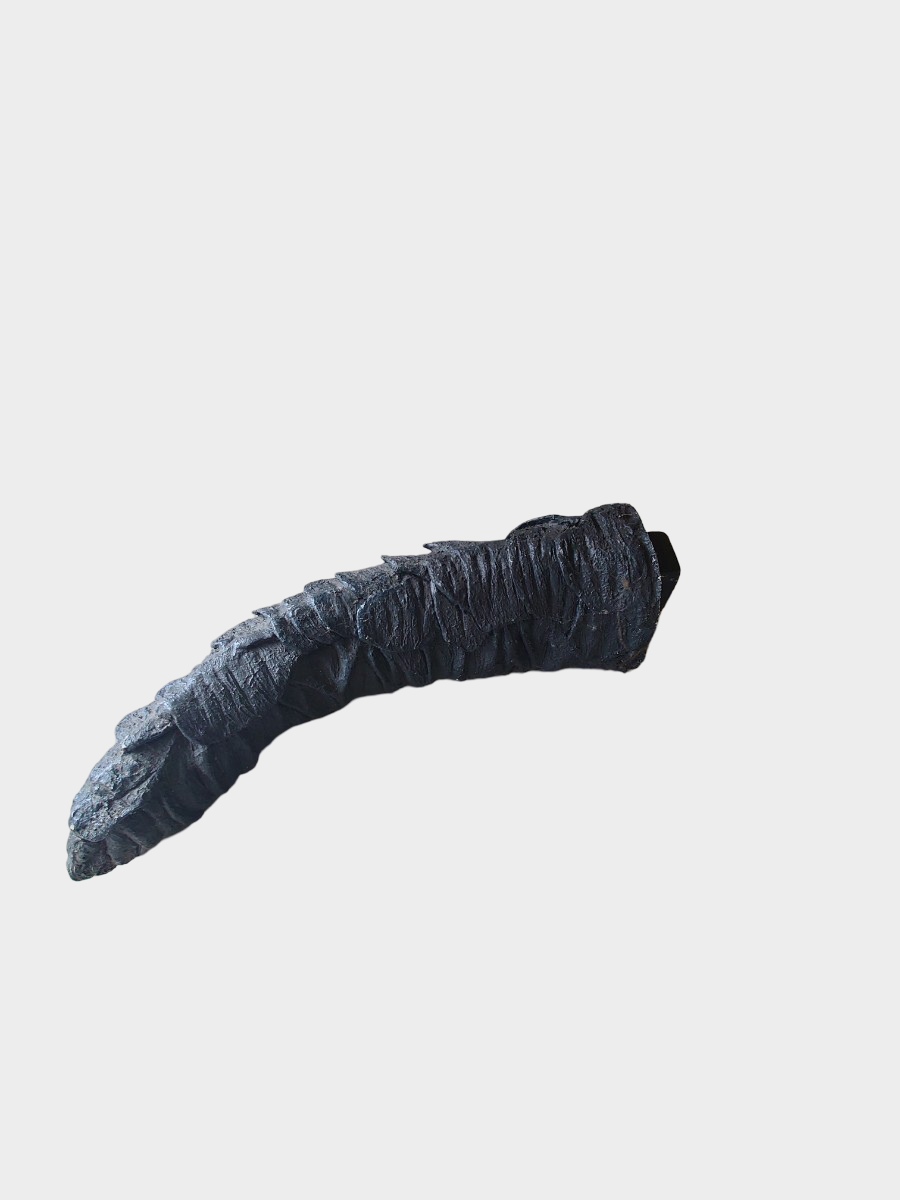
(Tail removable; surface wear noted but overall presence strong)
Dimensions (Object)
-
Height: approx. 150 cm
-
Width: approx. 120 cm
-
Depth: approx. 220 cm (with tail)
-
Depth (tail removed): approx. 160 cm
Estimated Weight (Object)
≈ 55–65 kg (FRP, hollow body)
ICONOGRAPHY & THEMATIC ANALYSIS
Gamera occupies a singular moral position in kaiju history: a guardian rather than a punishment.
His turtle-based form is not accidental symbolism:
-
The shell signifies endurance and protection
-
The upright stance grants heroic legibility
-
The forward gaze conveys awareness and moral intent
Unlike Godzilla’s allegorical rage, Gamera’s iconography communicates sacrifice. He is repeatedly injured, burned, frozen, or destroyed in defense of humanity — especially children — making him one of the few kaiju whose narrative identity is fundamentally empathetic.
Large figures such as this restore that intent. At human-adjacent scale, Gamera reads not as spectacle, but as sentinel.
Gamera — Guardian of the Children, Anomaly of the Kaiju Canon
Gamera occupies a singular, almost paradoxical position in Japanese kaiju history. Introduced in 1965 by Daiei Film as a competitor to Godzilla, Gamera was never meant to simply mirror his atomic predecessor. Instead, he evolved into something stranger, more emotional, and ultimately more human in spirit: a monster defined not by terror or punishment, but by protection, sacrifice, and an unambiguous moral alignment with children.
While Godzilla emerged as a metaphor for nuclear trauma and state-level destruction, Gamera became the kaiju of empathy—a colossal, prehistoric guardian repeatedly willing to destroy himself to save humanity, and especially its youngest members. This distinction would shape not only Gamera’s narrative arc, but his enduring cultural legacy.
From Pop Rival to Cult Icon
The early Gamera films of the late 1960s leaned into accessibility—lighter tone, vivid colors, and fantastical enemies—earning the series a reputation as “child-oriented.” But this framing misses the deeper truth: Gamera’s appeal lay in his moral clarity. He was not an ambivalent force of nature; he was a chosen protector.
That choice would later prove prophetic.
In the 1990s, director Shusuke Kaneko radically reinterpreted Gamera in the celebrated Heisei Trilogy (Guardian of the Universe, Attack of Legion, Revenge of Iris). These films elevated Gamera from nostalgic creature feature to philosophical kaiju cinema, reframing him as an ancient biotechnological weapon tied to humanity’s survival—and capable of catastrophic self-sacrifice.
Critics would later argue that the Heisei Gamera trilogy surpassed contemporary Godzilla films in narrative cohesion, emotional depth, and visual discipline. Gamera, once dismissed as a “children’s monster,” became a cult-critical darling.
Iconography — Why Gamera Looks the Way He Does
Gamera’s design is deceptively simple: a massive turtle-like form, rough carapace, beaked face, and expressive eyes. But this simplicity is deliberate.
-
The shell evokes ancient protection, a living fortress.
-
The tusked beak balances gentleness with latent violence.
-
The upright posture grants Gamera a heroic silhouette—less beast, more sentinel.
-
The eyes (often emphasized in high-end figures) are crucial: Gamera looks back at humanity, a rare trait among kaiju.
Unlike Godzilla’s jagged dorsal plates or King Ghidorah’s alien asymmetry, Gamera’s form reads as prehistoric, terrestrial, and loyal—a creature that belongs to Earth, not above it.
Large-scale statues and suits—like the one shown here—are especially powerful because they restore Gamera’s intended physical presence: towering, grounded, and emotionally legible even at rest.
Why Full-Scale Gamera Figures Matter
Life-size or near life-size Gamera figures occupy a rare category of collectible: they are environmental objects, not shelf pieces.
Historically, such figures were produced for:
-
Film studio promotions
-
Theme parks and exhibitions
-
Event displays and museum-style installations
They were never designed for private ownership, which is precisely why surviving examples carry such gravity today.
Most were:
-
Exposed to light, humidity, and transport stress
-
Disassembled, repainted, or discarded after use
-
Lost during studio closures or exhibition turnover
As a result, intact large-format Gamera figures—especially those with original sculpt fidelity and presence—now function as three-dimensional archives of Japan’s practical effects era.
They preserve:
-
The tactile language of suitmation
-
The scale logic of pre-CG kaiju cinema
-
The emotional intent embedded in physical mass
Cultural Legacy — Why Gamera Endures
Gamera endures not because he is the strongest kaiju, but because he is the most willing to suffer.
Again and again, Gamera is wounded, burned, frozen, impaled—yet rises to protect a world that often fears or misunderstands him. This narrative has resonated across generations, especially in postwar and post-bubble Japan, where themes of endurance, responsibility, and quiet guardianship carry deep emotional weight.
In modern retrospectives, Gamera is increasingly understood as:
-
A metaphor for intergenerational protection
-
A symbol of non-authoritarian heroism
-
A counterpoint to spectacle-driven destruction
That is why collectors, museums, and serious kaiju historians treat large Gamera artifacts not as novelty décor, but as cultural monuments.
Positioning This Piece (Collector-Facing Framing)
For a listing like this, the correct framing is:
-
Not “rare monster figure”
-
Not “huge display item”
-
But: A surviving physical witness to Japan’s kaiju conscience
This piece speaks to:
-
Kaiju historians
-
Film preservationists
-
High-end collectors seeking narrative weight
-
Institutions or private spaces designed for impact, not clutter
It is the kind of object that changes the room it occupies.
MATERIAL & CRAFT ASSESSMENT
-
FRP construction indicates professional fabrication
-
Hollow body design allows scale without excessive mass
-
Sculpt fidelity prioritizes silhouette over hyper-detail — correct for exhibition use
-
Tail detachment confirms modular transport intent
Surface wear is consistent with static display life, not mishandling. Importantly, the form remains visually coherent — a critical factor for museum or architectural placement.
HISTORICAL CONTEXT — WHY THESE SURVIVE AT ALL
Most large kaiju figures were:
-
Destroyed after campaigns
-
Repainted beyond recognition
-
Stored improperly and discarded
That this example survives — intact, identifiable, and structurally sound — places it firmly in the category of accidental cultural survivor.
As Japanese studios transitioned toward CGI and digital media, physical artifacts like this quietly vanished. What remains now is finite.
COLLECTOR RELEVANCE
This piece appeals to:
-
Kaiju historians
-
Private collectors seeking impact objects
-
Film culture preservationists
-
Commercial or institutional interiors (theaters, concept spaces, archives)
It is not shelf culture — it is spatial culture.
SUMMARY — WHY THIS PIECE MATTERS
This is a guardian made physical.
A rare surviving embodiment of Japan’s most compassionate kaiju.
An object that does not decorate a room — it defines it.
Cargo Shipping & Handling Notice
Due to the final packaged weight and/or dimensional requirements of this piece, standard parcel services such as Japan Post EMS, DHL, FedEx, or UPS are not applicable. This item will be shipped via cargo or freight-based shipping methods.
Cargo shipments require additional preparation time to ensure proper handling, which may include custom crating, reinforced packing, coordination with domestic logistics providers, and scheduling with international freight consolidators and export brokers. As a result, estimated delivery timelines typically range from 6 to 10 weeks, depending on routing, carrier availability, and customs clearance procedures in the destination country.
Please note that actual shipping costs may differ from automated shipping calculator estimates. By default, a portion of the expected shipping cost may be reflected in the listing price. Any difference or discrepancy will be quoted separately once destination, delivery method, and handling requirements are confirmed.
We kindly ask that collectors contact us prior to purchase to request an exact, customized shipping quotation for their destination. This ensures full transparency and allows us to arrange the most appropriate, secure, and efficient shipping solution for this piece.
Thank you for your understanding and patience as we take the necessary care to deliver this work safely.
🚚 SHIPPING & LOGISTICS INTELLIGENCE (CARGO-LEVEL)
* ESTIMATES TO USA ~ $5000 more or less (for door to door, please inquire directly)
PACKED SHIPPING ASSUMPTIONS
Disassembled Configuration
-
Body crate: 160 × 120 × 80 cm
-
Tail crate: 70 × 40 × 40 cm
Total Cubic Volume
≈ 1.8 m³
Packed Weight (with crate & padding)
≈ 85–95 kg
Volumetric Weight (Air)
≈ 300–330 kg equivalent
Authenticity & Stewardship
Evaluated under the Japonista Authentication Framework™:
- Material, carving, and surface-study comparison
- Iconographic and stylistic verification
- Condition and stability review (surface integrity)
- Construction assessment and handling-risk evaluation
Guaranteed 100% Authentic. Covered by the Japonista Lifetime Authenticity Warranty™.
A Note on Stewardship and Collecting
At Japonista, we approach Buddhist statues, sacred images, and ritual objects not merely as collectibles, but as cultural and spiritual artifacts deserving of respect, understanding, and careful presentation. Every piece we offer is thoughtfully examined, researched, and curated with sensitivity to its origin, meaning, and historical role.
Our role is not only to offer access to rare and meaningful objects, but to serve as responsible custodians—connecting the right works with collectors who value depth, intention, and authenticity.
Inquiries, Availability, and Private Consideration
Some of the cultural and heritage works may allow room for discussion, while others are held firmly due to rarity, condition, or cultural importance. All inquiries are reviewed personally and discreetly, and we welcome thoughtful questions or expressions of interest.
If you are exploring a particular theme, deity, lineage, or period—or seeking guidance in building a focused collection—our concierge team is always available to assist with quiet expertise and care.
Concierge Support & Collector Guidance
Japonista Concierge™ provides personalized assistance for collectors seeking deeper understanding, thoughtful acquisition, or long-term curation strategies. Whether your interest is devotional, scholarly, or aesthetic, we are here to help guide your journey with clarity and respect.
For select high-value or historically significant works, private reservation or structured payment arrangements may be available on a case-by-case basis. Please reach out to discuss eligibility and discreet options.
Before Proceeding
We kindly encourage collectors to review our shop policies and house guidelines, available through the links in our website footer, which outline shipping, handling, and conditions specific to vintage, sacred, and collectible works.
A Closing Note
Thank you for exploring Japonista’s collection of Oriental Cultural Heritage and arts. We are honored to share these meaningful works and to help place them where they may continue to be appreciated, studied, and respected.
If you have questions or wish to explore related works, please feel free to contact Japonista Concierge™ at any time.