Rare Vintage, Antiques and Art Collector / Curator / Personal Shopper From Japan
Flowers McColgan A-2 Flight Jacket Size 40 USA Made Leather Blood Chit Flying Tigers TALON Vintage Repro
Flowers McColgan A-2 Flight Jacket Size 40 USA Made Leather Blood Chit Flying Tigers TALON Vintage Repro
Couldn't load pickup availability
Have a reasonable price in mind? Submit your best offer and our concierge will review it personally.
A FLOWERS McCOLGAN A-2 STYLE FLIGHT JACKET, UNITED STATES, CIRCA 1990s
Limited-production American heritage reconstruction featuring extensive leather appliqué, Flying Tigers-related iconography, and a blood chit-style reverse panel
A U.S.-made leather flight jacket based on the WWII A-2 pattern, produced by Flowers McColgan and distinguished by unusually intensive custom surface construction. The jacket incorporates a vintage TALON zipper and is decorated with a combination of leather-built and textile-applied insignia, including Flying Tigers-associated front motifs and a large reverse blood chit-style panel composed with United States and Republic of China flags above vertically arranged Chinese script. The shell exhibits both intentional wash aging and later use wear, including localized underarm seam stress and the loss of one lower pocket button. Unlike painted custom garments, the present example derives much of its authority from built leather imagery integrated into the body of the jacket itself. It stands as a compelling artifact of late-20th-century American heritage reconstruction culture, in which military memory was translated into labor-intensive, collectible form.
Object
FLOWERS McCOLGAN A-2 Flight Jacket
Brand / Maker
FLOWERS McCOLGAN / McCollgan
Production Era
1990s American production, limited-run heritage military reinterpretation
Category
High-grade U.S.-made reproduction / reconstruction with multi-surface custom appliqué and blood chit-inspired rear panel
Material
Full-grain leather shell
Leather appliqué and leather-cut inlay work across front, sleeves, and back
Textile patching in selected front insignia zones
Vintage TALON zipper
Style Basis
WWII U.S. Army Air Forces A-2 flight jacket silhouette
Patch / Decoration Context
Front carries a Flying Tigers-style roundel and a tiger-lightning shield motif, both reading as theater-aviation-inspired iconography
Reverse carries a large leather-built dual-flag blood chit style panel combining the United States flag and Republic of China flag with vertically arranged Chinese rescue text
Sleeves carry additional leather-applied insignia work
Chest name-strip area present but left blank, reinforcing the object’s pseudo-issued, theater-custom grammar
Size
40
Condition Summary
Shell shows both pre-engineered wash aging and real subsequent wear
Noticeable surface rubbing, fading, and tonal migration throughout
Underarm seam stress and fray at both sides
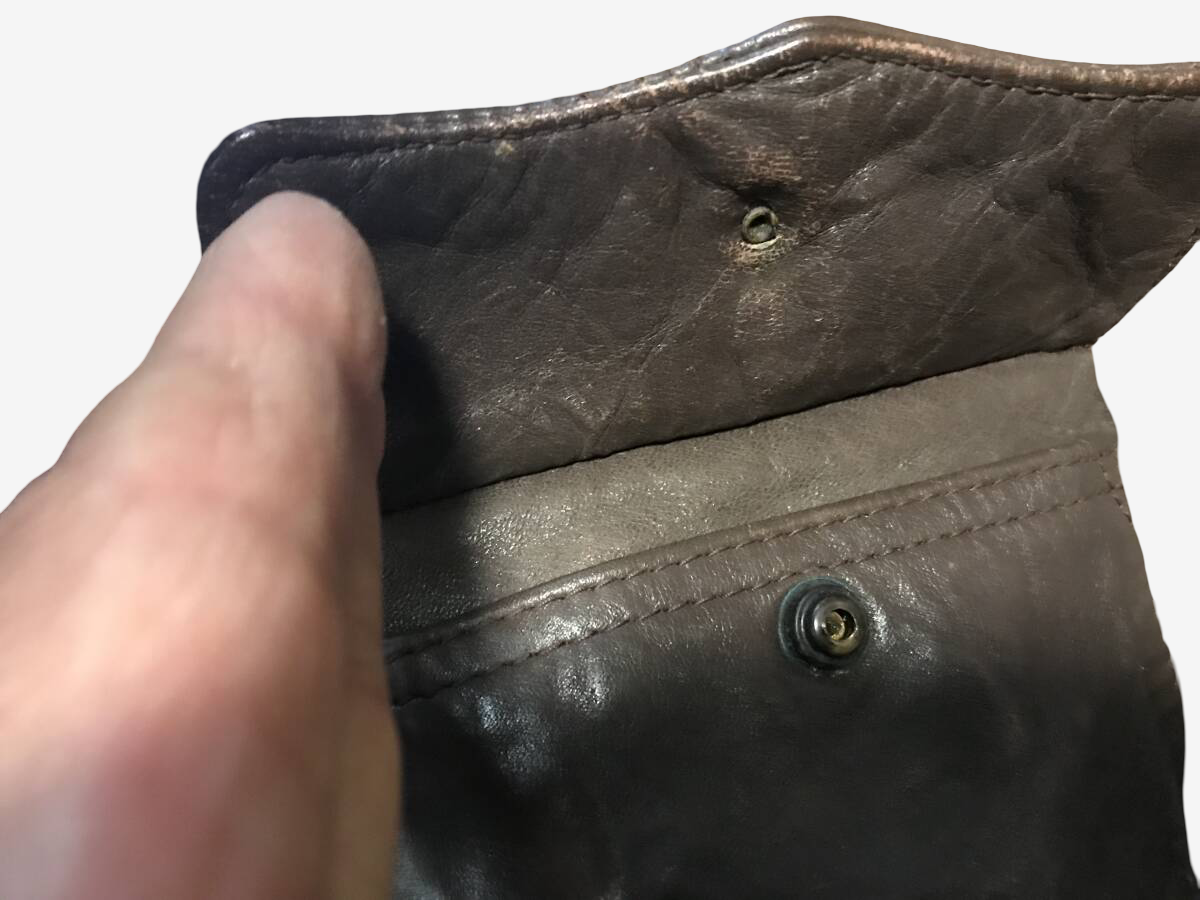
Right lower pocket button missing
Overall structure remains intact and highly displayable / wearable
General presentation remains strong because the value driver is not pristine condition but craftsmanship density plus visual authority
Custom
This is not painted decoration.
This is built imagery.
That distinction matters because it places the piece closer to constructed leather folk-heraldry than ordinary jacket customization.
Object Classification
Not an original WWII artifact
Not a casual fashion repro
A serious American heritage reconstruction with museum-theatrical ambition
COLLECTOR RELEVANCE
Tier: High-Craft Heritage Reconstruction / Advanced Niche Collector Category
This piece is for:
- heritage reconstruction collectors
- A-2 enthusiasts who appreciate reinterpretation rather than contract fetish
- Flying Tigers / CBI iconography buyers
- leather craftsmanship collectors
- archive-fashion buyers interested in 1990s American reinterpretation culture
This piece is not for:
- strict original-WWII purists
- buyers who want reproduction purity without custom intervention
- casual fashion buyers who do not understand why craftsmanship labor changes price logic
- condition absolutists focused on complete hardware neatness
This is for the collector who understands that some garments are valuable because they preserve history, and others because they rebuild it convincingly enough to matter.
CONFIDENCE & VERIFICATION NOTES
Strong positives
- maker label intact
- U.S. manufacture clearly established
- reconstruction intent coherent across front, sleeves, and reverse
- vintage TALON zipper materially supports the period-interpretive build
- labor density is unusually high
CURATORIAL ANALYSIS
A Reconstruction That Refuses To Stay In The Reproduction Category
Most reproductions remain trapped in imitation. They quote originals, borrow prestige, and hope accuracy alone will carry them. This jacket moves differently. It starts from the A-2, yes, but it does not stop at reverence. It pushes into construction-intensive reinterpretation, where the garment begins to build a second identity beyond the object it references.
That is the first threshold.
This is not merely an A-2 reproduction with extra decoration. It is a reconstruction object in which the custom work is not surface garnish but category-defining structure. Once that becomes clear, the jacket is no longer judged solely against contract-correct wartime examples. It must be judged against a different standard: how convincingly it transforms military memory into a collectible object of its own.
On that front, it is serious.
The Critical Difference Between Paint and Built Surface
The easiest mistake with this jacket is to read it like a painted custom A-2. It is not. The strongest work here is built, cut, layered, and attached. The rear blood chit style panel is not simply a graphic gesture. The flags are assembled from leather sections. The stars are cut, placed, and organized one by one. The chest and sleeve devices continue that same logic, mixing appliqué, shield forms, patch grammar, and theater-icon vocabulary into a jacket that behaves less like a customized shell and more like a constructed heraldic surface.
That difference matters because built imagery ages differently from paint.
Paint sits on top.
Construction becomes part of the object.
This is why the jacket carries more authority than ordinary custom repros. The imagery is not merely visible. It is integrated.
Why The Blood Chit Grammar Changes The Piece
The back panel is the dominant event. It introduces the full emotional and symbolic charge of a blood chit without pretending to be an actual wartime-issued survival panel. That is an important distinction, and handling it honestly improves the piece rather than diminishing it.
What the back does is borrow the visual language of wartime rescue communication and translate it into leatherwork. The U.S. and Republic of China flags immediately activate Flying Tigers / CBI / Sino-American wartime memory. The vertical Chinese rescue text deepens that signal. It turns the reverse of the jacket into a theater-facing declaration.
But because this is a 1990s reconstruction rather than a wartime artifact, the effect is different from pure provenance. It becomes something arguably more self-aware: an American act of historical remembrance rendered through craftsmanship.
That is where its value lives.
Flying Tigers Memory and Selective Reconstruction
The front reinforces the rear intelligently. The left chest roundel and right chest tiger-lightning shield do not merely add decoration. They create narrative continuity. The jacket is clearly trying to occupy a specific visual memory-field: China-Burma-India, volunteer group mythology, tiger insignia, rescue politics, and wartime alliance symbolism.
This is not random patchwork.
It is curated iconography.
The strongest reconstruction garments do this well. They do not pile symbols indiscriminately. They create a symbolic system. This jacket has one.
Why The Blank Name Strip Is Such A Good Detail
A lesser reconstruction would have forced a fake name strip or unit line to intensify the illusion. This piece stops short of that, and that restraint helps it. The blank strip position preserves the grammar of an issued military jacket while avoiding the embarrassing overclaim that often weakens theater-inspired heritage garments.
In collector terms, this is one of the smartest decisions on the jacket.
It leaves the object in a persuasive middle ground:
- military enough to feel anchored
- restrained enough to avoid cosplay falseness
- open enough for the buyer to project ownership without inherited fiction
That is strong design.
Leather, Wash, and Why Artificial Aging Sometimes Works
Artificial aging is usually where modern heritage garments fail. Most distressing looks applied, impatient, and conceptually hollow. Here, the washed and faded surface works better because it is not acting alone. The leather-built insignia, mixed media surface, and subsequent real wear all collaborate to create a more convincing total finish.
The shell now carries two aging systems at once:
- original intentional wash treatment
- actual later use and abrasion
That layered aging is why the jacket reads better in hand than a flat “deadstock repro” often does. The tonal migration across the sleeves, chest, and back gives it a mature field-referential presence without needing the buyer to do the first decade of work themselves.
The Brand Problem, Which Is Also The Brand Advantage
FLOWERS McCOLGAN is not a universally standardized name in the way Real McCoy’s, Buzz Rickson’s, or Aero are. For broad markets, that reduces easy liquidity. But in narrower collector channels, it does the opposite.
Because the maker is defunct and the production approach appears labor-heavy and small-batch, the brand becomes interesting precisely because it is not overexposed. The jacket is not one of a thousand familiar references. It feels more like an artifact from a lost side road in the American heritage movement.
That increases curiosity.
And curiosity, when supported by genuine construction quality, becomes value.
The Missing Pocket Button and Underarm Stress
These matter, but they matter correctly.
The underarm seam fray shows where the garment experiences stress under actual wear. That is not ideal, but it is predictable and, more importantly, locally intelligible. It does not compromise the central value proposition. The missing right lower pocket button similarly affects completeness, not identity.
The question is always: does the flaw damage the category, or merely the convenience?
Here, it damages convenience. The category remains strong.
Why This Piece Is Better Than A Simple “Fashion Heritage” Reading
Fashion heritage buyers will like it because it is striking. But that is not the highest reading. The higher reading is that this jacket belongs to a period in which American and Japanese makers alike began treating military garments not merely as templates for reproduction, but as sites of historical interpretation.
That makes this piece part of a larger cultural moment:
- archive study
- military memory
- object reconstruction
- artisanal intervention
- selective myth-building
The best 1990s heritage objects are not trying to fool anybody into thinking they are original. They are trying to prove they understand the original deeply enough to make something new from it.
This jacket succeeds because it understands that boundary.
MATERIAL FORENSICS
Shell
The full-grain leather remains one of the central strengths of the piece. It has enough body and enough visual movement to support the appliqué work without collapsing into decorative novelty. The wash treatment has softened the visual field, but the shell still holds the proper A-2 posture through the chest, pocket planes, and collar line.
Points that matter:
- leather retains shape and stance
- wash aging does not flatten the garment into costume softness
- tonal variance adds authority rather than chaos
This is where the reconstruction remains credible.
Appliqué and Leather-Cut Work
This is the real labor center of the jacket. The reverse flag alone requires significant handwork, but the front continues the same commitment. The stars, bars, shield edges, and symbol blocks all show the piece was not built for speed. In collector terms, that is the sort of work that keeps a reconstruction from becoming disposable.
The imagery here is materially persuasive because it is physically made, not merely visually referenced.
Underarm Stress Zones
The seam fray at both underarms is important to note because these are functional stress points. However, the issue remains localized. It does not erase the jacket’s wearable life, though it does move it out of carefree heavy-rotation wear and into careful collector-use territory unless conservation work is performed.
Pocket Hardware
The missing lower pocket button affects completeness but not silhouette. The pocket still reads correctly in form, which matters more than buyers often realize. Once flap pockets lose visual coherence, the front goes soft. Here, the front still holds.
Zipper
The vintage TALON zipper is one of the strongest coherence details on the piece. It stabilizes the whole reconstruction concept. A jacket like this with generic modern hardware would immediately lose seriousness. With TALON, it stays inside the right historical conversation.
Authenticity & Stewardship
Evaluated under the Japonista Aviation & Military Garment Authentication Framework™
Each work is examined through a structured, multi-layered assessment:
• Model classification and military typology verification (A-2, B-3, MA-1, G-1, L-2, etc.)
• Material evaluation across leather, shearling, nylon, wool, and mixed components
• Hardware inspection including zippers, snaps, and period-correct fastenings
• Graphic and nose art analysis, including paint method, iconography, and historical alignment
• Condition and structural integrity review, including wear patterns consistent with age and use
Where applicable, contract labels, manufacturer markings, and period construction details are reviewed to confirm authenticity and era alignment.
Guaranteed 100% Authentic.
All garments are curated and backed by the Japonista Lifetime Authenticity Warranty™, with emphasis on both material truth and historical accuracy.
A Note on Flight Jackets, Service & Visual Identity
Military flight jackets were engineered as functional equipment—designed for temperature regulation, durability, and survival in demanding conditions. Over time, they evolved into carriers of identity, memory, and personal expression.
Nose art and painted jackets—originally applied to aircraft and later to garments—represent a distinct form of visual folklore. Pin-up figures, squadron insignia, mascots, and symbolic imagery transformed standard-issue equipment into individualized statements of presence and morale.
At Japonista, these jackets are approached as wearable military artifacts. Surface wear, leather creasing, paint aging, and textile fatigue are evaluated as evidence of lived history rather than imperfection.
We preserve these works with restraint—allowing their material narrative to remain visible and intact.
Our role is to connect these garments with collectors who recognize their dual nature as both functional objects and historical documents.
Inquiries, Availability, and Private Consideration
Many flight jackets are singular in character due to condition, paintwork, contract variation, or production era. Certain pieces are held firmly due to rarity, historical resonance, or preservation status.
All inquiries are handled discreetly, and we welcome thoughtful discussion regarding provenance, contract details, nose art interpretation, and long-term wear or display considerations.
Collectors building focused archives—by model type, era, or graphic style—may consult with us for deeper guidance.
Concierge Support & Collector Guidance
Japonista Concierge™ provides tailored assistance for collectors seeking deeper engagement with aviation garments:
• Model and contract identification (A-2 variants, G-1 lineage, MA-1 evolution)
• Leather and textile preservation guidance
• Paint conservation and display considerations
• Wearability versus archival preservation assessment
• Strategic acquisition planning for aviation-focused collections
For select rare or historically significant works, private reservation or structured acquisition arrangements may be available on a case-by-case basis.
Before Proceeding
We encourage collectors to review our shop policies and house guidelines, available through the links in our website footer. These outline shipping protocols, handling considerations, and condition standards specific to vintage leather, painted garments, and military-issued clothing.
Understanding these guidelines supports responsible stewardship of each piece.
A Closing Note
Flight jackets occupy a distinct place within material history. They are objects of function shaped by environment, and over time, transformed into records of identity, service, and expression.
Nose art—whether applied to aircraft or garments—extends this narrative, capturing moments of humor, defiance, and individuality within structured military life.
At Japonista, we steward these works as aviation artifacts in wearable form—ensuring they continue their journey with collectors who understand both their construction and their story.
If you have questions or wish to explore related items, please feel free to contact Japonista Concierge™ at any time.