Rare Vintage, Antiques and Art Collector / Curator / Personal Shopper From Japan
Exquisite Rare Antique Japanese Hanging Scroll of Amida Nyorai Buddha w/ Celestial Court Gold Brocade – Edo Meiji Era Buddhist Buddhism Art
Exquisite Rare Antique Japanese Hanging Scroll of Amida Nyorai Buddha w/ Celestial Court Gold Brocade – Edo Meiji Era Buddhist Buddhism Art
Couldn't load pickup availability
A richly detailed Japanese Buddhist hanging scroll portraying Shakyamuni Buddha enthroned beneath a celestial canopy and surrounded by the Sixteen Benevolent Deities, bodhisattvas, monks, and sacred guardians.
Description
A golden Buddha sits in perfect stillness while an entire celestial court gathers around him.
This extraordinary Japanese hanging scroll presents a richly populated Buddhist vision centered upon Shaka Nyorai, the historical Buddha Shakyamuni, seated upon an elaborate lotus throne beneath an ornate canopy of flowers, jewels, suspended pendants, and sacred ornament.
Around him rises a formidable assembly of armored heavenly guardians, serene bodhisattvas, devotional monks, and sacred attendants. Some carry spears, swords, bows, staffs, ritual vessels, or symbolic implements. Others stand with palms joined in reverence. Together they form a living wall of protection around the Buddha and the teachings he represents.
The composition is most consistent with a Shaka Sanzon Jūroku Zenshin-zu, or Shakyamuni Triad with the Sixteen Benevolent Deities. The sixteen protectors were traditionally understood as guardians of the Great Perfection of Wisdom Sutra and were represented in paintings displayed during Buddhist ceremonies devoted to its recitation.
The palette is sumptuous yet disciplined: deep brown, emerald green, mineral blue, cinnabar red, ivory, muted turquoise, and luminous gold. The painting is framed by several layers of brocade, including dark green chrysanthemum medallions, orange-gold floral textiles, and an inner band of purple and gold.
The result is more than a religious portrait. It is a complete sacred court, an image of wisdom held at the center while spiritual guardians assemble around it like a jeweled fortress.
For the collector, this scroll offers remarkable iconographic richness.
For the practitioner, it offers protection, concentration, and reverence.
For the interior, it creates an unmistakable focal point with historical depth and ceremonial presence.
Artwork Identification
The composition appears to represent:
Shaka Sanzon Jūroku Zenshin-zu
Japanese: 釈迦三尊十六善神図
English: Shakyamuni Triad with the Sixteen Benevolent Deities
The principal figure is:
Shaka Nyorai
Japanese: 釈迦如来
Sanskrit: Śākyamuni
Meaning: The Sage of the Shakya Clan, the historical Buddha
The surrounding assembly likely includes a combination of:
- The Sixteen Benevolent Deities
- Bodhisattva attendants
- Armored Buddhist guardians
- Monks and sutra transmitters
- Heavenly Kings or related protective figures
- Additional sacred attendants associated with the Great Wisdom Sutra tradition
Canonical compositions frequently place Shakyamuni at the center with Monju and Fugen Bodhisattvas, while the Sixteen Protectors and figures connected with the transmission of Buddhist scripture gather below and around the triad.
Individual secondary figures cannot be identified with complete certainty from photographs alone, but the composition’s overall subject is strongly consistent with this established devotional format.
The Central Buddha
Shakyamuni occupies the vertical and spiritual center of the painting.
He is seated cross-legged upon a lotus throne raised above an elaborate multilevel pedestal. His right hand is lifted in a gesture of reassurance or teaching, while his left rests calmly near the lap.
The Buddha’s expression is composed and inward-looking. His lowered eyes, carefully drawn curls, elongated ears, and symmetrical features communicate awakened stillness rather than worldly emotion.
Behind him rises a monumental three-part aureole composed of green-blue inner fields and luminous gold outer bands. This layered halo separates the Buddha visually from the crowded celestial assembly while emphasizing his position as the source of wisdom around which the entire composition is organized.
His robes are described almost entirely through fine gold-toned linework. Swirling vines, geometric patterns, floral medallions, and repeating borders cover the textile surface, giving the garment the appearance of sacred brocade.
The contrast is striking: the Buddha remains silent and immovable, while the guardians around him bristle with weapons, expressive faces, fluttering ribbons, and ritual energy.
The Sixteen Benevolent Deities
The surrounding armored figures represent the protective force of Buddhist teaching.
Known in Japanese as the Jūroku Zenshin, the Sixteen Benevolent Deities were understood as guardians of the Great Perfection of Wisdom Sutra. They appear in dynamic poses, carrying weapons and sacred implements while directing their attention toward the central Buddha and the teachings entrusted to their protection.
Their fierce expressions should not be interpreted as evil or destructive.
Within Buddhist art, wrathful appearance often represents:
- The defeat of ignorance
- Protection of sacred teachings
- Courage against spiritual obstacles
- Discipline and vigilance
- The transformation of destructive forces
- The uncompromising defense of wisdom
The guardians’ elaborate armor, layered garments, crowns, helmets, scarves, boots, and weapons create a brilliant visual counterpoint to Shakyamuni’s stillness.
Each figure has an individual face, posture, attribute, and personality. Some appear vigilant, others contemplative, and others ready to act. Together they form a sacred retinue rather than a random collection of warriors.
The Great Perfection of Wisdom Sutra
Paintings of Shakyamuni and the Sixteen Protectors were traditionally connected with the Daihannya-kyō, the Japanese name for the Great Perfection of Wisdom Sutra.
During ceremonial recitations known as Daihannya-e, such an image could be displayed as the principal devotional focus. The protectors symbolized the safeguarding of the sutra, its recitation, and those who upheld its teachings.
The spiritual themes associated with this tradition include:
- Wisdom beyond ordinary understanding
- Protection of Buddhist teaching
- Release from attachment
- Courage in the face of adversity
- Spiritual discipline
- The purification of obstacles
- Devotion to study and recitation
- The preservation of sacred knowledge
This context gives the painting a powerful meaning for libraries, studies, meditation rooms, learning spaces, temples, and interiors devoted to contemplation.
The Celestial Canopy
Above the Buddha hangs an extraordinary floral canopy.
Its layered chrysanthemum and lotus-like blossoms are rendered in green, white, gold, and soft red. Suspended chains descend from the flowers, ending in bells, jewels, medallions, rings, and ritual ornaments.
This canopy visually marks the area beneath it as sacred.
Rather than depicting an ordinary interior, the artist creates a ceremonial heaven around the Buddha. Flowers appear suspended above the central figure while golden pendants shimmer against the dark field.
The canopy introduces softness and refinement into a composition otherwise dominated by armored guardians. Its flowers suggest purity and offering, while the descending ornaments create a visual link between the celestial realm and Shakyamuni’s halo.
A purple-and-gold brocade band immediately above the painted field reinforces the impression that the hanging canopy continues outward into the textile mounting.
Bodhisattvas, Monks and Sacred Attendants
Among the armored protectors are several pale-faced bodhisattvas and robed monks.
Some stand with palms joined. Others hold ritual objects, scrolls, staffs, or offerings. Their quieter gestures provide moments of contemplation within the crowded assembly.
Traditional Shaka and Sixteen Protectors compositions may include:
- Monju Bosatsu, associated with transcendent wisdom
- Fugen Bosatsu, associated with practice and compassionate action
- Xuanzang, the celebrated monk and translator connected with the transmission of Buddhist scripture
- Jinja Daishō, a guardian traditionally associated with Xuanzang
- Ānanda and other disciples or attendants
- Additional protectors and figures associated with the sutra tradition
The exact identities of every figure in this particular painting would require direct specialist examination, comparison with iconographic manuals, and closer study of attributes that may be obscured by age or surface wear.
Even without assigning every individual name, the composition communicates its purpose clearly: the Buddha is surrounded by an entire world of wisdom, guardianship, devotion, and sacred transmission.
Artistic Character
This painting rewards close viewing.
From a distance, the central Buddha and his large gold-and-green halo dominate the composition.
As the viewer approaches, the surrounding court unfolds into dozens of details:
- Gold-lined armor plates
- Layered robes and scarves
- Fierce guardian faces
- Carefully articulated beards and hair
- Ceremonial crowns
- Spears, swords, bows, staffs, and ritual vessels
- Lotus motifs
- Jewelry and pendants
- Fine geometric textile patterns
- Praying monks
- Bodhisattva ornaments
- Guardian masks and animal-like faces
- Decorative architecture beneath the throne
- A blue protective face set into the pedestal
The artist uses fine gold-toned lines to bind the entire composition together. Even where green, red, blue, ivory, and brown pigments differ dramatically, the gold outlining creates visual unity.
The dark silk ground acts almost like a night sky. Figures emerge from it jewel by jewel, face by face, weapon by weapon.
This density gives the painting a ceremonial magnificence rarely found in simpler Buddhist portraits.
The Sacred Pedestal
Shakyamuni sits upon an elaborate architectural throne combining lotus imagery, geometric platforms, carved supports, and guardian ornament.
The upper lotus cushion supports the Buddha directly. Beneath it, an octagonal or polygonal platform is built in alternating bands of green, red, gold, and dark brown.
Decorative panels contain:
- Lotus petals
- Geometric borders
- Spiral motifs
- Architectural brackets
- Ornamental columns
- A vivid blue guardian or lion-like face
This pedestal is not merely furniture. It elevates the Buddha above the celestial gathering and presents his seat as a symbolic sacred universe.
The careful construction of the throne gives the painting a strong central spine. Even with the crowd of figures on both sides, the composition remains balanced and hierarchically clear.
Textile Mounting
The scroll is presented in an elaborate traditional Japanese mounting.
Visible textile elements include:
- A deep green outer brocade filled with repeating chrysanthemum medallions
- Diamond-patterned geometric fields
- Gold-toned floral motifs
- An orange-gold inner brocade with large chrysanthemums
- Pale blue, dark blue, and gold floral details
- A purple inner band woven with gold scrolling flowers
- Two narrow upper hanging strips
- Decorative corner fittings
- A traditional suspension cord
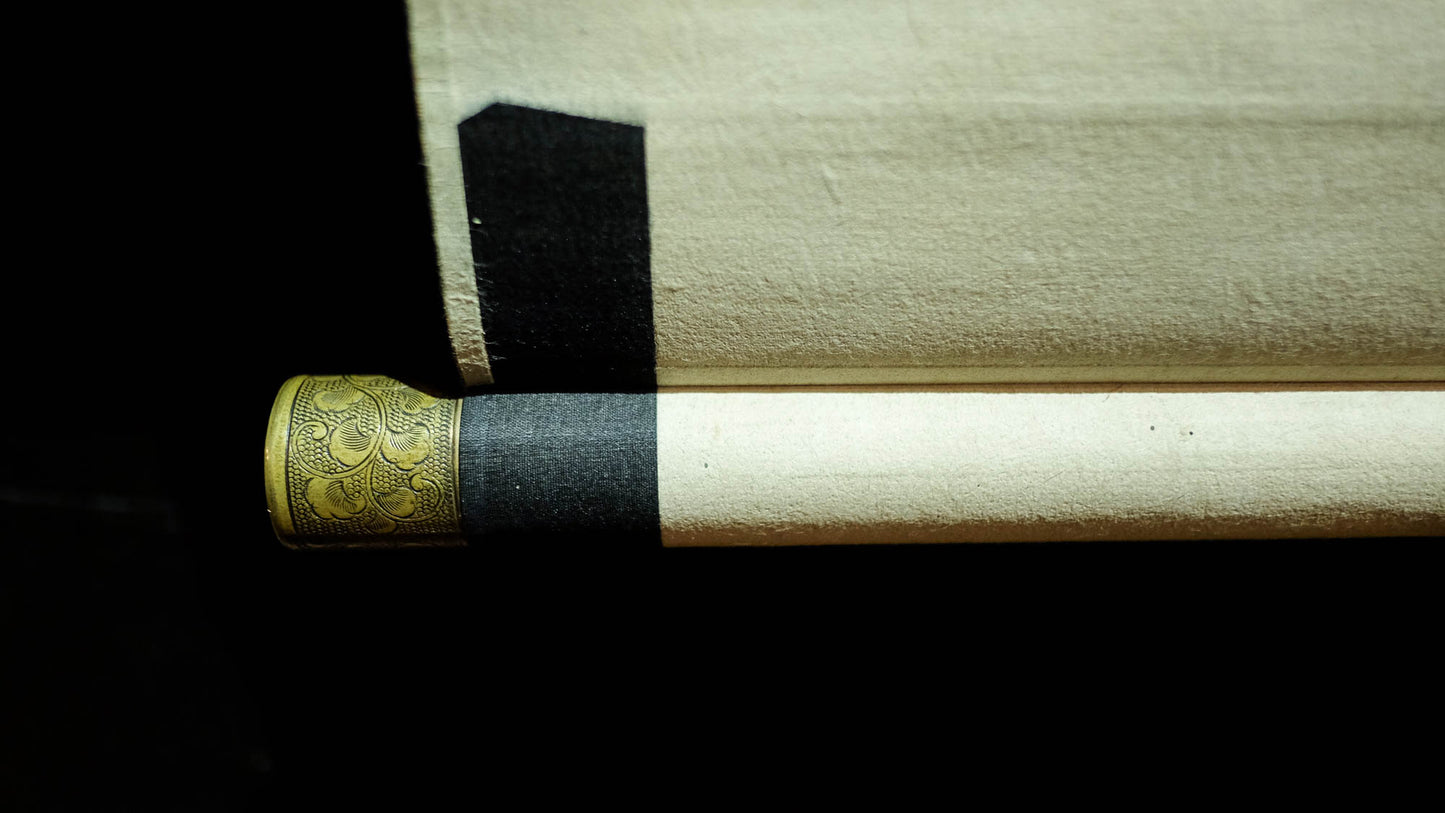
- A lower roller with gold-toned ends
The chrysanthemum is one of the most distinguished floral motifs in Japanese decorative art. Here it appears repeatedly across both the green outer field and the orange-gold inner mounting.
The layering of textiles creates a frame worthy of the densely detailed sacred painting.
The mounting does not compete with the image. Instead, it extends the courtly gold, green, purple, and floral vocabulary beyond the painted surface.
Estimated Period
Based upon the painting style, silk appearance, pigment palette, gold-toned detailing, mounting textiles, and visible aging, a reasonable working attribution is:
Late Edo to Meiji period, broadly mid-nineteenth to early twentieth century
A possible range would be approximately:
Circa 1850–1910
This date is an informed visual estimate rather than documented provenance.
The painting may also have been remounted during its history, as Buddhist scrolls were sometimes conserved or fitted with new brocade when older textiles became fragile.
No claim is made that the painting, mounting, and fittings were necessarily created at exactly the same time.
A precise date would require physical examination by a specialist in Japanese Buddhist painting, textile mounting, pigments, and historical silk.
Why This Scroll Matters
Highly Developed Buddhist Iconography
This is not a generic Buddha portrait. It belongs to a specific and historically significant devotional tradition centered upon Shakyamuni and the protectors of Buddhist wisdom.
Complete Celestial Assembly
The large retinue gives the piece exceptional visual richness. It combines a Buddha image, guardian painting, bodhisattva imagery, monastic figures, sacred architecture, and ceremonial ornament within one composition.
Extensive Gold-Toned Detail
The Buddha’s robes, halos, pedestal, canopy, weapons, armor, jewelry, and garments are articulated through elaborate gold-colored linework.
Powerful Contrast
The serene Buddha and fierce guardians create a visual dialogue between inward wisdom and outward protection.
Traditional Silk and Brocade Format
The painted silk, layered brocade, suspension cord, roller, and hanging strips preserve the physical character of a Japanese kakejiku rather than a modern framed reproduction.
Collector-Level Presence
The scroll’s scale, density, iconography, textile mounting, and jewel-like palette give it commanding presence in a private collection or contemplative interior.
Why You Will Love It
- Shakyamuni Buddha as the central figure
- Sixteen Benevolent Deities iconography
- Associated with the Great Perfection of Wisdom Sutra
- Elaborate Buddhist celestial court
- Numerous individualized guardian figures
- Fine gold-toned linework
- Deep green, red, blue, ivory, purple, and gold palette
- Monumental triple halo
- Ornate lotus and architectural pedestal
- Suspended floral and jeweled canopy
- Richly patterned Japanese brocade mounting
- Chrysanthemum textile motifs
- Strong ceremonial character
- Visually complex but carefully balanced composition
- Suitable for serious Buddhist-art collections
- One distinctive vintage or antique scroll available
Ideal Display Spaces
This scroll would be especially effective in:
- A Buddhist altar room
- A meditation room
- A private library
- A collector’s study
- A Japanese-style room
- A tokonoma alcove
- A contemplative gallery
- A temple-inspired interior
- A yoga or wellness studio
- A cultural institution
- A private Asian-art collection
- A wabi-sabi interior
- A Japandi room
- A ceremonial reception area
- A scholarly or spiritual workspace
The scroll’s long vertical proportions and dark central field would be especially striking against pale plaster, natural wood, stone, charcoal, cream, or muted green walls.
Ideal For
- Collectors of Japanese Buddhist art
- Collectors of antique kakejiku
- Devotees of Shakyamuni Buddha
- Students of Buddhist iconography
- Collectors of guardian-deity imagery
- Japanese temple-art enthusiasts
- Scholars of East Asian religious art
- Meditation and mindfulness practitioners
- Interior designers creating contemplative spaces
- Collectors of painted silk
- Admirers of gold devotional painting
- Collectors of Edo and Meiji-period art
- Those creating a sacred study or library
- Lovers of ornate Japanese textiles
- Buyers seeking an uncommon ceremonial centerpiece
Item Details
Origin: Japan
Principal Subject: Shaka Nyorai, the historical Buddha Shakyamuni
Probable Composition: Shaka Sanzon Jūroku Zenshin-zu
Japanese Title: 釈迦三尊十六善神図
English Title: Shakyamuni Triad with the Sixteen Benevolent Deities
Artwork Type: Japanese Buddhist devotional painting
Format: Kakejiku or kakemono hanging scroll
Medium: Appears to be ink, color, mineral-style pigments, and extensive gold-toned decoration on silk
Mounting: Traditional multilayered Japanese brocade mounting with suspension cord and roller
Estimated Period: Late Edo to Meiji period, possibly with later remounting
Working Date Range: Approximately 1850–1910
Artist: Unidentified from the supplied photographs
Primary Colors: Dark brown, gold, emerald green, blue, red, ivory, turquoise, purple, and orange-gold
Principal Motifs: Shakyamuni Buddha, Sixteen Protectors, bodhisattvas, monks, celestial guardians, lotus throne, jeweled canopy, sacred weapons, chrysanthemum brocade, and triple halo
Quantity: One unique vintage or antique hanging scroll
Condition
This is a vintage or antique hanging scroll displaying visible signs of age, handling, rolling, storage, and devotional use.
The photographs show:
- Numerous horizontal rolling creases across the painted silk
- General surface waviness
- Age-related discoloration and tonal variation
- Areas of pigment fading
- Minor rubbing and abrasion
- Scattered small marks
- Possible old stains or moisture-related tonal changes
- Gentle wear along the textile borders
- Creasing and handling wear within the brocade
- Minor wear around the upper mounting and hanging strips
- Age-related wear to the suspension cord and fittings
The painted composition remains remarkably legible.
Shakyamuni’s face, halo, robes, lotus throne, architectural pedestal, canopy, guardian figures, bodhisattvas, monks, weapons, and colored details remain visually strong and highly decorative.
The dark background and gold-toned linework show natural variation consistent with age. Some areas appear brighter or more subdued depending upon lighting and viewing angle.
The scroll appears substantially complete in the supplied photographs, with the roller, roller ends, suspension cord, hanging strips, decorative fittings, and textile mounting present.
No claim is made that the work has undergone professional conservation, pigment analysis, textile analysis, or scientific dating.
Please inspect every photograph carefully, as the images form an essential part of the condition description. Additional photographs may be requested before purchase.
Final Words to the Collector
This painting presents wisdom not as something fragile, but as something guarded.
At its center, Shakyamuni remains perfectly still.
Around him, armored deities raise spears, swords, staffs, and sacred implements. Bodhisattvas offer prayer. Monks preserve the line of transmission. Flowers and jewels descend from the celestial canopy. Gold lines move across robes, armor, halos, and architecture until the entire composition seems woven from sacred light.
The guardians do not diminish the Buddha’s serenity. They make that serenity possible.
For the practitioner, this scroll may represent courage, protection, discipline, and the preservation of wisdom.
For the scholar, it offers a richly layered example of Japanese Buddhist visual tradition.
For the collector, it possesses extraordinary density, color, textile craftsmanship, and ceremonial presence.
For an interior, it creates a sanctuary within the room, a place where stillness sits at the center and every surrounding force stands ready to defend it.
Bring this celestial assembly into your space and allow its intricate world of wisdom, guardianship, and sacred beauty to reveal itself slowly over time.
Offers
Some objects in our collection allow limited room for negotiation, while others are offered at a firm price.
Respectful and reasonable offers are welcome. Should you have a particular figure in mind, please send us a message. Every proposal will be considered carefully, although acceptance cannot be guaranteed.
We are also happy to assist with questions regarding measurements, condition, display, packing, combined purchases, or international shipping.
Product Representation and Questions
We make every reasonable effort to photograph and describe our items accurately.
Colors, textures, metallic details, and tonal variations may appear slightly different depending upon lighting, photography, screen settings, and viewing conditions. Antique silk, pigment, brocade, paper, lacquer, cord, and textile fibers may also reveal subtle irregularities that are difficult to capture completely in photographs.
Please contact us before purchasing should you have questions regarding condition, measurements, materials, mounting, age, storage, display, provenance, or shipping.
We would much rather clarify any uncertainty before payment than leave a concern unresolved afterward.
Condition and Sales Policy
This item is vintage or antique and is sold in its present condition, as photographed and described.
Please do not expect factory-new condition. Age-related wear, patina, fading, creasing, marks, rubbing, textile deterioration, discoloration, historical repairs, and other characteristics may be present.
All sales are considered final except where otherwise required by applicable law or Etsy policy.
By purchasing, the buyer confirms that they have reviewed the description, photographs, dimensions, estimated attribution, condition information, shipping terms, and shop policies.
Shipping
We ship worldwide from Japan using Japan Post EMS wherever service is available.
Shipping and handling charges are calculated through the listing’s shipping settings. Should your destination not appear among the available options, please contact us for assistance or a manual quotation.
The scroll will be carefully rolled, protected, and packed for international transportation.
Import duties, customs taxes, brokerage fees, and destination-country charges are the responsibility of the buyer unless otherwise required by law.
Tracking
Tracking information will be provided after dispatch.
Please allow approximately three to five business days after shipment for tracking activity to become visible, depending upon postal processing and the destination country.
International delivery times may vary because of customs inspections, local postal conditions, holidays, weather, transportation disruptions, or other circumstances beyond our control.
Store Policies
Please review our complete shop policies before completing your purchase.
Payment confirms that the buyer understands and accepts the photographed condition, listing description, estimated dating, shipping terms, and the natural limitations involved in purchasing vintage and antique objects online.
#ShakyamuniBuddha #ShakaNyorai #SixteenProtectors #JurokuZenshin #JapaneseScroll #JapaneseKakejiku #BuddhistScroll #JapaneseBuddhistArt #GreatWisdomSutra #DaihannyaKyo #GuardianDeities #BuddhistGuardians #AntiqueJapaneseArt #EdoPeriodArt #MeijiPeriodArt #SilkPainting #GoldBuddhistArt #HandPaintedScroll #TempleArt #SacredArt #MeditationRoomDecor #SpiritualWallArt #AsianAntiqueArt #JapaneseTempleArt #BuddhistIconography #ChrysanthemumBrocade #WabiSabiDecor #JapandiInterior #DevotionalArt #BuddhistCollector