Rare Vintage, Antiques and Art Collector / Curator / Personal Shopper From Japan
Edo-Period Zushi Amida Nyorai — Large Gilt Wooden Standing Buddha with Shrine Cabinet (81.5 cm)
Edo-Period Zushi Amida Nyorai — Large Gilt Wooden Standing Buddha with Shrine Cabinet (81.5 cm)
Couldn't load pickup availability
Have a reasonable price in mind? Submit your best offer and our concierge will review it personally.
This is not merely a Buddhist statue; it is a complete devotional system preserved in architectural form. A standing Amida Nyorai housed within a gilt wooden zushi represents one of the most intimate yet authoritative formats in Japanese Buddhist practice.
Amida Nyorai (Amitābha Buddha) is the Buddha of Infinite Light and Infinite Life, central to Pure Land Buddhism. His role is assurance—the vow to welcome beings into the Western Pure Land through faith and remembrance.
The Zushi Format
A zushi is a micro-temple. Opening it transforms viewing into participation, revealing the sacred through deliberate action.
Standing Amida
The standing posture conveys active salvation—Amida rising to welcome the faithful—an especially powerful image when enclosed within a shrine.
Museum-Grade Significance
Scale, completeness, and period character elevate this work from devotional object to exhibition-grade centerpiece.
Dimensions
- Zushi Exterior: H 81.5 cm / W 34 cm / D 23 cm
- Interior Height: 70 cm
- Figure Height: approx. 64 cm
This is not merely a Buddhist statue; it is a complete devotional system preserved in architectural form. A standing Amida Nyorai housed within a gilt wooden zushi (portable shrine) represents one of the most intimate yet authoritative formats in Japanese Buddhist practice. At an exterior height of approximately 81.5 cm, this example crosses the threshold from personal altar object into temple-grade presence, while still retaining the enclosed sanctity that defines zushi sculpture.
Amida Nyorai (Amitābha Buddha) is the Buddha of Infinite Light and Infinite Life, the central figure of Pure Land Buddhism. His role is not abstract philosophy but assurance: the vow to welcome sentient beings into the Western Pure Land through faith, remembrance, and trust. In Japanese religious life—particularly from the late Heian through Edo periods—Amida was the most widely venerated Buddha because his salvation was accessible to all, regardless of status, literacy, or monastic training.
THE SIGNIFICANCE OF THE ZUSHI FORMAT
A zushi is not simply a box. It is a micro-temple. When closed, it protects the icon physically and ritually; when opened, it creates a moment of revelation. This opening action is itself devotional—transforming the viewer from observer into participant. Zushi were commonly used in temples, sub-halls, and high-ranking private homes, especially for icons considered spiritually potent or personally significant.
Large zushi of this scale were expensive to commission. They required architectural carpentry, lacquer or gilt finishing, painted door guardians, and precise proportional harmony between cabinet and image. This immediately places the work in a higher tier of historical patronage.
WHY AMIDA IS DEPICTED STANDING
Standing Amida figures are often associated with active salvation—Amida rising to welcome the faithful (raigō imagery). Unlike seated meditation Buddhas, the standing posture conveys movement, readiness, and compassionate approach. Within a zushi, this creates a powerful visual contradiction: stillness contained within readiness, silence containing motion.
ICONOGRAPHY AND FORM
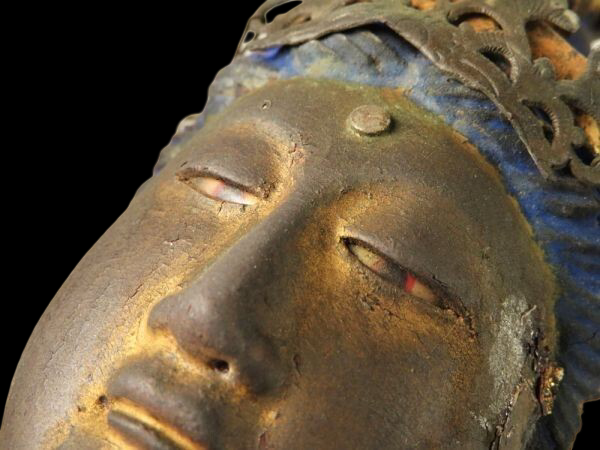
• Facial Expression: Serene, inwardly focused, embodying infinite compassion rather than authority.
• Hands (Mudra): Typically related to reassurance and welcome, reinforcing Pure Land doctrine.
• Gilding and Surface: Gilt surfaces amplify light in dim interiors, symbolizing Amida’s infinite radiance. Wear to gilding is expected and valued as evidence of age and devotional life.
• Shrine Doors: Often painted with attendant figures or symbolic guardians, completing the devotional “threshold.”
WHY THIS PIECE IS MUSEUM-GRADE
Museum-grade does not mean pristine. It means historically legible, structurally coherent, and conceptually complete. This piece qualifies because:
• Scale: At over 80 cm including shrine, it commands architectural presence.
• Completeness: Statue, base, and zushi function as a unified object.
• Period Character: Edo-period craftsmanship with visible age, patina, and devotional wear.
• Display Authority: Reads clearly at distance and under controlled lighting, suitable for institutional exhibition.
In museum or advanced private contexts, works like this anchor entire rooms. They are not supporting objects; they are narrative centers around which interpretation is built.
CONDITION
This work shows age-related wear consistent with Edo-period gilt wooden sculpture. Noted issues include surface wear, small losses, and minor damage visible in images. These are within acceptable bounds for a work of this age and type. No claims are made regarding untouched condition; responsible acquisition assumes conservation-aware stewardship.
MATERIALS
Carved wood with gilt and polychrome elements; wooden zushi with gilt interior and painted doors. Exact materials and restoration history should be confirmed by inspection.
COLLECTOR RELEVANCE
This piece is for collectors who value lived religious heritage rather than decorative Buddhism. It suits a dedicated alcove, gallery-style installation, or institutional collection focused on Japanese religious art, Edo-period devotion, or Pure Land practice.
COLLECTOR’S RESONANCE
If you understand sacred art as something meant to be encountered slowly, opened deliberately, and respected as presence rather than ornament, this work will resonate deeply.
CONFIDENCE & VERIFICATION NOTES
• Period attribution is based on stylistic and material indicators; treated as informed estimate.
• Zushi hinges, door alignment, and interior stability should be reviewed before long-term display.
Authenticity & Stewardship
Evaluated under the Japonista Authentication Framework™:
- Material, carving, and surface-study comparison
- Iconographic and stylistic verification
- Condition and stability review (surface integrity)
- Construction assessment and handling-risk evaluation
Guaranteed 100% Authentic. Covered by the Japonista Lifetime Authenticity Warranty™.
A Note on Stewardship and Collecting
At Japonista, we approach Buddhist statues, sacred images, and ritual objects not merely as collectibles, but as cultural and spiritual artifacts deserving of respect, understanding, and careful presentation. Every piece we offer is thoughtfully examined, researched, and curated with sensitivity to its origin, meaning, and historical role.
Our role is not only to offer access to rare and meaningful objects, but to serve as responsible custodians—connecting the right works with collectors who value depth, intention, and authenticity.
Inquiries, Availability, and Private Consideration
Some of the cultural and heritage works may allow room for discussion, while others are held firmly due to rarity, condition, or cultural importance. All inquiries are reviewed personally and discreetly, and we welcome thoughtful questions or expressions of interest.
If you are exploring a particular theme, deity, lineage, or period—or seeking guidance in building a focused collection—our concierge team is always available to assist with quiet expertise and care.
Concierge Support & Collector Guidance
Japonista Concierge™ provides personalized assistance for collectors seeking deeper understanding, thoughtful acquisition, or long-term curation strategies. Whether your interest is devotional, scholarly, or aesthetic, we are here to help guide your journey with clarity and respect.
For select high-value or historically significant works, private reservation or structured payment arrangements may be available on a case-by-case basis. Please reach out to discuss eligibility and discreet options.
Before Proceeding
We kindly encourage collectors to review our shop policies and house guidelines, available through the links in our website footer, which outline shipping, handling, and conditions specific to vintage, sacred, and collectible works.
A Closing Note
Thank you for exploring Japonista’s collection of Oriental Cultural Heritage and arts. We are honored to share these meaningful works and to help place them where they may continue to be appreciated, studied, and respected.
If you have questions or wish to explore related works, please feel free to contact Japonista Concierge™ at any time.