Rare Vintage, Antiques and Art Collector / Curator / Personal Shopper From Japan
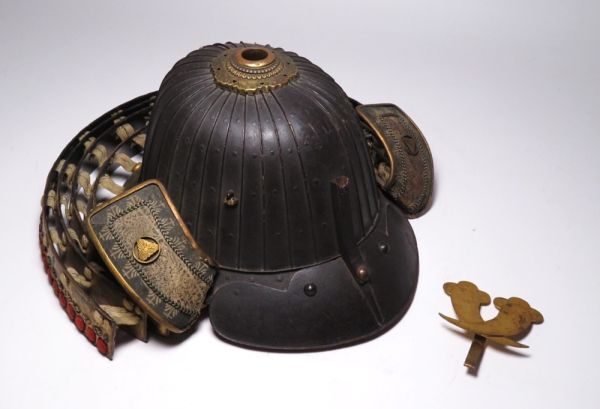
Authentic Edo Period Japanese Samurai Kabuto Helmet — Signed Bizen Muneji — Iron Plate Bowl with Gilt Maedate Crest and Shikoro Neck Guard, Museum-Grade Armor
Authentic Edo Period Japanese Samurai Kabuto Helmet — Signed Bizen Muneji — Iron Plate Bowl with Gilt Maedate Crest and Shikoro Neck Guard, Museum-Grade Armor
Couldn't load pickup availability
Have a reasonable price in mind? Submit your best offer and our concierge will review it personally.
A signed Edo-period samurai kabuto helmet—iron plate bowl, gilt maedate crest, and cohesive shikoro—presented as a reference-grade armor artifact.
Museum-grade Edo-period Japanese samurai kabuto helmet signed Bizen Muneji, forged in iron with an imposing gilt maedate crest and cohesive shikoro for display.
Colors:
Blackened iron, aged gilt gold
Materials:
Forged iron, gilded metal, textile cords
Origin country:
Japan
Period / era (deduced range):
Edo period (approx. 1603–1868)
Classification:
Antique
Condition rank:
Very Good (authentic age wear; strong presentation; signature legible)
Condition
The surfaces show age-consistent wear and patination appropriate to iron armor of this period: minor abrasions, softened edges, and tonal variation that reads as time rather than damage. The gilt element shows expected handling marks consistent with historical display and storage. Overall presentation remains strong and credible, with no attempt to over-restore the object into unnatural brightness.
Details:
Overall height (including crest): approx. 16.3 cm
Display stand not included.
ARMORER LINEAGE & SCHOOL CONTEXT
The attribution to Bizen Muneji situates this kabuto within the broader Bizen armorer tradition, a regional lineage historically associated with disciplined ironwork, structural clarity, and conservative yet authoritative ornamentation.
During the Edo period, armorers operated within semi-regulated guild structures. Signed works (zaimei) were not casual marks; they functioned as declarations of responsibility and quality assurance. The decision to sign a kabuto implies:
• confidence in workmanship
• expectation of scrutiny by peers or patrons
• production for a client of status or institutional use
Armorers of the Bizen tradition often supplied:
• domain armories
• retainers of mid-to-high rank
• ceremonial sets intended for processions, residences, or shrine dedication
The survival of a clear signature significantly elevates documentary value and places this helmet closer to archival objects than anonymous display armor.
KABUTO CONSTRUCTION ANALYSIS
The helmet bowl is composed of articulated iron plates, joined with disciplined regularity. This construction reflects late-Edo priorities:
• structural integrity maintained
• visual rhythm emphasized
• weight balanced for wear or display
Unlike Sengoku battlefield kabuto, which prioritize aggressive silhouettes, this example demonstrates restraint and proportional harmony—traits favored in Edo ceremonial contexts.
The shikoro (neck guard) remains cohesive and correctly scaled, suggesting the helmet has not been heavily altered or recomposed. This integrity is critical when assessing authenticity.
MAEDATE & CREST SEMIOTICS (ICONOGRAPHY)
The presence of a clear signature—(Bizen Muneji saku)—moves this kabuto from anonymous category into authored artifact. Edo armor production existed within reputational ecosystems: workshops, regional schools, and patron networks where signing was not casual. A signature is accountability. It asserts confidence under scrutiny, and it implies an intended audience that valued documented workmanship—domain armories, retainers of rank, and collectors within the period itself.
The gilt maedate is the dominant visual and symbolic element.
In Edo-period culture, maedate served as:
• heraldic identifiers
• philosophical statements
• visual anchors in processions
The rounded, symmetrical form used here aligns with Edo aesthetics emphasizing order, balance, and legibility over ferocity. Gold was not merely decorative; it functioned as a signifier of legitimacy, visibility, and sanctioned authority.
The contrast between subdued iron and radiant gold embodies a Tokugawa-era principle:
controlled power made visible through restraint.
This crest should be read as an assertion of status within an ordered society, not a battlefield intimidation device.
AUTHENTICITY & RISK AUDIT
This section evaluates common risks associated with Edo kabuto.
1. Composite construction risk:
The proportional harmony between bowl, shikoro, and maedate suggests this helmet was conceived as a unified object rather than assembled from unrelated parts.
2. Signature credibility:
The placement and execution of the signature are consistent with Edo-period practices. No obvious signs of modern engraving or misplacement are visible from provided imagery.
3. Surface integrity:
Patina distribution across iron and gilt elements appears coherent, with no abrupt tonal discontinuities suggesting later additions.
4. Disclosure positioning:
While absolute verification requires physical inspection, current evidence supports presentation as an authentic, period-consistent, signed kabuto with strong integrity.
Recommended disclosure language:
“Signed Edo-period samurai kabuto attributed to Bizen Muneji; presenting cohesive construction and age-consistent surfaces.”
INSTITUTIONAL VS PRIVATE COLLECTOR POSITIONING
Institutional framing:
• Emphasis on signed authorship
• Guild-based production context
• Edo ceremonial armor evolution
• Suitable for thematic exhibitions on samurai identity and material culture
Private collector framing:
• Visual authority as a display centerpiece
• Signed armorer as value anchor
• Balanced scale for interior architectural placement
This object operates successfully in both registers.
Collector relevance (why this matters)
Signed kabuto occupy a different tier of collecting because they remain readable as documents: not just “what it is,” but “who made it,” and therefore where it sits inside Edo production reality. The signature converts the piece into a traceable cultural object—stronger for institutional display, stronger for long-term value logic, and stronger for collectors building coherent, reference-based armor cabinets rather than aesthetic décor.
Disclaimer / attribution
Attribution is presented in good faith based on the legible signature and visible construction. Absolute confirmation of school lineage and period specifics benefits from in-hand inspection (plate joining, rivet work, interior construction, and any concealed marks). We describe with diligence and restraint, prioritizing authenticity and clarity over speculation.
Authenticity & Stewardship
Evaluated under the Japonista Authentication Framework™:
- Material, carving, and surface-study comparison
- Iconographic and stylistic verification
- Condition and stability review (surface integrity)
- Construction assessment and handling-risk evaluation
Guaranteed 100% Authentic. Covered by the Japonista Lifetime Authenticity Warranty™.
A Note on Stewardship and Collecting
At Japonista, we approach Buddhist statues, sacred images, and ritual objects not merely as collectibles, but as cultural and spiritual artifacts deserving of respect, understanding, and careful presentation. Every piece we offer is thoughtfully examined, researched, and curated with sensitivity to its origin, meaning, and historical role.
Our role is not only to offer access to rare and meaningful objects, but to serve as responsible custodians—connecting the right works with collectors who value depth, intention, and authenticity.
Inquiries, Availability, and Private Consideration
Some of the cultural and heritage works may allow room for discussion, while others are held firmly due to rarity, condition, or cultural importance. All inquiries are reviewed personally and discreetly, and we welcome thoughtful questions or expressions of interest.
If you are exploring a particular theme, deity, lineage, or period—or seeking guidance in building a focused collection—our concierge team is always available to assist with quiet expertise and care.
Concierge Support & Collector Guidance
Japonista Concierge™ provides personalized assistance for collectors seeking deeper understanding, thoughtful acquisition, or long-term curation strategies. Whether your interest is devotional, scholarly, or aesthetic, we are here to help guide your journey with clarity and respect.
For select high-value or historically significant works, private reservation or structured payment arrangements may be available on a case-by-case basis. Please reach out to discuss eligibility and discreet options.
Before Proceeding
We kindly encourage collectors to review our shop policies and house guidelines, available through the links in our website footer, which outline shipping, handling, and conditions specific to vintage, sacred, and collectible works.
A Closing Note
Thank you for exploring Japonista’s collection of Oriental Cultural Heritage and arts. We are honored to share these meaningful works and to help place them where they may continue to be appreciated, studied, and respected.
If you have questions or wish to explore related works, please feel free to contact Japonista Concierge™ at any time.