Rare Vintage, Antiques and Art Collector / Curator / Personal Shopper From Japan
Edo-Period Black Lacquer Katana-Kake with Gold Maki-e, Samurai Sword Stand with Original Storage Box
Edo-Period Black Lacquer Katana-Kake with Gold Maki-e, Samurai Sword Stand with Original Storage Box
Couldn't load pickup availability
Have a reasonable price in mind? Submit your best offer and our concierge will review it personally.
Edo-Period Black Urushi Katana-Kake Sword Stand with Gold Maki-e — With Original Storage Box
In the samurai interior, the sword was never “stored.” It was composed—positioned with the same discipline that governed the body, the household, and the self. The katana-kake (sword stand) is therefore not auxiliary furniture but a quiet instrument of etiquette, a stage on which lineage and restraint are made visible.
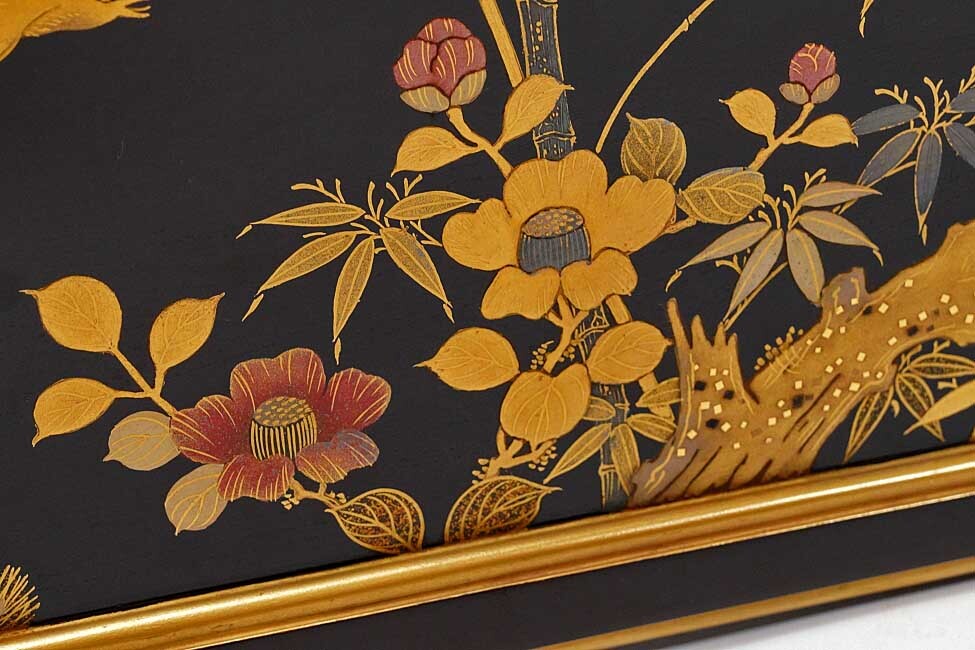
This example, finished in deep black urushi lacquer and accented with restrained gold maki-e, belongs to that refined genre of Edo-period domestic fittings where function is inseparable from poise. The decorative program is intentionally legible at close distance: floral and vegetal scrollwork that seems to drift rather than shout, the gold powder settled into the lacquer like candlelight caught on night silk. In a tokonoma or private chamber, the piece would have read as a low, deliberate horizon line—an anchor for the formal presence of a daisho pair.
A feature of particular collecting relevance is the survival of the original storage box. Lacquer has always been understood in Japan as an art of protection and patience: urushi dislikes harsh light, shock, and careless abrasion. A fitted box is not a convenience; it is the historical continuation of stewardship. The box effectively turns the stand into an “enshrined object,” kept safely when not in use, brought out with intention.
Design cues point to the codified world of sword display protocol: the shaped uprights that cradle the scabbard, the stable span that allows two swords to read as a pair, and the disciplined symmetry that avoids ostentation. A good katana-kake does not compete with the sword; it frames the sword’s authority. This is why lacquer and maki-e were preferred—materials that hold darkness and reflect light in controlled measure.
Condition note: Minor lacquer wear and surface abrasions should be understood as life-history rather than loss. Objects like this were repeatedly moved, wiped, and placed—ritualized in daily life. In a serious collection, that patina functions as evidence of correct use.
Object Details
- Object type: Katana-kake (samurai sword stand / daisho display rack)
- Period: Edo period (seller-described); stylistically consistent with Edo to early modern lacquer furnishings
- Materials: Lacquered wood (black urushi), gold maki-e decoration
- Includes: Original storage box (wood)
- Dimensions (approx.): Height 36.3 cm; Width 48.0 cm; Depth 19.5 cm
Design & Symbol Notes
- Gold maki-e floral scrollwork: A classic vocabulary for lacquer furnishings—elegant, readable up close, and appropriate for domestic display rather than court-level density.
- Black lacquer ground: Chosen for visual authority and to avoid competing with the sword fittings; it frames rather than performs.
- Daisho etiquette: Stands of this type formalize the paired reading of long and short swords, supporting correct orientation and compositional hierarchy.
Collector Relevance
- Ideal for sword collectors who rotate display and value period-appropriate furnishings.
- Strong interior object for tokonoma-inspired staging, tea-room adjacent spaces, or study collections focused on samurai domestic culture.
- Original box materially increases long-term stewardship potential for lacquer.
HS Code Decision (Reference)
- Likely classification if verified antique (100+ years): HS 9706.00 (antiques of an age exceeding 100 years) — jurisdiction dependent.
- If treated as lacquered wooden furniture/ornament instead: classification may shift (country-specific).
Confidence & Verification Notes
Period attribution is presented in line with seller description and visual cues typical of Edo to early modern lacquer furnishings. Without workshop documentation, an exact maker attribution is not claimed. The original storage box supports long-term stewardship but is not, by itself, a dated certificate.
Authenticity & Stewardship
Evaluated under the Japonista Authentication Framework™:
- Material, carving, and surface-study comparison
- Iconographic and stylistic verification
- Condition and stability review (surface integrity)
- Construction assessment and handling-risk evaluation
Guaranteed 100% Authentic. Covered by the Japonista Lifetime Authenticity Warranty™.
A Note on Stewardship and Collecting
At Japonista, we approach Buddhist statues, sacred images, and ritual objects not merely as collectibles, but as cultural and spiritual artifacts deserving of respect, understanding, and careful presentation. Every piece we offer is thoughtfully examined, researched, and curated with sensitivity to its origin, meaning, and historical role.
Our role is not only to offer access to rare and meaningful objects, but to serve as responsible custodians—connecting the right works with collectors who value depth, intention, and authenticity.
Inquiries, Availability, and Private Consideration
Some of the cultural and heritage works may allow room for discussion, while others are held firmly due to rarity, condition, or cultural importance. All inquiries are reviewed personally and discreetly, and we welcome thoughtful questions or expressions of interest.
If you are exploring a particular theme, deity, lineage, or period—or seeking guidance in building a focused collection—our concierge team is always available to assist with quiet expertise and care.
Concierge Support & Collector Guidance
Japonista Concierge™ provides personalized assistance for collectors seeking deeper understanding, thoughtful acquisition, or long-term curation strategies. Whether your interest is devotional, scholarly, or aesthetic, we are here to help guide your journey with clarity and respect.
For select high-value or historically significant works, private reservation or structured payment arrangements may be available on a case-by-case basis. Please reach out to discuss eligibility and discreet options.
Before Proceeding
We kindly encourage collectors to review our shop policies and house guidelines, available through the links in our website footer, which outline shipping, handling, and conditions specific to vintage, sacred, and collectible works.
A Closing Note
Thank you for exploring Japonista’s collection of Oriental Cultural Heritage and arts. We are honored to share these meaningful works and to help place them where they may continue to be appreciated, studied, and respected.
If you have questions or wish to explore related works, please feel free to contact Japonista Concierge™ at any time.