Rare Vintage, Antiques and Art Collector / Curator / Personal Shopper From Japan
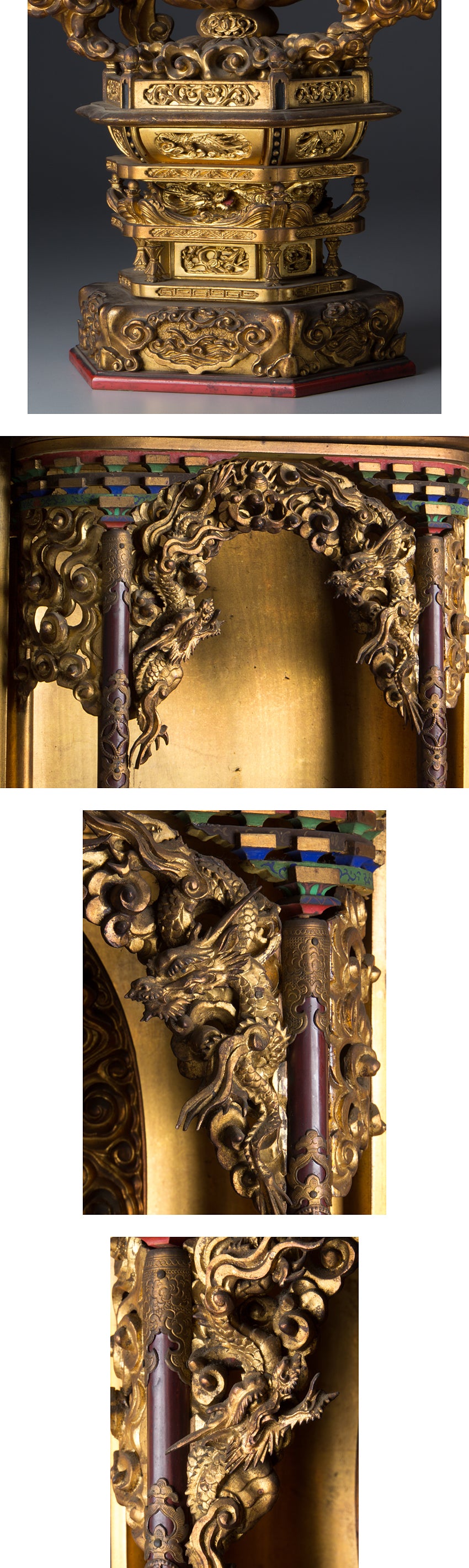
Edo–Meiji Period Gilt Wooden Amida Nyorai Triad Zushi | Large Temple Shrine Cabinet | 68cm
Edo–Meiji Period Gilt Wooden Amida Nyorai Triad Zushi | Large Temple Shrine Cabinet | 68cm
Couldn't load pickup availability
Have a reasonable price in mind? Submit your best offer and our concierge will review it personally.
Catalogue Narrative — Edo–Meiji Period Amida Nyorai Triad Zushi
This imposing Buddhist zushi shrine presents a fully realized Amida Nyorai Triad, carved in wood and richly gilt, and housed within a large-scale temple-style cabinet of notable presence. Measuring approximately 68 cm in height, the shrine belongs to the transitional period spanning the late Edo to early Meiji era, when devotional craftsmanship retained classical Buddhist iconography while responding to evolving modes of domestic and temple worship. The scale, finish, and compositional authority of the ensemble indicate a work intended not for private travel or modest household devotion, but for sustained veneration within a dedicated altar setting.
At the center of the triad stands Amida Nyorai, the Buddha of Infinite Light, whose serene expression and symmetrical posture embody the doctrinal calm of Pure Land belief. Flanked by attendant bodhisattvas—traditionally Kannon and Seishi—the composition forms a balanced devotional hierarchy, each figure rendered with careful proportional restraint. The figures are unified by their gilt surfaces, which catch and diffuse light in a manner consistent with ritual illumination, reinforcing the metaphysical symbolism of radiance and transcendence associated with Amida worship.
The zushi cabinet itself is integral to the work’s devotional function and visual authority. Constructed in solid wood and finished with applied gilding, the shrine’s architectural framing recalls miniature temple interiors, with deep recesses designed to create spatial depth and contemplative focus. When opened, the doors reveal the triad as a unified sacred presence; when closed, the cabinet serves as a protective and symbolic enclosure, emphasizing the Buddhist principle of safeguarding the Dharma. The proportional relationship between figures and housing suggests a carefully planned commission rather than an assemblage of disparate elements.
Stylistically, the shrine reflects late traditional carving practices that persisted into the Meiji period, prior to the widespread decline of Buddhist patronage following state-driven secularization reforms. The carving exhibits disciplined restraint rather than flamboyance, favoring clarity of form and legibility of iconography over excessive ornamentation. This approach aligns with temple-grade works intended for doctrinal continuity, rather than popular or touristic appeal, and reinforces the shrine’s standing as a religious object first and foremost.
The gilt surfaces, now softened by age, display the subdued patina expected of devotional objects subjected to decades of incense smoke and ritual handling. Such wear should be understood not as deterioration, but as evidence of sustained use within a religious context. In Buddhist material culture, this accumulated surface character often enhances rather than diminishes spiritual resonance, marking the object as one that has participated in lived practice rather than remaining purely ornamental.
As a complete triad housed within its original zushi cabinet, this work represents a cohesive devotional ensemble of considerable presence. Comparable examples of this scale are increasingly scarce, particularly those retaining intact figures and housing without modern intervention. For collectors, institutions, or serious students of Japanese Buddhist art, the shrine offers not only visual gravitas but also a tangible link to Pure Land devotion as it was practiced across the threshold of Japan’s transition from feudal to modern society.
Material Classification:
• Carved Wood (Hinoki / Softwood)
• Gilt Lacquer (Urushi with Gold Leaf)
• Polychrome Interior Detailing
PERIOD & ATTRIBUTION ANALYSIS
This work is attributable to the late Edo to early Meiji period (circa mid–19th century),
a transitional era marked by the gradual dissolution of temple patronage systems and
the refinement of portable devotional objects for household worship.
The architectural form, lotus pedestal geometry, and proportional restraint of the
Amida figure align closely with late Edo Pure Land iconographic conventions, while the
exceptional preservation of gilding suggests controlled indoor enshrinement rather
than prolonged temple exposure.
ICONOGRAPHY & DEITY CONTEXT
Central Deity:
Amida Nyorai (Amitabha Buddha)
Function:
Amida Nyorai is the principal Buddha of Pure Land Buddhism, presiding over the Western
Paradise (Sukhavati). The triad configuration—Amida flanked by attendant bodhisattvas
(Kannon and Seishi)—symbolizes the Raigo descent, welcoming the faithful at the moment
of death.
This zushi presents a focused devotional object intended for daily contemplation and
posthumous merit transfer, rather than public temple ritual.
STRUCTURAL & CRAFT ANALYSIS
Zushi Cabinet:
• Tall, shrine-form cabinet with curved roof profile
• Hinged gilt doors with interior gold-leaf lining
• Multi-tiered lotus pedestal with architectural base
Interior Sculpture:
• Fully carved standing Amida figure
• Delicately modeled facial features and drapery folds
• Balanced vertical posture consistent with late Edo statuary norms
Craftsmanship Indicators:
• Even gilding with minimal blistering
• Crisp carving lines retained in facial planes
• Stable joinery with no major warping
DIMENSIONS
Overall Zushi:
Height: approx. 68 cm
Width: approx. 38.5 cm
Depth: approx. 27.5 cm
Interior Figure:
Height (including lotus base): approx. 50 cm
CONDITION REPORT
Condition: Excellent for Age
• Gilding remains largely intact with natural patina
• No structural cracks or insect damage observed
• Hinges functional; doors align correctly
• Minor surface wear consistent with age and devotional handling
No modern repairs or over-restoration detected.
COLLECTOR SIGNIFICANCE
This zushi represents a museum-grade example of late Edo–Meiji Buddhist domestic devotion.
Its scale exceeds most household shrines, positioning it between private altar and
small temple object.
Such pieces are increasingly scarce due to Meiji-era temple dissolution and postwar
losses, making intact triad zushi of this size highly desirable among serious collectors.
Authenticity & Stewardship
Evaluated under the Japonista Authentication Framework™:
- Material, carving, and surface-study comparison
- Iconographic and stylistic verification
- Condition and stability review (surface integrity)
- Construction assessment and handling-risk evaluation
Guaranteed 100% Authentic. Covered by the Japonista Lifetime Authenticity Warranty™.
A Note on Stewardship and Collecting
At Japonista, we approach Buddhist statues, sacred images, and ritual objects not merely as collectibles, but as cultural and spiritual artifacts deserving of respect, understanding, and careful presentation. Every piece we offer is thoughtfully examined, researched, and curated with sensitivity to its origin, meaning, and historical role.
Our role is not only to offer access to rare and meaningful objects, but to serve as responsible custodians—connecting the right works with collectors who value depth, intention, and authenticity.
Inquiries, Availability, and Private Consideration
Some of the cultural and heritage works may allow room for discussion, while others are held firmly due to rarity, condition, or cultural importance. All inquiries are reviewed personally and discreetly, and we welcome thoughtful questions or expressions of interest.
If you are exploring a particular theme, deity, lineage, or period—or seeking guidance in building a focused collection—our concierge team is always available to assist with quiet expertise and care.
Concierge Support & Collector Guidance
Japonista Concierge™ provides personalized assistance for collectors seeking deeper understanding, thoughtful acquisition, or long-term curation strategies. Whether your interest is devotional, scholarly, or aesthetic, we are here to help guide your journey with clarity and respect.
For select high-value or historically significant works, private reservation or structured payment arrangements may be available on a case-by-case basis. Please reach out to discuss eligibility and discreet options.
Before Proceeding
We kindly encourage collectors to review our shop policies and house guidelines, available through the links in our website footer, which outline shipping, handling, and conditions specific to vintage, sacred, and collectible works.
A Closing Note
Thank you for exploring Japonista’s collection of Oriental Cultural Heritage and arts. We are honored to share these meaningful works and to help place them where they may continue to be appreciated, studied, and respected.
If you have questions or wish to explore related works, please feel free to contact Japonista Concierge™ at any time.