Rare Vintage, Antiques and Art Collector / Curator / Personal Shopper From Japan
Edo Period Iron Abumi Stirrup Pair with Silver Inlay — Samurai Horse Gear Artifact
Edo Period Iron Abumi Stirrup Pair with Silver Inlay — Samurai Horse Gear Artifact
Couldn't load pickup availability
Have a reasonable price in mind? Submit your best offer and our concierge will review it personally.
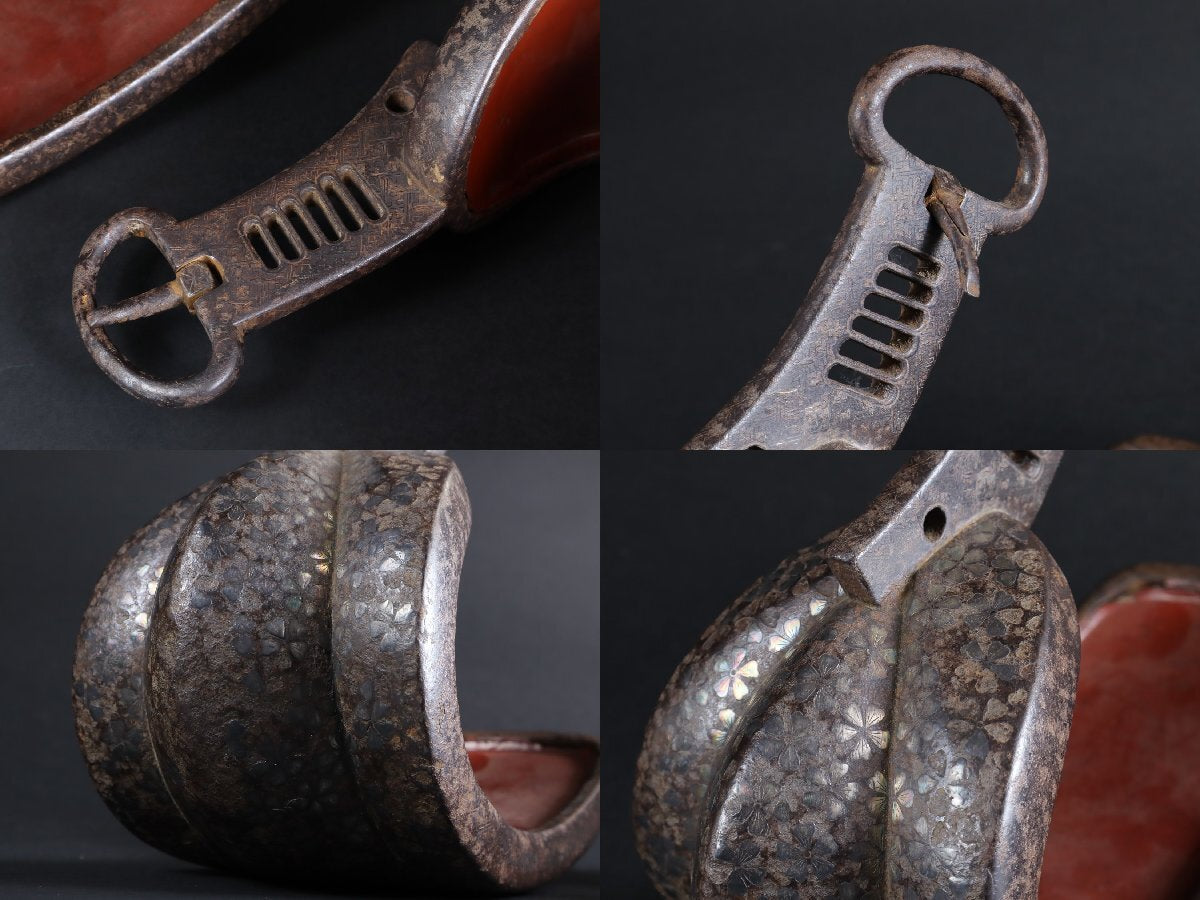
This pair of iron abumi represents a mature, utilitarian expression of Edo-period samurai equestrian equipment, where battlefield pragmatism and restrained aesthetic refinement coexist. Forged from heavy iron plate and shaped into the characteristic deep cradle form, these stirrups were designed to stabilize the rider during mounted combat, archery, and rapid maneuvering while wearing full armor.
What elevates this pair beyond purely utilitarian horse gear is the presence of silver inlay dispersed across the exterior surfaces. Rather than flamboyant heraldry, the decoration appears as repeating botanical and geometric motifs, subtly embedded into the iron skin. This approach reflects Edo sensibilities: dignity through restraint, authority expressed through material quality rather than excess ornamentation.
The interiors retain traces of red lacquer, a functional and symbolic choice. Lacquer protected the iron from moisture introduced by footwear and weather, while the red pigment echoed auspicious associations of vitality and protection. Over time, wear, oxidation, and surface loss have softened these elements, producing an honest patina consistent with prolonged use and age.
WHAT THIS OBJECT IS
“Abumi” are the stirrups used in Japanese equestrian practice—most famously in samurai contexts where the horse was not merely transport, but a platform of status, strategy, and ceremony. Unlike many Western stirrups, Japanese abumi often present as deep, shoe-like forms: engineered to stabilize the foot while riding in armor, and equally engineered to be seen—signaling rank, taste, and lineage through surface ornament.
This pair reads as collector-facing and presentation-grade: iron-bodied, large, and deliberately ornate. The “iron ground” gives the object its authority—dense, stable, and historically correct for functional horse gear—while the gold & silver zogan provides controlled brilliance that transforms equipment into cultural artifact.
In short: this is not “decorative metalwork that resembles armor.” It is horse-gear design language executed in the register of samurai material culture, where utility and symbolism are fused into a single surface.
ATTRIBUTION, DATE LOGIC & MATERIAL CONFIDENCE
Why Edo Period is a reasonable working attribution:
• The abumi form and ornamental approach align with Edo collecting and display culture, when fittings and horse gear were refined as status objects and later as heirlooms.
• Iron ground with precious-metal zogan is a classic Japanese contrast strategy: dark field, controlled shine, linework readable at distance.
• The overall build suggests an object made to endure handling and transport—consistent with fittings traditions rather than fragile decorative casting.
ICONOGRAPHY & CULTURAL READING
Abumi are “silent biography.” A stirrup carries the memory of the rider’s posture; it encodes the body’s relationship to the horse; it reveals what a culture believed a warrior should look like while moving.
The decorative program here refuses to choose between battlefield object and art object. The inlay is distributed as surface logic—medallions, scrolls, and dense fields that imply a coherent design grammar, as if the abumi belong to a larger harmonized set of horse fittings (saddle hardware, stirrups, and bridle ornaments).
For collectors, this is where abumi become more than “armor accessories.” They sit at the crossroads of:
• Samurai aesthetics (restraint + precision)
• Japanese metalwork traditions (iron ground with precious contrast)
• Equestrian ritual culture (processions and formal riding)
• Object-based history (wear as evidence rather than damage)
MEASUREMENTS & PHYSICAL SPEC
Stated Size (approx):
Height: approx. 27 cm
Width: approx. 13.5 cm
Depth: approx. 29 cm
Stated Weight:
Total weight approx: 4.5 kg (pair)
Practical Handling Notes:
This is a heavy, large-scale pair. Treat as an armor-grade object, not a light decorative curio.
CONDITION, CONSERVATION, & DISPLAY GUIDANCE
Observed / Expected Condition:
• Surface wear and oxidation consistent with age
• Inlay may show losses, dulling, or interruption in areas (typical for zogan over time)
• Tread surfaces likely show contact wear (authentic use-wear pattern)
Collector-safe handling:
• Avoid aggressive polishing (can flatten patina and damage inlay edges)
• Use soft gloves; support from the base, not by strap bars
• Keep in stable humidity; avoid rapid temperature swings
Display recommendations:
• Pair display with openings slightly outward to emphasize symmetry
• Low-profile dark plinth; angled light to “catch” zogan without glare
• Optional: pair with a small label explaining abumi function for museum-style clarity
HOW TO PLACE IT IN YOUR COLLECTION
This object belongs in the “samurai horse gear” lane—an area many collections lack even when they own helmets, cuirasses, or sword fittings. Abumi fill the missing chapter: the samurai as rider, not only as swordsman.
Collector fit:
• Samurai armor & bugu collectors seeking a horse-culture anchor piece
• Tosogu collectors expanding into broader warrior material culture
• Japanese decorative arts collectors who want functional form with museum-grade surface logic
• Interior collectors building a gallery vignette where one major object can carry a room
This pair represents genuine samurai martial equipment rather than decorative
revival pieces. As intact matched abumi pairs become increasingly scarce, such
examples are valued for:
- Samurai armor collections
- Japanese equestrian history
- Museum or academic reference
- Tokugawa-period material culture
CURATORIAL NOTE
These abumi should be regarded as historical artifacts bearing the physical
record of use, not restored display objects. Their wear is integral to their
historical value and authenticity.
Disclaimer / attribution
Attribution is presented in good faith based on the legible signature and visible construction. We describe with diligence and restraint, prioritizing authenticity and clarity over speculation.
Authenticity & Stewardship
Evaluated under the Japonista Authentication Framework™:
- Material, carving, and surface-study comparison
- Iconographic and stylistic verification
- Condition and stability review (surface integrity)
- Construction assessment and handling-risk evaluation
Guaranteed 100% Authentic. Covered by the Japonista Lifetime Authenticity Warranty™.
A Note on Stewardship and Collecting
At Japonista, we approach Buddhist statues, sacred images, and ritual objects not merely as collectibles, but as cultural and spiritual artifacts deserving of respect, understanding, and careful presentation. Every piece we offer is thoughtfully examined, researched, and curated with sensitivity to its origin, meaning, and historical role.
Our role is not only to offer access to rare and meaningful objects, but to serve as responsible custodians—connecting the right works with collectors who value depth, intention, and authenticity.
Inquiries, Availability, and Private Consideration
Some of the cultural and heritage works may allow room for discussion, while others are held firmly due to rarity, condition, or cultural importance. All inquiries are reviewed personally and discreetly, and we welcome thoughtful questions or expressions of interest.
If you are exploring a particular theme, deity, lineage, or period—or seeking guidance in building a focused collection—our concierge team is always available to assist with quiet expertise and care.
Concierge Support & Collector Guidance
Japonista Concierge™ provides personalized assistance for collectors seeking deeper understanding, thoughtful acquisition, or long-term curation strategies. Whether your interest is devotional, scholarly, or aesthetic, we are here to help guide your journey with clarity and respect.
For select high-value or historically significant works, private reservation or structured payment arrangements may be available on a case-by-case basis. Please reach out to discuss eligibility and discreet options.
Before Proceeding
We kindly encourage collectors to review our shop policies and house guidelines, available through the links in our website footer, which outline shipping, handling, and conditions specific to vintage, sacred, and collectible works.
A Closing Note
Thank you for exploring Japonista’s collection of Oriental Cultural Heritage and arts. We are honored to share these meaningful works and to help place them where they may continue to be appreciated, studied, and respected.
If you have questions or wish to explore related works, please feel free to contact Japonista Concierge™ at any time.