Rare Vintage, Antiques and Art Collector / Curator / Personal Shopper From Japan
Antique Japanese Thirteen Buddhas Scroll, Jūsanbutsu Gold Buddhist Kakejiku, Memorial Temple Art, Edo Meiji Silk Painting
Antique Japanese Thirteen Buddhas Scroll, Jūsanbutsu Gold Buddhist Kakejiku, Memorial Temple Art, Edo Meiji Silk Painting
Couldn't load pickup availability
Atmospheric Japanese Buddhist memorial scroll depicting a sacred assembly of thirteen deities, centered on a standing Amida Nyorai and rendered in aged gold pigment against a deep nocturnal ground.
Description
Enter a world where sacred figures emerge slowly from darkness, their golden forms appearing and disappearing as the light moves across the surface.
This extraordinary Japanese Buddhist hanging scroll presents what appears to be a Jūsanbutsu, or Thirteen Buddhas, assembly, painted in subdued gold-toned pigment against an almost black silk ground. At the center stands a serene Buddha, most likely Amida Nyorai, surrounded by twelve additional Buddhas, bodhisattvas, and protective beings arranged upon deep crimson clouds.
Time has softened the image into something profoundly atmospheric. The figures no longer announce themselves with bright ceremonial color. Instead, they hover within the darkness like memories preserved inside an old temple sanctuary. Under stronger or angled light, halos, robes, ritual implements, jewelry, cloud forms, and delicate facial details quietly return to view.
This is not a pristine decorative reproduction. It is an aged devotional object whose surface bears visible evidence of folding, handling, worship, storage, and the long passage of time. Its beauty lies partly in that survival.
For a collector of Japanese Buddhist art, a contemplative interior, a private altar, or a room built around wabi-sabi restraint, this scroll possesses a presence that newer works simply cannot imitate.
Identification
Object: Japanese Buddhist hanging scroll
Japanese term: Kakejiku or kakemono
Probable subject: Jūsanbutsu, the Thirteen Buddhas
Central figure: Likely Amida Nyorai, Amitabha Buddha
Origin: Japan
Estimated period: Possibly late Edo to Meiji period, approximately 19th century, with later mounting or restoration possible
Artist: Anonymous
Signature or seal: No clearly legible signature or seal is visible in the supplied photographs
Medium: Gold-toned metallic or mineral pigment with dark red-brown color on a black silk or silk-like ground
Mounting: Traditional textile mounting with olive-green patterned brocade, gold-toned inner fabric, narrow turquoise edging, hanging cords, and capped roller ends
Condition: Antique condition with extensive age-related surface wear, creasing, pigment loss, fading, darkening, and structural stress
The Thirteen Buddhas, Jūsanbutsu
The Japanese Thirteen Buddhas are not thirteen versions of one Buddha. They form a sacred memorial assembly traditionally composed of Buddhas, bodhisattvas, and a Wisdom King.
The group commonly includes:
Fudō Myōō, Shaka Nyorai, Monju Bosatsu, Fugen Bosatsu, Jizō Bosatsu, Miroku Bosatsu, Yakushi Nyorai, Kannon Bosatsu, Seishi Bosatsu, Amida Nyorai, Ashuku Nyorai, Dainichi Nyorai, and Kokūzō Bosatsu.
Each deity became associated with a particular stage in Japanese memorial practice, extending from the first observances after death through later anniversary services. Together they embody purification, wisdom, healing, compassion, protection, remembrance, and the gradual guidance of the departed.
The grouping developed in medieval Japan and became especially important in memorial rites, where one image could serve repeatedly during successive ceremonies for the deceased.
This makes the scroll more than a collection of divine portraits. It is a complete visual structure of remembrance.
The Central Buddha
The largest figure stands at the center of the composition, clothed in a long monastic robe and raising one hand in a refined circular gesture formed by the fingers.
The posture and hand position strongly suggest Amida Nyorai, the Buddha of Infinite Light and Infinite Life. Amida is one of the central figures of Japanese Buddhist devotion and is closely associated with compassion, peaceful transition, and liberation from suffering.
In this painting, the central Buddha does not dominate through dramatic color. He emerges softly from the dark field, calm and nearly weightless, while the surrounding deities form a protective celestial court.
The image offers reassurance rather than spectacle.
The Surrounding Deities
Twelve additional figures appear above, beside, and below the central Buddha.
Some wear the simple robes of Buddhas or monastic figures. Others are ornamented as bodhisattvas, with crowns, jewelry, scarves, ritual objects, and elaborate garments. Several carry attributes that may include a staff, vessel, jewel, lotus, sword, ritual implement, or other Buddhist emblem.
Because of the painting’s considerable fading and pigment loss, assigning every visible figure individually would require close physical inspection and comparison with a complete iconographic reference. However, their number and tiered arrangement strongly support the Thirteen Buddhas interpretation.
The deities are not positioned on an ordinary earthly landscape. They float upon layered dark-red clouds, suspended against a vast black ground. The surrounding darkness intensifies the sense that the figures belong to another realm.
Gold Emerging from Darkness
The visual power of this scroll comes from its restrained palette.
Gold figures are painted against a nearly black surface, accompanied by muted reddish-brown clouds. The contrast would originally have produced a luminous devotional image, with the sacred beings appearing to glow when viewed by candlelight or lamplight.
Age has reduced that original brilliance, but it has also created something rarer: an almost archaeological atmosphere.
The gold now flickers rather than shines. Some figures remain clear, while others dissolve into shadow. This creates a deeply meditative visual rhythm in which the viewer must slow down and allow the image to reveal itself.
It is a painting that rewards quiet looking.
Materials and Technique
The sacred figures appear to have been drawn with fine linear detail and filled or highlighted with metallic gold-toned pigment. The cloud formations were painted in dark red and brown, while the primary ground is black.
The visible surface may be silk, or a fine woven textile prepared for Buddhist painting. Based on photographs alone, it is not possible to confirm whether the metallic material is genuine gold leaf, powdered gold, brass-based pigment, or another traditional metallic medium.
For that reason, this listing describes it as gold-toned or metallic pigment rather than claiming laboratory-confirmed gold.
The fine robes, halos, jewelry, facial outlines, and ritual objects suggest careful devotional workmanship rather than rapid commercial decoration.
Traditional Mounting
The painting has been preserved as a formal Japanese hanging scroll.
Its outer mounting uses an olive-green brocade with a subdued repeating floral or geometric pattern. A gold-toned inner field surrounds the painting, accented by a narrow turquoise line. Dark and gold-patterned textile bands border the upper and lower edges of the painted image.
The restrained green and bronze palette complements the dark religious painting particularly well. It allows the central image to remain solemn while giving the complete scroll an elegant architectural frame.
The mounting may be later than the painting itself. Antique Japanese paintings were often remounted when the original textiles became unstable, damaged, or unsuitable for continued display.
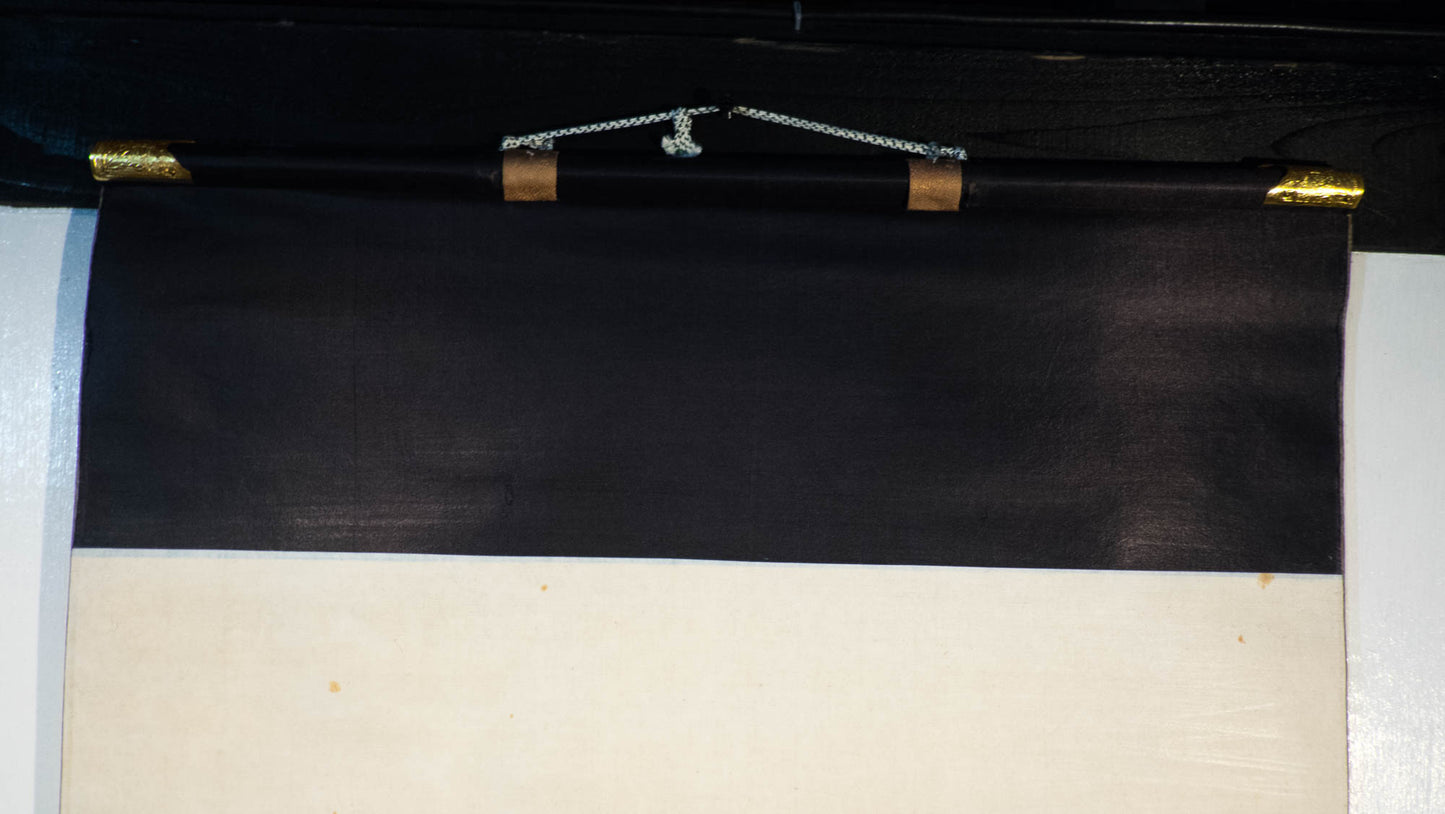
Visible hanging cords, textile straps, upper fittings, roller bar, and decorative end caps remain present.
Estimated Period
The age of this work cannot be conclusively determined without direct examination, documentation, pigment analysis, or a signed storage box.
The subdued metallic painting, dark devotional ground, traditional Buddhist iconography, accumulated creasing, pigment deterioration, and aged textile support are compatible with a late Edo to Meiji-period work, broadly within the 19th century.
A conservative listing description would therefore be:
Estimated late Edo to Meiji period, possibly 19th century, with later mounting or restoration possible.
This dating should be understood as an informed visual assessment rather than a certified attribution.
Why This Scroll Matters
Rare Memorial Iconography
Jūsanbutsu paintings are closely connected to Japanese remembrance rites. They bring together an entire sequence of sacred protectors in one devotional image.
Gold-on-Dark Presentation
The nocturnal ground and softly emerging figures create an unusually dramatic and contemplative effect. The image changes significantly depending on the direction and strength of the surrounding light.
Authentic Passage of Time
The worn surface is not concealed. Creases, fading, losses, and darkening reveal that this is an object that has lived through generations rather than a newly manufactured decorative scroll.
Spiritual and Cultural Depth
The painting connects Japanese Buddhist iconography, memorial tradition, textile mounting, gold-pigment painting, and domestic or temple devotion within a single surviving object.
Strong Interior Presence
Despite its muted condition, the scroll commands attention. Its narrow vertical format and dark central field work especially well in restrained interiors where atmosphere matters more than brightness.
Why You Will Love It
You may be drawn to this scroll if you appreciate art that whispers rather than shouts.
Its figures emerge slowly, requiring patience and changing with the light. From a distance, it appears mysterious and almost abstract. Viewed closely, the robes, faces, halos, jewels, vessels, staffs, and cloud forms begin to reassemble.
This dual identity makes it particularly compelling:
From across the room, it is a dark field of gold and shadow.
At close range, it becomes a sacred assembly filled with individual presences.
The scroll would bring weight and stillness to a room without overwhelming it. It carries the gravity of an antique temple object, yet its muted olive, bronze, black, turquoise, and aged-gold palette can sit beautifully within contemporary interiors.
Symbolism
Gold: Sacred radiance, enlightenment, incorruptibility, and the light of Buddhist wisdom.
Black ground: The infinite, the unseen spiritual realm, contemplation, night, and the mystery beyond ordinary perception.
Clouds: Movement between worlds, divine manifestation, and the arrival of sacred beings.
Halos: Enlightened consciousness and spiritual authority.
Thirteen figures: A complete memorial sequence, representing continued guidance rather than a single isolated moment.
Amida Nyorai: Compassion, infinite light, peaceful transition, and the promise of liberation.
Ideal Display Spaces
This scroll would be especially effective in:
A Buddhist altar or butsudan room
A meditation or mindfulness space
A tea room or tokonoma-style alcove
A wabi-sabi or Japandi interior
A private study or library
A collector’s cabinet room
A memorial or remembrance space
A yoga or contemplative studio
A gallery wall devoted to Asian art
A restrained hotel, retreat, or wellness interior
Because of its age and sensitivity, it should not be placed in direct sunlight, near heaters, in a bathroom, or in a space with rapidly changing humidity.
Ideal Collector
This work may appeal to:
Collectors of Japanese Buddhist painting
Collectors of kakejiku and kakemono
Students of Jūsanbutsu iconography
Collectors of Edo and Meiji religious art
Buddhist practitioners
Temple-art specialists
Interior designers seeking authentic Japanese antiques
Collectors of gold-pigment painting
Wabi-sabi and Japandi enthusiasts
Those creating a memorial or contemplative space
Museums, study collections, and cultural institutions
Buyers who value aged devotional objects over pristine modern décor
Item Details
Subject: Thirteen Buddhas memorial assembly, likely centered on Amida Nyorai
Japanese title: 十三仏図, Jūsanbutsu-zu
Object type: Japanese Buddhist hanging scroll
Format: Vertical kakejiku
Origin: Japan
Estimated age: Late Edo to Meiji period, possibly 19th century
Artist: Anonymous
Signature: No clearly legible signature visible
Painting material: Metallic gold-toned pigment and dark color on silk or textile
Mounting: Patterned brocade and textile mounting
Roller ends: Present
Storage box: Not shown or included in the supplied information
Authenticity: Sold as an antique Japanese devotional scroll based on its construction, materials, subject, and visible age; no third-party certificate accompanies the work unless specifically stated elsewhere
Detailed Condition Report
This is an antique devotional painting with substantial and clearly visible age-related condition issues.
The central painted panel displays extensive horizontal creasing and fold lines across the composition. There is widespread cracking, abrasion, fading, darkening, and loss of metallic pigment. Several figures have partially obscured details, and some areas of the image are considerably weaker than others.
Additional visible characteristics include:
Surface wear and scattered pigment loss
Vertical and horizontal stress lines
Small areas of flaking or missing material
Darkening and possible oxidation of the painting ground
Scattered spots, marks, stains, and surface deposits
Possible old moisture exposure or uneven discoloration
Areas where the support appears thin, brittle, or stressed
Distortion and waviness from long-term rolling or storage
Wear along the textile borders and mounting transitions
General discoloration consistent with age
Possible historic repairs, remounting, or reinforcement
The full sacred composition remains visible, but the work should be considered fragile and unrestored unless otherwise documented.
Its worn appearance is a major part of its historical and wabi-sabi character, but buyers seeking a bright, flawless, or newly restored scroll should not purchase this piece.
Please examine every photograph closely. The photographs form an essential part of the condition description.
Care and Display
Handle only with clean, dry hands and avoid touching the painted surface.
Do not pull the scroll tightly when opening or closing it. Roll slowly and evenly around the lower roller, ensuring the painting does not buckle or crease.
Keep away from:
Direct sunlight
Strong artificial light
High humidity
Dry heating vents
Air-conditioning outlets
Smoke and kitchen vapors
Bathrooms and damp walls
Pets and young children
Long-term permanent display
For important or extended display, consultation with a professional conservator of Japanese paintings or Asian textiles is recommended.
No cleaning, flattening, gluing, ironing, or home restoration should be attempted.
Final Words to the Collector
This scroll does not survive as a polished ornament. It survives as a shadowed sacred object.
Its gold has softened. Its figures have passed partly into darkness. The silk carries folds, cracks, abrasions, and the quiet evidence of time. Yet the assembly remains.
One Buddha stands at the center. Twelve sacred presences gather around him. Their robes, halos, vessels, staffs, jewels, and clouds appear only when the light finds them.
That is the power of this work.
It does not reveal everything at once. It asks the viewer to pause, adjust, and look again.
For the right collector, this is not damage hiding a painting. It is history becoming part of the painting.
Bring into your space an authentic fragment of Japanese Buddhist memory, a dark celestial court suspended in aged gold, and a devotional image created to accompany remembrance across generations.
Hang it not merely as decoration, but as a surviving field of contemplation, protection, and sacred time.
Offers
Some items in our collection allow limited room for negotiation, while others are offered at firm prices.
Respectful and realistic proposals are welcome. Should you have a particular budget, shipping concern, or related request, please contact us directly. Every offer is considered individually, although submission of an offer does not guarantee acceptance.
We are happy to assist and are only a message away.
Product Representation and Questions
We make every reasonable effort to photograph and describe our items accurately.
Color, brightness, gold tone, contrast, and surface detail may vary depending on lighting, display settings, screen calibration, and viewing angle. This particular painting is exceptionally dark, and its gold details become more or less visible depending on illumination.
Please review all photographs at full size and contact us before purchasing with any questions regarding condition, age, materials, mounting, dimensions, or included accessories.
We would much rather clarify a concern before payment than disappoint a collector afterward.
Condition and Sales Policy
This item is an antique and is sold in its present condition, as photographed and described.
It is not factory-new, flawless, recently restored, or guaranteed free from previous repairs. Age-related wear, creasing, fading, staining, pigment loss, textile deterioration, and structural irregularities should be expected.
Due to the unique, fragile, and one-of-a-kind nature of antique objects, all sales are considered final except where return rights are required by applicable law or Etsy policy.
Please purchase only after carefully reviewing the complete description and all photographs.
Shipping
Worldwide tracked shipping is available to destinations served by our shipping carriers.
We generally ship from Japan using Japan Post EMS or another appropriate tracked international service. The final method may depend on destination, parcel size, insurance limits, service availability, and current carrier restrictions.
The scroll will be carefully rolled, protected against moisture, cushioned, and packed inside a rigid outer container suitable for international transit.
Import duties, customs charges, taxes, and brokerage fees are the responsibility of the buyer unless otherwise required by law.
Tracking
Tracking information will be provided after dispatch.
Please allow time for the first carrier scan to appear. International delivery times vary according to destination, customs processing, local postal conditions, weather, and seasonal demand.
Store Policies
Please review our shop policies before completing your purchase.
By placing an order, you confirm that you have read the listing, examined the photographs, understood the antique condition, and accepted the limitations inherent in purchasing unique vintage and antique objects online.
Questions are always welcome before checkout.
#ThirteenBuddhas #Jusanbutsu #JapaneseBuddhistArt #AntiqueJapaneseScroll #JapaneseHangingScroll #Kakejiku #BuddhistMemorialArt #GoldBuddhaPainting #GoldPigmentArt #AmidaNyorai #DainichiNyorai #FudoMyoo #BodhisattvaArt #JapaneseTempleArt #SacredArt #DevotionalArt #MeditationRoomDecor #SpiritualWallArt #EdoPeriodArt #MeijiPeriodArt #JapaneseAntique #AsianAntiqueArt #BuddhistWallArt #EsotericBuddhism #ShingonArt #WabiSabiDecor #CollectorArt #TempleDecor #BuddhistIconography #JapaneseArtCollector