Rare Vintage, Antiques and Art Collector / Curator / Personal Shopper From Japan
Early Type L-2 Flight Jacket 1st Pattern Two Tone Cigarette Pocket Old Crown Zip Repaired Rare Nylon Military Jacket
Early Type L-2 Flight Jacket 1st Pattern Two Tone Cigarette Pocket Old Crown Zip Repaired Rare Nylon Military Jacket
Couldn't load pickup availability
Have a reasonable price in mind? Submit your best offer and our concierge will review it personally.
Type L-2 Flight Jacket
Early pattern example, with rare structural details, circa postwar transitional period
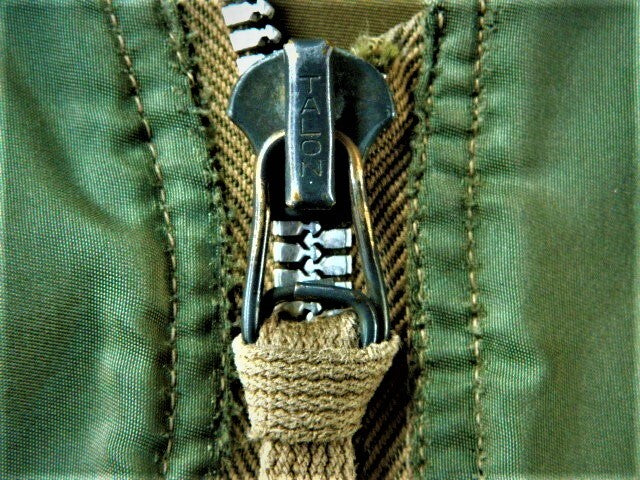
A highly uncommon early Type L-2 flight jacket, notable less for preserved condition than for the rarity of its surviving pattern characteristics. Though substantially repaired and fitted with replacement front zipper and knits, the jacket retains several details of potentially major collector interest, including an early leather tab configuration and a two-tone olive-drab cigarette pocket construction with original Old Crown zipper.
As one of the earliest nylon flight-jacket forms, the L-2 occupies a critical position in the evolution of military aircrew clothing, marking the transition away from leather and toward the lighter, more technical garments of the jet age. Examples of this early stage are significantly scarcer than later standardized nylon flight jackets, and even compromised survivors can command specialist attention when the base shell preserves uncommon and desirable pattern traits.
This example should not be approached as a condition-driven trophy piece. Rather, it belongs to the category of study-worthy survivors: garments whose altered or restored state is offset by the rarity of their underlying architecture. For the advanced collector of transitional military flightwear, such pieces can remain deeply significant.
A difficult jacket, but a potentially important one.
Object
Type L-2 Flight Jacket
Category
Early U.S. military nylon flight jacket
Era Attribution
Likely late-1940s to early postwar transitional flight-clothing period rather than a clean WWII combat-era category object
Seller frames it in broad “30s/40s/WWII/USAF” language, but the more disciplined reading is:
early-generation L-2, highly important if authentic, but not to be treated as a pristine wartime issue garment
Model Significance
Early L-2 jackets occupy a pivotal historical place in military flightwear because they represent the movement away from leather toward nylon-based aircrew clothing adapted to jet-era logic, lighter thermal requirements, and changing production methods.
Construction Details Highlighted by Seller
- leather oxygen / bomb tab (ボンベタブ)
- two-tone olive drab nylon cigarette pocket construction
- early-pattern L-2 architecture
- Old Crown zipper on cigarette pocket reported original
- main front zipper replaced
- all knits replaced
- multiple repairs throughout
Material
Nylon shell with mixed-component wartime/postwar military hardware language
Leather tab detail retained
Color
Olive drab tonal variation, including two-shade pocket-area interest
Measurements
Shoulder: approx. 44 cm
Chest: approx. 54 cm
Sleeve: approx. 64 cm
Length: approx. 60 cm
Condition Summary
Heavy use, extensive repair, replacement of key components, but still wearable
Collector relevance depends on whether the base shell and pattern details are as early and uncommon as claimed
Object Classification
Not a museum-pure untouched example
Not investment-grade on condition
Potentially a pattern-important survivor / study piece / advanced collector restoration-conscious acquisition
COLLECTOR RELEVANCE
Tier: Specialist Pattern Collector / Study Piece
This is for:
- early nylon flight-jacket specialists
- collectors who care about first-pattern construction
- buyers willing to prioritize rarity of shell over condition purity
- advanced military-clothing historians
This is not for:
- beginners
- condition purists
- buyers influenced mainly by dramatic seller adjectives
This is a jacket you buy because you know exactly what you are looking at.
CONFIDENCE & VERIFICATION NOTES
This piece requires extremely disciplined due diligence:
- verify that the shell is truly early-pattern L-2
- confirm the leather tab and two-tone pocket are correct period indicators
- inspect whether the Old Crown zipper is genuinely original to the pocket
- determine whether repairs preserve or distort original geometry
- compare shell fabric and interior construction to accepted early L-2 examples
Without that work, the ask is reckless.
With that work, the piece may still be important, but not necessarily at this level.
CURATORIAL ANALYSIS
A Jacket From the Moment Flightwear Changed Its Mind
The great importance of an early L-2 is not merely rarity. It is historical turning point. The A-2 and its leather cousins belong to one chapter of military aviation dress: weight, hide, warmth, and heroic material density. The L-series belongs to another. It is the beginning of modernity in flight clothing.
That shift is profound.
Leather says permanence.
Nylon says speed.
Leather belongs to propeller mythology, cockpit romance, and interwar military elegance. Early nylon belongs to a world becoming lighter, faster, more technical, and less sentimental. The L-2 stands at that edge, and the best early examples still carry enough of the old seriousness while already announcing the future.
That is why collectors care.
Why Early Pattern Matters More Than Clean Condition Here
In most categories, heavy repair and replaced parts would collapse value dramatically. In early nylon military jackets, however, pattern rarity can sometimes keep an object alive in the collector conversation even when condition is badly compromised.
That is the central question with this jacket.
If it is simply an old L-2 in rough shape, the price is fantasy.
If it is a genuinely scarce first-pattern survivor with the right early details, then the shell itself becomes the collectible object, even after substantial replacement and repair.
This is the difference between collecting a garment as condition and collecting a garment as evidence.
The former market wants clean examples.
The latter market will tolerate damage if the pattern is rare enough.
The Two-Tone Cigarette Pocket and the Logic of Scarcity
The seller emphasizes the unusual two-tone olive-drab treatment on the cigarette pocket and cites the Old Crown zipper as surviving original hardware. This is exactly the kind of small, strange construction detail that can matter disproportionately in military-flightwear collecting.
Why? Because rare jackets often reveal themselves through anomalies in the periphery:
- pocket construction
- tab material
- zipper supplier
- stitch geometry
- shade inconsistency
- lining transitions
- hardware mix
To casual buyers, these are quirks.
To serious collectors, they are fingerprints.
If the two-tone pocket and leather tab are correct early-pattern indicators rather than random later substitutions, they are the very reason the jacket remains relevant despite the compromised front zip and replaced knits.
Replacement vs Survivor Ethics
This jacket exists inside a difficult ethical zone.
On one hand, its survival has clearly required intervention:
- main zipper replaced
- all knits replaced
- broad repairs entered into the body
On the other hand, without those interventions, it may not have survived as a wearable object at all.
This is where advanced vintage collecting becomes uncomfortable. Restoration preserves life while reducing purity. Purity preserves category while sometimes allowing collapse. There is no perfect answer.
What matters is whether the remaining original shell still carries enough early-pattern authority to justify the compromises.
If yes, then the repairs become part of the jacket’s biography.
If no, then the repairs simply become expensive noise.
L-2 as Study Object Rather Than Trophy Object
This is not, at least from the description, a trophy-piece L-2. It is not the jacket a museum places under perfect light to demonstrate untouched original condition. It is closer to the jacket a specialist collector acquires because they may never see that exact early shell architecture again, and because the surviving details are sufficient to keep the conversation alive.
That is a very different acquisition logic.
This is not about bragging rights from condition.
It is about access to a rare stage in military clothing evolution.
MATERIAL FORENSICS
Shell
The shell is the kingdom here. The first question is not zipper, not rib, not resale. It is whether the body fabric retains authentic early nylon character:
- weave density
- oxidation and fading logic
- stitch architecture
- panel shape
- seam-to-pocket proportion
- color drift consistent with age rather than chemical fade
If the shell is right, the jacket still matters.
Main Zipper
The front zipper replacement is one of the most serious value deductions. On rare early flight jackets, the front zip is not incidental. It is a structural and chronological anchor. Replacing it keeps the jacket alive but weakens the object’s evidentiary purity.
That said, the survival of the Old Crown cigarette-pocket zipper is an important counterweight. It keeps one original hardware signature in place, which may help support period reading.
Knits
Complete knit replacement changes the silhouette truth of a jacket more than casual buyers realize. Ribs are not trim. They are architecture. Replaced knits mean the jacket no longer holds its original tension in a pure way.
Still, in a shell-rarity context, this does not automatically kill collectibility. It just moves the piece out of museum-purity territory and into connoisseur-compromise territory.
Repairs
“All over repairs” sounds alarming, but the real question is whether the repairs are old, sympathetic, and structurally honest, or recent, clumsy, and category-breaking. A careful in-hand review would need to examine:
- thread color mismatch
- patch-back reinforcement
- seam restitch chronology
- whether repaired areas distort original panel geometry
Authenticity & Stewardship
Evaluated under the Japonista Aviation & Military Garment Authentication Framework™
Each work is examined through a structured, multi-layered assessment:
• Model classification and military typology verification (A-2, B-3, MA-1, G-1, L-2, etc.)
• Material evaluation across leather, shearling, nylon, wool, and mixed components
• Hardware inspection including zippers, snaps, and period-correct fastenings
• Graphic and nose art analysis, including paint method, iconography, and historical alignment
• Condition and structural integrity review, including wear patterns consistent with age and use
Where applicable, contract labels, manufacturer markings, and period construction details are reviewed to confirm authenticity and era alignment.
Guaranteed 100% Authentic.
All garments are curated and backed by the Japonista Lifetime Authenticity Warranty™, with emphasis on both material truth and historical accuracy.
A Note on Flight Jackets, Service & Visual Identity
Military flight jackets were engineered as functional equipment—designed for temperature regulation, durability, and survival in demanding conditions. Over time, they evolved into carriers of identity, memory, and personal expression.
Nose art and painted jackets—originally applied to aircraft and later to garments—represent a distinct form of visual folklore. Pin-up figures, squadron insignia, mascots, and symbolic imagery transformed standard-issue equipment into individualized statements of presence and morale.
At Japonista, these jackets are approached as wearable military artifacts. Surface wear, leather creasing, paint aging, and textile fatigue are evaluated as evidence of lived history rather than imperfection.
We preserve these works with restraint—allowing their material narrative to remain visible and intact.
Our role is to connect these garments with collectors who recognize their dual nature as both functional objects and historical documents.
Inquiries, Availability, and Private Consideration
Many flight jackets are singular in character due to condition, paintwork, contract variation, or production era. Certain pieces are held firmly due to rarity, historical resonance, or preservation status.
All inquiries are handled discreetly, and we welcome thoughtful discussion regarding provenance, contract details, nose art interpretation, and long-term wear or display considerations.
Collectors building focused archives—by model type, era, or graphic style—may consult with us for deeper guidance.
Concierge Support & Collector Guidance
Japonista Concierge™ provides tailored assistance for collectors seeking deeper engagement with aviation garments:
• Model and contract identification (A-2 variants, G-1 lineage, MA-1 evolution)
• Leather and textile preservation guidance
• Paint conservation and display considerations
• Wearability versus archival preservation assessment
• Strategic acquisition planning for aviation-focused collections
For select rare or historically significant works, private reservation or structured acquisition arrangements may be available on a case-by-case basis.
Before Proceeding
We encourage collectors to review our shop policies and house guidelines, available through the links in our website footer. These outline shipping protocols, handling considerations, and condition standards specific to vintage leather, painted garments, and military-issued clothing.
Understanding these guidelines supports responsible stewardship of each piece.
A Closing Note
Flight jackets occupy a distinct place within material history. They are objects of function shaped by environment, and over time, transformed into records of identity, service, and expression.
Nose art—whether applied to aircraft or garments—extends this narrative, capturing moments of humor, defiance, and individuality within structured military life.
At Japonista, we steward these works as aviation artifacts in wearable form—ensuring they continue their journey with collectors who understand both their construction and their story.
If you have questions or wish to explore related items, please feel free to contact Japonista Concierge™ at any time.