Rare Vintage, Antiques and Art Collector / Curator / Personal Shopper From Japan
Dry Bones DJ-1186 “Nosarashi” Reversible Sukajan Jacket Skull Spiderweb × Tiger Dragon Rayon Satin Size M / 38
Dry Bones DJ-1186 “Nosarashi” Reversible Sukajan Jacket Skull Spiderweb × Tiger Dragon Rayon Satin Size M / 38
Couldn't load pickup availability
Dry Bones Japan DJ-1186 Embroidered Reversible Souvenir Jacket • 野晒 Nosarashi Skull & Bones Spiderweb • Tiger & Dragon • Black × Green Rayon Satin • Size 38 / M
Two Faces of Japanese Rebellion: Death on Black, Tiger & Dragon on Green ☠️🕸️🐯🐉
This is the kind of sukajan that refuses to behave quietly.
From Dry Bones Japan, the DJ-1186 Embroidered Jacket “野晒 / Nosarashi” is an extravagant fully reversible souvenir jacket built around two dramatically different visual worlds.
One side is almost monochromatic and macabre: lustrous black rayon satin carrying silver-white skull-and-crossbones embroidery beneath an enormous spiderweb.
Reverse it and the jacket erupts into classic sukajan color: rich green quilted satin, contrasting ivory sleeves, roaring tiger imagery and an elaborate dragon motif.
The result feels less like one jacket with two color options and more like two opposing chapters stitched into the same garment.
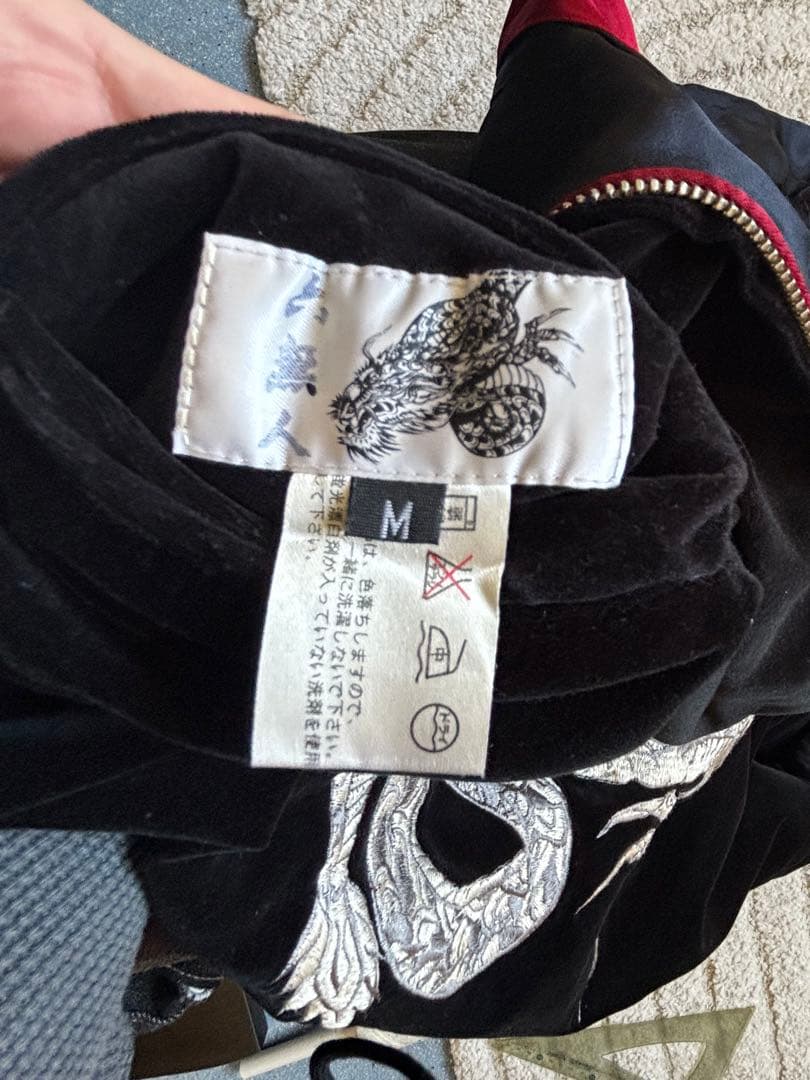
Tagged Size: 38 / M
Identification
Brand: Dry Bones / ドライボーンズ
Model: DJ-1186
Official Style Name: Embroidered Jacket “野晒” / Nosarashi
Type: Reversible Sukajan / Japanese Souvenir Jacket
Tagged Size: 38 / M
Primary Material: Rayon satin
Colorway: Black / Green with ivory contrast
Construction: Fully reversible embroidered jacket
Major Motifs: Skull, crossbones, spiderweb, spider, tiger, dragon, clouds, flowers
Original Japanese Retail Price: ¥91,300 tax included
Japanese Size Range for this model: 36 / 38 / 40 / 42
The Black “Nosarashi” Side ☠️
The black side is immediately different from the crowded multicolor imagery usually associated with sukajan.
Instead, Dry Bones strips the palette almost completely down to:
black rayon satin
silver-white embroidery
cream striped ribbing
The restraint makes the imagery more sinister.
Across the chest sit two embroidered skull-and-crossbones motifs, almost like outlaw insignia or vintage club emblems.
But the real spectacle waits on the back.
Skull, Bones & Spiderweb Back
A huge spiderweb stretches across the upper back in pale embroidery.
At its center hangs a small spider.
Below it sits an enormous weathered skull, its cracked crown and exaggerated teeth rendered in thick dimensional thread.
Crossbones extend beneath.
The composition fills much of the back without becoming visually chaotic because virtually everything is executed in the same pale tonal family.
Against the glossy black rayon satin, the embroidery appears almost luminous.
It has the visual impact of an old tattoo flash sheet, biker-club insignia, pirate memento and Japanese macabre illustration compressed into one image.
野晒 • Nosarashi
The model's Japanese name is especially important:
野晒
Often read nosarashi.
The expression evokes something exposed to the elements, literally left out in the open, and has longstanding associations with bones or human remains weathered in the field.
For this jacket, Dry Bones turns that grim image into textile art.
The cracked skull does not feel polished or ceremonial. It feels ancient, exposed and almost archaeological.
The spiderweb deepens that sense of abandonment and passing time.
This makes the design particularly compelling for collectors interested in Japanese interpretations of mortality imagery, tattoo culture, underground Americana and vintage horror aesthetics.
Monochrome Embroidery
The black side gains much of its strength from what it does not use.
There is no explosion of red, gold and green.
There is no giant “JAPAN” slogan.
Instead, pale thread floats over black satin.
The effect is graphic enough for streetwear, but restrained enough that the jacket can still be worn with a relatively minimal outfit.
The skulls become the punctuation marks.
Classic Ribbed Bomber Details
The collar, cuffs and waistband use striped rib knit in black and warm ivory tones.
That narrow contrast is particularly effective against the otherwise nearly monochromatic shell.
The silhouette follows the compact Japanese souvenir-jacket tradition:
short bomber body,
full sleeves,
ribbed edges,
front zipper,
angled welt pockets.
It gives the macabre graphics a distinctly vintage athletic-jacket frame rather than turning the garment into costume.
Reverse Side: Green Tiger & Dragon 🐯🐉
Turn the jacket inside out and the mood changes completely.
The black skull world disappears.
In its place is a luminous green quilted satin body paired with ivory / champagne sleeves.
This side returns to the great visual vocabulary of the Japanese souvenir jacket:
Tiger
Dragon
Flowers
Quilting
Contrasting satin
Dense multicolor embroidery
It is much more traditional in spirit, but no less spectacular.
Roaring Tiger Back
The center of the green reverse is dominated by an enormous roaring tiger head.
The tiger is rendered with:
burnt orange,
deep black,
cream,
white,
pink,
red,
and silver-gray thread.
Its mouth opens dramatically, exposing fangs and a vivid tongue.
White whiskers radiate outward against the dark green field.
Above the tiger appears an embroidered script:
Japan
This simple inscription connects the design directly to the souvenir-jacket tradition while allowing the animal itself to remain the primary focus.
Diamond-Quilted Green Satin
The green body is diamond quilted.
That quilting does more than add padding.
It creates an architectural background behind the tiger and gives the reverse side a distinctly mid-century souvenir-jacket atmosphere.
Depending on the light, the green shifts between forest, emerald and racing green.
The raised seams of the quilting fracture the reflections across the rayon satin, giving the jacket considerably more visual depth in person than a flat photograph can fully capture.
Tiger & Dragon Front
The front of the green side presents two classic Japanese power motifs facing the wearer.
One chest carries a roaring tiger.
The opposite chest carries a dragon, surrounded by decorative floral and cloud-like forms.
Together they create one of the most enduring symbolic pairings in East Asian visual culture.
The tiger belongs to the earth.
The dragon belongs to the heavens.
Placed opposite one another, they suggest complementary forces, power, movement and balance.
On sukajan, the pairing has become nearly archetypal.
Ivory Satin Sleeves
The pale sleeves bring warmth and contrast to the green body.
Their champagne / ivory coloration also gives the reverse side much more of a vintage souvenir-jacket feeling than a simple green-and-black combination would.
When worn, the color blocking is immediately visible from a distance:
green torso
light sleeves
green ribbing
multicolor chest embroidery
It is almost the chromatic opposite of the black side.
Two Jackets in One
This is where DJ-1186 earns its place as an unusually satisfying reversible piece.
Side A: Nosarashi
Black rayon satin
Silver-white skulls
Crossbones
Spiderweb
Spider
Macabre monochrome styling
Side B: Tiger & Dragon
Green quilted satin
Ivory contrast sleeves
Roaring tiger
Dragon
Floral ornament
Classic Japan souvenir-jacket styling
You can move from gothic monochrome to traditional embroidered sukajan without changing garments.
That is a genuinely useful form of reversibility rather than a novelty lining.
Dry Bones Japan
Dry Bones has long occupied an interesting territory within Japanese heritage fashion.
Rather than reproducing vintage clothing mechanically, the label has consistently drawn from overlapping subcultures:
1950s Americana,
rockabilly,
hot rod culture,
motorcycle clothing,
military garments,
Japanese tattoo imagery,
souvenir jackets,
and underground retro design.
DJ-1186 fits beautifully into that world.
It looks backward toward vintage souvenir jackets while still feeling unmistakably like a modern Japanese interpretation.
Rayon Satin
According to the supplied original product information, the jacket uses:
Rayon Satin
with the specification:
R100 / Rayon 100%
Rayon is particularly prized for this style because of the way it handles light.
Unlike a dull synthetic shell, rayon satin develops rich highlights and deep shadows as the fabric moves.
That makes it particularly effective beneath dense embroidery.
On the black side, the sheen emphasizes the eerie pale skull work.
On the green side, it gives the quilted field an almost liquid surface.
Size 38 / M
Tagged Size: 38 / M
The supplied model chart identifies:
36 = S
38 = M
40 = L
42 = XL
For Size 38 / M, the chart lists approximately:
Length: 60 cm
Body Width: 55 cm
Sleeve Width: 22.5 cm
Yukitake / Center-back-to-cuff style sleeve measurement: 81 cm
Because Japanese sizing and vintage-inspired bomber proportions can differ substantially from contemporary Western garments, please compare these measurements carefully with a jacket that already fits you well.
The 55 cm flat body width corresponds to roughly 110 cm around the body before allowing for garment thickness and ease.
Why the Shape Matters
Sukajan are not designed like long modern fashion bombers.
Their visual proportions depend on a relatively compact torso and fuller sleeve.
That shorter body allows the waistband to sit cleanly while concentrating the embroidered artwork across the upper body.
For this reason, buyers should pay close attention to both the 60 cm body length and 81 cm yukitake rather than relying on the “M” designation alone.
Iconography: Skull & Spiderweb
The skull has traveled through countless visual cultures:
memento mori,
pirate symbolism,
military insignia,
motorcycle clubs,
punk fashion,
tattoo flash,
and Japanese underground art.
Here the spiderweb changes the emotional register.
The skull is not simply aggressive.
It feels abandoned.
Time has passed.
The web has grown.
The imagery therefore carries a darker, almost narrative dimension that a conventional skull logo would not have.
Iconography: Tiger
The tiger has been one of the defining creatures of Japanese embroidered souvenir jackets.
Its physical mass, striped pattern and expressive face translate exceptionally well into thread.
On this example, Dry Bones enlarges the tiger head until it becomes almost mask-like.
It is not depicted quietly walking through bamboo.
It roars directly outward.
That exaggerated expression gives the reverse side the energy associated with classic Yokosuka-jacket art.
Iconography: Dragon
The dragon provides the complementary supernatural element.
Where the tiger feels muscular and terrestrial, the dragon is fluid and celestial.
Its placement on the opposite front creates a familiar ryū-ko / dragon-and-tiger dialogue that has appeared repeatedly across Japanese art, martial symbolism and decorative traditions.
For anyone collecting sukajan by motif, having both on the same side is a particularly satisfying combination.
A Sukajan for Two Different Wardrobes
One of the pleasures of this jacket is how differently each side can be styled.
Black Skull Side
Works naturally with:
black denim,
engineer boots,
leather trousers,
heavy silver jewelry,
motorcycle pieces,
punk styling,
rockabilly,
monochrome streetwear.
Green Tiger Side
Works beautifully with:
raw indigo denim,
1950s-inspired trousers,
white tees,
vintage sneakers,
military chinos,
work boots,
classic Amekaji.
It can move from Tokyo biker noir to colorful heritage Americana with one zip and a flip.
Condition
This piece should be treated as a pre-owned collectible garment.
Please examine all supplied photographs carefully for the exact condition of:
rayon satin,
embroidery,
ribbing,
zipper,
quilting,
cuffs,
collar,
waistband,
pockets,
and any naturally occurring signs of storage or previous wear.
Rayon satin is a particularly expressive fabric and may naturally show creasing, pressure marks, changes in nap or sheen, and other visual variations depending on lighting and how the garment has been stored.
These characteristics are part of the physical identity of a pre-owned embroidered jacket and should be assessed through the photographs before purchase.
Collector Appeal
DJ-1186 sits at an unusually attractive intersection.
It is recognizably sukajan.
Yet the Nosarashi side breaks away from conventional souvenir-jacket imagery.
That means it can interest multiple collecting audiences simultaneously:
Japanese sukajan collectors,
Dry Bones collectors,
Amekaji enthusiasts,
rockabilly collectors,
tattoo-art enthusiasts,
skull collectors,
biker-fashion collectors,
Japanese heritage-fashion fans,
and buyers simply searching for unusual statement outerwear.
The reversible construction doubles that visual range.
Why This Piece Stands Out
There are many tiger sukajan.
There are many dragon sukajan.
There are also many skull jackets.
Far fewer successfully combine all three worlds in a coherent reversible design.
The strongest point here is the contrast:
Deathly monochrome on one side.
Saturated Japanese animal mythology on the other.
The jacket changes character completely depending on which face is shown.
That duality gives it considerably more display and styling value than a one-sided embroidered bomber.
Wearable Textile Art
Even unworn, DJ-1186 has substantial decorative presence.
Hung with the black side outward, it resembles an oversized embroidered tattoo panel.
Displayed green-side-out, it becomes a classic Japanese souvenir composition.
For collectors who rotate pieces between wearing and display, the jacket offers effectively two different textile artworks.
Purchase, Shipping & Vintage Policy
Please review all photographs and listed measurements carefully before purchase.
This is a pre-owned collectible garment offered as-is. Natural signs of prior ownership, storage, handling and fabric aging may be present.
Japanese tagged sizing may differ significantly from contemporary international sizing. Measurements should always take precedence over the nominal letter size.
Preparation, shipping and handling normally takes 5–10 business days or earlier.
Worldwide shipping is normally arranged through EMS or another appropriate tracked international service, depending on destination and logistical conditions.
Tracking information will be provided after dispatch.
Reasonable and respectful offers may be considered.
If you are looking for this design or model in another size, please feel free to message us. Although availability cannot be guaranteed, we may be able to locate the same or a closely matching piece in a different size through our sourcing network.
#DryBones #DryBonesJapan #DJ1186 #Nosarashi #野晒 #Sukajan #VintageSukajan #JapaneseSukajan #SouvenirJacket #YokosukaJacket #SkullJacket #SpiderwebJacket #SkullAndBones #TigerJacket #DragonJacket #TigerAndDragon #JapaneseEmbroidery #EmbroideredJacket #RayonSatin #ReversibleJacket #JapaneseVintage #Amekaji #RockabillyFashion #BikerFashion #TattooArt #JapaneseStreetwear #HeritageFashion #WearableArt #JapanJacket #CollectorJacket
dry bones jacket, dry bones sukajan, dj1186 jacket, skull sukajan, tiger sukajan, dragon sukajan, spiderweb jacket, reversible jacket, japanese jacket, rayon sukajan, amekaji jacket, souvenir jacket, size m sukajan
Material Tags
rayon satin, rayon 100%, embroidery thread, quilted rayon, rib knit, metal zipper, satin fabric