Rare Vintage, Antiques and Art Collector / Curator / Personal Shopper From Japan
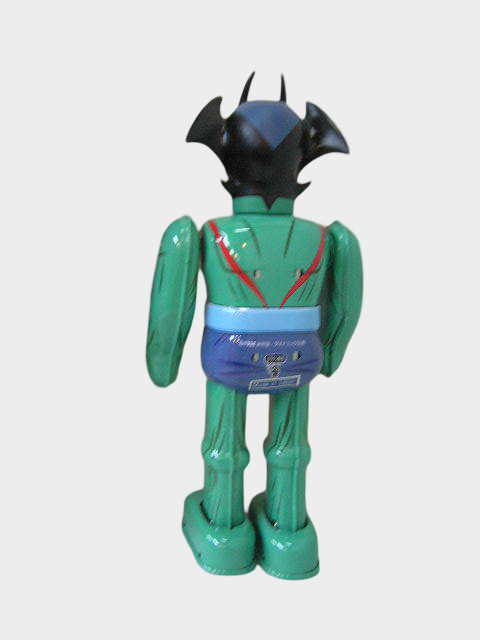
Devilman Tin Wind-Up Figure — Japanese Buriki Deadstock Showa Era Toy
Devilman Tin Wind-Up Figure — Japanese Buriki Deadstock Showa Era Toy
Couldn't load pickup availability
Have a reasonable price in mind? Submit your best offer and our concierge will review it personally.
Devilman Tin Wind-Up Figure
(Japanese buriki interpretation of postwar moral horror)
OBJECT IDENTITY
-
Original Medium: Manga / Television anime (early 1970s)
-
Toy Format: Tinplate (buriki) wind-up figure
-
Mechanism: Spring-driven (zenmai), walking motion
-
Material: Lithographed tinplate with gloss enamel
-
Presentation: Original illustrated box
-
Condition Type: Deadstock / unused example
This is not a “character toy.”
It is a material translation of Japanese moral anxiety into mechanical form.
ICONOGRAPHY & VISUAL LANGUAGE
Why Devilman works exceptionally well in buriki
Devilman is already a contradiction:
-
Hero and monster
-
Violence and empathy
-
Justice and despair
Buriki — a medium built on rigidity, repetition, and mechanical inevitability — amplifies this tension.
Key iconographic elements:
-
Horns & bat wings → silhouette legibility at distance
-
Exposed chest emblem → identity over realism
-
Forward-locked posture → inevitability, not choice
-
Simplified musculature → symbolic strength, not anatomy
The figure does not pose — it advances.
That matters.
Tinplate + DEVILMAN = IDEOLOGICAL MATCH
Unlike Western superheroes, Devilman was never about triumph.
He represents:
-
Postwar trauma
-
The fear of humanity’s capacity for violence
-
The collapse of moral binaries
Buriki toys, historically, were:
-
Products of scarcity
-
Products of repetition
-
Products of endurance
Putting Devilman into tin does not soften him — it hardens his meaning.
MECHANICAL SEMIOTICS
What the movement means
-
Walking motion only
-
No attack pose
-
No transformation gimmick
This is crucial.
The Devilman buriki does not fight.
It moves forward endlessly, powered by a wound spring — a metaphor for:
Moral momentum without escape.
This is unintentional poetry — but unmistakable.
SHOWA-ERA CONTEXT
Devilman emerged during:
-
Late-Showa social unrest
-
Youth disillusionment
-
A rejection of optimistic hero narratives
Tin toys were already becoming obsolete by plastic — yet Devilman was rendered in the oldest industrial toy language Japan had.
That tension is the artifact.
MATERIAL & COLOR THEORY
-
Green body tone → unnatural life
-
High gloss finish → artificiality, not flesh
-
Black horns & wings → silhouette authority
-
Bold chest mark → identity fixed, not evolving
This is not realism.
It is graphic morality, flattened into metal.
CONDITION & PRESERVATION NOTES
-
Surface: Clean gloss, no corrosion evident
-
Paint: Strong saturation, no visible lifting
-
Mechanism: Preserved (function not central to value)
-
Box: Original illustrated carton with age-consistent handling
Deadstock Devilman buriki pieces are increasingly rare due to:
-
Paint fragility
-
Mechanical tension stress
-
Graphic box desirability
COLLECTOR RESONANCE
Who this piece speaks to
This object resonates with collectors who value:
-
Go Nagai’s darker legacy
-
Pre-mecha Japanese horror design
-
Buriki as ideological medium
-
Manga history beyond “cute” nostalgia
Especially meaningful for:
-
Devilman scholars
-
Showa-era pop historians
-
Japanese tin & sofubi crossover collectors
Biliken Shokai & the Osaka Tin Toy Lineage
Japan’s tin toy tradition is inseparable from Osaka—a city that once stood at the heart of postwar toy manufacturing. Within this lineage, two names define the present and the preservation of the craft: Biliken Shokai and the Osaka Tin Toy Institute.
The Osaka Tin Toy Institute serves as a cultural archive, safeguarding vintage tin toys, production records, and manufacturing techniques that shaped Japan’s global toy legacy. Its role is historical and educational—ensuring that the knowledge, aesthetics, and craftsmanship of classic Osaka tin toys are not lost to time.
Biliken Shokai represents the living continuation of that tradition. Rather than reproducing the past, the workshop creates newly manufactured tin toys using traditional methods—hand-assembled forms, vivid lithography, and mechanical simplicity—while introducing original designs rooted in kaiju culture and Japanese popular imagery. Each piece reflects both respect for historical technique and a contemporary artistic voice.
Together, these two entities embody a rare continuity: one preserving the foundation, the other actively building upon it. Collectors recognize this relationship as a mark of authenticity—not nostalgia as imitation, but heritage as an evolving craft.
Owning a Biliken Shokai tin toy is not merely acquiring a playful object; it is participating in a lineage that connects postwar Osaka workshops, museum-grade preservation, and modern Japanese artisan culture in a single, tangible form.
Authenticity & Collectible Stewardship
Evaluated under the Japonista Collectibles Authentication Framework™:
-
Period, manufacturer, and production-era assessment
-
Material, paint, lithography, and surface-wear analysis
-
Mechanical, structural, and component integrity review (where applicable)
-
Design, iconography, and cultural-context verification
Guaranteed 100% Authentic.
Every piece is backed by the Japonista Lifetime Authenticity Warranty™ and curated with collector-grade scrutiny.
A Note on Collecting & Preservation
At Japonista, we approach vintage and modern toys not merely as nostalgic objects, but as design artifacts, cultural touchstones, and expressions of their era—from postwar ingenuity and Showa imagination to contemporary pop and designer movements.
Each work is carefully examined, researched, and presented with respect for its original intent, historical context, and collector relevance, balancing preservation with the honest character earned through time and play.
Our role is not only to offer access to meaningful collectibles, but to act as thoughtful custodians—connecting the right pieces with collectors who value history, originality, and lasting significance.
Inquiries, Availability, and Private Consideration
Some collectible works may allow room for discussion, while others are held firmly due to rarity, condition, provenance, or cultural importance. All inquiries are reviewed personally and discreetly, and we welcome thoughtful questions or expressions of interest.
If you are exploring a specific theme, franchise, maker, era, or mechanical category—or seeking guidance in building a focused collection—our team is always available to assist with informed, quiet expertise.
Concierge Support & Collector Guidance
Japonista Concierge™ offers personalized assistance for collectors seeking deeper understanding, strategic acquisitions, or long-term curation across vintage and modern collectibles.
Whether your interest lies in nostalgia, design history, mechanical fascination, or pop-culture legacy, we are here to support your collecting journey with clarity, care, and discretion.
For select high-value or historically significant pieces, private reservation or structured payment arrangements may be available on a case-by-case basis. Please contact us to discuss eligibility and options.
Before Proceeding
We kindly encourage collectors to review our shop policies and house guidelines, available through the links in our website footer, which outline shipping, handling, and condition standards specific to vintage, mechanical, and collectible works.
A Closing Note
Thank you for exploring Japonista’s collection of vintage and modern toys, robots, and cultural collectibles. We are honored to share these enduring objects of imagination and design—and to help place them where they may continue to be appreciated, studied, and enjoyed.
If you have questions or wish to explore related works, please feel free to contact Japonista Concierge™ at any time.