Rare Vintage, Antiques and Art Collector / Curator / Personal Shopper From Japan
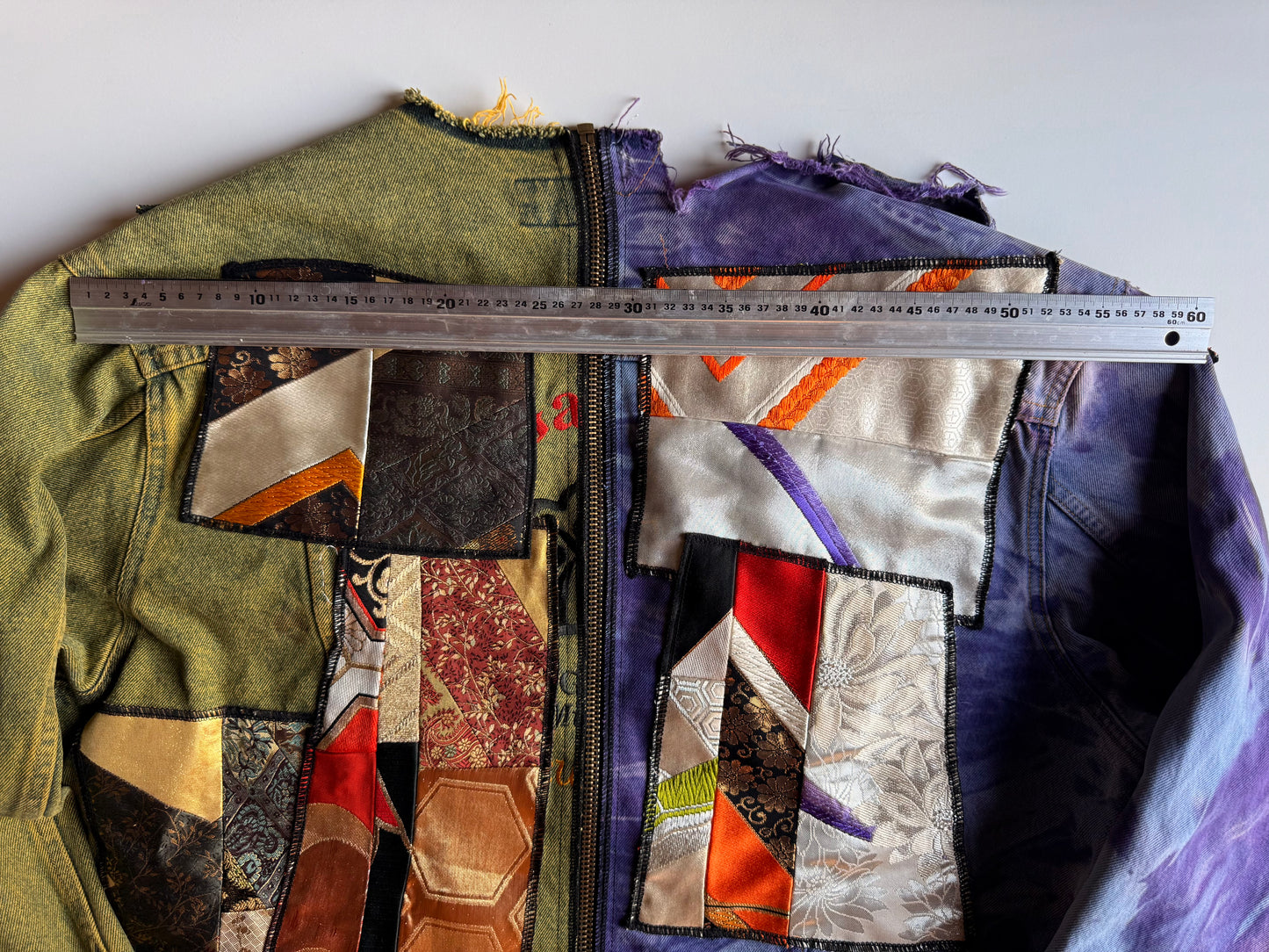
COTÉ MER Kimono Obi Patchwork Denim Remake Jacket L XL Japanese One of One Harajuku Streetwear Wearable Art
COTÉ MER Kimono Obi Patchwork Denim Remake Jacket L XL Japanese One of One Harajuku Streetwear Wearable Art
Couldn't load pickup availability
Have a reasonable price in mind? Submit your best offer and our concierge will review it personally.
Crimson and Purple Reconstructed Denim Couture with Vintage Japanese Brocade, Metallic Embroidery and Avant-Garde Patchwork Sleeves
Description
A singular COTÉ MER kimono-remake denim jacket that brings together Japanese textile heritage, distressed workwear, underground rock styling and the fearless collage language of contemporary Tokyo fashion.
Built upon a reconstructed denim foundation in deep crimson, burgundy, purple and faded indigo tones, the jacket has been transformed through individually arranged sections of vintage kimono and obi-style brocade. Metallic gold weaving, richly colored floral patterns, geometric textile fragments, graphic lettering and darker contrasting panels move across the garment in a deliberately irregular composition.
This is not a conventional denim jacket decorated with a few ornamental patches. The original garment has been visually and structurally reimagined. Traditional Japanese textiles become major components of the sleeves and decorative architecture, while the weathered denim remains visible as a rugged framework beneath them.
Every angle reveals a different relationship between cloth, pattern and color. One sleeve may flash with gold-thread florals, another with sharply defined geometry or contemporary typography. Crimson denim dissolves into purple and indigo, while black graphic elements interrupt the ceremonial richness of the brocade.
The result is unmistakably COTÉ MER: familiar clothing dismantled, disrupted and reborn as an individual work of Japanese streetwear art.
Design Character
This jacket lives in the electric space between kimono textile preservation and urban reconstruction.
The denim foundation introduces the cultural vocabulary of American workwear, rockabilly clothing and postwar youth style. The kimono and obi fragments carry another history entirely, one of formal Japanese dress, woven ornament, seasonal imagery and ceremonial color.
COTÉ MER allows those worlds to collide rather than politely blending them.
Metallic brocade is positioned beside faded denim. Traditional flowers meet oversized Western typography. Refined woven surfaces are framed by rugged seams and intentionally visible transitions. Areas of softness and shimmer are interrupted by harder graphic sections, giving the garment an almost armored appearance.
The composition is asymmetrical, but not arbitrary. Each fragment has been placed to create tension, movement and visual balance. The garment feels accumulated rather than manufactured, as though multiple textile histories have converged within one rebellious silhouette.
It is simultaneously:
- A reconstructed denim jacket
- A kimono and obi textile collage
- A Harajuku statement piece
- A rock-influenced art garment
- An example of Japanese slow fashion
- A one-of-one COTÉ MER collector piece
Identification
Designer: COTÉ MER / Cote Mer
Garment type: Reconstructed denim jacket
Category: Japanese designer remake fashion / wearable textile art
Textile treatment: Vintage kimono and obi brocade patchwork
Approximate fit: Asian L–XL
Silhouette: Relaxed, oversized and unisex
Primary colors: Crimson, burgundy, purple, faded indigo, black and gold
Decorative palette: Metallic gold, bronze, scarlet, lavender, ivory, green and multicolor accents
Closure: Front button construction
Style influences: Harajuku, rockabilly, Visual Kei, punk reconstruction and contemporary Japonisme
Production character: Individually reconstructed and one of a kind
Origin: Japan
The confirmed COTÉ MER attribution places this garment within the label’s established practice of transforming existing denim and vintage clothing through Japanese textiles, graphic collage and experimental reconstruction.
Japanese Textile Vocabulary
The patchwork incorporates fabrics from the visual world of Japanese kimono and obi weaving.
Unlike ordinary printed decoration, brocade is created through the physical interaction of threads. Pattern and color are woven into the textile itself, often incorporating metallic-wrapped yarns that reflect light differently according to movement and viewing angle.
This gives the jacket a continuously changing surface.
Under soft daylight, the brocade may appear aged, warm and textural. Under stronger directional lighting, gold and silver passages flare brightly against the darker denim. The textile therefore behaves almost like jewelry sewn into the garment.
The fragments appear to include a mixture of:
- Floral brocade
- Sakura-like blossoms
- Chrysanthemum and peony-inspired forms
- Crane silhouettes
- Scrolling foliage
- Geometric lattice patterns
- Metallic ceremonial weaving
- Decorative borders
- Abstracted traditional motifs
The jacket does not attempt to reproduce one complete kimono design. Instead, multiple textile fragments have been liberated from their original compositions and assembled into a new visual archive.
Floral Symbolism
Flowers are central to Japanese decorative art because they communicate season, atmosphere and the passage of time.
The floral fragments within this jacket may evoke several traditional motif systems.
Sakura-like blossoms suggest spring, renewal and the fleeting intensity of beauty.
Chrysanthemum forms are associated with longevity, refinement and autumnal splendor.
Peony-inspired flowers traditionally carry impressions of magnificence, prosperity and confident beauty.
Placed upon reconstructed denim, these motifs take on a new personality. They no longer belong exclusively to ceremonial clothing. Their petals become sharper, more urban and almost shield-like when surrounded by distressed fabric, graphic lettering and dark paneling.
Crane and Auspicious Imagery
Crane-like forms appearing within the textile fragments introduce another layer of Japanese symbolism.
The crane, or tsuru, is traditionally connected with longevity, fidelity, good fortune and an elevated spiritual presence. Because cranes are often represented in formal kimono and obi designs, even partial surviving silhouettes can carry a sense of ceremony and celebration.
Within this jacket, such imagery appears in fragments rather than a complete traditional scene. That interruption is part of the design’s power. The viewer encounters flashes of inherited symbolism among the reconstructed surfaces, almost like memories preserved inside the cloth.
Geometric Structure
Geometric textile fragments provide visual discipline among the florals and graphic elements.
Hexagonal, interlocking, striped and lattice-like patterns are frequently found in Japanese weaving. Depending on their specific form, they may suggest continuity, protection, endurance, family connection or architectural order.
These repeated structures act as stabilizing elements within the jacket’s more chaotic visual field.
The floral patterns expand organically, while geometric sections create boundaries, rhythm and visual weight. Together, they allow the garment to remain richly layered without becoming an uncontrolled jumble.
Armor-Like Presence
Although not a literal oni costume, the jacket carries an unmistakably armor-like atmosphere.
Overlapping textile panels resemble protective plates. Crimson, black, purple and metallic gold create a palette associated with theatrical power and warrior imagery. Dense woven surfaces produce physical depth, while darker areas sharpen the silhouette.
This gives the garment a sense of visual protection:
Strength appears through substantial layered textiles.
Transformation is expressed through discarded garments becoming something singular.
Defiance emerges from placing ceremonial materials inside an unconventional streetwear form.
Individuality is embedded in the impossibility of reproducing the same composition twice.
The jacket behaves like cultural armor for the modern city, less a costume than an external declaration of creative independence.
Color Architecture
The palette moves through several emotional registers.
Crimson and burgundy create the jacket’s fiery center. They communicate intensity, warmth and theatrical confidence.
Purple introduces shadow and richness, allowing the garment to move beyond the familiar blue-denim vocabulary. Faded indigo remains visible beneath the reconstruction, preserving a connection to workwear and Japanese denim culture.
Black graphic sections provide interruption and contrast. Without these darker passages, the brocade could become overly decorative. Instead, black gives the eye places to pause while strengthening the garment’s punk and rock character.
Gold and bronze threads form the visual sparks. They appear subtly in indirect light and become far more dramatic under illumination, making the garment shift in personality between daytime wear, nightlife styling and photography.
Reconstruction and Craftsmanship
COTÉ MER approaches existing garments as raw material rather than finished products.
The jacket appears to have undergone extensive intervention, including the selection of a denim foundation, tonal treatment, panel placement, textile cutting, stabilization and reconstruction around the original garment architecture.
The process includes:
- Reworked denim foundation
- Individually cut kimono and obi textile fragments
- Mixed fabric weights and textures
- Metallic woven brocade
- Embroidered decorative surfaces
- Contemporary graphic textile inserts
- Reconstructed sleeve sections
- Purposefully irregular panel boundaries
- Visible transitions between fabrics
- Retained denim workwear elements
- Original-style metal hardware
- Small-workshop or individually finished construction
Working with these materials requires careful control.
Denim is comparatively heavy and stable. Brocade may be dense but more vulnerable at cut edges. Satin-like textiles can shift under tension, while metallic threads may respond differently to bending and friction.
The garment’s irregularities reveal the negotiation between these materials. Rather than disguising that process beneath industrial uniformity, COTÉ MER makes it part of the jacket’s identity.
One-of-a-Kind Composition
No second example can possess exactly the same arrangement.
Even another COTÉ MER jacket created from similar materials would differ according to:
- The original denim garment
- Its wash, fading and color
- The available kimono and obi fragments
- The condition and dimensions of those textiles
- The location of individual motifs
- The designer’s cutting decisions
- The relationship between patterns and garment seams
- The position of graphics and lettering
- The final balance between front, sleeves and back
This irreproducibility is essential to its collector appeal.
It is not simply a limited colorway within a repeated production model. The material composition itself prevents exact duplication.
Modern Japonisme
The jacket represents a contemporary form of Japonisme driven from within Japan rather than imposed from outside it.
Traditional textiles are not preserved in a museum-like state or reduced to a printed reference. They are actively repositioned within modern streetwear, allowing historical materials to enter a new cycle of movement and use.
The result neither imitates a kimono nor hides the Western origin of the denim jacket. Both identities remain visible.
That tension is the work’s central language:
- East and West
- Ceremony and rebellion
- Textile refinement and distressed workwear
- Historical pattern and contemporary typography
- Preservation and disruption
- Familiar clothing and experimental art
Harajuku and Rock Styling
The jacket’s bold surface aligns naturally with several Japanese fashion subcultures.
Its distressed denim and strong silhouette connect with rockabilly and biker styling. Metallic brocade and oversized graphic elements bring it toward Visual Kei and performance fashion. The one-of-one reconstruction fits the highly individualized street language associated with Harajuku.
Yet the garment is not confined to costume or subculture styling.
Its relaxed silhouette and substantial color depth allow it to be integrated into more restrained contemporary wardrobes, particularly when paired with simple black, charcoal, cream or indigo garments.
Slow Fashion and Textile Preservation
This jacket offers an alternative to disposable fashion by treating existing garments and older textiles as valuable resources.
The denim foundation has been retained rather than discarded. Decorative Japanese fabrics have been removed from storage or previous use and given a new structural purpose. Their signs of age remain visible rather than erased.
This preserves not only material but also evidence of craftsmanship:
- Woven pattern
- Metallic thread
- Traditional color relationships
- Textile texture
- Previous wear
- Surface history
- Human handling
Its sustainability does not appear through visual minimalism. It appears through abundance, with many surviving fragments assembled into one continuing object.
Period Assessment
This is a contemporary or recent COTÉ MER reconstruction created from a mixture of older and pre-owned materials.
The denim foundation and Japanese textile fragments may predate the jacket’s present form. The finished garment should therefore not be assigned one single historical period.
Its identity exists across several timelines:
- Vintage or pre-owned Japanese textiles
- An earlier denim foundation
- Contemporary reconstruction
- Modern Harajuku and artwear styling
- Traditional patterns placed into a current fashion context
The jacket is best described as a contemporary COTÉ MER one-of-one remake incorporating vintage kimono and obi textiles.
Condition
Good pre-owned reconstructed condition with variations expected from vintage textiles and individually remade garments.
Visible or inherent characteristics may include:
- Fading and tonal variation across the denim
- Intentional washed or distressed coloration
- Natural creasing from wear and storage
- Differences in fabric thickness
- Minor fraying around selected textile edges
- Visible seam transitions
- Irregular stitching associated with reconstruction
- Light pulls or thread movement within brocade
- Surface variation in metallic weaving
- Patina to buttons and hardware
- Uneven areas where textiles overlap
- Earlier marks or imperfections within reused fabrics
- Slight asymmetry between reconstructed sections
These details contribute to the jacket’s wabi-sabi character and should not be interpreted according to the standards of newly manufactured factory clothing.
The brocade and metallic sections remain the garment’s central visual features and should be treated with appropriate care.
Please examine all photographs closely, as they form an essential part of the condition description.
Size and Fit
Approximate Asian size: L–XL
Suggested fit: Relaxed unisex L to XL, depending on body shape, layering and preferred silhouette
The jacket is designed to have a generous, visually substantial presence rather than a sharply fitted contemporary cut.
Its mixed-textile construction may influence how the garment drapes. Brocade panels possess more body than ordinary denim, while reconstructed sleeves may create additional visual volume.
Comparing the garment with a similarly shaped jacket that fits comfortably is recommended before purchase.
Styling
This jacket is designed to anchor the entire outfit.
It pairs especially well with:
- Black wide-leg trousers
- Dark raw denim
- Cropped pants
- Relaxed cargo trousers
- Leather or engineer boots
- Minimal sneakers
- Plain black or white T-shirts
- Roll-neck knitwear
- Hakama-inspired silhouettes
- Visual Kei layering
- Rockabilly denim
- Vintage military garments
- Silver accessories
- Monochrome streetwear
Wearing the jacket open allows the textile panels to spread and move freely. Closing the front creates a more concentrated, armor-like silhouette.
Because the surface is highly detailed, simple supporting garments give the brocade and reconstructed architecture enough visual space.
Display and Collecting Appeal
This garment can also be presented as textile art when not being worn.
Its metallic weaving, layered sleeves and unusual color architecture make it suitable for display in:
- Fashion studios
- Japanese streetwear archives
- Textile collections
- Creative offices
- Music rooms
- Tattoo studios
- Rockabilly interiors
- Harajuku-inspired boutiques
- Photography sets
- Gallery-style feature walls
A broad, supportive hanger is recommended to distribute the weight of the reconstructed sleeves.
Directional lighting will emphasize the gold and metallic weaving, while softer natural light will reveal the subtler denim fading and changes in textile texture.
Why This Piece Stands Out
This jacket offers several qualities rarely found together:
- Confirmed COTÉ MER designer attribution
- One-of-a-kind reconstruction
- Vintage kimono and obi brocade
- Crimson and purple denim foundation
- Metallic woven detail
- Extensive reconstructed sleeves
- Harajuku and rockabilly character
- Visual Kei crossover appeal
- Relaxed L–XL wearability
- Strong unisex styling
- Japanese textile preservation
- International artwear appeal
- Display-worthy construction
- No possibility of exact reproduction
It is not merely a garment influenced by COTÉ MER’s aesthetic. It is an authentic expression of the label’s reconstruction practice, with the brand attribution materially strengthening its position as collectible Japanese designer fashion.
Care
Specialist cleaning is strongly recommended.
Avoid ordinary machine washing, bleach, harsh detergent, prolonged soaking or tumble drying. Different textiles may react differently to moisture, agitation and heat.
Metallic threads and older brocade can be vulnerable to abrasion. Avoid repeatedly rubbing the textile panels against rough bags, furniture or hard surfaces.
Store the jacket on a broad hanger in a cool, dry environment away from prolonged direct sunlight and excessive humidity.
Offers, Shipping and Store Policies
Respectful and reasonable offers may be considered. Some prices have limited flexibility depending on rarity, condition and international demand.
This is a pre-owned, individually reconstructed designer garment offered in its existing condition. Please review the photographs, fit information and condition description carefully before purchasing.
Colors may appear slightly different according to lighting, photography and individual screen settings. Additional photographs may be available upon request.
All sales are final. Returns, exchanges, cancellations and condition-related claims are not accepted.
Worldwide shipping is available through Japan Post EMS with tracking. Orders are generally prepared for dispatch within approximately 3–5 business days. Delivery times may vary according to destination, customs processing and local postal conditions.
Customs duties, import taxes, brokerage charges and local handling fees remain the buyer’s responsibility where applicable.
#CoteMer #COTEMER #CoteMerJacket #KimonoRemake #ObiPatchwork #DenimRemake #JapaneseStreetwear #HarajukuFashion #RockabillyFashion #VisualKei #JapaneseBrocade #KimonoTextile #ObiTextile #PatchworkJacket #WearableArt #OneOfAKindFashion #ReconstructedFashion #UpcycledLuxury #JapaneseDesigner #TokyoStreetwear #AvantGardeFashion #ModernJaponisme #WabiSabiStyle #StatementJacket #DesignerDenim #KimonoJacket #SlowFashion #UnisexStreetwear #CollectorFashion #Japonista
cote mer jacket, kimono denim, obi patchwork, denim remake, japanese streetwear, harajuku jacket, wearable art coat, one of one jacket, japanese brocade, rockabilly jacket, visual kei fashion, unisex l xl jacket, reconstructed denim
Material Tags
Cotton denim, vintage kimono textile, Japanese obi brocade, metallic woven thread, embroidered fabric, graphic textile appliqué, cotton thread, metal buttons, mixed vintage textiles