Rare Vintage, Antiques and Art Collector / Curator / Personal Shopper From Japan
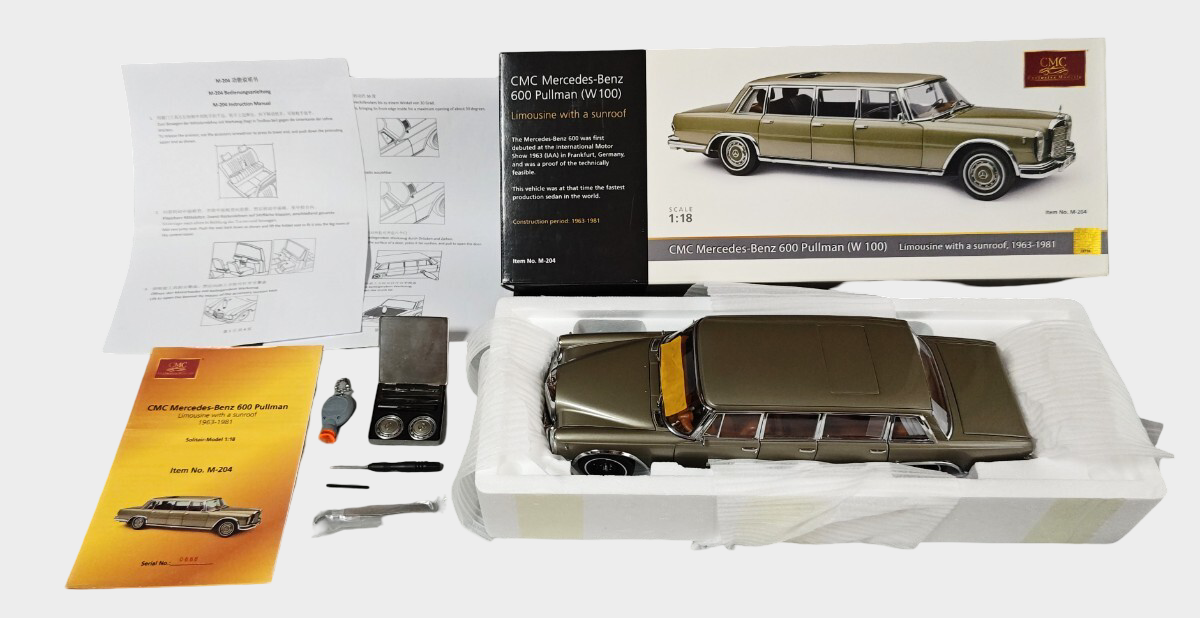
CMC 1/18 Mercedes-Benz 600 Pullman (W100) Limousine Diecast Model — Opening Features, Tool Set, Sunroof, Display-Grade
CMC 1/18 Mercedes-Benz 600 Pullman (W100) Limousine Diecast Model — Opening Features, Tool Set, Sunroof, Display-Grade
Couldn't load pickup availability
Have a reasonable price in mind? Submit your best offer and our concierge will review it personally.
CURATORIAL OVERVIEW — WHAT THIS OBJECT ACTUALLY IS
This is a CMC large-scale diecast interpretation of the Mercedes-Benz 600 Pullman (W100)—the limousine that functioned less like a “car” and more like a rolling architecture of power. In 1/18 scale, the Pullman becomes a miniature museum object: long wheelbase proportions, formal cabin geometry, and that unmistakable “state vehicle” silhouette that looks calm even when it’s doing something historically loud (like arriving).
CMC sits in the upper stratum of diecast making: not a toy, not a simple shelf model—more like a mechanical illustration of a car. The appeal is the way it invites slow looking: door seams, interior depth, and the small rituals of opening panels and checking compartments. This example includes a tool set and functional elements (including a sliding sunroof), which reinforces the point: it’s meant to be handled like a precise object, not merely viewed from five feet away.
Object: CMC 1/18 Mercedes-Benz 600 Pullman (W100) Limousine — diecast model with opening features + accessory tools
Era referenced: 1968–1981 (W100 Pullman production window)
Scale: 1/18 (large-format display model, but not “large cargo”)
Condition snapshot (as observed / disclosed):
-
Opening/working accessory tool set included (for wheel/tire handling)
-
Flagpole mounts at front fenders are press-fit; left flagpole leans
-
Middle seat in the 3rd row is folded (stowed)
-
Spare tire present in trunk; cover removal is tricky
-
Tires secured with realistic lug-nut style fastening; removable with supplied driver tool
-
Sunroof slides front-to-back (push while moving)
-
Outer box shows scuffs/scratches
-
Trunk lid does not stay open by itself (needs a prop/support)
-
Overall described as close to unused, but with the above operational/handling quirks
ICONOGRAPHY & THEMATIC ANALYSIS
The Pullman’s cultural “symbol work” is almost unfairly strong. It embodies a specific 20th-century idea: legitimacy rendered in metal and glass, where length equals authority and silence equals control. The W100’s form language is all about restraint—flat planes, upright presence, minimal drama—yet the drama is implicit: you don’t design a car like this for fun; you design it to mean something.
In miniature, that symbolism becomes display theatre. The cabin reads like a formal room. The long roofline and the limousine’s measured stance give collectors the aesthetic pleasure of scale power: a small object that still projects weight, ceremony, and historical gravity. That’s why this model sits comfortably not only with automotive collectors, but also with design/architecture people—because it’s essentially a modernist object with political shadow.
MATERIAL & CRAFT ASSESSMENT
This piece is a diecast build with opening features and accessory components intended to enhance realism and interaction. Key practical notes that matter for collector satisfaction (and must be stated cleanly):
-
The front fender flagpole mounts are press-fit; left side leans (a common kind of “precision annoyance” in detailed builds—cosmetically visible, potentially correctable by a careful hand).
-
The third-row middle seat is folded (presentation detail—some collectors will prefer it deployed; others will appreciate it as a “how it was stored” realism moment).
-
Trunk compartment includes a spare tire, but the cover is difficult to remove (important so expectations don’t get nuked).
-
Tires use lug-nut style fastening and are removable with the included tool set—this is part of the “CMC ritual” experience.
-
Sunroof operation is present: it slides while pressed.
-
The trunk lid does not hold itself open and needs support—this is not a deal-breaker, but it is the kind of thing collectors want disclosed upfront.
-
Box shows scuffs/scratches, which matters because CMC buyers often treat packaging as part of the object.
HISTORICAL CONTEXT — WHY THESE SURVIVE AT ALL
The W100 Pullman belongs to a category of vehicles that survive in memory because they were never just transportation. They were stage props for history—used in formal processions, state occasions, and the whole choreography of “important people moving through space.” The 600’s reputation is welded to that function.
Diecast models of the Pullman endure because they compress that entire historical aura into a controllable, displayable form. And CMC’s particular contribution is to treat the car not as a simplified shape but as a material culture artifact—something you can “read” through details, openings, compartments, and tools. That’s why a model like this doesn’t compete with ordinary diecast; it competes with other premium objects collectors justify as “forever pieces.”
COLLECTOR RELEVANCE
This is for the collector who wants one (1) statement limousine in the display—an anchor object that signals seriousness without needing bright colors or racing stripes. It also suits the buyer who is building a shelf that mixes automotive design, mid-century modern taste, and cinematic history (the Pullman silhouette instantly reads “formal world,” even to people who don’t know the chassis code).
Condition-wise, the model remains highly attractive because the disclosed issues are mostly presentation/operation quirks rather than catastrophic damage: leaning flagpole, tricky trunk cover, trunk lid support requirement, and box wear. If your photography emphasizes exterior cleanliness, interior richness, and the included tools, the narrative stays premium.
SUMMARY — WHY THIS PIECE MATTERS
A CMC Pullman isn’t “a model car.” It’s a compact monument to a particular era of industrial confidence: when a vehicle could be a room, a symbol, and a machine all at once. This example retains the core collector draw—opening features, tool presentation, and the Pullman’s unmistakable long-form presence—while clearly disclosing the handful of handling/presentation realities (flagpole lean, trunk support, box wear) that sophisticated buyers will appreciate knowing in advance.
Authenticity & Collectible Stewardship
Evaluated under the Japonista Scale Model Authentication Framework™:
-
Manufacturer, series, scale, and production-era verification
-
Material assessment across plastics, resins, metals, and mixed components
-
Kit completeness review including sprues, decals, instructions, and accessories
-
Condition evaluation covering box integrity, part preservation, and storage quality
Guaranteed 100% Authentic.
Every kit and model is curated under the Japonista Lifetime Authenticity Warranty™, with standards appropriate to both collectors and builders.
A Note on Scale, Learning, and Mechanical Literacy
Model kits are not static objects; they are systems for understanding form, structure, and motion. Whether automotive, military, aviation, or character-based, scale models translate real-world engineering into manageable, human-scale study.
At Japonista, we approach model cars and PURAMO as design documents and educational artifacts, not disposable hobbies. Attention is given to mold quality, part accuracy, engineering logic, and period context. Unbuilt condition is respected for archival value, while builder-grade kits are evaluated honestly for usability and completeness.
We recognize both paths equally: preservation and construction.
Inquiries, Availability, and Private Consideration
Some kits may allow discussion, while others are held firmly due to rarity, early production runs, discontinued molds, or archive relevance. All inquiries are reviewed personally and discreetly, with clear disclosure regarding condition, missing components, or age-related material considerations.
Collectors building reference archives, and builders seeking historically accurate or technically satisfying kits, are encouraged to consult with our team.
Concierge Support & Collector Guidance
Japonista Concierge™ provides informed guidance on:
-
Scale accuracy and series hierarchy
-
Vintage vs modern tooling distinctions
-
Storage considerations for aging plastics and decals
-
Builder vs archive suitability
We assist in matching each kit to the collector’s or builder’s intent, without imposing a single definition of value.
Japonista Concierge™ offers personalized assistance for collectors seeking deeper understanding, strategic acquisitions, or long-term curation across vintage and modern collectibles.
Whether your interest lies in nostalgia, design history, mechanical fascination, or pop-culture legacy, we are here to support your collecting journey with clarity, care, and discretion.
For select high-value or historically significant pieces, private reservation or structured payment arrangements may be available on a case-by-case basis. Please contact us to discuss eligibility and options.
Before Proceeding
We kindly encourage collectors to review our shop policies and house guidelines, available through the links in our website footer, which outline shipping, handling, and condition standards specific to vintage, mechanical, and collectible works.
A Closing Note
Thank you for exploring Japonista’s archive of model cars, hobby kits, and PURAMO. These works embody curiosity, precision, and the pleasure of making—whether preserved intact or brought to life through careful assembly.
If you have questions or wish to explore related works, please feel free to contact Japonista Concierge™ at any time.