Rare Vintage, Antiques and Art Collector / Curator / Personal Shopper From Japan
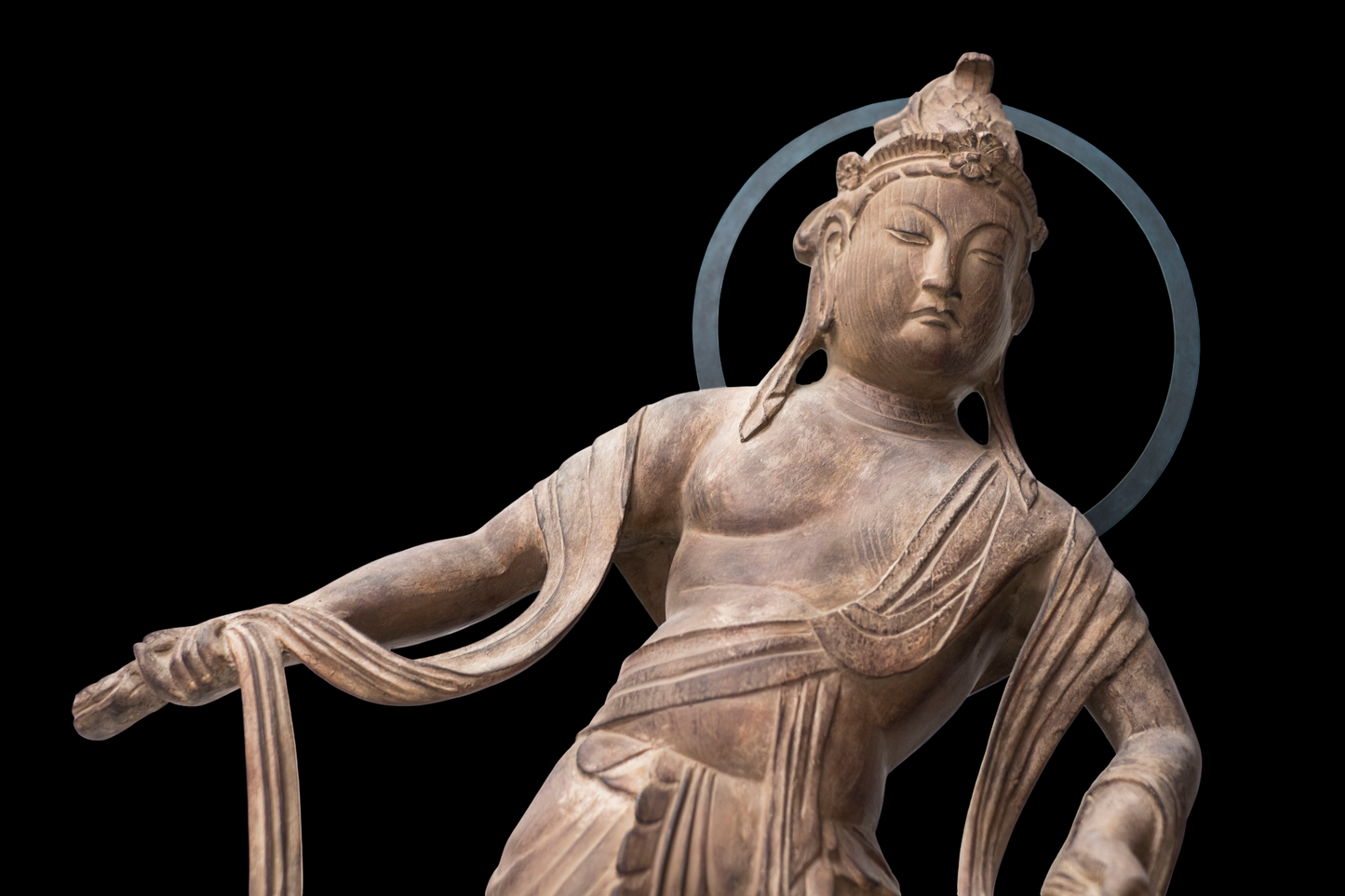
Byodo-in Inspired Cloudborne Offering Bodhisattva Unchu Kuyo Bosatsu, often called Hiten/Tennyo Standing Celestial Attendant Figure Statue
Byodo-in Inspired Cloudborne Offering Bodhisattva Unchu Kuyo Bosatsu, often called Hiten/Tennyo Standing Celestial Attendant Figure Statue
Couldn't load pickup availability
Have a reasonable price in mind? Submit your best offer and our concierge will review it personally.
Byodo-in Inspired Cloudborne Offering Bodhisattva (Unchu Kuyo Bosatsu, often called Hiten/Tennyo) — Standing Celestial Attendant Figure, Modern Japanese Revival
CATALOGUE IDENTIFICATION NOTE —
Although frequently marketed as a ‘Hiten / Tennyo’ (celestial maiden), the more exact reading for this pose and the listing’s ‘numbered’ Byodo-in reference aligns it with the celebrated Cloudborne Offering Bodhisattvas (Unchu Kuyo Bosatsu): the airborne musicians and dancers that orbit Amida’s Pure Land court at Byodo-in’s Phoenix Hall. In other words: this is best approached not as a generic heavenly maiden, but as a specific Heian Pure Land attendant-type, reissued for the modern collector.
A luminous category within Japanese Buddhist imagery, the Hiten—also called Tennyo, “heavenly maiden”—belongs to the realm of praise rather than petition. She is neither a savior nor a judge, neither the fierce protector nor the compassionate intercessor. Instead, she is a presence of devotion made visible: the celestial attendant whose very movement becomes offering.
The iconographic genealogy begins in India with the apsaras, beings of the heavenly courts whose grace and music signify a world beyond human weight. Transmitted through the Silk Road and reconfigured in East Asia, the motif crystallized in China as feitian and reached its most distilled, lyric expression in Japan during the Heian period. Here, the heavenly maiden is no longer merely “entertainment” for the gods; she becomes a doctrinal atmosphere—an embodied sign that the Buddha’s realm is already perfected.
In Pure Land contexts—where paradise is defined not by power but by clarity—Hiten appear as dancers and musicians suspended upon cloud scrolls, garments streaming like calligraphy, their bodies angled in gentle descent. Their presence announces a particular truth: the awakened realm is so suffused with harmony that praise is not performed; it occurs naturally.
The present figure is best understood as a modern Japanese revival work—made in the twentieth century for collectors, study, and domestic contemplation—drawing directly upon classical prototypes preserved in temple decoration and court-sponsored Buddhist art. While not a monumental temple commission, it demonstrates a disciplined fidelity to orthodox models: the controlled poise, the drapery logic, and the restrained expression align with the Heian ideal of sacred elegance.
What such a sculpture offers, in the private setting, is not spectacle but orientation. It serves as a quiet reminder that devotion can be practiced not only through supplication, but through refinement of attention—through the cultivation of an inner “Pure Land” in which gratitude becomes the default condition.
— Comparative Sidebar: Hiten vs Bosatsu vs Karyobinga (Why They Are Not the Same)
Hiten (Celestial Maiden / Tennyo)
• Function: praise and auspicious presence. Hiten do not teach doctrine directly; they sanctify the space by embodying devotion.
• Visual cues: airborne or weightless stance; flowing scarves and garments; dance-gesture or musical posture; often associated with cloud forms and Pure Land settings.
• Doctrinal role: an “atmospheric” icon—signaling that the Buddha-field is complete, harmonious, and already in celebration.
Bosatsu (Bodhisattva)
• Function: compassionate intervention. Bosatsu vow to remain engaged with the world to guide beings toward liberation.
• Visual cues: regal adornment; crown or jeweled ornaments; calm authority; implements (lotus, vase, rosary, staff) identifying specific vows and attributes.
• Doctrinal role: salvific agency—Bosatsu represent the path of compassion in action.
Karyobinga (Kalavinka)
• Function: the voice of paradise. Karyobinga are mythical birds of the Pure Land, famed for song so pure it awakens the mind.
• Visual cues: bird body with human head (often feminine); perched or floating; frequently paired, flanking lotus scrolls or celestial music motifs.
• Doctrinal role: sonic teaching—where Hiten “praise” through movement, Karyobinga “teach” through sound that turns the listener toward the Dharma.
Side-by-Side Doctrine Explainer: Hiten and Karyobinga
Hiten represent the visual choreography of devotion—gesture, drapery, and descent as a language of gratitude. Karyobinga represent the auditory doctrine of the Pure Land—music and birdsong as a vehicle for awakening. Together they form a paired logic of paradise: a realm where beauty is not distraction but a method, where the senses themselves become pathways toward clarity.
Approximate Height x Width =
73 x 55 cm
Condition
Wear, lacquer loss, cracking, insect traces, abrasions, and surface losses consistent with age and use.
Confidence & Verification Notes
Attribution is based on stylistic and iconographic analysis. No inscriptions or documentation accompany the piece. All descriptions are provided in good-faith scholarly language.
Authenticity & Stewardship
Evaluated under the Japonista Sacred Art Authentication Framework™:
• Iconographic accuracy and doctrinal alignment verification
• Material assessment across wood, bronze, lacquer, pigment, silk, and mixed media
• Structural integrity, restoration history, and age-consistent wear evaluation
• Provenance context and devotional-use assessment
Guaranteed 100% Authentic.
All works are curated and backed by the Japonista Lifetime Authenticity Warranty™, with reverence for both material integrity and spiritual significance.
A Note on Presence, Devotion & Sacred Form
Buddhist statues and sacred artworks are not decorative objects; they are embodiments of doctrine, meditation, and spiritual presence. Each mudra, attribute, and expression reflects codified meaning shaped by centuries of devotional transmission.
At Japonista, we approach sacred works with disciplined restraint. Surface wear, pigment loss, and patina are evaluated within historical and devotional context rather than corrected toward artificial perfection. Restoration, when present, is disclosed transparently and assessed for doctrinal fidelity.
Our role is not merely to facilitate acquisition, but to steward these works with cultural literacy and spiritual seriousness—ensuring they are placed where their presence may continue with dignity.
Inquiries, Availability, and Private Consideration
Certain sacred works are held firmly due to iconographic rarity, historical importance, or preservation sensitivity. All inquiries are handled discreetly, and we welcome thoughtful discussion regarding lineage, devotional context, or conservation history.
If you are building a focused Buddhist archive—by deity, sect, period, or material—our team is available to provide informed, respectful guidance.
Concierge Support & Collector Guidance
Japonista Concierge™ offers personalized assistance for collectors seeking deeper understanding of iconographic distinctions, regional stylistic variations, conservation planning, and responsible placement.
Whether your intention is devotional installation, academic study, or cultural preservation, we guide each acquisition with clarity and reverence.
For select historically significant works, private reservation or structured arrangements may be available on a case-by-case basis, handled with appropriate discretion.
Before Proceeding
We kindly encourage collectors to review our shop policies and sacred art guidelines, available through the links in our website footer, outlining conservation standards, handling practices, environmental considerations, and cultural respect protocols specific to devotional objects.
A Closing Note
Thank you for exploring Japonista’s curated archive of Buddhist statues and sacred art. These works carry centuries of contemplation, doctrine, and devotion within their form. We are honored to steward them where their presence may continue with integrity, respect, and quiet strength.
If you have questions or wish to explore related items, please feel free to contact Japonista Concierge™ at any time.