Rare Vintage, Antiques and Art Collector / Curator / Personal Shopper From Japan
Premium Buzz Rickson’s G-1 USS Princeton CV-37 Tiger Print Leather Tribute Flight Jacket BR80611 Size 36 Toyo
Premium Buzz Rickson’s G-1 USS Princeton CV-37 Tiger Print Leather Tribute Flight Jacket BR80611 Size 36 Toyo
Couldn't load pickup availability
Have a reasonable price in mind? Submit your best offer and our concierge will review it personally.
Buzz Rickson’s
G-1 Leather Flight Jacket
USS Princeton CV-37 tiger-print back, model BR80611
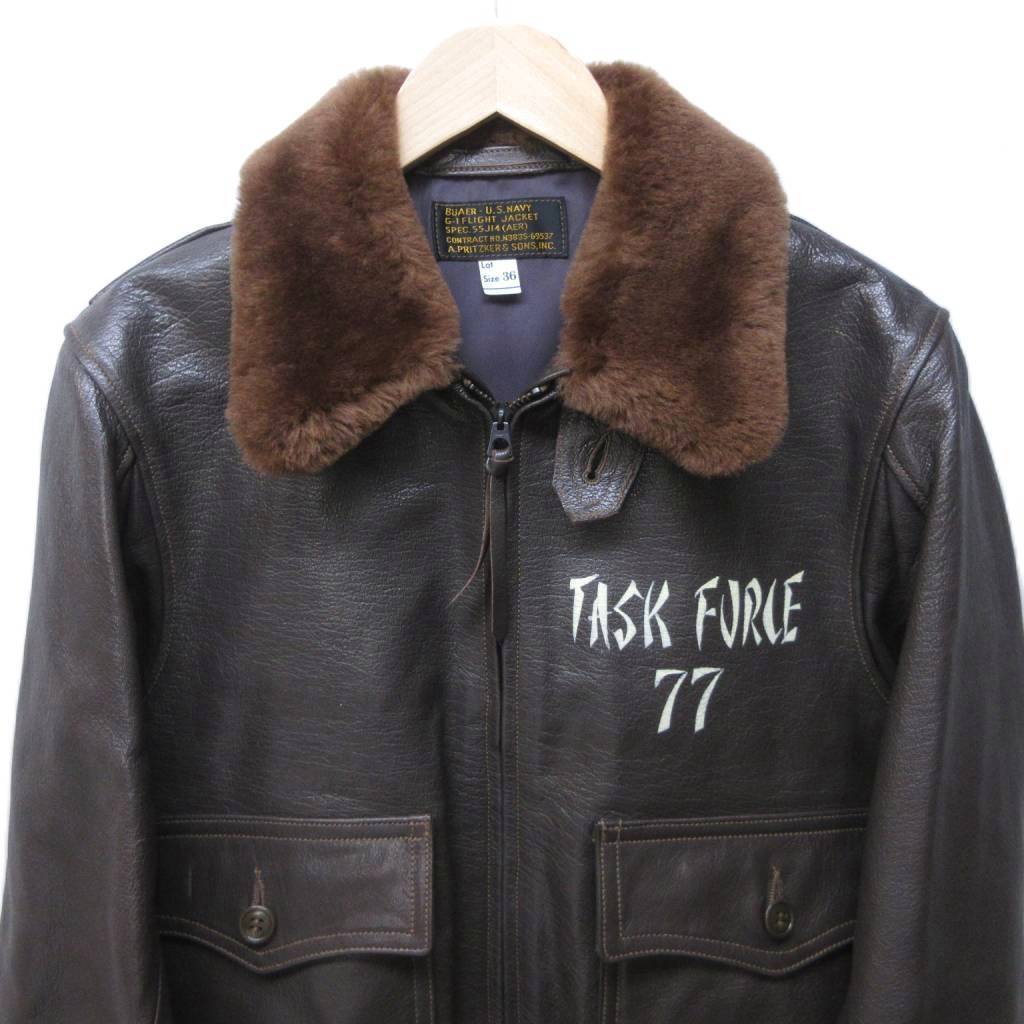
A highly appealing Buzz Rickson’s G-1 leather flight jacket distinguished by its dramatic USS Princeton CV-37 tiger back print and executed with the material and structural seriousness for which Toyo Enterprise’s military-reproduction line is known. Though not an original naval issue garment, the jacket belongs to the upper tier of Japanese heritage flightwear, where reproduction and collectible design meet with unusual fluency.
The silhouette remains faithful to the essential authority of the G-1: compact, fur-collared, and sharply proportioned. The reverse, however, is the true event, combining carrier identity with a vivid tiger motif that transforms the jacket from disciplined naval homage into a far more culturally resonant object. The result sits at the fertile intersection of American military iconography and Japanese narrative outerwear.
Offered in notably strong condition, the present example preserves not only the wearability expected of a premium reproduction, but also the display value of a jacket whose back image is central to its appeal. A particularly successful synthesis of military form and graphic drama.
An excellent collector’s example for those who understand how Japanese reproduction culture elevated tribute garments into artifacts of their own era.
Object
Buzz Rickson’s G-1 flight jacket with USS Princeton CV-37 tiger back print
Brand
Buzz Rickson’s
Under Toyo Enterprise, one of the strongest names in Japanese military reproduction culture
Model
BR80611
Contract Inspiration
A. Pritzker & Sons, Inc.–style G-1 tribute language
Theme / Artwork
USS Princeton CV-37 tiger back print
This is the emotional center of the jacket and the primary distinction from a plain reproduction G-1
Type
Japanese military reproduction / tribute G-1
Not government issue
Not wartime original
High-grade heritage reproduction collectible
Material
Leather shell
Brown tonal finish
Traditional G-1 silhouette with mouton-style collar and ribbed hem/cuffs
Color
Brown / dark seal brown family
Configuration
- two external hand pockets
- large back tiger art
- naval carrier-themed tribute identity
- mouton-style collar
- classic G-1 body proportions
Size
36
Measured Fit
Shoulder: 44 cm
Chest: 52 cm
Sleeve: 64 cm
Length: 61 cm
Condition
Seller grades it effectively as A-rank used condition
Low wear, very clean overall, little visible use, strong presentation value
Object Classification
A premium Japanese naval-aviation tribute leather jacket, collectible as both a wearable heritage piece and a Buzz Rickson’s archive item
COLLECTOR RELEVANCE
Tier: Strong Premium Reproduction / Archive-Wear Piece
Ideal for:
- Buzz Rickson’s collectors
- naval aviation tribute-jacket buyers
- heritage-fashion collectors who want image and structure together
- wearers seeking a premium G-1 that is more distinctive than a plain reproduction
Less ideal for:
- original-only military purists
- buyers who prefer understated backs
- anyone wanting oversized modern styling over historical proportion
This is a piece for someone who wants a G-1 with a memory built into the back.
CONFIDENCE & VERIFICATION NOTES
Important checks:
- collar pile condition
- print stability and surface integrity
- leather suppleness at elbows and shoulders
- zipper function and base stress
- knit elasticity and waistband tension
CURATORIAL ANALYSIS
A Naval Tribute Jacket That Understands the Power of Restraint and Spectacle
The best reproduction jackets know exactly where to be disciplined and where to become theatrical. This one gets the balance right.
In structure, it is recognizably a G-1: dark leather, fur collar, ribbed waist, naval flight-jacket authority, crisp chest, compact body. In image, however, it becomes something larger. The back erupts into a tiger composition linked to USS Princeton CV-37, turning what might have been a sober reproduction into a stage for postwar naval bravado, deck-culture mythology, and souvenir-jacket-adjacent drama.
That is precisely why it works.
The body remains serious.
The back tells the story.
Why Buzz Rickson’s Matters Here
Buzz Rickson’s is one of the few labels in reproduction culture whose name alone materially changes how a jacket should be read. The brand is not simply selling military-looking outerwear. It has built its reputation on taking original military garments seriously enough that the reproduction itself becomes worthy of specialist scrutiny.
That matters because in the wrong hands, a tiger-back naval jacket can become costume. In the right hands, it becomes tribute with discipline. Buzz Rickson’s usually belongs to the second category. The house understands proportions, leather behavior, collar presence, and how much theatricality a military-derived garment can absorb before it falls apart.
This jacket stays on the right side of that line.
USS Princeton CV-37 and the Romance of Carrier Identity
Carrier-named jackets carry a different emotional charge from generic military motifs. A carrier is not just a vessel. It is a floating city of discipline, danger, machinery, and group identity. To place USS Princeton CV-37 across the back of a G-1 is to load the garment with that whole environment: flight deck noise, salt air, painted steel, squadron ritual, and the swagger of naval aviation memory.
The tiger image intensifies that energy. Tigers on military jackets are never merely animals. They are proxy-emblems for aggression, vigilance, territorial pride, and visual command. Here the tiger is not incidental decoration. It is the living force of the back panel, the reason the jacket turns when someone walks away.
And that matters in a G-1. The best G-1s often reveal their true personality from behind.
The Cultural Sweet Spot Between G-1 and Souvenir Jacket
One reason this jacket is especially compelling is that it quietly inhabits the fertile territory between two traditions:
- the U.S. naval flight jacket
- the East Asian / Japanese appetite for narrative-backed military outerwear
That is a powerful combination.
A plain G-1 can feel austere.
A souvenir jacket can feel too unmoored from military structure.
This piece borrows the disciplined silhouette of the first and the storytelling instinct of the second. The result is a jacket that satisfies both the purist’s eye for line and the collector’s hunger for image.
That crossover is one of the great strengths of high-level Japanese heritage design.
Condition and Why It Matters More in Reproduction Than Originals
When dealing with wartime originals, some damage can deepen aura. When dealing with reproduction pieces, condition behaves differently. Because these jackets are collected partly for wearability and partly for archive value, clean condition has greater leverage. A low-wear Buzz Rickson’s piece holds its shape, collar authority, and leather finish in a way that better preserves what the brand intended.
That is why the seller’s condition note matters. A clean example of a special-print Buzz Rickson’s G-1 is more desirable than a heavily used one, not because wear ruins the category, but because these jackets were designed with such deliberate finish language that preservation enhances their readability.
This one appears to remain very readable.
Size 36 and the Sharpness of Naval Proportion
A size 36 in a G-1 tribute like this often wears beautifully because the jacket keeps the intended high-waist, compact-chest, and collar-forward line that made military flightwear visually powerful in the first place. Larger sizes can become more broadly wearable. Smaller sizes often become more correct.
For collectors and style-conscious wearers alike, a size 36 with these measurements suggests a lean, disciplined silhouette rather than a soft modern fit. That is often exactly what buyers want from a premium repro: not merely comfort, but the restoration of proportion.
Toyo Enterprise and the Quiet Reliability of Construction
The mention of Toyo Enterprise is not a footnote. It is a structural reassurance. Toyo-built leather jackets tend to have the kind of coherence that allows buyers to focus on taste rather than survival anxiety. That means:
- stronger confidence in stitching quality
- better material selection
- cleaner hardware logic
- more trustworthy long-term wear potential
In a jacket with a visually assertive back, such reliability matters even more. It ensures the piece is not all image and no body.
This is not a poster printed on leather.
It is a real garment carrying a poster-worthy image.
MATERIAL FORENSICS
Leather
The shell should be checked for:
- grain consistency across shoulders and back
- whether finish is matte-rich or overly polished by use
- elbow break and sleeve flex memory
- pocket edge abrasion
- any dryness around collar stand and zipper base
Given the stated condition, the leather likely remains one of the strongest assets of the piece.
Back Print
The tiger print is the principal premium driver. In-hand, one would want to verify:
- no crack-prone paint zones
- no lifting or flake at high-flex points
- whether the print retains depth under natural light
- whether the image balance and saturation remain strong
If the back remains crisp, the jacket keeps much of its premium.
Collar and Knits
On G-1 tributes, the collar can make or break the garment. The mouton should be checked for pile retention, dryness, and evenness. Likewise the knits should hold tension. Good knits preserve body. Bad knits collapse the whole silhouette.
Authenticity & Stewardship
Evaluated under the Japonista Aviation & Military Garment Authentication Framework™
Each work is examined through a structured, multi-layered assessment:
• Model classification and military typology verification (A-2, B-3, MA-1, G-1, L-2, etc.)
• Material evaluation across leather, shearling, nylon, wool, and mixed components
• Hardware inspection including zippers, snaps, and period-correct fastenings
• Graphic and nose art analysis, including paint method, iconography, and historical alignment
• Condition and structural integrity review, including wear patterns consistent with age and use
Where applicable, contract labels, manufacturer markings, and period construction details are reviewed to confirm authenticity and era alignment.
Guaranteed 100% Authentic.
All garments are curated and backed by the Japonista Lifetime Authenticity Warranty™, with emphasis on both material truth and historical accuracy.
A Note on Flight Jackets, Service & Visual Identity
Military flight jackets were engineered as functional equipment—designed for temperature regulation, durability, and survival in demanding conditions. Over time, they evolved into carriers of identity, memory, and personal expression.
Nose art and painted jackets—originally applied to aircraft and later to garments—represent a distinct form of visual folklore. Pin-up figures, squadron insignia, mascots, and symbolic imagery transformed standard-issue equipment into individualized statements of presence and morale.
At Japonista, these jackets are approached as wearable military artifacts. Surface wear, leather creasing, paint aging, and textile fatigue are evaluated as evidence of lived history rather than imperfection.
We preserve these works with restraint—allowing their material narrative to remain visible and intact.
Our role is to connect these garments with collectors who recognize their dual nature as both functional objects and historical documents.
Inquiries, Availability, and Private Consideration
Many flight jackets are singular in character due to condition, paintwork, contract variation, or production era. Certain pieces are held firmly due to rarity, historical resonance, or preservation status.
All inquiries are handled discreetly, and we welcome thoughtful discussion regarding provenance, contract details, nose art interpretation, and long-term wear or display considerations.
Collectors building focused archives—by model type, era, or graphic style—may consult with us for deeper guidance.
Concierge Support & Collector Guidance
Japonista Concierge™ provides tailored assistance for collectors seeking deeper engagement with aviation garments:
• Model and contract identification (A-2 variants, G-1 lineage, MA-1 evolution)
• Leather and textile preservation guidance
• Paint conservation and display considerations
• Wearability versus archival preservation assessment
• Strategic acquisition planning for aviation-focused collections
For select rare or historically significant works, private reservation or structured acquisition arrangements may be available on a case-by-case basis.
Before Proceeding
We encourage collectors to review our shop policies and house guidelines, available through the links in our website footer. These outline shipping protocols, handling considerations, and condition standards specific to vintage leather, painted garments, and military-issued clothing.
Understanding these guidelines supports responsible stewardship of each piece.
A Closing Note
Flight jackets occupy a distinct place within material history. They are objects of function shaped by environment, and over time, transformed into records of identity, service, and expression.
Nose art—whether applied to aircraft or garments—extends this narrative, capturing moments of humor, defiance, and individuality within structured military life.
At Japonista, we steward these works as aviation artifacts in wearable form—ensuring they continue their journey with collectors who understand both their construction and their story.
If you have questions or wish to explore related items, please feel free to contact Japonista Concierge™ at any time.