Bullmark
Bullmark Ultra Seven Tinplate Toy with Original Illustrated Box, Tsuburaya Tokusatsu, Late 1960s–Early 1970s
Bullmark Ultra Seven Tinplate Toy with Original Illustrated Box, Tsuburaya Tokusatsu, Late 1960s–Early 1970s
Couldn't load pickup availability
Have a reasonable price in mind? Submit your best offer and our concierge will review it personally.
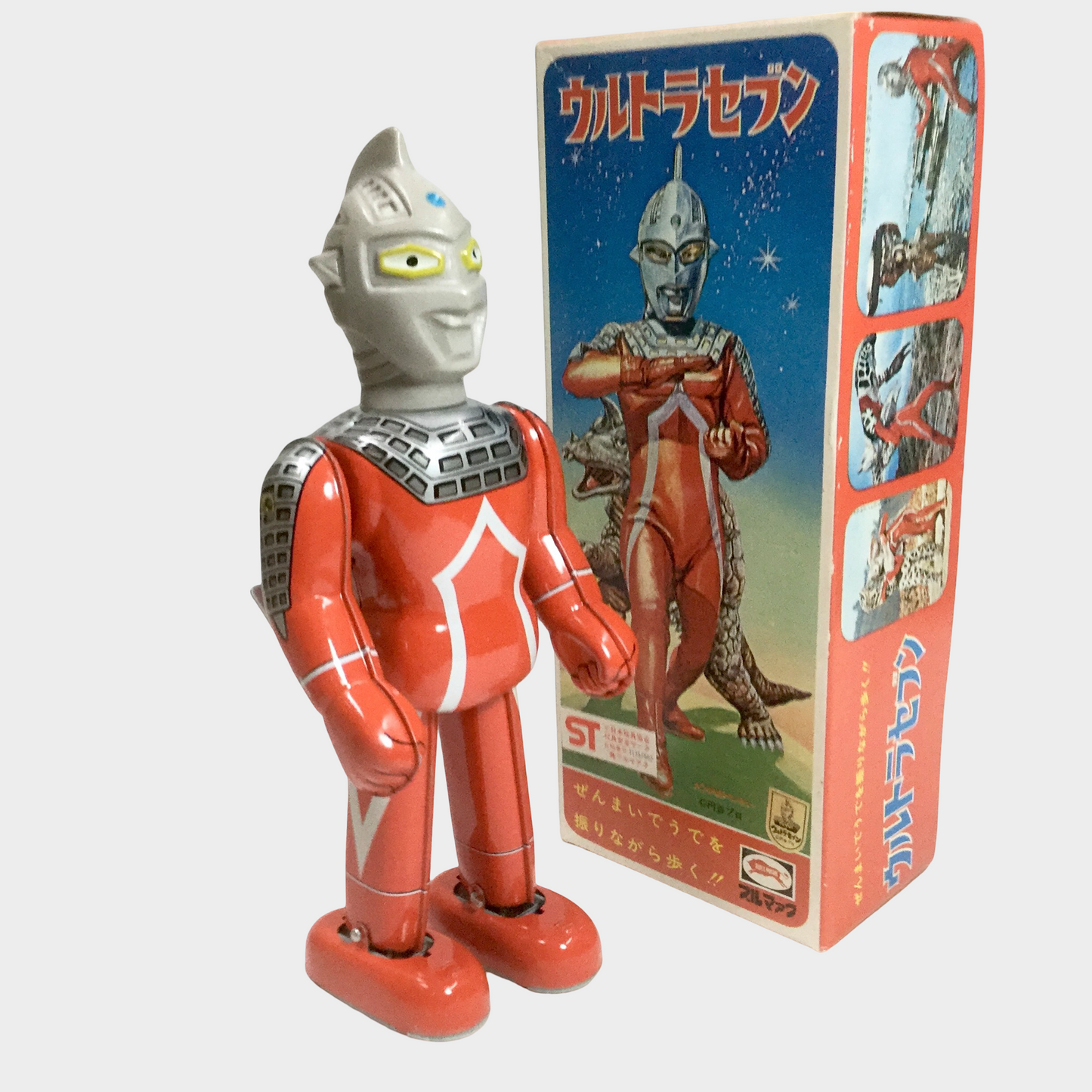
Before soft vinyl took over, Bullmark made Tsuburaya's Ultra Seven in tinplate, and boxed survivors of that metal phase are increasingly scarce. This example is unused and complete, with vivid paintwork and its original illustrated box, a museum-grade document of early tokusatsu toy history.
The Piece
Produced by Bullmark during the late 1960s to early 1970s, the figure depicts Ultra Seven, the Ultra hero created by Tsuburaya Productions. It is an authentic Japanese release from the golden age of tokusatsu collectibles, and its tinplate construction predates the widespread adoption of soft vinyl, reflecting Japan's transitional era from metal toys to vinyl.
The original illustrated box shows Ultra Seven in dynamic artwork alongside kaiju imagery, reinforcing its period character. The figure retains vivid paintwork and crisp mechanical detailing.
Bullmark's toys are industrial expressions of Showa-era imagination, made when Japanese manufacturing, television and childhood play converged into something new. Tin figures of this kind were heavily played with, dented and discarded, so boxed examples that survive intact are inherently rare. The piece suits advanced collectors of Ultraman, Tsuburaya Productions, Bullmark production and boxed vintage Japanese tin toys.
Details
- Maker: Bullmark
- Character: Ultra Seven (Tsuburaya Productions)
- Era: Late 1960s–early 1970s
- Origin: Japan
- Material: Tinplate
- Included: Original illustrated box with Ultra Seven and kaiju artwork
Condition
Japonista grade S · Unworn or as new, complete with original packaging.
- Unused and complete, with vivid paintwork and crisp mechanical detailing.
- The box shows age-appropriate wear consistent with decades of storage.
Authenticity & Care
Production year and release run are placed by known Bullmark manufacturing periods and visual comparison with documented examples; provenance is deliberately not over-claimed. Every piece is examined and documented in Japan before dispatch and is offered with the Japonista authenticity guarantee.
Delivery from Japan
Packed by hand in Japan and shipped insured and tracked by EMS or an equivalent express service. Import duties and taxes, where applicable, are payable on arrival. Returns follow our published policy.
Considered offers are welcome through Send an Offer, and each one is reviewed personally. Pieces over $1,000 may be reserved over several payments with Layaway Privilege™.
Continue browsing: Vintage Toys · Anime Collectibles
Related pieces: Bullmark Baragon electric walking tin kaiju · Bullmark Godzilla remote-control tinplate toy · Bullmark Baragon metallic green tin kaiju
Toy Box Requests
Hunting a particular robot, kaiju, figure or model? The Hunting Salon™ searches Japan’s collector shops and private collections, and the Deputy Vault™ secures a piece you have already found. Begin a Hunting Salon™ request →
Collectors also search: bullmark ultra seven tin toy · ultra seven tinplate toy · vintage ultraman tin toy · bullmark boxed ultraman · tsuburaya vintage collectible · japanese tinplate tokusatsu · ultraseven vintage toy with box