Rare Vintage, Antiques and Art Collector / Curator / Personal Shopper From Japan
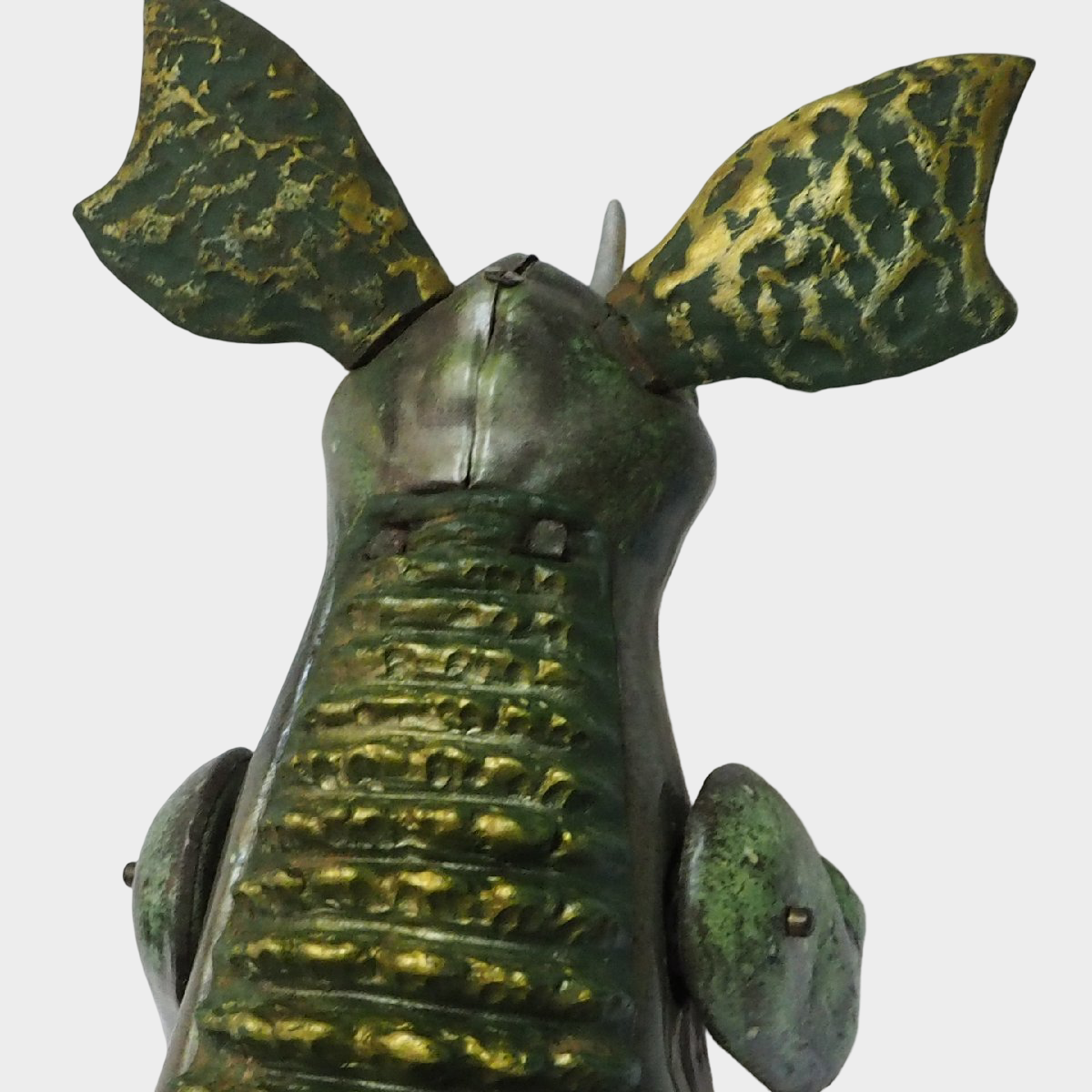
Vintage Bullmark Baragon Vintage Tin Kaiju Remote Control Monster Showa Era Japan
Vintage Bullmark Baragon Vintage Tin Kaiju Remote Control Monster Showa Era Japan
Couldn't load pickup availability
Have a reasonable price in mind? Submit your best offer and our concierge will review it personally.
🧾 OBJECT IDENTIFICATION
Object: Electric walking kaiju tin toy
Character: Baragon
Manufacturer: Bullmark (Japan)
Era: Showa period, late 1960s–early 1970s
Material: Tinplate body with painted surface, internal motor
Height: approx. 27 cm
Mechanism: Electric walking action via wired controller
Condition: Non-working (“junk”), oxidation, wear, surface rust, paint loss (no controller)
This Bullmark Baragon represents one of the most elusive intersections in Showa-era toy history: licensed tokusatsu kaiju rendered not in sofubi, but in heavy-gauge tin with mechanical remote-control action. While Bullmark is globally revered for its vinyl monsters, tin Baragon examples occupy a far rarer stratum, produced in significantly smaller numbers and aimed at a premium domestic audience.
Baragon’s sculpt is immediately recognizable—oversized bat-like ears, forward-leaning posture, and a thick, muscular torso that conveys subterranean power. The surface finish combines dark green metallic tones with subtle textural variation, creating a lifelike presence that reads as creature rather than toy when displayed at scale.
Unlike static sofubi figures, this example incorporates remote-controlled walking motion, transforming Baragon into an active mechanical monster. This places it closer to elite mechanical kaiju such as tin Mechagodzilla or battery-operated Ultraman-era vehicles than to standard vinyl releases. The engineering reflects Bullmark’s ambition during the late Showa period to compete not only in character licensing, but in mechanical spectacle.
BULLMARK
Bullmark stands among the most important Japanese kaiju manufacturers of the late 1960s–1970s, operating at the peak of tokusatsu popularity. While the company is most famous for sofubi, Bullmark’s tin output represents its experimental and premium edge, where mechanical complexity, cost, and risk were significantly higher.
Tin kaiju production was expensive, fragile, and less forgiving than vinyl, which is precisely why surviving examples are scarce. When combined with remote-control systems, these toys were never mass-market objects—they were aspirational, expensive, and often heavily played with, resulting in high attrition rates.
BARAGON — CHARACTER CONTEXT
Baragon debuted as a subterranean monster, distinguished by speed, agility, and exaggerated sensory features rather than brute size alone. This toy captures that identity through stance and balance: slightly crouched legs, raised arms, and an alert head position that suggests movement even at rest.
Among Showa kaiju, Baragon occupies a cult-favorite position—less common than Godzilla or Gamera, yet deeply respected by serious collectors. That status amplifies demand when paired with non-standard formats such as tin or mechanical variants.
CONSTRUCTION & FEATURES
-
Heavy-gauge tin body with sculpted monster anatomy
-
Metallic green finish with natural aging patina
-
Integrated remote-control walking mechanism
-
Expressive oversized ears and defined facial detailing
-
Large-scale presence suitable for centerpiece display
CONDITION OVERVIEW
This example presents with expected surface wear consistent with age and use. The tin structure remains intact, with strong visual impact and no structural collapse. Patina enhances authenticity rather than detracts. Remote-control components should be treated as collectible mechanisms rather than daily-use systems.
🧠 HISTORICAL & CULTURAL PLACEMENT
Baragon occupies a unique position in Japanese kaiju history. First appearing in Frankenstein Conquers the World (1965) and later integrated into the Ultraman kaiju ecosystem, Baragon bridges Toho cinematic kaiju and TV-era tokusatsu monsters.
Bullmark’s decision to produce Baragon as an electric walking tin toy places this piece at the absolute apex of mechanical kaiju manufacturing. Unlike friction or pull-back toys, electric walking kaiju required:
-
complex internal gearing
-
heavy-gauge tin bodies
-
external controllers (often lost)
As a result, survivorship is dramatically lower than standard Bullmark soft vinyl figures.
🧠 WHY COLLECT — BULLMARK BARAGON
This object is not collected for play value. It is collected because it represents:
-
The peak of Showa kaiju toy engineering
Electric walking monsters were the most expensive and least produced kaiju toys of their era. -
A bridge between cinema and television kaiju culture
Baragon connects Toho film monsters with Ultraman-era merchandising. -
Display power even in non-working condition
Collectors value patina, scale, and silhouette — operation is secondary. -
Comparable tier to Bullmark Giras (Jirass), Gomora, Red King (electric variants)
Among serious collectors, electric Bullmark kaiju are grouped together as a top-tier subcategory distinct from vinyl.
📊 COMPARATIVE CONTEXT (SAME-ERA)
| Category | Relative Scarcity | Market Tier |
|---|---|---|
| Bullmark soft vinyl kaiju | Medium | High |
| Bullmark friction tin kaiju | Low-Medium | High |
| Bullmark electric walking kaiju | Extremely Low | Top-Tier |
| Nomura electric robots | Low | Top-Tier |
| Masudaya electric vehicles | Medium | High |
This Baragon belongs firmly in the electric walking kaiju tier, which consistently outperforms vinyl equivalents in long-term value retention.
MATERIAL, MECHANISM & BUILD
-
Material: Lithographed tin body with molded and applied details
-
Action: Remote control walking (original wiring and mechanism present)
-
Scale: Large, floor-play oriented kaiju format
-
Finish: Original factory paint with aged surface patina
Bullmark kaiju toys are known for thick-gauge tin, simplified but powerful sculpting, and robust internal mechanisms. Even in worn condition, intact mechanical kaiju from this maker remain highly desirable due to low survival rates.
⚡ ELECTRIC WALKING KAIJU — TOP-TIER COMPARISON MATRIX
Bullmark Showa-Era Mechanical Monsters
| Dimension | Giras (Jirass) | Baragon | Gomora |
|---|---|---|---|
| Primary Franchise | Ultraman (TV) | Toho cinema → Ultraman ecosystem | Ultraman (TV) |
| First Appearance | 1966 (Ultraman) | 1965 (Frankenstein Conquers the World) | 1966 (Ultraman) |
| Bullmark Format | Electric walking tin + controller | Electric walking tin + controller | Electric walking tin + controller |
| Manufacturing Complexity | Very high | Very high | Extremely high |
| Silhouette Impact | Upright reptilian with frill | Stocky quadruped w/ ears | Massive dinosaurian bulk |
| Display Presence | Aggressive, alert stance | Heavy, grounded menace | Monumental, dominating |
| Mechanical Survivorship | Very low | Very low | Lowest |
| Controller Survivorship | Rare | Rare | Extremely rare |
| Surface Patina Appeal | Excellent (oxidation enhances texture) | Excellent | Excellent but often uneven |
| Known Production Volume | Low | Very low | Lowest of the three |
| Market Recognition | High (variant-name searches help liquidity) | Medium-High (cine prestige) | Very High (icon status) |
| Collector Tier | Blue-chip electric kaiju | Blue-chip electric kaiju | Crown-tier electric kaiju |
🧠 INTERPRETIVE ANALYSIS
🟢 Giras (Jirass) — The Strategist’s Electric Kaiju
-
Benefits from dual-name discoverability (Giras / Jirass).
-
Visually dynamic frill + upright posture reads well even when static.
-
Often considered the entry point into electric kaiju collecting — but still blue-chip.
-
Best balance of rarity + liquidity.
Collector profile:
Methodical, SEO-aware, long-term holder who values discoverability and display symmetry.
🟤 Baragon — The Cine-Heritage Electric Monster
-
Carries Toho film pedigree, which elevates cultural gravity.
-
Production appears slightly lower than Giras.
-
Electric examples are dramatically rarer than vinyl Baragon.
-
Strong appeal to collectors who cross-collect film kaiju + Ultraman toys.
Collector profile:
Historian-collector, Toho-leaning, values narrative lineage over sheer size.
🔴 Gomora — The Apex Predator
-
Gomora is Ultraman’s most iconic physical monster.
-
Electric walking Gomora represents the absolute peak of Bullmark mechanical ambition.
-
Largest body mass → highest failure rate → lowest survivorship.
-
When complete, it often anchors entire collections.
Collector profile:
Institutional-level collector, museum mindset, accepts long holding periods and illiquidity.
🏛️ TIER SUMMARY (UNOFFICIAL BUT UNIVERSALLY UNDERSTOOD)
| Tier | Electric Kaiju |
|---|---|
| Crown Tier | Gomora |
| Upper Blue-Chip | Baragon |
| Blue-Chip / Strategic | Giras (Jirass) |
In serious collections, only one electric Gomora is usually needed.
Giras and Baragon are often held together as a matched pair
HISTORICAL PLACEMENT — ULTRAMAN & BULLMARK
Bullmark dominated the kaiju toy market during the late 1960s Showa explosion of tokusatsu media. While many competitors produced static figures, Bullmark pushed toward motion-based toys—walking, sparking, remote-controlled monsters that brought television battles into the home.
Giras figures sit firmly within Bullmark’s golden production window, when kaiju toys were still designed as physical experiences rather than shelf collectibles.
WHY COLLECT BULLMARK KAIJU?
Serious kaiju collectors prioritize Bullmark for several reasons:
-
Era Authenticity
Bullmark toys were produced during the original broadcast years—not nostalgia revivals. -
Mechanical Complexity
Remote control and walking kaiju represent the highest tier of Showa toy engineering. -
Low Survival Rate
Large tin kaiju were heavily played with; intact examples are scarce. -
Monster-First Focus
Unlike hero-centric toys, Bullmark elevated the kaiju themselves to main attraction status.
Giras, in particular, appeals to collectors seeking monsters beyond the usual icons, adding depth and variety to Ultraman-focused collections.
COMPARATIVE CONTEXT
Compared to:
-
Marusan vinyl kaiju: softer, more sculptural, less mechanical
-
Yonezawa tin robots: hero-focused, not monster-centric
-
Later soft vinyl releases: nostalgic, but not era-original
This Bullmark Giras sits at the intersection of mechanical tin engineering and kaiju mythology, a category that continues to outperform generic Showa toys.
🐲 What is a kaiju?
Kaiju (怪獣) is a Japanese word that literally means “strange beast” or “mysterious creature.” In practice, it refers to giant monsters in Japanese film, TV, and pop culture—creatures so large and powerful that they overwhelm cities, armies, and even human understanding.
Kaiju aren’t just “big monsters.” In Japanese culture, they function as symbols, forces of nature, and moral metaphors.
🧠 Core idea (the simplest definition)
A kaiju is a being that represents something humanity cannot fully control.
That “something” might be:
-
nuclear power
-
war trauma
-
natural disasters
-
pollution
-
technological hubris
-
fear of the unknown
The monster is the expression, not the point.
🏗️ Origins of kaiju (why they exist)
Kaiju emerge from post–World War II Japan, especially after:
-
Hiroshima & Nagasaki
-
U.S. nuclear testing in the Pacific
-
Rapid industrialization
The first and most important kaiju is Godzilla (Gojira), created as a living metaphor for nuclear devastation. His burned skin, atomic breath, and unstoppable march are not fantasy—they are memory.
From that point on, kaiju became a language for disaster.
🧩 What makes kaiju different from Western monsters?
| Western Monsters | Kaiju |
|---|---|
| Individual villains | Collective threat |
| Often defeated permanently | Return repeatedly |
| Evil or cursed | Neutral / consequential |
| Human-sized fear | City-sized fear |
A kaiju is rarely “evil.”
It exists because conditions made it inevitable.
🧬 Types of kaiju (important distinction)
🌋 Nature-born kaiju
-
Earth spirits
-
Ancient creatures
-
Natural balance gone wrong
Example: volcanic or oceanic monsters
☢️ Science-created kaiju
-
Nuclear mutation
-
Experiments gone wrong
Example: Godzilla, many Showa-era monsters
👽 Alien kaiju
-
Invasions
-
External threats
Common in late Showa films
🤖 Mechanical kaiju
-
Artificial responses to fear
Example: Mechagodzilla
(technology trying—and failing—to control chaos)
📺 Kaiju in Japanese media
Kaiju dominate tokusatsu (special effects media), especially:
-
giant-suit performances
-
miniature city destruction
-
practical effects over realism
They appear in:
-
Godzilla films
-
Ultraman series
-
Gamera films
In Ultraman, kaiju are weekly threats—manageable fears.
In Godzilla, the kaiju is the trauma itself.
🧭 Cultural meaning (this is the key)
Kaiju allow Japan to ask questions like:
-
What happens when progress goes too far?
-
Who pays the price for power?
-
Can humans coexist with forces greater than themselves?
Rather than heroes conquering monsters, kaiju stories often end with:
-
uneasy balance
-
sacrifice
-
containment, not victory
That’s very different from “monster slayed, problem solved.”
🕯️ In one sentence
A kaiju is not just a monster—it is a warning made visible.
WHY COLLECT BULLMARK KAIJU
Bullmark kaiju occupy a singular position in the history of Japanese pop-culture artifacts. They are not merely toys, nor are they simplified representations of television monsters. They are industrial expressions of Showa-era imagination, produced at a moment when Japanese manufacturing, television, and childhood play converged into something entirely new.
Unlike later soft vinyl kaiju, Bullmark monsters were designed with weight, motion, and physical consequence. Thick tin bodies, internal motors, and remote-control walking mechanisms transformed kaiju from screen icons into living presences within domestic space. These were not shelf objects. They were engineered to stomp, turn, spark, and collide.
Bullmark also treated kaiju as protagonists in their own right. While many manufacturers centered heroes, Bullmark elevated the monsters themselves—granting them scale, mechanical complexity, and visual authority. A Bullmark kaiju does not feel secondary to Ultraman; it feels like an equal adversary.
From a collector standpoint, Bullmark kaiju represent a perfect storm of scarcity, fragility, and cultural importance. Large tin monsters were heavily played with, dented, rewired, or discarded. Surviving examples—especially those retaining original mechanisms—are inherently rare. Each intact piece is a survivor of both time and childhood.
Culturally, these objects sit at the foundation of modern kaiju fandom. Long before designer toys or adult collectors, Bullmark kaiju taught an entire generation how monsters should look, move, and feel. Their silhouettes still echo in contemporary kaiju design.
To collect Bullmark kaiju is not to chase nostalgia—it is to acquire primary artifacts of the Showa imagination, objects that shaped how monsters were experienced in the physical world. They are heavy, imperfect, mechanical, and alive in a way few collectibles ever are.
Authenticity & Stewardship
Evaluated under the Japonista Authentication Framework™:
- Material, carving, and surface-study comparison
- Iconographic and stylistic verification
- Condition and stability review (surface integrity)
- Construction assessment and handling-risk evaluation
Guaranteed 100% Authentic. Covered by the Japonista Lifetime Authenticity Warranty™.
A Note on Stewardship and Collecting
At Japonista, we approach Buddhist statues, sacred images, and ritual objects not merely as collectibles, but as cultural and spiritual artifacts deserving of respect, understanding, and careful presentation. Every piece we offer is thoughtfully examined, researched, and curated with sensitivity to its origin, meaning, and historical role.
Our role is not only to offer access to rare and meaningful objects, but to serve as responsible custodians—connecting the right works with collectors who value depth, intention, and authenticity.
Inquiries, Availability, and Private Consideration
Some of the cultural and heritage works may allow room for discussion, while others are held firmly due to rarity, condition, or cultural importance. All inquiries are reviewed personally and discreetly, and we welcome thoughtful questions or expressions of interest.
If you are exploring a particular theme, deity, lineage, or period—or seeking guidance in building a focused collection—our concierge team is always available to assist with quiet expertise and care.
Concierge Support & Collector Guidance
Japonista Concierge™ provides personalized assistance for collectors seeking deeper understanding, thoughtful acquisition, or long-term curation strategies. Whether your interest is devotional, scholarly, or aesthetic, we are here to help guide your journey with clarity and respect.
For select high-value or historically significant works, private reservation or structured payment arrangements may be available on a case-by-case basis. Please reach out to discuss eligibility and discreet options.
Before Proceeding
We kindly encourage collectors to review our shop policies and house guidelines, available through the links in our website footer, which outline shipping, handling, and conditions specific to vintage, sacred, and collectible works.
A Closing Note
Thank you for exploring Japonista’s collection of Oriental Cultural Heritage and arts. We are honored to share these meaningful works and to help place them where they may continue to be appreciated, studied, and respected.
If you have questions or wish to explore related works, please feel free to contact Japonista Concierge™ at any time.